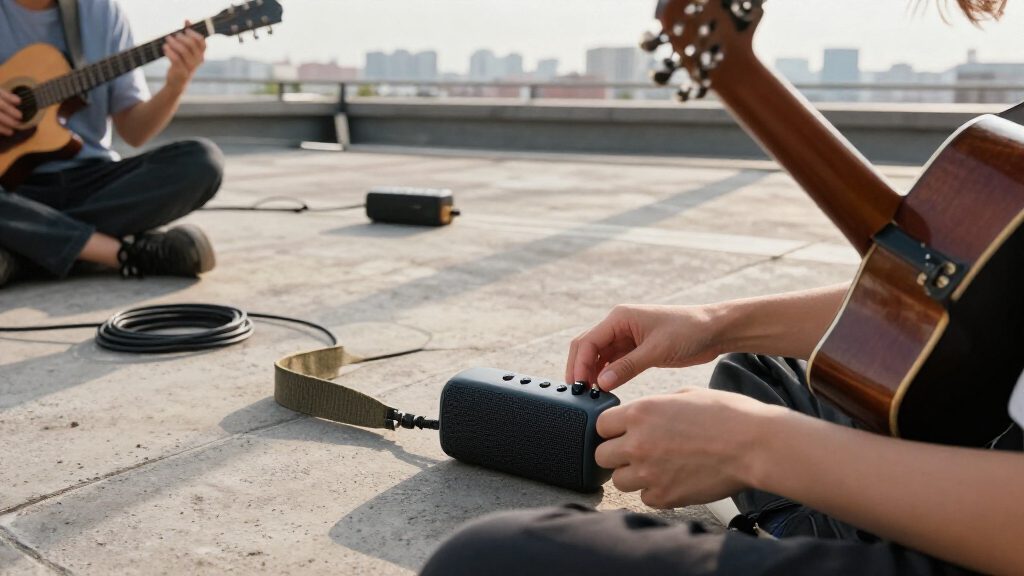

For musicians who need sound for rehearsal, busking, or small gigs, the Bose S1 Pro+ is my best overall pick for its portable PA format and musician-focused flexibility. The JBL Professional IRX112BT suits players who want a more conventional powered PA speaker, while the JBL PRX ONE is the premium choice for a larger, column-style setup. The main tradeoff is between easy battery-powered portability and the headroom, inputs, and coverage of a larger PA system. Bluetooth can play backing tracks, but it does not replace the wired instrument or microphone connections a performance may need. Read on for the full breakdown and guidance on matching a speaker to your setup.

Get audio and creator gear delivered free with Prime
- Fast, free delivery on millions of items
- Prime Video, Amazon Music and more included
- Member-only deals all year
Complete the kit


Key Takeaways
- The Bose S1 Pro+ leads this lineup for musicians seeking a compact, portable PA rather than a party speaker with Bluetooth added on.
- The JBL IRX112BT and PRX ONE represent different PA priorities: a more traditional powered cabinet versus a larger column-style system suited to broader coverage.
- Several Pyle models bundle microphones, mixers, or lights, but bundled extras do not automatically make a speaker the strongest choice for instrument sound or gig coverage.
- Battery power and wheels solve different portability problems: battery operation helps when outlets are scarce, while wheels matter most for moving heavier speakers over smooth ground.
- The lineup spans musician-focused PA systems and party-oriented speakers, so buyers should check input options and intended use before treating Bluetooth playback as performance readiness.
| Bose S1 Pro+ Portable Wireless PA Speaker |  | Best Overall for Solo Musicians | Weight: 14.4 lbs | Dimensions: 10.98 × 9.37 × 13.07 inches | Battery life: Up to 11 hours | VIEW LATEST PRICE | See Our Full Breakdown |
| JBL Professional PRX ONE Powered Column PA Speaker System, 2000 W, Black |  | Best for Larger Gigs and Full Bands | Amplifier power: 2,000 W peak | Maximum SPL: 130 dB | Frequency response: 35 Hz–20 kHz | VIEW LATEST PRICE | See Our Full Breakdown |
| Pyle PSBT105A Portable Bluetooth PA Speaker with 10-Inch Subwoofer |  | Best for Practice and Simple Vocal Sets | Power output: 1,000 watts | Subwoofer: 10 inches | Treble speaker: 3 inches | VIEW LATEST PRICE | See Our Full Breakdown |
| Pyle PPHP101WMB Portable Bluetooth PA Speaker with Two Wireless Microphones |  | Best for Vocal Duos and Group Activities | Maximum output: 600 watts | Subwoofer: 10 inches | Tweeter: 1 inch | VIEW LATEST PRICE | See Our Full Breakdown |
| JBL Professional IRX112BT 12-Inch Powered PA Speaker with Bluetooth |  | Best for Feedback-Prone Vocal and Instrument Sets | Speaker type: Powered two-way PA speaker | Woofer diameter: 12 inches | Frequency response: 53 Hz | VIEW LATEST PRICE | See Our Full Breakdown |
| ION Block Rocker Portable Bluetooth Party Speaker with Microphone |  | Best All-in-One for Outdoor Vocal Practice | Power: 120 W | Bluetooth: Bluetooth 5.3; range up to 100 ft | Drivers: 8-inch woofer, 2-inch tweeter, and two 4-inch drivers | VIEW LATEST PRICE | See Our Full Breakdown |
| Pyle PWMA230BT 400W Portable Bluetooth PA Speaker System |  | Best for Instrument-and-Vocal Practice | Peak power: 400 W | RMS power: 200 W | Speaker size: 8 inches | VIEW LATEST PRICE | See Our Full Breakdown |
| ION Sport 320 200W Bluetooth Outdoor Speaker with Wheels |  | Best for Long Outdoor Sessions | Power: 200 W | Speaker system: Five speakers: one 8-inch woofer, two 1-inch tweeters, and two 3-inch drivers | Sound coverage: 320 degrees | VIEW LATEST PRICE | See Our Full Breakdown |
| Pyle PPHP2835B Portable Bluetooth PA Speaker System |  | Best for Bass-Forward Party Sets | Peak output: 600 W | Speaker system: Two 8-inch subwoofers and 1-inch tweeters | Connectivity: Bluetooth, USB, 3.5 mm AUX, 1/4-inch mic/guitar input, and FM radio | VIEW LATEST PRICE | See Our Full Breakdown |
| Pyle PPHP28AMX Portable PA Speaker and DJ Mixer Bundle |  | Best Complete Starter PA Rig | Power output: 300 W | Speaker configuration: Two 8-inch speakers with 1-inch tweeters | Mixer channels: 8 | VIEW LATEST PRICE | See Our Full Breakdown |
| Pyle PPHP1044B Portable Bluetooth PA Speaker System with Rechargeable Battery and Party Lights |  | Best for Mobile Small-Gig Setups | Peak power: 600 W | RMS power: 300 W | Speaker drivers: 10-inch subwoofer and 1-inch tweeter | VIEW LATEST PRICE | See Our Full Breakdown |
| Monster Rockin’ Roller 270 Portable Bluetooth Speaker |  | Best for Long-Running Outdoor Playlists | Power output: Up to 200 W | Battery life: Up to 100 hours | Battery charge time: 15 hours | VIEW LATEST PRICE | See Our Full Breakdown |
| Pyle PSBT125A Portable Bluetooth PA Speaker with Wireless Microphone |  | Best for Karaoke and Mic-Led Practice | Output wattage: 1200 W | Speaker drivers: 12-inch subwoofer and 3-inch tweeter | Bluetooth: Version 4.2; up to 33 ft range | VIEW LATEST PRICE | See Our Full Breakdown |
| Rockville Rock Party 9 Portable Bluetooth Speaker |  | Best for Guitar-and-Vocal Party Sets | Peak and RMS power: 1000 W peak; 250 W RMS | Drivers: Dual 8-inch woofers and 2-inch tweeters | Bluetooth: Version 5.0; up to 45 ft range | VIEW LATEST PRICE | See Our Full Breakdown |
| portable Bluetooth speakers for musician | Weight |
|---|---|
| Bose S1 Pro+ Portable Wireless | 14.4 lbs |
| JBL Professional PRX ONE Power | Conflicting listings: 35.65 lbs and 56.6 lbs |
| Pyle PSBT105A Portable Bluetoo | 14.3 pounds |
| Pyle PPHP101WMB Portable Bluet | 10.6 pounds |
| JBL Professional IRX112BT 12-I | — |
| ION Block Rocker Portable Blue | 20.5 lb |
| Pyle PWMA230BT 400W Portable B | — |
| ION Sport 320 200W Bluetooth O | 22.7 lb |
| Pyle PPHP2835B Portable Blueto | — |
| Pyle PPHP28AMX Portable PA Spe | 44.8 lb |
| Pyle PPHP1044B Portable Blueto | — |
| Monster Rockin’ Roller 270 Por | — |
| Pyle PSBT125A Portable Bluetoo | — |
| Rockville Rock Party 9 Portabl | — |
More Details on Our Top Picks
Bose S1 Pro+ Portable Wireless PA Speaker
The Bose S1 Pro+ is my strongest fit for a musician who needs one battery-powered speaker for vocals, an instrument, and backing tracks. Its three-channel mixer gives those sources separate inputs, while four placement options with Auto EQ help adapt the sound whether it is on a stand, table, or floor. At 14.4 pounds with a carry handle and up to 11 hours of stated playtime, it is easier to move between small gigs than the much larger, corded JBL PRX ONE. The tradeoff is less mixer capacity and output for a full band or larger venue. Bluetooth handles playback, but the optional wireless transmitters cost extra, and actual battery life varies with use. I would choose this for compact acoustic sets, not high-volume event coverage.
Pros:- Three-channel mixer accommodates microphones, instruments, and music playback
- Battery operation and ergonomic handle suit mobile gigs
- Four positioning options with Auto EQ adapt to different placements
- Up to 11 hours of stated playtime
Cons:- Optional wireless transmitters are sold separately
- Three channels offer less mixing capacity than the JBL PRX ONE
- Battery life varies with volume, content, and temperature
Best for: Solo singers, guitarists, and acoustic duos who need battery-powered amplification with separate mic, instrument, and music channels.
Not ideal for: Bands needing several simultaneous inputs or musicians playing large venues who need the JBL PRX ONE’s higher stated output and seven-channel mixer.
- Weight:14.4 lbs
- Dimensions:10.98 × 9.37 × 13.07 inches
- Battery life:Up to 11 hours
- Output wattage:150 watts
- Mixer channels:3
- Connectivity:Bluetooth
- Connectors:USB, XLR
- Mounting options:Stand, table, floor; compatible with standard 35 mm mounts
Our verdict“Choose the Bose S1 Pro+ for portable, battery-powered solo and small-group performances where flexible placement matters more than extensive mixing or maximum output.”
JBL Professional PRX ONE Powered Column PA Speaker System, 2000 W, Black
When a musician needs a more substantial system for a band, DJ set, or venue, the JBL PRX ONE offers far more mixing and output headroom than the compact Bose S1 Pro+. Its seven-channel digital mixer, 12-inch subwoofer, and 12 high-frequency drivers are suited to fuller arrangements and larger audiences; Lexicon and dbx processing add tools for shaping sound and controlling feedback. Bluetooth 5.0 and app control make it flexible for playback and adjustments, but this is not a grab-and-go battery speaker: it needs corded power and is not water resistant. The listed weight also conflicts, at 35.65 pounds in the description and 56.6 pounds in product information, so transport planning is less straightforward. I rank it for performance capacity, not portability.
Pros:- Seven-channel digital mixer supports more sources than the Bose S1 Pro+
- 12-inch subwoofer and 12 high-frequency drivers suit fuller, louder performances
- Lexicon and dbx processing include effects and feedback suppression
- Bluetooth 5.0 and app control provide playback and remote adjustment options
Cons:- Corded power rules it out for performances without an outlet
- Not water resistant
- Listed weight conflicts between the description and product information
Best for: Working bands, DJs, and performers who need multiple mixer channels, substantial output, and a column system for venues with access to power.
Not ideal for: Buskers and musicians who perform away from outlets, need weather resistance, or want a lightweight speaker for frequent solo transport.
- Amplifier power:2,000 W peak
- Maximum SPL:130 dB
- Frequency response:35 Hz–20 kHz
- Subwoofer:12 inches
- High-frequency drivers:12 × 2.5 inches
- Mixer:7-channel digital mixer
- Connectivity:Bluetooth 5.0
- Weight:Conflicting listings: 35.65 lbs and 56.6 lbs
- Power source:Corded electric
Our verdict“Choose the JBL PRX ONE when mixer capacity and venue-scale output matter more than battery operation, easy carrying, or weather protection.”
Pyle PSBT105A Portable Bluetooth PA Speaker with 10-Inch Subwoofer
The Pyle PSBT105A makes sense for musicians who want a basic battery-powered PA with a wireless microphone included, rather than the more performance-focused mixer of the Bose S1 Pro+. Bluetooth, USB, SD card, and AUX playback give practice sessions several ways to run tracks, and the rechargeable battery supports use away from an outlet. Its 10-inch subwoofer and 3-inch treble speaker provide a familiar all-in-one format, while the included UHF mic can simplify announcements or a simple vocal setup. The compromises are its 14.3-pound carry and only two channels, which limit flexibility for players combining several live sources. The stated frequency response is listed as 20 kHz, without a lower bound, so it offers little guidance about bass extension. I see it as a straightforward practice and small-event option, not a detailed gig mixer.
Pros:- Included UHF wireless microphone supports simple vocal use
- Bluetooth, USB, SD card, and AUX offer varied playback options
- Rechargeable battery supports portable use
- 10-inch subwoofer provides a larger speaker format than compact personal amps
Cons:- Two channels limit simultaneous live-source flexibility compared with the Bose S1 Pro+
- At 14.3 pounds, it may be cumbersome for frequent carrying
- The listed frequency response gives only a 20 kHz figure, not a complete range
Best for: Solo performers and music teachers who want a rechargeable speaker with an included UHF microphone and multiple ways to play practice tracks.
Not ideal for: Instrumentalists or small bands needing separate control over several live inputs, or musicians seeking clearly specified low-frequency response.
- Power output:1,000 watts
- Subwoofer:10 inches
- Treble speaker:3 inches
- Connectivity:Bluetooth, USB, SD card, AUX
- Bluetooth range:Up to 33 feet
- Battery:Rechargeable
- Dimensions:12.4 × 10.2 × 19.5 inches
- Weight:14.3 pounds
- Channels:2
Our verdict“Choose the Pyle PSBT105A for practice or simple vocal sets where an included wireless mic and varied playback are more useful than a flexible mixer.”
Pyle PPHP101WMB Portable Bluetooth PA Speaker with Two Wireless Microphones
The Pyle PPHP101WMB is the most ready-made vocal option here: it includes two wireless microphones, a rechargeable battery, and rolling wheels with an extending handle. That package suits a singer-songwriter hosting a casual set, a vocal duo, or a music leader who needs to move a PA between rooms. Compared with the Pyle PSBT105A, it includes a second wireless mic and easier rolling transport, while adding FM radio and party lights. Those extras are less useful for musicians focused on shaping a live mix; the provided details do not establish a dedicated mixer channel count, and its 600-watt maximum output figure is not directly comparable to the JBL PRX ONE’s stated peak system power. Its 10-inch woofer and 1-inch tweeter offer a simpler speaker setup, so I would favor convenience over nuanced stage control.
Pros:- Two wireless microphones are included for duets and shared vocal duties
- Wheels and an extending handle help move the speaker
- Rechargeable battery supports use away from an outlet
- Bluetooth, USB, SD, AUX, and FM provide multiple playback sources
Cons:- The provided details do not specify a dedicated mixer channel count
- Party lights and FM radio add little for musicians focused on live sound control
- The stated maximum output does not establish performance against a full PA system
Best for: Vocal duos, music instructors, and community performers who want two wireless microphones and a battery-powered speaker that can be rolled between locations.
Not ideal for: Musicians who need detailed control of several instrument and vocal sources, or performers who want a compact speaker without party-oriented extras.
- Maximum output:600 watts
- Subwoofer:10 inches
- Tweeter:1 inch
- Connectivity:Bluetooth, AUX, USB, SD card
- Inputs:3.5 mm AUX, 6.5 mm microphone
- Microphones included:2 wireless
- Power source:Rechargeable battery
- Dimensions:21.5 × 13 × 11.5 inches
- Weight:10.6 pounds
Our verdict“Choose the PPHP101WMB for casual vocal performances where two included wireless microphones and rolling transport take priority over precise live mixing.”
JBL Professional IRX112BT 12-Inch Powered PA Speaker with Bluetooth
The JBL IRX112BT is a practical choice for musicians who want a conventional powered PA speaker with useful live-sound controls, rather than the Bose S1 Pro+’s battery-powered portability. Its two mic/line combo inputs can take common performance sources, while automatic feedback suppression can help keep a vocal mic usable in challenging setups. One-touch ducking lowers music when speech needs priority, and four EQ presets make quick tonal changes simpler than building a mix from scratch. Bluetooth supports backing tracks, but the speaker requires corded power and is not water resistant, so it is a poor match for outdoor sets without reliable power or weather cover. Unlike the JBL PRX ONE, it has no listed multi-channel digital mixer or app control; its appeal is a simpler speaker with focused performance tools.
Pros:- Two mic/line combo inputs accommodate common live sources
- Automatic feedback suppression can help manage microphone squeal
- Four EQ presets simplify quick sound adjustments
- One-touch ducking prioritizes speech over music playback
Cons:- Corded power limits use away from outlets
- Not water resistant
- No listed multi-channel digital mixer or app control like the JBL PRX ONE
Best for: Singers and instrumentalists using a wired mic or line-level source who need feedback control and quick sound adjustments at powered indoor gigs.
Not ideal for: Buskers and outdoor performers needing battery operation, as well as bands wanting the JBL PRX ONE’s seven-channel digital mixer.
- Speaker type:Powered two-way PA speaker
- Woofer diameter:12 inches
- Frequency response:53 Hz
- Inputs:Two mic/line combo inputs
- Output:XLR loop-out
- EQ presets:4
- Feedback suppression:dbx DriveRack automatic feedback suppression
- Bluetooth range:10 meters
- Power source:Corded electric
Our verdict“Choose the JBL IRX112BT for powered indoor performances where feedback control and straightforward mic inputs matter more than battery mobility or advanced mixing.”
ION Block Rocker Portable Bluetooth Party Speaker with Microphone
I’d pick the ION Block Rocker when a musician wants a self-contained speaker for vocal practice, informal sets, or announcements outside. Its included wired microphone and 1/4-inch mic input let a singer plug in without assembling a separate PA, while Bluetooth, AUX, USB, and FM radio offer handy playback choices. The 35-hour battery claim and IPX5 water resistance suit long days where an outlet or a change in weather could be a concern. Compared with the Pyle PWMA230BT, it adds a much longer stated battery life and water resistance; the Pyle, however, provides two instrument inputs. The Block Rocker’s 20.5-pound weight and mono output make it less appealing for musicians seeking a light practice monitor or wide stereo sound, even with wheels and handles.
Pros:- Included wired microphone supports vocals and announcements without a separate mic purchase.
- Up to 35 hours of stated battery life suits extended outdoor sessions.
- IPX5 water resistance adds protection for use around splashes.
- Bluetooth, AUX, USB, and FM radio provide several playback sources.
Cons:- At 20.5 pounds, it is cumbersome to carry despite its wheels and handles.
- Mono output does not provide stereo separation.
- Its single stated microphone input is less flexible for multi-instrument setups than the Pyle PWMA230BT.
Best for: Singers, acoustic players, and outdoor instructors who want a battery-powered speaker with a microphone included for casual performance or rehearsal.
Not ideal for: Musicians who need stereo separation, multiple instrument inputs, or a speaker they can comfortably carry for long distances.
- Power:120 W
- Bluetooth:Bluetooth 5.3; range up to 100 ft
- Drivers:8-inch woofer, 2-inch tweeter, and two 4-inch drivers
- Battery life:Up to 35 hours
- Water resistance:IPX5
- Inputs:1/4-inch microphone, 1/8-inch AUX, and USB
- Weight:20.5 lb
- Included microphone:Wired microphone with 7.5 ft cable
Our verdict“Choose the Block Rocker for outdoor vocal sessions where an included mic, long battery life, and splash resistance matter more than stereo sound or easy lifting.”
Pyle PWMA230BT 400W Portable Bluetooth PA Speaker System
The Pyle PWMA230BT earns its place for musicians who need more direct input flexibility than a party speaker typically offers. It has two microphone and two instrument 1/4-inch inputs, so a small practice group can connect several sources without relying only on Bluetooth playback. Its wireless microphone and front-panel sound controls make it usable for simple vocal rehearsals, too. Compared with the ION Block Rocker, the Pyle gives musicians more ways to connect instruments, but its stated battery life is only up to 10 hours, versus the ION’s 35. The rechargeable lead-acid battery also takes about 8–10 hours to charge, making advance planning sensible. Bluetooth 3.0 is an older standard, and the wireless mic needs two AA batteries, so this is a practical small PA rather than the most current or fuss-free option.
Pros:- Two microphone and two instrument inputs support small multi-source setups.
- Wireless microphone is included for vocals or announcements.
- Rechargeable battery offers up to 10 hours of stated use.
- Telescoping handle and caster wheels help move the system.
Cons:- The 8–10-hour charging time makes quick turnarounds difficult.
- Wireless microphone requires two AA batteries.
- Bluetooth 3.0 is older than the Bluetooth 5.3 connection in the ION Block Rocker.
Best for: Small acoustic duos or music teachers who need multiple wired instrument and microphone inputs in a wheeled, rechargeable PA.
Not ideal for: Outdoor performers who need a long-running battery, weather resistance, or a compact speaker that is quick to recharge between sessions.
- Peak power:400 W
- RMS power:200 W
- Speaker size:8 inches
- Bluetooth:Bluetooth 3.0; range up to 100 ft
- Battery:12 V, 7 Ah rechargeable lead-acid battery
- Battery life:Up to 10 hours
- Inputs:Two microphone and two instrument 1/4-inch inputs
- Included accessories:Wireless microphone, audio cables, and power cable
Our verdict“Choose the PWMA230BT if your practice setup needs several instrument and mic connections more than long battery life or newer Bluetooth.”
ION Sport 320 200W Bluetooth Outdoor Speaker with Wheels
For musicians who need music to keep playing through an outdoor event or a long day of rehearsals, the ION Sport 320 is the battery-life specialist in this group. Its stated up to 100 hours goes well beyond the Block Rocker’s 35 hours, and the 320-degree sound coverage is designed to spread playback around a gathering rather than focus it in one direction. IPX5 protection, wheels, and a retractable handle make it better suited to outdoor transport than a typical home speaker. The tradeoff is that the supplied details list Bluetooth playback and stereo linking, but no dedicated microphone or instrument input; it is more of a music source than a musician’s complete PA. Linking a second unit for wireless stereo also requires buying that speaker separately, and actual battery life varies with use.
Pros:- Up to 100 hours of stated battery life supports long sessions away from outlets.
- 320-degree sound coverage helps distribute playback around a group.
- IPX5 water resistance, wheels, and a retractable handle suit outdoor use.
- Bluetooth, FM radio, USB charging, and app controls add playback and convenience options.
Cons:- The listed connections do not include dedicated microphone or instrument inputs.
- At 22.7 pounds, it is not a lightweight carry.
- Wireless stereo linking requires a second speaker sold separately, and runtime varies with settings and use.
Best for: Outdoor performers and rehearsal leaders who need wide-area backing playback and extended battery life, and can connect their instruments through another device.
Not ideal for: Musicians who need a direct mic or guitar input, or who prioritize low weight and a compact carry.
- Power:200 W
- Speaker system:Five speakers: one 8-inch woofer, two 1-inch tweeters, and two 3-inch drivers
- Sound coverage:320 degrees
- Battery life:Up to 100 hours
- Water resistance:IPX5
- Bluetooth:Bluetooth 5.0
- Weight:22.7 lb
- Additional features:FM radio with 16 presets, wireless stereo linking, USB fast-charging port, and app controls
Our verdict“Pick the Sport 320 for long outdoor playback and broad coverage, but choose a PA with direct instrument inputs if you need to plug in and perform.”
Pyle PPHP2835B Portable Bluetooth PA Speaker System
The Pyle PPHP2835B is the bass-oriented choice for musicians who want a portable party PA for informal performances, karaoke, or guitar-backed gatherings. Its dual 8-inch subwoofers and 1-inch tweeters promise a fuller, more low-end-focused presentation than the single 8-inch speaker in the PWMA230BT. The listed mic/guitar input, Bluetooth, USB, AUX, and FM radio give it useful source options, while a rechargeable battery and carry handle help it leave the house. But the headline 600-watt figure is peak power, not a stated continuous RMS rating, so I would not use it as a reliable guide to sustained performance or compare it directly with the PWMA230BT’s 200 W RMS. The supplied information also omits battery runtime and water resistance, which makes it a less certain pick for outdoor sets than the IPX5-rated ION models.
Pros:- Dual 8-inch subwoofers are suited to bass-forward music and party playback.
- Mic/guitar input supports a direct connection for casual performance.
- Bluetooth, USB, AUX, and FM radio provide varied playback sources.
- Rechargeable battery and carry handle support portable use.
Cons:- The 600 W rating is peak power; no continuous RMS output is provided.
- Battery runtime is not specified, making session planning less predictable.
- No water-resistance rating is listed for outdoor use.
Best for: Guitarists and karaoke hosts who want bass-heavy playback, built-in battery power, and several media connections for casual events.
Not ideal for: Performers who need documented continuous power, a known battery runtime, water resistance, or a more transparent specification sheet.
- Peak output:600 W
- Speaker system:Two 8-inch subwoofers and 1-inch tweeters
- Connectivity:Bluetooth, USB, 3.5 mm AUX, 1/4-inch mic/guitar input, and FM radio
- Battery:Rechargeable battery with level indicator
- Impedance:2.6 ohms
- Dimensions:9 × 8.66 × 23.2 in
- Enclosure material:Polypropylene
- Warranty:1 year
Our verdict“Choose the PPHP2835B for bass-heavy casual sets, but favor the PWMA230BT or an IPX5-rated ION model when input details or outdoor readiness matter more.”
Pyle PPHP28AMX Portable PA Speaker and DJ Mixer Bundle
The Pyle PPHP28AMX is the most complete setup here for a musician starting from scratch: it bundles two speakers, an 8-channel powered mixer, a wired microphone, two stands, and connection cables. That package supports a small group with several sources more naturally than the all-in-one ION Block Rocker, which is easier to move and run but is centered on one speaker and its included mic. Bluetooth and USB/SD playback add convenience, while XLR, 1/4-inch, RCA, and AUX connections give the mixer broader source compatibility. The key compromise is mobility: at 44.8 pounds and powered from a corded electrical source, this is not a grab-and-go battery speaker like the ION Sport 320. I’d choose it for rehearsals or small events where a full basic rig matters more than quick setup or outdoor independence.
Pros:- Bundle includes two speakers, an 8-channel mixer, wired microphone, stands, and cables.
- XLR, 1/4-inch, RCA, AUX, Bluetooth, USB, and SD support a range of sources.
- Two speakers can serve a small group better than a single-speaker setup such as the Block Rocker.
- 300 W output is specified for the system.
Cons:- The 44.8-pound package is cumbersome to transport.
- Corded electric power rules out battery-only performances away from outlets.
- Multiple components require more setup and packing than the all-in-one ION Sport 320.
Best for: New bands, community performers, and small event hosts who need speakers, a mixer, stands, microphone, and cables in one bundle.
Not ideal for: Buskers and outdoor musicians who need battery operation, quick solo setup, or a lightweight speaker to carry between locations.
- Power output:300 W
- Speaker configuration:Two 8-inch speakers with 1-inch tweeters
- Mixer channels:8
- Connectivity:Bluetooth, USB, SD, XLR, 1/4-inch, RCA, and AUX
- Power source:Corded electric
- Weight:44.8 lb
- Included components:Mixer, two PA speakers, wired microphone, two tripod stands, two 1/4-inch audio cables, and power cable
- Warranty:1-year limited
Our verdict“Choose this bundle if you need a basic multi-source PA rig with mixer and stands, but skip it for performances where battery power and easy transport are priorities.”
Pyle PPHP1044B Portable Bluetooth PA Speaker System with Rechargeable Battery and Party Lights
I’d pick the Pyle PPHP1044B for musicians who need a speaker they can roll between rehearsal rooms, small gigs, and community events. Its 10-inch driver, rechargeable battery, and microphone/guitar input make it more performance-ready than a Bluetooth-only speaker, while USB and aux inputs offer easy playback for backing tracks. The talk-over control is handy for announcements between songs. Compared with the larger Pyle PSBT125A, this model is more compact and lighter to move, but gives up the bigger 12-inch driver and bundled wireless microphone. The built-in lights suit casual events, though they matter less for focused practice. Its listed battery capacity is modest, so I’d plan around shorter sessions rather than assume all-day amplified use; Bluetooth also reaches only up to 32 feet.
Pros:- Rechargeable and fitted with wheels and an extendable handle for easier transport
- Microphone/guitar input and talk-over controls suit announcements and simple live setups
- Bluetooth, USB, and 3.5 mm aux playback cover common backing-track sources
- 10-inch subwoofer offers a fuller low end than compact Bluetooth speakers
Cons:- Bluetooth range is limited to up to 32 feet
- USB flash drive support is limited to 32 GB
- The listed 16.2 Wh battery capacity gives little basis for expecting long amplified sessions
Best for: Solo performers and music teachers who need a wheeled, battery-powered speaker with a wired mic or guitar input for small indoor events.
Not ideal for: Musicians playing long sets away from power or needing a wide Bluetooth range; the battery capacity is modest and the listed range is 32 feet.
- Peak power:600 W
- RMS power:300 W
- Speaker drivers:10-inch subwoofer and 1-inch tweeter
- Bluetooth:Version 5.0; up to 32 ft range
- Inputs:USB, 3.5 mm aux, 1/4-inch microphone/guitar
- Battery:7.4 V Li-ion, 2200 mAh (16.2 Wh)
- Frequency response:55 Hz–20 kHz
- Dimensions and weight:11.8 × 9.6 × 17.7 inches; 4.84 kg
Our verdict“Choose the PPHP1044B for compact, rollable small-gig use with basic instrument and microphone connections, not for extended battery-powered sets.”
Monster Rockin’ Roller 270 Portable Bluetooth Speaker
The Monster Rockin’ Roller 270 is the lineup’s strongest fit for musicians who need background music or practice playback to run for a long stretch without frequent charging. Its stated up to 100-hour battery life is the standout advantage, while IPX4 protection provides some cover from splashes during outdoor use. Qi charging can keep a compatible phone topped up, and TWS pairing lets you connect a second speaker. Compared with the Pyle PPHP1044B, this Monster favors endurance and device convenience over direct performance controls: the supplied specs list no microphone or guitar input. It is also a 13 kg unit with a 15-hour charge time, so it is less appealing for musicians who move frequently or need a quick turnaround. IPX4 is splash resistance, not protection from submersion.
Pros:- Rated for up to 100 hours of playback per charge
- IPX4 protection helps with splashes during outdoor use
- Qi wireless charging can replenish compatible phones
- TWS pairing supports linking two speakers
Cons:- A full charge takes 15 hours
- At 13 kg, it is heavier than the Pyle PPHP1044B
- IPX4 does not protect against submersion, and listed specs do not include instrument or microphone inputs
Best for: Outdoor rehearsals, busking breaks, and event crews who need long-running Bluetooth playback and can transport a 13 kg speaker.
Not ideal for: Performers who need direct microphone or guitar connections, fast recharging, or a speaker to carry over long distances.
- Power output:Up to 200 W
- Battery life:Up to 100 hours
- Battery charge time:15 hours
- Water resistance:IPX4
- Bluetooth range:10 meters
- Drivers:3-inch woofer, 8-inch subwoofer, and 3-inch tweeter
- Features:Qi wireless charging, TWS pairing, USB port
- Dimensions and weight:13.2 × 18.6 × 10.8 inches; 13 kg
Our verdict“Pick the Rockin’ Roller 270 when extended playback and splash resistance matter more than direct live-instrument inputs or easy lifting.”
Pyle PSBT125A Portable Bluetooth PA Speaker with Wireless Microphone
For a musician who wants a portable PA that can also handle vocal practice, karaoke, and simple recording, the Pyle PSBT125A brings more built-in functions than the PPHP1044B. It pairs a 12-inch subwoofer with a wireless microphone and adds echo, bass, and treble controls, plus recording and playback from USB or SD card. Those controls make it easier to shape a casual vocal setup without adding a separate mixer. The tradeoff is size: at 23 inches tall and 8.29 kg, it is larger and heavier than the Pyle PPHP1044B, whose wheels and handle make transport easier. Bluetooth 4.2 is also older than the PPHP1044B’s 5.0, and the included microphone needs two AA batteries that are not supplied. I’d treat the stated 1200-watt figure as a listed output spec, not a direct guide to real-world loudness.
Pros:- Wireless microphone is included for vocal practice and karaoke
- Echo, bass, and treble controls allow basic sound shaping
- USB, SD card, Bluetooth, and aux playback support several backing-track sources
- Recording feature adds a simple way to capture performances
Cons:- Larger and heavier than the Pyle PPHP1044B, with no wheels listed
- The microphone requires two AA batteries that are not included
- USB and SD card support is limited to 32 GB
Best for: Singers, music teachers, and karaoke hosts who want a rechargeable PA with a wireless mic, vocal effects, and onboard recording.
Not ideal for: Musicians prioritizing compact transport, newer Bluetooth, or a microphone that is ready to use without separate batteries.
- Output wattage:1200 W
- Speaker drivers:12-inch subwoofer and 3-inch tweeter
- Bluetooth:Version 4.2; up to 33 ft range
- Audio formats:MP3, WMA, WAV
- Playback inputs:USB, SD card, auxiliary
- USB/SD capacity:Up to 32 GB
- Frequency response and impedance:55 Hz–20 kHz; 4 ohms
- Battery:3.7 V lithium-ion, 2200 mAh (×2)
- Dimensions and weight:15 × 12 × 23 inches; 8.29 kg
Our verdict“Choose the PSBT125A for mic-led practice and karaoke features, provided its larger body and battery-dependent wireless microphone fit your setup.”
Rockville Rock Party 9 Portable Bluetooth Speaker
The Rockville Rock Party 9 is the most performance-oriented choice here for a musician who wants to plug in both a guitar and microphones without building a separate PA rig. Its dual 8-inch woofers, 250 W RMS output, two microphone inputs, guitar input, and voice effects give it a broader live-use setup than the Monster Rockin’ Roller 270, which is better suited to long-duration playback than direct instrument connections. USB, TF card, and aux options also keep backing tracks flexible, while Bluetooth 5.0 reaches up to 45 feet. The compromises are substantial for outdoor performers: it is not water resistant, and its battery is listed at only 2–8 hours, dropping to 2–3 hours at maximum volume. At 19.6 pounds, it is portable by handle, but not a light carry.
Pros:- Dual microphone inputs and a guitar input support small live setups
- 250 W RMS output and dual 8-inch woofers suit louder gatherings
- Bluetooth, USB, TF card, and aux provide varied playback options
- Customizable LED effects and voice effects add performance flexibility
Cons:- Battery life falls to 2–3 hours at maximum volume
- Not water resistant, limiting use in wet outdoor conditions
- At 19.6 pounds, it is heavier than the Pyle PPHP1044B
Best for: Guitarists and vocalists running informal live sets, karaoke, or parties who need multiple wired inputs and onboard voice effects.
Not ideal for: Outdoor musicians exposed to rain or long high-volume sets; it has no water resistance and maximum-volume battery life is only 2–3 hours.
- Peak and RMS power:1000 W peak; 250 W RMS
- Drivers:Dual 8-inch woofers and 2-inch tweeters
- Bluetooth:Version 5.0; up to 45 ft range
- Inputs:Dual microphone, guitar, USB, TF card, AUX
- Battery life:2–8 hours depending on volume
- Enclosure:Polypropylene
- Water resistance:Not water resistant
- Dimensions and weight:11.75 × 12 × 27.75 inches; 19.6 pounds
Our verdict“Pick the Rock Party 9 for guitar-and-vocal party performances with several input options, but not for wet locations or long, loud battery-only sets.”
How We Picked
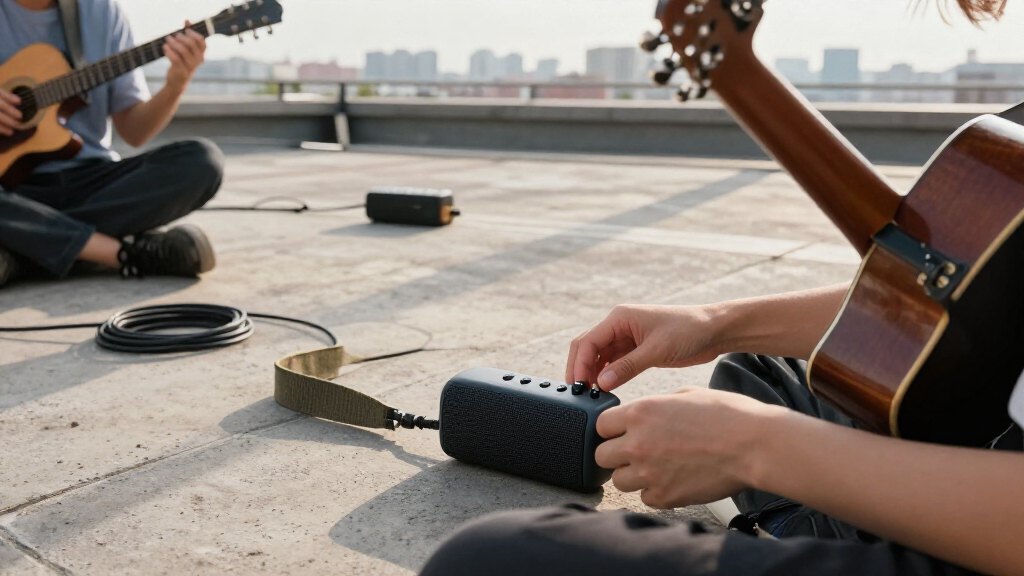
I ranked these 14 speakers by how well their stated design and features fit musicians’ real tasks: rehearsing with backing tracks, connecting instruments or microphones, performing in small spaces, and transporting gear. I gave more weight to PA suitability, input flexibility, usable portability, and performance-oriented controls than to party lights or bundled accessories. Bluetooth matters for playing tracks, but it is not a substitute for dependable wired connections when an instrument or vocal microphone is part of the setup.
The order reflects those priorities, not a claim that every model serves the same buyer. Musician-oriented PA systems rank ahead when performance use is the central need; portable party models make more sense for casual playback, outdoor gatherings, or buyers who value wheels and bundled microphones. I also weighed the tradeoffs implied by each product’s form and feature set, including battery dependence, system size, and whether included extras may add convenience without improving a musician’s core signal path.
Factors to Consider When Choosing Portable Bluetooth Speakers For Musicians
Before choosing, decide what job the speaker must do. A unit that works well for bedroom practice may not carry vocals across a busy outdoor space, and a large PA can be needless bulk for a solo player with a small setup. These factors help separate a musician’s portable sound system from a Bluetooth speaker that is mainly built for general listening.
Match Inputs to Your Actual Instruments
Make a list of every source you expect to connect at once: instrument, vocal microphone, phone, and perhaps a second performer’s mic. Bluetooth is useful for backing tracks, but it usually does not solve the need to plug in a guitar, keyboard, or microphone. Check the input types and available channels before buying, rather than assuming that a product called a PA speaker will support your full setup. A small mixer or adapter may fill a gap, but it adds cables, setup time, and another piece of gear to carry. If you perform with a bandmate, test the connection plan on paper so you do not discover that two sources compete for one input. Fewer, suitable inputs can be more useful than a long list of accessories you will not use.
Choose Coverage Before Chasing Power Claims
Think about the audience size, room shape, and how far sound needs to travel. A speaker that feels loud in a practice room may struggle to keep vocals clear in a noisy outdoor setting. Wattage figures alone do not tell you how evenly a system covers listeners or how clean it remains when turned up. For close rehearsal, a compact speaker can be easier to place and less tiring to transport; for a wider audience, a larger PA or column system may suit the job better. Avoid buying more system than your usual venues need, since extra size can add storage and setup burdens. If your gigs vary, prioritize a system that can fit your common settings rather than an occasional outlier.
Treat Battery Runtime as a Gig Constraint
Battery operation can make outdoor practice and busking far simpler, but it introduces a planning limit that a mains-powered system does not have. Check the manufacturer’s runtime conditions and remember that louder playback and multiple connected devices can affect how long a charge lasts. Leave a margin rather than planning a set around the most optimistic figure. A rechargeable battery is less helpful if the speaker is regularly used far from a charger and cannot cover the whole session. For venue work with reliable outlets, mains power may be the more practical priority. For street performance or remote rehearsal, battery access can matter more than extra bundled features.
Count the Whole Carry, Not Just the Speaker
Portability includes the speaker, stand, cables, microphones, power supply, and any mixer needed to make the setup work. Wheels help move heavier cabinets across level paths, but they do not make stairs or rough ground easy. A compact battery speaker may be faster to carry even if it has less output, while a larger system can require a stand or a second person to move safely. Consider where the speaker will live between gigs and how it fits in your vehicle or storage space. If you busk, walk to rehearsals, or use public transport, bulk can matter more than a feature you rarely use. Compare the complete rig instead of judging the speaker in isolation.
Separate Musician Features From Party Extras
Wireless microphones, lights, and party controls can be convenient for informal events, but they do not automatically improve an instrument’s tone or make a speaker easier to use on stage. Ask whether each extra replaces gear you already own or simply adds another item to manage. For a performance setup, stable connections, accessible controls, and appropriate inputs often matter more than decorative effects. A bundled microphone may be handy for announcements or casual vocals, but a musician with specific microphone needs should check compatibility and connection options. Bluetooth is best treated as a backing-track path, not the entire audio system. Prioritize the functions you will use at every rehearsal or performance.
Plan for Setup, Monitoring, and Future Use
A portable speaker may serve as a rehearsal PA, a small-gig system, or a source for backing tracks, but those jobs place different demands on placement and control. Before buying, decide whether you need the speaker to face an audience, help you hear yourself, or do both. A single speaker positioned for listeners may not give a performer the monitoring they want, so a second monitor or a different placement could be needed. Think about whether your usual venues provide stands, outlets, and space for a larger system. Paying more can make sense when it gives you connections or coverage you will use often, not simply because a model has a higher power label. Choose for the next realistic step in your playing, while avoiding a system that solves needs you are unlikely to have.
Frequently Asked Questions
Can I plug an electric guitar directly into any Bluetooth speaker?
No. Bluetooth playback only covers audio sent wirelessly from a compatible device; it does not guarantee an instrument input or the right signal handling for a guitar. Check the speaker’s documented inputs and whether it is designed to accept an instrument or microphone directly. If it lacks a suitable connection, you may need an amplifier, preamp, or mixer between the guitar and speaker. That extra gear affects both setup time and portability. For a simple practice rig, confirm the whole signal path before choosing.
Is a party speaker enough for busking?
It can work for casual busking if its battery life, volume, and inputs match your performance, but many party-oriented models are not built around an instrument-first setup. Check how you will connect your instrument and microphone, then confirm the speaker can run for the length of your set at your intended volume. Street noise and open-air spaces can demand more coverage than a quiet room. Wheels may help on smooth routes, while a lighter battery-powered unit may be easier to carry. Treat bundled lights or microphones as extras, not proof that the speaker suits busking.
Should I choose a battery speaker or a larger mains-powered PA?
Choose around where you play most often. A battery speaker is the more flexible choice when outlets are absent, but runtime and recharge access become part of gig planning. A larger mains-powered PA may better suit venues with reliable power and a need for broader coverage, though it can be less convenient to transport. If you perform in both settings, compare whether the battery model has enough output for your busiest regular use or whether a mains system is acceptable for most gigs. A backup power plan can matter more than a small difference in headline specifications.
Do I need a mixer if the speaker has Bluetooth?
Bluetooth can send backing tracks from a phone or tablet, but it does not mix every live source for you. A mixer may be needed if you want to combine several microphones or instruments, control their levels separately, or connect sources the speaker does not accept directly. Some PA speakers include controls or channels that cover a simple solo setup, so an external mixer may be unnecessary. Draw your connection list before buying and count how many inputs need independent adjustment. This avoids carrying extra gear—or finding out at rehearsal that one source cannot be connected.
Which features should a beginner prioritize over bundled accessories?
A beginner will usually benefit more from a clear connection plan, manageable setup, and a speaker suited to the spaces they play than from lights or several included accessories. Check whether the speaker supports the instrument and microphone connections you need now, and whether its controls are easy to understand. A bundled wireless microphone can be convenient for casual use, but it may not suit every performance style or future setup. Keep the first rig simple enough to carry and operate without an assistant. Add a mixer or other gear only when a specific need appears.
Conclusion
For a flexible musician-first portable PA, I’d start with the Bose S1 Pro+ as the best overall pick. The Pyle PSBT105A is my best-value direction for buyers who want a more accessible portable PA format, while the JBL PRX ONE is the best premium choice for musicians prioritizing a larger column-style system. Beginners who mainly need a straightforward speaker for practice and casual use should compare the ION Block Rocker with the more performance-oriented options and confirm its inputs fit their instruments. For a conventional powered PA setup, consider the JBL IRX112BT; for outdoor mobility, the wheeled ION Sport 320 may suit buyers who value easy movement. Match the choice to your connections, performance space, and transport needs before treating any one model as a universal fit.