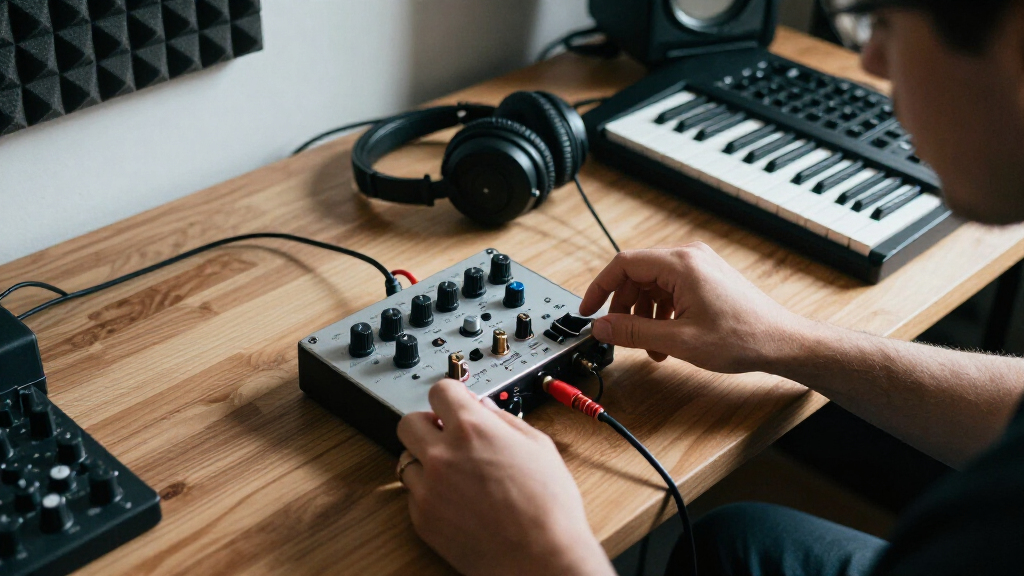

For musicians who need a portable recording setup, the Focusrite Scarlett 2i2 4th Gen is my best overall pick for its two-input recording flexibility, while the Scarlett Solo 4th Gen suits simpler one-mic-or-guitar sessions and the Zoom H1essential works for standalone stereo capture. The main choice is whether you need a USB interface for a laptop or phone, a dedicated portable recorder, or a compact guitar-to-mobile adapter. Input count, device compatibility, monitoring, and how much gear you want to carry can matter more than headline sample-rate figures. This roundup compares those tradeoffs across 15 options; read on for the full breakdown and recommendations by musician type.

Get audio and creator gear delivered free with Prime
- Fast, free delivery on millions of items
- Prime Video, Amazon Music and more included
- Member-only deals all year
Complete the kit


Key Takeaways
- The Scarlett 2i2 4th Gen is the most flexible studio-style pick in this group for musicians who need to record two sources at once; solo-input models trade that flexibility for a simpler setup.
- The Zoom H1essential serves a different purpose from USB interfaces: it records stereo audio on its own, so it suits rehearsals and field capture without requiring a computer.
- Guitar-to-phone adapters prioritize portability over studio expandability; the KYXAIN MOMIX CAB, JOYO MOMIX CAB, IK Multimedia iRig 2, and Ueteto are aimed at direct mobile guitar workflows rather than multi-mic sessions.
- USB-C, Lightning, and USB connection details affect real-world usability; musicians should check device and cable compatibility before choosing a model, especially for phone recording.
- The lineup spans basic and more feature-rich 2-in/2-out choices: M-Audio’s Duo models, the Universal Audio Volt 2, and the PIYONE 2×2 differ in intended workflow, so input count alone does not determine the best fit.
| BOMGE 22M 2-Channel USB Audio Interface |  | Best for Two-Mic Setups on a Simple Rig | Channels: 2 | Inputs: 2 combo XLR/MIC/LINE | Maximum sample rate: 48 kHz | VIEW LATEST PRICE | See Our Full Breakdown |
| M-Audio M-Track Solo USB Audio Interface |  | Best Budget-Friendly Starter Interface | Audio resolution: Up to 48 kHz | Inputs: One combo XLR/line input and one switchable line/instrument input | Phantom power: Supported on combo input | VIEW LATEST PRICE | See Our Full Breakdown |
| M-Audio M-Track Duo HD 2-In/2-Out USB-C Audio Interface |  | Best Overall for Flexible Mobile Recording | Inputs/outputs: 2-in/2-out | Input types: Two combo microphone, instrument, or line inputs | Audio resolution: 24-bit/192 kHz | VIEW LATEST PRICE | See Our Full Breakdown |
| Zoom H1essential Portable Stereo Recorder |  | Best for Capturing Music Away from a Computer | Microphones: Built-in X/Y stereo microphones | Recording format: WAV | Recording type: 32-bit float | VIEW LATEST PRICE | See Our Full Breakdown |
| KYXAIN MOMIX CAB Portable Guitar Audio Interface with USB-C and Lightning Adapters |  | Best Pocket Interface for Guitar and Bass | Recording resolution: 24-bit/48 kHz | Channels: 2 | Audio input: 1/4-inch jack | VIEW LATEST PRICE | See Our Full Breakdown |
| Focusrite Scarlett Solo 4th Gen USB-C Audio Interface |  | Best Compact Studio Interface | Connectivity: USB-C | Inputs: 1 XLR mic preamp; 1 Hi-Z instrument input | Channels: 2 | VIEW LATEST PRICE | See Our Full Breakdown |
| Synido A20 Pro Portable USB-C Audio Interface for Guitar and DJ Recording |  | Best for Mobile Guitar and DJ Setups | Connectivity: USB-C | Channels: 2 | Audio resolution: 24-bit/96 kHz | VIEW LATEST PRICE | See Our Full Breakdown |
| JOYO MOMIX CAB Guitar Audio Interface for Phone |  | Best Pocket Guitar Adapter | Connectivity: USB-C and Lightning | Input: 6.35 mm guitar input | Headphone output: 3.5 mm | VIEW LATEST PRICE | See Our Full Breakdown |
| Focusrite Scarlett 2i2 4th Gen USB-C Audio Interface |  | Best Overall for Two-Input Recording | Connectivity: USB-C | Microphone preamps: 2 | Audio inputs: 2 | VIEW LATEST PRICE | See Our Full Breakdown |
| Universal Audio Volt 2 USB-C Audio Interface |  | Best for Vintage-Style Recording | Inputs/outputs: 2-in/2-out | Connectivity: USB-C | Maximum recording resolution: 24-bit/192 kHz | VIEW LATEST PRICE | See Our Full Breakdown |
| IK Multimedia iRig 2 Portable Guitar Audio Interface |  | Best for Amp-and-Phone Guitar Practice | Instrument input: Guitar or bass | Device connection: 3.5 mm TRRS; adapters may be required for newer devices | Outputs: 3.5 mm headphone; 1/4-inch amplifier | VIEW LATEST PRICE | See Our Full Breakdown |
| PIYONE 2×2 USB-C Audio Interface, 24-bit/192 kHz, Alloy Red |  | Best for Two-Input USB-C Tracking | Inputs: 2 XLR/TRS combo inputs | Channels: 2 | Audio resolution: 24-bit/192 kHz | VIEW LATEST PRICE | See Our Full Breakdown |
| Focusrite Scarlett Solo 3rd Gen USB-C Audio Interface |  | Best for Solo Home Recording | Generation: 3rd Gen | Channels: 2 | Inputs: XLR microphone and instrument | VIEW LATEST PRICE | See Our Full Breakdown |
| M-Audio M-Track Duo USB Audio Interface |  | Best for Flexible Two-Source Recording | Inputs: 2 combo XLR/Line/Instrument inputs | Audio resolution: 48 kHz | Preamps: Crystal preamps with phantom power | VIEW LATEST PRICE | See Our Full Breakdown |
| Ueteto Portable Guitar Audio Interface |  | Best for Driver-Free Mobile Guitar Recording | Model: UI-8 | Compatible devices: Guitar, headphones, laptop, smartphone, tablet | Supported operating systems: iOS, Android | VIEW LATEST PRICE | See Our Full Breakdown |
| portable audio interfaces for musician | Connectivity | Weight | Channels |
|---|---|---|---|
| BOMGE 22M 2-Channel USB Audio | USB | 0.32 kg | 2 |
| M-Audio M-Track Solo USB Audio | USB | — | — |
| M-Audio M-Track Duo HD 2-In/2- | USB-C | 0.47 kg | — |
| Zoom H1essential Portable Ster | — | 92 g | — |
| KYXAIN MOMIX CAB Portable Guit | USB | — | 2 |
| Focusrite Scarlett Solo 4th Ge | USB-C | 14.4 oz | 2 |
| Synido A20 Pro Portable USB-C | USB-C | 6.4 oz | 2 |
| JOYO MOMIX CAB Guitar Audio In | USB-C and Lightning | 20 g | 2 |
| Focusrite Scarlett 2i2 4th Gen | USB-C | 1.3 lb | — |
| Universal Audio Volt 2 USB-C A | USB-C | 650 g | — |
| IK Multimedia iRig 2 Portable | — | 3.53 ounces | 1 |
| PIYONE 2×2 USB-C Audio Interfa | USB-C | 0.74 kg | 2 |
| Focusrite Scarlett Solo 3rd Ge | USB | 12.32 ounces | 2 |
| M-Audio M-Track Duo USB Audio | — | — | — |
| Ueteto Portable Guitar Audio I | USB | — | 2 |
More Details on Our Top Picks
BOMGE 22M 2-Channel USB Audio Interface
The BOMGE 22M is a straightforward pick for musicians who need two microphone-capable inputs without stepping up to a larger recording setup. Its combo jacks also accept line-level sources, while 48V phantom power supports compatible condenser mics. Compared with the single-combo-input M-Audio M-Track Solo, the BOMGE can handle two mics or a mic and another source at once, which suits a small vocal-and-instrument recording session. It also provides stereo RCA and 1/4-inch outputs, plus a direct-monitoring switch to hear inputs without the USB monitoring delay. The tradeoff is a 48 kHz maximum sample rate and limited two-channel capacity; the M-Track Duo HD offers higher-resolution recording and USB-C connectivity. I’d choose the 22M for a compact, uncomplicated Mac or Windows setup, not a system intended to grow into multitrack recording.
Pros:- Two combo inputs accommodate microphones, instruments, and line-level sources.
- 48V phantom power supports compatible condenser microphones.
- Direct monitoring and headphone, RCA, and 1/4-inch outputs provide flexible listening options.
- Compact USB design supports portable Mac and Windows recording.
Cons:- The 48 kHz maximum sample rate is lower than the M-Track Duo HD’s 192 kHz capability.
- Two channels limit larger band or multi-microphone recording setups.
- The listed Windows compatibility does not specify newer Windows versions.
Best for: Musicians recording two microphones or a microphone and line-level instrument at home who want direct monitoring and a compact USB interface.
Not ideal for: Producers seeking higher sample rates, USB-C connectivity, or more than two simultaneous input channels; the M-Track Duo HD is a stronger fit for higher-resolution sessions.
- Channels:2
- Inputs:2 combo XLR/MIC/LINE
- Maximum sample rate:48 kHz
- Phantom power:48V
- Connectivity:USB
- Outputs:Stereo RCA and 1/4-inch
- Monitoring:USB/Direct switch for zero-latency monitoring
- Weight:0.32 kg
Our verdict“Choose the BOMGE 22M for a portable, two-input rig with phantom power, but pick the M-Track Duo HD if higher-resolution recording matters more.”
M-Audio M-Track Solo USB Audio Interface
The M-Track Solo keeps a first recording setup compact: one combo input handles a microphone or line source, and a second switchable input accepts an instrument or line-level signal. That makes it more useful for a singer-songwriter recording vocals and guitar than a single-input guitar adapter, though it cannot capture two microphones like the BOMGE 22M or M-Track Duo HD. USB power and a direct-monitoring switch also suit a desk that needs to pack away between sessions, while the included MPC Beats software gives new producers a starting point. Its limits are clear: recording tops out at 48 kHz, the headphone jack is 1/8-inch, and its listed computer support names older Windows and macOS versions. I’d favor the Solo for a basic one-person setup, but musicians needing two combo inputs or balanced main outputs should look at the Duo HD instead.
Pros:- Combo microphone/line input and switchable instrument input cover common solo recording needs.
- USB-powered design needs no separate power supply.
- Direct monitoring, stereo RCA outputs, and headphone output support basic recording and playback.
- MPC Beats is included for starting music production.
Cons:- Only one input is a combo XLR/line input, so it cannot match the two-mic flexibility of the BOMGE 22M.
- The 1/8-inch headphone output may require an adapter for common 1/4-inch headphones.
- Listed Windows and macOS versions are limited to older releases, and iOS use needs a separate adapter.
Best for: Beginning singer-songwriters and home recordists who need one microphone input plus a separate guitar or keyboard input in a USB-powered setup.
Not ideal for: Musicians recording two microphones at once, relying on a 1/4-inch headphone jack, or needing specified support for newer operating systems.
- Audio resolution:Up to 48 kHz
- Inputs:One combo XLR/line input and one switchable line/instrument input
- Phantom power:Supported on combo input
- Connectivity:USB
- Power:USB-powered
- Outputs:Stereo RCA and 1/8-inch headphone
- Monitoring:USB/Direct switch for zero-latency monitoring
- Supported software:Ableton Live Lite and MPC Beats
Our verdict“Pick the M-Track Solo for a simple, USB-powered first setup with one mic and one instrument, not for two-mic recording or a growing studio rig.”
M-Audio M-Track Duo HD 2-In/2-Out USB-C Audio Interface
The M-Track Duo HD earns the broadest-use role here by pairing two combo inputs with 24-bit/192 kHz recording, USB-C, and compatibility with computers and mobile devices. For musicians who record vocals and instruments together, it offers more room to work than the single-combo-input M-Track Solo; its balanced 1/4-inch outputs and independently controlled 1/4-inch headphone output also make monitoring more studio-oriented than the BOMGE 22M’s RCA connections. Up to 55 dB of preamp gain and a Direct/USB switch support practical mic recording and low-latency monitoring. The tradeoff is still a two-in, two-out limit, so it will not cover a full band’s simultaneous inputs. It also depends on a USB-C connection or an externally powered hub for some setups. I’d choose it when one portable interface needs to serve both desktop and mobile recording.
Pros:- Two combo inputs support microphone, instrument, and line-level sources.
- 24-bit/192 kHz recording and up to 55 dB of preamp gain give more headroom in recording format and input adjustment than the 48 kHz BOMGE 22M.
- USB-C connectivity supports Mac, PC, iOS, and Android devices.
- Balanced main outputs and an independently controlled 1/4-inch headphone output aid monitoring.
Cons:- Two inputs and two outputs constrain larger recording and routing setups.
- A USB-C cable or externally powered USB hub is needed for connectivity.
- Its higher-resolution recording features may be unnecessary for musicians who only need simple 48 kHz stereo capture.
Best for: Musicians who record two sources at once and want one compact USB-C interface for a computer, iOS device, or Android device.
Not ideal for: Bands or producers who need more than two simultaneous inputs, or buyers who want a setup that does not depend on USB-C connectivity or a suitable powered hub.
- Inputs/outputs:2-in/2-out
- Input types:Two combo microphone, instrument, or line inputs
- Audio resolution:24-bit/192 kHz
- Preamplifier gain:Up to 55 dB
- Connectivity:USB-C
- Main outputs:Balanced 1/4-inch TRS
- Headphone output:1/4-inch TRS with independent level control
- Weight:0.47 kg
Our verdict“Choose the Duo HD if you want a portable two-input interface with high-resolution recording and broad device support; skip it if you need more channels.”
Zoom H1essential Portable Stereo Recorder
The Zoom H1essential is the outlier in this group: it is a stereo field recorder first, rather than a conventional interface for connecting multiple studio microphones or instruments. Its built-in X/Y microphones let musicians capture rehearsals, acoustic ideas, or ambient sound without packing external mics, while 32-bit float WAV recording helps accommodate unpredictable changes in volume. The USB-C connection also lets it serve as a microphone for a computer or compatible mobile device. Compared with the M-Track Duo HD, it is much less suited to a fixed two-mic studio setup, but far more self-contained for recording a performance on location. Its onboard microphones and stereo capture also differ from the MOMIX CAB, which is built around a direct mono guitar or bass input. Bring two AAA batteries and an SD card for standalone recording.
Pros:- Built-in X/Y microphones capture stereo sound without external microphones.
- 32-bit float WAV recording accommodates wide changes in recording levels.
- USB-C supports use as a microphone with computers and compatible mobile devices.
- Lightweight handheld design supports portable recording away from a desk.
Cons:- Standalone recording requires two AAA batteries and a separately supplied SD card.
- Built-in microphones do not replace the combo inputs and preamps on the M-Track Duo HD for studio recording.
- The 3.5 mm headphone jack may need an adapter for some monitoring headphones.
Best for: Musicians who want to capture rehearsals, acoustic performances, or location sound with built-in stereo microphones and no separate mic setup.
Not ideal for: Players who need XLR inputs for studio microphones, direct instrument inputs, or the routing and monitoring controls of a traditional audio interface.
- Microphones:Built-in X/Y stereo microphones
- Recording format:WAV
- Recording type:32-bit float
- USB interface:USB Type-C
- Headphone jack:3.5 mm
- Storage:SD card, up to 1 TB
- Power:2 AAA batteries
- Weight:92 g
Our verdict“Choose the H1essential for portable stereo recording of live music and ideas, but pick a conventional interface if you need external mic or instrument inputs.”
KYXAIN MOMIX CAB Portable Guitar Audio Interface with USB-C and Lightning Adapters
The MOMIX CAB is the most specialized and pocketable option here: it sends a guitar or bass signal straight to a phone or computer for recording and monitoring. Its 24-bit/48 kHz recording and low-latency monitoring give solo players a simple way to capture riffs without bringing a conventional interface, and the included USB-C cable and Lightning adapter broaden its device connections. Unlike the M-Track Solo, it has no microphone preamp or second independent input; unlike the Zoom H1essential, it does not capture stereo sound with built-in microphones. That narrow focus is also its main drawback: the input is mono, there are no mixing or editing functions, and app compatibility can vary. Players with active pickups may need to lower their instrument output to avoid peaks. I’d treat it as a compact practice and idea-capture tool, not a replacement for a two-input studio interface.
Pros:- Pocket-sized design with a back clip is easy to carry with an instrument.
- 24-bit/48 kHz recording and low-latency monitoring support basic guitar and bass capture.
- USB-C cable and Lightning adapter are included.
- Powered by the connected smartphone, so it needs no separate batteries.
Cons:- Mono instrument input cannot record a microphone-and-instrument pair like the M-Track Solo.
- It provides recording and monitoring only, with no mixing or editing functions.
- App and software support varies, and active pickups may peak unless their output is reduced.
Best for: Guitarists and bassists who want to record or monitor a mono instrument directly on a phone or laptop with minimal gear.
Not ideal for: Musicians who need microphone recording, stereo capture, onboard mixing or editing, or reliable compatibility across a wide range of apps.
- Recording resolution:24-bit/48 kHz
- Channels:2
- Audio input:1/4-inch jack
- Headphone output:1/8-inch (3.5 mm)
- Connectivity:USB
- Compatible operating systems:Android, Linux, Windows, iOS, macOS
- Power:Powered by connected smartphone
- Included accessories:USB-C male-to-male cable and smartphone port converter
Our verdict“Choose the MOMIX CAB for pocket-sized phone or laptop recording of guitar and bass, but pick a conventional interface for microphones, stereo sources, or broader routing.”
Focusrite Scarlett Solo 4th Gen USB-C Audio Interface
The Scarlett Solo 4th Gen is a strong fit for musicians who travel light but still want 192 kHz recording and a 120 dB dynamic range. Its single XLR preamp and separate Hi-Z input suit a common solo setup: one microphone for vocals and one instrument input for guitar or bass. Air modes offer a way to add presence without reaching for a plug-in, while the bundled software gives new sessions a practical starting point.
Compared with the Scarlett 2i2 4th Gen, the Solo is smaller and simpler, but gives up the second mic preamp needed for two vocalists or a stereo mic pair. It also has fewer recording inputs than the Universal Audio Volt 2’s flexible 2-in/2-out format. Choose it for portable solo recording; skip it if your sessions regularly involve multiple microphones.
Pros:- 120 dB dynamic range and recording up to 24-bit/192 kHz
- Separate XLR microphone and Hi-Z instrument inputs suit a basic solo recording setup
- Air modes add presence and harmonic character to vocals and instruments
- Includes several recording applications and effects, plus independent headphone volume control
Cons:- Only one XLR microphone preamp, limiting simultaneous multi-mic recording
- Requires a compatible computer or iOS device and recording software
Best for: Solo singer-songwriters who want a compact interface for recording vocals and guitar or bass to a computer or compatible iOS device.
Not ideal for: Duos, interviewers, and musicians who need two microphone preamps at once; the Solo has only one XLR mic input.
- Connectivity:USB-C
- Inputs:1 XLR mic preamp; 1 Hi-Z instrument input
- Channels:2
- Maximum sample rate:192 kHz
- Bit depth:24-bit
- Dynamic range:120 dB
- Dimensions:3.78 × 5.63 × 1.83 in
- Weight:14.4 oz
Our verdict“Choose the Scarlett Solo if you want a portable, high-resolution interface for one microphone and one instrument, not a setup for recording multiple mics.”
Synido A20 Pro Portable USB-C Audio Interface for Guitar and DJ Recording
The Synido A20 Pro is aimed at musicians who need more than a simple phone guitar adapter: it records at 24-bit/96 kHz, offers zero-latency monitoring, and can play wireless backing tracks while charging a connected device. Its LED input meter gives a quick view of levels, a practical aid when recording away from a full studio setup. At 6.4 ounces, it remains easy to pack for rehearsals or mobile sessions.
Compared with the JOYO MOMIX CAB, the Synido offers broader instrument, microphone, and DJ recording use rather than a pocket-sized guitar-first design. The tradeoff is more setup complexity: direct phone audio embedding depends on the phone or camera supporting USB-C audio, and the listed mic gain range may not suit every microphone. Choose it for mobile flexibility, not the simplest guitar-only connection.
Pros:- Records at 24-bit/96 kHz with zero-latency monitoring
- LED input metering helps musicians keep an eye on recording levels
- Wireless backing-track playback and simultaneous device charging support mobile sessions
- Compact 6.4-ounce body includes an OTG extension cable and 1/4-inch adapter
Cons:- Direct audio embedding depends on the connected phone or camera supporting USB-C audio input
- Specified microphone gain ranges may limit compatibility with some microphone setups
Best for: Guitarists, DJs, and mobile musicians who want to record or monitor audio on a phone, tablet, or computer while using backing tracks.
Not ideal for: Musicians seeking a straightforward guitar-to-phone adapter or those whose microphone needs more gain than the stated ranges provide.
- Connectivity:USB-C
- Channels:2
- Audio resolution:24-bit/96 kHz
- Signal-to-noise ratio:100 dB
- Hi-Z input impedance:1 MΩ
- Microphone gain range:0–35 dB for condenser microphones; 0–40 dB for dynamic microphones
- Dimensions:6 × 4.45 × 1.1 in
- Weight:6.4 oz
Our verdict“Pick the Synido A20 Pro for mobile sessions that mix instruments, DJ audio, and backing tracks, but check device and microphone compatibility first.”
JOYO MOMIX CAB Guitar Audio Interface for Phone
The MOMIX CAB is the most guitar-specific option here: it connects a bass or guitar to a USB-C or Lightning phone and provides direct, zero-latency monitoring through its headphone output. At just 20 g, with no charging or driver installation required, it is easy to keep with a guitar for quick practice recordings or ideas on the go. Unlike the larger Synido A20 Pro, it favors minimal size and a simple guitar-to-phone path over meters, broader inputs, and mobile-production features.
That simplicity comes with a meaningful limitation: the direct guitar signal cannot be muted, so the interface is not suited to hearing a software amp simulation or effects alone while playing. Its 48 kHz maximum also falls below the Focusrite interfaces’ 192 kHz capability. Choose it for uncomplicated capture and monitoring, not as a compact substitute for a full recording interface.
Pros:- Pocket-sized 20 g design with a back clip
- Connects to USB-C and Lightning smartphones using the included cable and adapter
- Direct guitar monitoring avoids noticeable monitoring delay
- Needs no charging, drivers, or separate recording software to connect
Cons:- Direct guitar signal cannot be muted, preventing processed-only software monitoring
- Maximum sample rate is 48 kHz, lower than the 96 kHz Synido A20 Pro and 192 kHz Focusrite models
- Android operation may require OTG support and the included USB-C cable
Best for: Guitarists and bassists who want to capture ideas on a USB-C or Lightning phone with minimal setup and direct headphone monitoring.
Not ideal for: Players who need to monitor software amp simulations or effects without hearing the unprocessed guitar signal, or who need higher-resolution recording.
- Connectivity:USB-C and Lightning
- Input:6.35 mm guitar input
- Headphone output:3.5 mm
- Channels:2
- Maximum sample rate:48 kHz
- Power:No charging required
- Dimensions:1.14 × 2.52 × 0.79 in
- Weight:20 g
Our verdict“Choose the MOMIX CAB for quick, pocketable guitar-to-phone recording, but skip it if software-processed monitoring is part of your playing setup.”
Focusrite Scarlett 2i2 4th Gen USB-C Audio Interface
The Scarlett 2i2 4th Gen earns its place as the most adaptable general-purpose interface in this group. Its two mic preamps let musicians record a pair of singers or a vocal and a mic’d instrument together; two Hi-Z instrument inputs also make direct guitar-and-bass recording possible. It matches the Solo’s 120 dB dynamic range and 192 kHz maximum sample rate, while Auto Gain and Clip Safe help manage levels when a session moves quickly.
Compared with the Scarlett Solo, the 2i2 costs you more space and weight in exchange for a second microphone input. It is a better fit for duos and small recording setups, though it remains a two-input interface rather than a multichannel studio hub. The Universal Audio Volt 2 also records two inputs, but the Scarlett’s automatic level tools make it the more guided choice for changing sources.
Pros:- Two low-noise microphone preamps support vocals, duos, and mic’d instruments
- Two Hi-Z instrument inputs allow direct recording of two instruments
- Auto Gain and Clip Safe help manage levels and reduce clipping risk
- Air mode, 120 dB dynamic range, and included recording software support a wide range of sessions
Cons:- Limited to two audio inputs, so it cannot handle larger multi-microphone sessions
- Larger and heavier than the Scarlett Solo for musicians who only need one mic input
- Requires a compatible connected device and recording software
Best for: Singer-songwriters, duos, and home-recording musicians who need two mic preamps or want to record two sources at the same time.
Not ideal for: Solo players who only need one microphone input and prioritize the smallest, lightest setup; the Scarlett Solo is more compact.
- Connectivity:USB-C
- Microphone preamps:2
- Audio inputs:2
- Maximum sample rate:192 kHz
- Dynamic range:120 dB
- Dimensions:4.61 × 7.09 × 1.87 in
- Weight:1.3 lb
- Warranty:3 years
Our verdict“Choose the Scarlett 2i2 if you need two simultaneous recording inputs and useful level-setting aids in a portable, general-purpose interface.”
Universal Audio Volt 2 USB-C Audio Interface
The Volt 2 brings a distinct recording character to a portable 2-in/2-out setup. Its Vintage mode draws on Universal Audio’s 610 tube preamp, giving musicians an onboard tonal option rather than relying only on the more neutral workflow of the Focusrite Scarlett 2i2. It records at 24-bit/192 kHz and includes a DAW plus UAD plug-ins and instruments, so it can form a useful starting point for production, podcasting, or livestreaming.
Like the Scarlett 2i2, the Volt 2 can handle two input sources, but its appeal centers more on Vintage preamp flavor and bundled production tools than on the Scarlett’s Auto Gain and Clip Safe features. It is portable at 650 g, yet mobile use may call for an additional power supply and, for some Apple setups, a camera adapter. The stated one-year warranty is also shorter than the Focusrite models’ three years.
Pros:- Vintage mode offers a 610 tube-preamp-inspired sound option
- Records up to 24-bit/192 kHz in a portable 2-in/2-out format
- Includes a DAW and a suite of plug-ins and instruments
- Supports Windows, macOS, iPad, and iPhone
Cons:- Some mobile configurations require an external power supply and an Apple camera adapter
- One-year manufacturer warranty is shorter than the three-year warranty listed for the Focusrite Scarlett models
- Two inputs limit its use for larger ensembles or multi-mic recording
Best for: Musicians who want two-input recording, an onboard vintage-inspired preamp option, and bundled production tools for computer-based sessions.
Not ideal for: Traveling musicians who need the simplest phone-powered setup or buyers who prioritize a longer stated warranty.
- Inputs/outputs:2-in/2-out
- Connectivity:USB-C
- Maximum recording resolution:24-bit/192 kHz
- Preamp mode:Vintage mode inspired by UA 610 tube preamp
- Compatible devices:Personal computers, iPad, iPhone
- Dimensions:5.12 × 6.85 × 2.09 in
- Weight:650 g
- Warranty:1 year manufacturer
Our verdict“Pick the Volt 2 if vintage-inspired preamp character and bundled production tools matter more than the Scarlett 2i2’s automatic level controls or easier mobile setup.”
IK Multimedia iRig 2 Portable Guitar Audio Interface
The iRig 2 is the most guitar-specific choice here: it connects a guitar or bass to compatible Apple devices, while its ¼-inch amp output also lets you route the signal to a physical amplifier. That makes it more useful for a player who wants to move between mobile apps and an amp than the Ueteto UI-8, which is oriented toward recording on phones and tablets. An adjustable gain dial helps control the incoming signal, and the switchable clean analog passthrough gives you an unprocessed signal when you do not want the app effect. The tradeoff is connectivity: its 3.5 mm TRRS connection can require an adapter with newer devices, and headset-jack compatibility matters. Choose it for a compact guitar-app link, not for recording multiple sources or a full studio setup.
Pros:- Adjustable input gain helps set the guitar or bass signal before it reaches the device.
- ¼-inch amplifier output allows a direct connection to an amp.
- Switchable clean analog passthrough provides an unprocessed signal option.
- Small, lightweight body is easy to carry with a guitar.
Cons:- Newer devices may need a separate Lightning or USB-C audio adapter.
- Compatibility depends on a CTIA/AHJ-compliant headset connection or a suitable adapter.
Best for: Guitarists or bassists who want to use compatible iPhone, iPad, iPod touch, or Mac apps and keep the option of connecting to an amplifier.
Not ideal for: Musicians seeking two microphone inputs, broad USB-C connectivity, or a setup that works with newer devices without checking adapters and headset-jack compatibility.
- Instrument input:Guitar or bass
- Device connection:3.5 mm TRRS; adapters may be required for newer devices
- Outputs:3.5 mm headphone; 1/4-inch amplifier
- Channels:1
- Maximum sample rate:48 kHz
- Compatible devices:iPhone, iPad, iPod touch, and Mac
- Signal selection:Processed or clean analog passthrough
- Dimensions:1.6 × 2.9 × 0.9 inches
- Weight:3.53 ounces
Our verdict“Pick the iRig 2 if you want a compact guitar-to-mobile-app connection with a useful amp output and can accommodate its headset-style connection.”
PIYONE 2×2 USB-C Audio Interface, 24-bit/192 kHz, Alloy Red
The PIYONE Q2-Alloy Red suits musicians who need two inputs in a bus-powered USB-C unit: its combo sockets accept microphones or instruments, and 48V phantom power supports compatible condenser mics. Direct monitoring lets you hear the input without the software-monitoring delay that can distract during a take. Compared with the Focusrite Scarlett Solo 3rd Gen, the PIYONE offers two combo inputs rather than a single mic preamp, making simultaneous mic-and-instrument recording more practical. Its listed 24-bit/192 kHz resolution and illuminated gain controls round out a capable feature set for a compact recording station. The key limitation is documented compatibility: the specs name Windows, while Mac and iOS support is not clearly specified. I would choose it only after confirming it works with your computer and recording software.
Pros:- Two XLR/TRS combo inputs handle microphones and instruments.
- 48V phantom power supports compatible condenser microphones.
- Direct monitoring avoids software-monitoring delay while tracking.
- USB-C bus power and illuminated gain controls suit a compact recording setup.
Cons:- Listed operating-system compatibility specifies Windows, leaving Mac and iOS support unclear.
- At 0.74 kg, it is heavier than a pocket-sized mobile guitar interface.
Best for: Windows-based musicians who need two mic or instrument inputs, phantom power, and direct monitoring in a USB-C interface.
Not ideal for: Mac or iOS musicians who need clearly documented compatibility, or players who want a particularly lightweight interface for frequent travel.
- Inputs:2 XLR/TRS combo inputs
- Channels:2
- Audio resolution:24-bit/192 kHz
- Connectivity:USB-C
- Phantom power:48V
- Monitoring:Direct zero-latency monitoring
- Headphone output:3.5 mm
- Listed operating system:Windows
- Weight:0.74 kg
Our verdict“Choose the PIYONE for two-input tracking on a confirmed-compatible Windows setup, but verify platform support before buying.”
Focusrite Scarlett Solo 3rd Gen USB-C Audio Interface
The Scarlett Solo 3rd Gen is a focused choice for musicians recording one vocal mic alongside guitar or bass. Its mic preamp includes switchable Air mode, while the separate high-headroom instrument input and gain Halo metering help keep levels manageable without adding another box to the setup. Compared with the M-Audio M-Track Duo, the Solo is less suited to tracking two microphones at once, but its Air mode, balanced outputs, and bundled recording software make it a more tailored fit for a solo home-recording workflow. USB bus power keeps the desk setup simple, and the 24-bit/192 kHz converters support detailed recording and playback. The main compromise is the single mic preamp: duos and stereo mic techniques need more inputs, so they should look toward a two-input alternative instead.
Pros:- Air mode offers an alternate tonal option for vocals and acoustic instruments.
- High-headroom instrument input is suited to guitar and bass recording.
- Gain Halo metering gives a clear visual cue for input levels.
- USB bus power, balanced outputs, and bundled recording software support a compact studio setup.
Cons:- Only one microphone preamp is available for recording.
- Its two-channel layout does not suit musicians who need two mic inputs at once.
Best for: Solo musicians recording one microphone and one instrument on a Mac or PC who want direct level feedback and bundled recording software.
Not ideal for: Bands, duos, or musicians recording two microphones simultaneously, since the interface has only one microphone preamp.
- Generation:3rd Gen
- Channels:2
- Inputs:XLR microphone and instrument
- Bit depth and sample rate:24-bit/192 kHz
- Connectivity:USB
- Power:USB bus-powered; no external power required
- Supported operating systems:Mac OS, Windows OS, iOS
- Dimensions:1.71 × 5.65 × 3.77 inches (D × W × H)
- Weight:12.32 ounces
Our verdict“Choose the Scarlett Solo 3rd Gen for a compact vocal-and-instrument setup, but pick a two-preamp interface for duet or stereo-mic recording.”
M-Audio M-Track Duo USB Audio Interface
The M-Track Duo is a practical portable pick when a musician needs two inputs for sources such as a vocal mic and guitar, or two microphones for a simple recording. Both combo inputs accept mic, line, or instrument signals, and phantom power supports condenser microphones. Its USB-powered design avoids a separate supply, while the USB/Direct balance switch lets players blend the input with computer playback for monitoring. Compared with the Scarlett Solo 3rd Gen, it gives you two combo inputs rather than one mic preamp, making it more flexible for two-source sessions; the Solo, by contrast, lists higher-resolution converters. The M-Track Duo’s listed resolution is 48 kHz, and mobile use requires an adapter on iOS. It is a sensible small-session tool, not the pick for high-resolution recording requirements.
Pros:- Two combo inputs accept microphone, line-level, and instrument sources.
- Phantom power supports compatible condenser microphones.
- USB power and direct monitoring make a simple portable recording setup.
- Separate stereo headphone and main outputs support independent listening and speakers.
Cons:- Listed audio resolution is 48 kHz, below the Scarlett Solo 3rd Gen’s stated maximum.
- Connecting to iOS devices requires an adapter.
- Some headphones may need a 1/4-inch adapter.
Best for: Musicians, podcasters, or streamers who need two mic, instrument, or line inputs and straightforward monitoring on Mac or PC.
Not ideal for: Players who require 24-bit/192 kHz recording, or iOS users who want a direct connection without an adapter.
- Inputs:2 combo XLR/Line/Instrument inputs
- Audio resolution:48 kHz
- Preamps:Crystal preamps with phantom power
- Monitoring:Zero-latency direct monitoring with USB/Direct balance switch
- Headphone output:1/4-inch stereo
- Main outputs:1/4-inch stereo
- Power:USB-powered
- Compatibility:Mac, PC, and iOS (adapter required)
- Supported software:Ableton Live Lite and MPC Beats
Our verdict“Choose the M-Track Duo when two flexible inputs matter more than high sample-rate recording, and plan for an adapter if using iOS.”
Ueteto Portable Guitar Audio Interface
The Ueteto UI-8 is aimed at guitarists who want to capture a performance directly on a phone or tablet without setting up a desktop interface. It works with iOS and Android, needs no charging or driver, and includes a USB-C cable and Lightning converter. A 3.5 mm headphone jack supports monitoring, while the input-level indicator can warn when the signal may distort. Compared with the IK Multimedia iRig 2, the Ueteto is more explicitly geared toward mobile recording across both major phone platforms, but it does not offer the iRig’s ¼-inch amplifier output or clean analog passthrough. Its app limitations matter: GarageBand is unsupported, Android users must enable OTG, and recording does not include editing or mixing. This is a grab-and-record accessory, not a replacement for a fuller interface and DAW workflow.
Pros:- Works with iOS and Android devices for mobile guitar recording.
- Plug-and-play operation requires no driver or charging.
- Included USB-C cable and Lightning converter support different device connections.
- Headphone monitoring and an input-level indicator help during recording.
Cons:- Not compatible with GarageBand, and app support is limited.
- Recording features do not include editing or mixing.
- Android users need to enable OTG.
Best for: Guitarists who want to record directly to a compatible iPhone, iPad, or Android device without driver installation or separate charging.
Not ideal for: Musicians who rely on GarageBand, need editing and mixing tools in the recording workflow, or want to connect the interface directly to an amplifier.
- Model:UI-8
- Compatible devices:Guitar, headphones, laptop, smartphone, tablet
- Supported operating systems:iOS, Android
- Connectivity:USB
- Channels:2
- Maximum sample rate:48 kHz
- Headphone jack:3.5 mm
- Power:No charging required
- Included accessories:USB-C cable and Lightning converter
Our verdict“Pick the Ueteto for simple phone-based guitar capture across iOS and Android, but skip it if GarageBand or in-app editing is part of your workflow.”
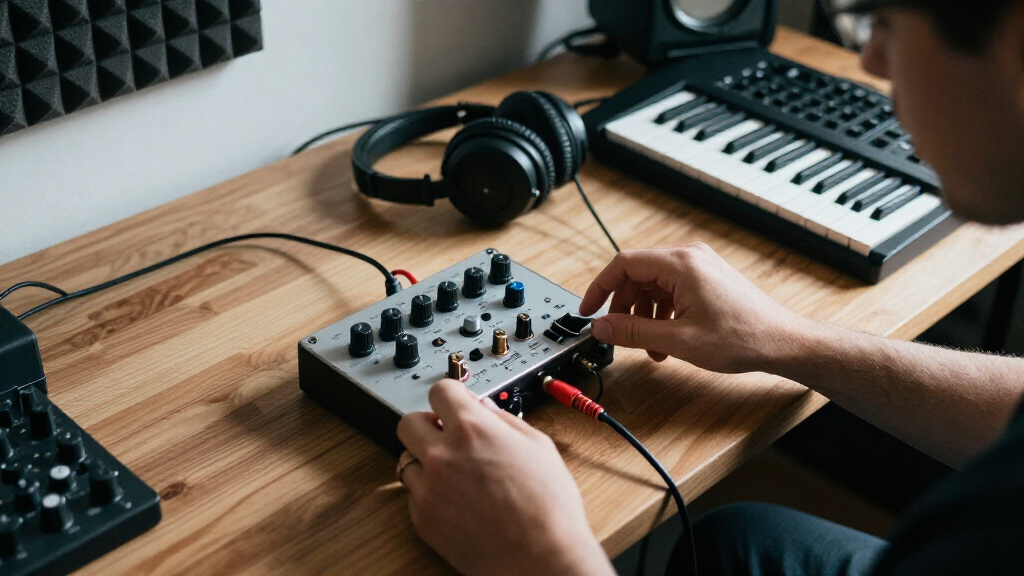
How We Picked
I ranked these options by how well they serve musicians who need a recording setup that can travel. The main criteria were input and output usefulness for common sessions, connection and device compatibility, monitoring and control practicality, portability, and the role each product can realistically fill. I also separated standalone stereo recording from computer- or phone-connected interfaces, since those solve different problems and should not be judged as interchangeable.
The ranking favors adaptable gear that can handle more than one common recording task without adding needless complexity. That puts the Scarlett 2i2 4th Gen first for broad musician use, while specialized picks rank higher for their particular needs rather than pretending to replace a full interface. Entry-level and compact models remain worthwhile when their simpler setup matches the buyer’s workflow, but limited inputs, narrower compatibility, or reduced expandability count as real tradeoffs.
| portable audio interfaces for musician | Connectivity |
|---|---|
| BOMGE 22M 2-Channel USB Audio | USB |
| M-Audio M-Track Solo USB Audio | USB |
| M-Audio M-Track Duo HD 2-In/2- | USB-C |
| Zoom H1essential Portable Ster | — |
| KYXAIN MOMIX CAB Portable Guit | USB |
| Focusrite Scarlett Solo 4th Ge | USB-C |
| Synido A20 Pro Portable USB-C | USB-C |
| JOYO MOMIX CAB Guitar Audio In | USB-C and Lightning |
| Focusrite Scarlett 2i2 4th Gen | USB-C |
| Universal Audio Volt 2 USB-C A | USB-C |
| IK Multimedia iRig 2 Portable | — |
| PIYONE 2×2 USB-C Audio Interfa | USB-C |
| Focusrite Scarlett Solo 3rd Ge | USB |
| M-Audio M-Track Duo USB Audio | — |
| Ueteto Portable Guitar Audio I | USB |
Factors to Consider When Choosing Portable Audio Interfaces For Musicians
Before choosing, decide where the audio will come from and where it needs to go. A portable interface for a laptop vocal session is not the same tool as a phone-connected guitar adapter or a recorder for capturing a rehearsal. These questions help narrow the field beyond brand names and headline specifications.
Count Simultaneous Sources, Not Just Inputs
Think about what you need to record at the same time: one vocal microphone, a vocal and guitar, or two microphones for a stereo or two-person session. An interface with two inputs can still have limitations in how those inputs are configured, so check whether they accept the source types you use. Buying for a single-source setup can keep the rig compact, but it may force you to record parts separately later. That is workable for overdubbing, not for a live duet or a performance where timing between sources matters. Leave room for the sessions you expect to do, rather than counting every possible future instrument. If your needs are uncertain, two usable inputs are often a more helpful upgrade than a higher advertised sample rate.
Match the Device and Connection Before Buying
Portability depends on the whole connection chain, not just the connector printed on the interface. Check whether your computer or phone supports the device, whether it needs an adapter, and whether your recording app recognizes it. A USB-C label does not by itself promise direct compatibility with every phone or tablet. Lightning-equipped devices and older USB connections may call for different cables or adapters, which can add bulk and create extra points of failure. Confirm how the interface is powered, too, since a mobile setup can be less convenient if it depends on a power source your session location lacks. For travel, a proven cable path and dependable app support can be more useful than a small difference in technical specifications.
Choose Between an Interface and a Standalone Recorder
A USB audio interface routes sound into a connected computer or mobile device, while a standalone recorder can capture audio without that host. The distinction affects setup time, editing, and what you can do during a session. Interfaces make sense when you want to record into a DAW, use software instruments, or build a repeatable home-studio workflow. A recorder such as the Zoom H1essential is a different fit for capturing rehearsals, ideas, or ambient stereo sound when opening a computer would slow you down. A common mistake is buying a recorder expecting the same microphone inputs and DAW workflow as an interface. Choose based on where you want the recording to happen, not simply which device looks more portable.
Prioritize Monitoring for the Way You Record
Monitoring determines whether you can hear your performance clearly while recording, and the right arrangement depends on the session. Vocalists and instrumentalists often need a headphone output they can use without complicated routing; guitarists recording through a phone may care more about hearing their processed signal while playing. Before buying, check the available monitoring controls and whether the workflow lets you hear both the live input and playback at a useful balance. A minimal adapter may be easy to carry but less suited to sessions that need several monitoring adjustments. Do not assume that software monitoring will feel immediate in every setup, since latency can interrupt timing and performance. If you record with other musicians, check how everyone will hear the mix, not only how the recording enters the device.
Pay for Expandability Only When You Will Use It
A more flexible interface can save a later replacement if your sessions grow, but extra capability is not automatically useful. If you record one guitar directly into a phone, a small guitar adapter may make more sense than carrying a larger two-input unit. If you expect to add a microphone, record two sources together, or work across several projects, the additional input flexibility may justify choosing a larger interface now. Separate the features you need today from features that might be convenient but will add setup steps or gear. Also consider the less visible costs of expansion, such as more cables, a stand, or a powered hub for your mobile rig. The best portable setup is the one you can deploy consistently, not the one with the longest feature list.
Treat Sample Rate as One Part of the Recording Chain
High sample-rate figures can attract attention, but they do not guarantee a better-sounding recording on their own. Microphone choice, instrument performance, room acoustics, gain setting, and the recording app all influence the result. For many songwriting, demo, and home-studio sessions, reliable input handling and a straightforward workflow matter more than chasing the largest number on a specification sheet. Higher settings can also increase file size and system demands, which may be inconvenient on a phone or an older computer. Check that your software supports the formats you plan to use, then choose a setting that suits the project. Avoid paying extra for a specification you cannot identify a real use for.
Frequently Asked Questions
Should I buy a two-input interface if I usually record one instrument at a time?
Not necessarily. A one-input model can be a sensible, compact choice if you record tracks separately and do not need to capture two sources together. A second input becomes useful for a vocal and guitar performance, two microphones, or a guest joining the session. Consider whether you are likely to record those combinations rather than buying extra capacity just in case. In this roundup, the Scarlett Solo is the more focused choice, while the Scarlett 2i2 offers more room for simultaneous sources.
Can I use a portable audio interface with my phone instead of a computer?
Some models and workflows support phone recording, but compatibility depends on the interface, phone connector, operating system, app, and power needs. Guitar adapters such as the IK Multimedia iRig 2 and the MOMIX CAB options are designed around mobile guitar use, while a conventional USB interface may need compatible cables or an adapter. Check that your recording app accepts the device as an audio input and that you can monitor playback in your chosen setup. If you use both phone and computer, verify support for each rather than assuming one connection will cover both. A short cable check before a session can prevent a portable rig from becoming unusable on location.
Is a portable stereo recorder a substitute for a USB audio interface?
Only for some recording jobs. A standalone recorder can capture a rehearsal, ambience, or a quick musical idea without a computer, which is a different advantage from routing instruments and microphones into a DAW. If you need to record separate tracks, use software instruments, or build a session with flexible input routing, an interface is usually the more suitable tool. The Zoom H1essential belongs in a portable capture workflow, but it should not be treated as a direct substitute for a multi-input studio interface. Choose based on whether you want a ready-made stereo recording or audio entering a connected device for production.
What should I check before using a guitar interface with an amp-simulation app?
Confirm that the adapter supports your phone or tablet and that the app can receive audio from it. Then check how you will monitor the processed sound, since hearing only the unprocessed input can make playing feel disconnected from the tone you are recording. Look at the adapter’s connection and headphone arrangements, and confirm that any required cables are included or available. A very compact guitar adapter can simplify travel, but it may not offer the input choices or routing of a conventional interface. If you also record vocals or microphones, a guitar-specific adapter may be too narrow for your wider workflow.
When does it make sense to pay more for a more flexible interface?
Paying for extra flexibility makes sense when it removes a real limitation from sessions you expect to record. Two simultaneous sources, broader input options, or a setup that works across your regular devices can save repeated workarounds. It is less compelling if you only record one direct guitar part at a time and value a small mobile rig above expansion. Compare the extra capability with the cables, power, and setup it may require; more features can make a travel setup less convenient. For musicians who anticipate recording duets, vocals with instruments, or multiple sources together, flexibility can be worth carrying.
Conclusion
For the broadest musician use, I recommend the Focusrite Scarlett 2i2 4th Gen as the best overall pick because two-source recording suits more sessions than a single-input setup. The M-Audio M-Track Duo is my best value direction for buyers who want a straightforward two-input interface, while the Universal Audio Volt 2 is the best premium choice for musicians who want a more feature-focused desktop-style recording hub. Beginners who plan to record one vocal or instrument at a time should start with the Focusrite Scarlett Solo 4th Gen and keep the setup simple. For standalone rehearsal or stereo capture, choose the Zoom H1essential; for a compact guitar-to-phone workflow, look at the IK Multimedia iRig 2 or a MOMIX CAB option after checking device compatibility. Match the choice to your actual recording chain, and the right interface is the one that lets you capture the sources you need without carrying gear you will not use.