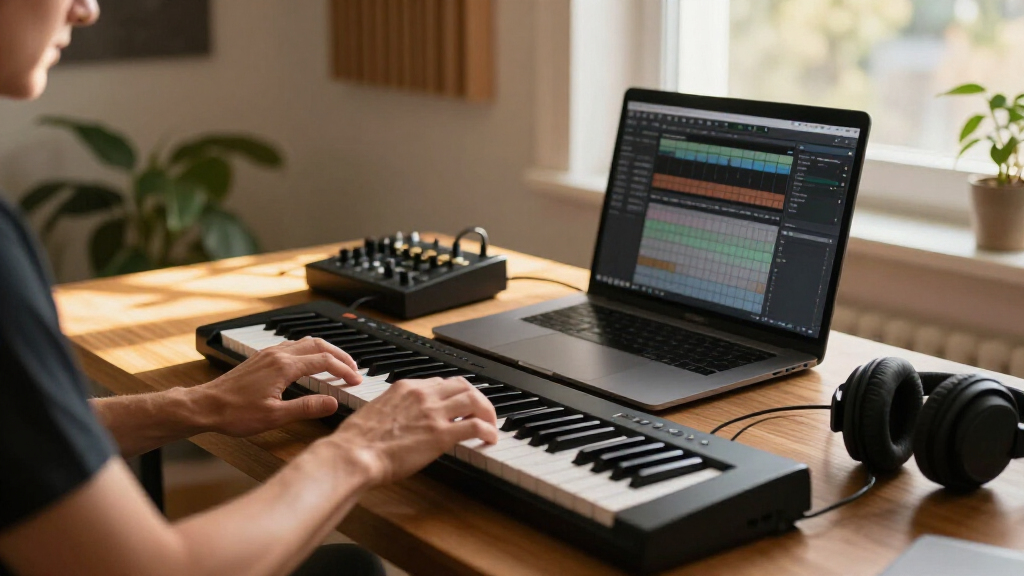

Wireless MIDI keyboards can cut the cable between your controller and compatible music setup, but wireless support varies: some models offer Bluetooth MIDI, while others rely on USB or need a separate adapter. I’d put the M-VAVE SMK-25 II forward as the best overall wireless-focused pick in this lineup, with the M-VAVE K5 standing out for Bluetooth and the K32 for its extra keys and built-in speaker. The main tradeoff is between portability and playing space: most options have 25 keys, while the 32- and 37-key models offer more range but take up more room. You’ll also need to check device compatibility and whether wireless use suits your latency and power needs. Read on for the full breakdown and help matching a controller to your setup.

Get audio and creator gear delivered free with Prime
- Fast, free delivery on millions of items
- Prime Video, Amazon Music and more included
- Member-only deals all year
Complete the kit


Key Takeaways
- The SMK-25 II is the roundup’s strongest wireless-first choice: it is a more focused pick for Bluetooth MIDI use than the Akai MPK Mini models, which are USB-centered controllers.
- Bluetooth support is not the same as universal wireless compatibility: the DaierTek, K5, and several M-VAVE models are wireless candidates, but buyers still need to confirm support on their specific computer, tablet, phone, and music software.
- Most choices share a 25-key format, so their real differences are controls and connectivity: drum pads, knobs, touch strips, and smart chord or scale functions can matter more than another similar mini-key layout.
- The K32 and STARRYKEY-37 PLAY address a different need: their 32- and 37-key layouts offer more room to play than the compact 25-key options, at the cost of portability.
- Wireless convenience can trade off against a simpler wired workflow: the MPK Mini MK3, MPK Mini IV, and Donner DMK-25 Pro make more sense for buyers prioritizing USB connections and a familiar computer-based setup.
| Akai Professional MPK Mini MK3 25-Key USB MIDI Keyboard Controller |  | Best for Beat-Making on a Computer | Keys: 25 velocity-sensitive mini keys | Connectivity: USB 2.0 Type-B | Pads: 8 velocity-sensitive MPC-style pads | VIEW LATEST PRICE | See Our Full Breakdown |
| M-VAVE 25-Key Mini MIDI Keyboard Controller, Wireless, White |  | Best for Wireless Pad Control | Keys: 25 velocity-sensitive keys | Pads: 16 RGB backlit velocity-sensitive pads | Rotary encoders: 8 assignable | VIEW LATEST PRICE | See Our Full Breakdown |
| Donner DMK-25 Pro USB-C MIDI Keyboard Controller, 25-Key Mini Keyboard |  | Best for Guided Learning | Keys: 25 | Drum pads: 8 | Connectivity: USB-C | VIEW LATEST PRICE | See Our Full Breakdown |
| DaierTek 25-Key Bluetooth and USB MIDI Keyboard Controller |  | Best for Expressive Wireless Playing | Keys: 25 velocity-sensitive keys | Drum pads: 8 RGB backlit, velocity-sensitive pads with aftertouch | Assignable knobs: 8 | VIEW LATEST PRICE | See Our Full Breakdown |
| 25-Key Wireless USB MIDI Keyboard Controller with Smart Chord and Scale |  | Best for External MIDI Integration | Keys: 25 velocity-sensitive mini keys | Pads: 8 RGB velocity- and pressure-sensitive pads with aftertouch and dual banks | Knobs: 9 assignable endless knobs with dual banks, controlling up to 18 parameters | VIEW LATEST PRICE | See Our Full Breakdown |
| M-VAVE 25-Key Mini MIDI Keyboard Controller |  | Best for a Feature-Rich Wireless Setup | Keys: 25 velocity-sensitive keys | Pads: 16 RGB backlit pads | Rotary encoders: 8 assignable | VIEW LATEST PRICE | See Our Full Breakdown |
| MEDIORAYS 25-Key Wireless MIDI Keyboard Controller with Drum Pads, Knobs, and Touch Strips |  | Best for Touch-Strip Pitch Control | Model: KeboradJK25 | Keys: 25 velocity-sensitive keys | Drum pads: 8 RGB backlit velocity-sensitive pads | VIEW LATEST PRICE | See Our Full Breakdown |
| M-VAVE SMK-25 MIDI Keyboard Controller |  | Best for Guided Chord and Scale Playing | Model: SMK-25 II | Keys: 25 velocity-sensitive keys | Drum pads: 16 RGB backlit pads with aftertouch | VIEW LATEST PRICE | See Our Full Breakdown |
| M-VAVE SMK-25 II Wireless MIDI Keyboard Controller |  | Best for Hardware-Friendly Wireless Performance | Model: SMK-25 II | Keys: 25 velocity-sensitive keys | Drum pads: 16 RGB backlit pads with aftertouch | VIEW LATEST PRICE | See Our Full Breakdown |
| Akai Professional MPK Mini IV 25-Key USB-C MIDI Keyboard Controller, Black |  | Best for Wired and Hardware Setups | Keys: 25 velocity-sensitive mini keys | Knobs: 8 assignable | Pads: 8 velocity- and pressure-sensitive RGB MPC pads | VIEW LATEST PRICE | See Our Full Breakdown |
| M-VAVE K5 25-Key Bluetooth MIDI Keyboard Controller |  | Best Compact All-in-One Control Set | Keys: 25 velocity-sensitive mini keys | Drum pads: 8 RGB backlit velocity-sensitive pads | Knobs: 8 assignable rotary encoders | VIEW LATEST PRICE | See Our Full Breakdown |
| M-VAVE 25-Key MIDI Keyboard Controller with 16 RGB Drum Pads, Bluetooth, and Built-In Battery |  | Best for Pad-Heavy Beat Making | Keys: 25 velocity-sensitive keys | Drum pads: 16 RGB backlit velocity-sensitive pads | Rotary encoders: 8 assignable | VIEW LATEST PRICE | See Our Full Breakdown |
| K32 Wireless 32-Key MIDI Keyboard Controller with Built-In Speaker |  | Best for Standalone Portable Playing | Keys: 32 | Connectivity: Wireless BLE MIDI | Battery life: Up to 6 hours | VIEW LATEST PRICE | See Our Full Breakdown |
| M-VAVE 25-Key MIDI Keyboard Controller with 16 Backlit Drum Pads |  | Best for Long Mobile Sessions | Keys: 25 velocity-sensitive keys | Drum pads: 16 RGB backlit velocity-sensitive pads | Rotary encoders: 8 assignable | VIEW LATEST PRICE | See Our Full Breakdown |
| Donner STARRYKEY-37 PLAY 37-Key MIDI Keyboard Controller |  | Best Feature-Rich 37-Key Option | Keys: 37 spring-loaded mini keys | Built-in sounds: 128 | Pads: 16 RGB pads | VIEW LATEST PRICE | See Our Full Breakdown |
| wireless MIDI keyboard | Keys | Connectivity | Battery | Drum pads |
|---|---|---|---|---|
| Akai Professional MPK Mini MK3 | 25 velocity-sensitive mini keys | USB 2.0 Type-B | — | — |
| M-VAVE 25-Key Mini MIDI Keyboa | 25 velocity-sensitive keys | USB and Bluetooth 5 | Built-in 2,000 mAh; about 18 hours of use | — |
| Donner DMK-25 Pro USB-C MIDI K | 25 | USB-C | — | 8 |
| DaierTek 25-Key Bluetooth and | 25 velocity-sensitive keys | Bluetooth and USB MIDI | 2,000 mAh; about 16 hours of operation | 8 RGB backlit, velocity-sensitive pads with aftertouch |
| 25-Key Wireless USB MIDI Keybo | 25 velocity-sensitive mini keys | Wireless MIDI, USB-C, 1/8-inch MIDI In/Out/Thru, and 1/4-inch sustain input | 3,000 mAh rechargeable; up to 5 hours of playtime | — |
| M-VAVE 25-Key Mini MIDI Keyboa | 25 velocity-sensitive keys | USB-C, Bluetooth | 2,000 mAh; about 18 hours of use | — |
| MEDIORAYS 25-Key Wireless MIDI | 25 velocity-sensitive keys | Bluetooth, USB | 2,000 mAh rechargeable; up to 16 hours | 8 RGB backlit velocity-sensitive pads |
| M-VAVE SMK-25 MIDI Keyboard Co | 25 velocity-sensitive keys | Bluetooth | — | 16 RGB backlit pads with aftertouch |
| M-VAVE SMK-25 II Wireless MIDI | 25 velocity-sensitive keys | Bluetooth; standard MIDI out | — | 16 RGB backlit pads with aftertouch |
| Akai Professional MPK Mini IV | 25 velocity-sensitive mini keys | USB-C, full-size MIDI Out | — | — |
| M-VAVE K5 25-Key Bluetooth MID | 25 velocity-sensitive mini keys | Bluetooth, USB | 2,000 mAh; about 16 hours | 8 RGB backlit velocity-sensitive pads |
| M-VAVE 25-Key MIDI Keyboard Co | 25 velocity-sensitive keys | USB, Bluetooth | Built-in 2,000 mAh; about 18 hours | 16 RGB backlit velocity-sensitive pads |
| K32 Wireless 32-Key MIDI Keybo | 32 | Wireless BLE MIDI | — | — |
| M-VAVE 25-Key MIDI Keyboard Co | 25 velocity-sensitive keys | Bluetooth 2.0, USB-C | Built-in 2,000 mAh; about 18 hours | 16 RGB backlit velocity-sensitive pads |
| Donner STARRYKEY-37 PLAY 37-Ke | 37 spring-loaded mini keys | USB, MIDI, wireless | — | — |
More Details on Our Top Picks
Akai Professional MPK Mini MK3 25-Key USB MIDI Keyboard Controller
I’d choose the MPK Mini MK3 for a computer-based setup where pads and hands-on controls matter more than wireless freedom. Its eight MPC-style pads, assignable knobs, and pitch/modulation joystick make it more suited to building beats and shaping software instruments than a basic mini keyboard. The included MPC Beats software, instruments, and sound content also give new producers a starting point without adding a wireless setup to configure.
The tradeoff is clear beside the M-VAVE 25-Key Mini MIDI Keyboard Controller: that model adds Bluetooth and a battery, while the Akai connects by USB and draws power from it. The Akai also has only 25 mini keys, so it is less comfortable for two-handed parts than a larger keyboard. I’d rank it here for production controls and bundled software, not for playing untethered.
Pros:- Eight velocity-sensitive pads support hands-on beat programming.
- Eight assignable knobs and a four-way joystick provide direct control of software instruments.
- Built-in arpeggiator adds performance options without relying solely on mouse input.
- Includes MPC Beats, three virtual instruments, and 2 GB of sound content.
Cons:- USB connection means it does not offer the wireless operation of the M-VAVE and other Bluetooth picks here.
- Mini keys can feel cramped for players accustomed to full-size keys.
- Requires a compatible computer and DAW or instrument software to produce sound.
Best for: Computer-based beat-makers who want pads, knobs, and included production software in a compact controller.
Not ideal for: Players who need Bluetooth or battery-powered sessions, or who prefer full-size keys for extended playing.
- Keys:25 velocity-sensitive mini keys
- Connectivity:USB 2.0 Type-B
- Pads:8 velocity-sensitive MPC-style pads
- Knobs:8 assignable 360-degree knobs
- Performance controls:4-way pitch and modulation joystick; built-in arpeggiator
- Compatibility:Mac and Windows
- Included software:MPC Beats, 3 virtual instruments, and 2 GB of sound content
Our verdict“Choose the MPK Mini MK3 for a compact, software-ready beat-making setup, but pick a Bluetooth model if cable-free use is your priority.”
M-VAVE 25-Key Mini MIDI Keyboard Controller, Wireless, White
The M-VAVE 25-Key makes the most sense for mobile producers who want a genuinely cable-free option and more pads than many compact controllers provide. Its Bluetooth 5 connection and built-in battery let it pair with compatible computers and mobile devices, while 16 RGB velocity-sensitive pads offer a broader layout for triggering clips or drum sounds than the eight-pad Akai MPK Mini MK3 or Donner DMK-25 Pro. Eight encoders and pitch controls keep it useful beyond basic note entry.
That extra flexibility comes with setup and fit caveats. The 25-key range and mini format are still limiting for extended keyboard parts, and Android connections may need a Type-C-to-Type-C cable, reducing the appeal of going wireless. Compared with the Donner, the M-VAVE prioritizes Bluetooth and pad count over an OLED display and learning content. I’d pick it for portable performance controls, not for a guided, screen-led workflow.
Pros:- Bluetooth 5 and a built-in 2,000 mAh battery support portable, cable-free sessions with compatible devices.
- Sixteen RGB velocity-sensitive pads provide more triggering space than the eight-pad Akai and Donner models.
- Eight assignable encoders and pitch controls offer hands-on editing and performance options.
- Supports Windows, Mac OS, Android, and iOS.
Cons:- Android connection may require a Type-C-to-Type-C cable.
- The 25-key mini format limits range and may feel small for players used to full-size keys.
- As a MIDI controller, it needs compatible music software or instruments to produce sound.
Best for: Mobile producers and performers who want Bluetooth, a rechargeable battery, and a generous pad layout in a compact controller.
Not ideal for: Android users who want a guaranteed cable-free connection, or keyboard players who need more than 25 mini keys.
- Keys:25 velocity-sensitive keys
- Pads:16 RGB backlit velocity-sensitive pads
- Rotary encoders:8 assignable
- Pitch controls:Pitch bend and modulation wheel; 2 capacitive touch strips
- Connectivity:USB and Bluetooth 5
- Battery:Built-in 2,000 mAh; about 18 hours of use
- Compatibility:Windows, Mac OS, Android, and iOS
Our verdict“Pick the M-VAVE for Bluetooth mobility and 16 pads, but choose the Donner DMK-25 Pro if an OLED display and learning features matter more.”
Donner DMK-25 Pro USB-C MIDI Keyboard Controller, 25-Key Mini Keyboard
I’d put the Donner DMK-25 Pro on a beginner’s shortlist for its combination of compact controls and learning support. The OLED display, smart scales, chord functions, arpeggio, and note repeat offer ways to explore ideas without needing to memorize every setting or musical pattern first. Its eight drum pads and transport controls also make it more capable as a small production surface than a keyboard focused only on note entry.
Compared with the wireless M-VAVE 25-Key, the Donner is a more screen- and learning-oriented choice, but its listed connection is USB-C rather than Bluetooth. That means a cable remains part of the setup, and some mobile devices may need a separately purchased OTG adapter. The included 40 teaching courses and software access add practical support, but this is still a MIDI controller: it requires a connected device and DAW or instrument software to make sound. I’d choose it for guided practice, not untethered sessions.
Pros:- OLED display helps make controller settings and functions easier to follow.
- Smart scales, chord functions, arpeggio, and note repeat support exploration and practice.
- Includes 40 keyboard-teaching courses and access to DAW software.
- USB-C connection and compatibility with computers and mobile platforms give it broad setup options.
Cons:- USB-C is the listed connection, unlike the Bluetooth-enabled M-VAVE 25-Key.
- Some mobile devices may require a separately purchased OTG adapter.
- It produces no sound on its own and requires DAW or instrument software.
Best for: New keyboard players who want smart scale and chord aids, a display, and included teaching courses alongside DAW controls.
Not ideal for: Buyers who prioritize Bluetooth operation or want a keyboard that produces sound without a connected device.
- Keys:25
- Drum pads:8
- Connectivity:USB-C
- Display:OLED
- Creative functions:16 smart scales, arpeggio, note repeat, and chord functions
- Additional controls:Touch bar, 4 control wheels, and 6 transport controllers
- Supported platforms:Android, Mac, Windows, and iOS
- Learning content:40 keyboard-teaching courses
Our verdict“Choose the Donner DMK-25 Pro for learning aids and a display, but look to the M-VAVE if wireless operation is the deciding factor.”
DaierTek 25-Key Bluetooth and USB MIDI Keyboard Controller
The DaierTek 25-Key is a good fit for players who want Bluetooth mobility without giving up expressive pads and performance aids. Its eight RGB pads are velocity-sensitive with aftertouch, while the pitch and modulation touch strips offer a compact alternative to conventional wheels. Smart chord, smart scale, and arpeggio functions can help a player build parts quickly, and the built-in battery is rated for about 16 hours of operation.
Compared with the M-VAVE 25-Key, DaierTek has eight pads rather than 16, so it gives up some triggering space in exchange for a simpler pad layout. The Akai MPK Mini MK3 offers a joystick and bundled production content, but no Bluetooth; DaierTek is the more mobile pick if the operating system handles its wireless connection well. That last condition matters: Bluetooth setup can vary by device, and this controller needs a DAW or music software to produce sound.
Pros:- Bluetooth and a 2,000 mAh battery support untethered sessions with compatible devices.
- Velocity-sensitive pads with aftertouch offer expressive triggering.
- Smart chord, smart scale, and arpeggio functions support quick idea-building.
- Works with Windows, Mac OS, Android, and iOS, plus popular DAWs.
Cons:- Eight pads offer less triggering space than the 16-pad M-VAVE 25-Key.
- Bluetooth setup may vary by operating system and may require a compatible app or driver.
- Requires music software or a DAW to produce sound.
Best for: Mobile performers who want Bluetooth, expressive pads with aftertouch, and onboard scale or chord aids for compatible DAWs.
Not ideal for: Producers who need 16 pads, a standalone sound source, or a wireless setup that works identically across every operating system.
- Keys:25 velocity-sensitive keys
- Drum pads:8 RGB backlit, velocity-sensitive pads with aftertouch
- Assignable knobs:8
- Performance controls:Mini-display and 2 capacitive touch strips for pitch bend and modulation
- Connectivity:Bluetooth and USB MIDI
- Battery:2,000 mAh; about 16 hours of operation
- Compatibility:Windows, Mac OS, Android, and iOS
- Supported software:Ableton Live, FL Studio, Cubase, GarageBand, and other compatible DAWs
Our verdict“Choose DaierTek for expressive wireless control and built-in creative aids, but favor the M-VAVE if you need a larger pad bank.”
25-Key Wireless USB MIDI Keyboard Controller with Smart Chord and Scale
This 25-Key Wireless USB MIDI Controller stands out for connecting a compact keyboard to more than just a computer setup. Alongside wireless MIDI and USB-C, it has 5-pin MIDI In/Out/Thru and a sustain input, making it the most flexible choice here for a player who wants to control external MIDI gear as well as software. Nine endless knobs with dual banks, aftertouch-capable pads, an OLED display, and smart chord and scale functions give it a deeper control set than the straightforward Akai MPK Mini MK3.
That flexibility comes with a real battery compromise: its 3,000 mAh battery is rated for up to five hours, much less than the roughly 16–18 hours listed for the DaierTek and M-VAVE. At 2.75 pounds, it is portable but not the lightest kind of travel controller, and its 25 mini keys remain limiting for broad parts. I’d choose it for external connections and control depth, not long wireless sessions.
Pros:- Wireless MIDI, USB-C, and 5-pin MIDI In/Out/Thru support varied studio and performance setups.
- Nine dual-bank endless knobs can control up to 18 parameters.
- Eight RGB pads support velocity, pressure, aftertouch, and dual banks.
- Smart Scale, Smart Chord, arpeggiator, OLED display, and MIDI Clock Sync add onboard control options.
Cons:- Battery life is rated for up to five hours, shorter than the DaierTek and M-VAVE options.
- The mini keys may not suit players who prefer full-size keybeds.
- It has no built-in speakers or sound generation and requires software or virtual instruments.
Best for: Producers who need a compact wireless controller that can also connect to external MIDI equipment and a sustain pedal.
Not ideal for: Players planning long sessions away from power, or those who want full-size keys or built-in sound.
- Keys:25 velocity-sensitive mini keys
- Pads:8 RGB velocity- and pressure-sensitive pads with aftertouch and dual banks
- Knobs:9 assignable endless knobs with dual banks, controlling up to 18 parameters
- Connectivity:Wireless MIDI, USB-C, 1/8-inch MIDI In/Out/Thru, and 1/4-inch sustain input
- Battery:3,000 mAh rechargeable; up to 5 hours of playtime
- Display:OLED
- Additional features:Smart Scale, Smart Chord, arpeggiator, pitch bend and modulation wheels, octave/semitone transpose, and MIDI Clock Sync
- Weight and dimensions:2.75 lbs; 1.98 inches thick
- Included sounds:120 instrument sounds and 8 drum kits; requires software or virtual instruments for sound
Our verdict“Pick this controller if external MIDI connections and extensive controls outweigh its short wireless runtime and mini-key format.”
M-VAVE 25-Key Mini MIDI Keyboard Controller
The M-VAVE pairs Bluetooth and a rechargeable battery with more hands-on controls than many compact wireless boards: its 16 velocity-sensitive RGB pads and eight assignable encoders give you room to trigger drums and adjust software parameters without reaching for a mouse. Compared with the MEDIORAYS KeboradJK25, it offers twice as many pads, while the MEDIORAYS instead has two touch strips for pitch control. That makes this a stronger fit for beat-focused sessions, though its pitch-bend controls are also included. The 25-key range keeps the controller easy to carry but limits two-handed parts, and the listed battery life of about 18 hours is useful for mobile work. Android users should note that the supplied connection requirements call for a Type-C to Type-C cable.
Pros:- Bluetooth and an 18-hour-rated rechargeable battery support untethered sessions.
- Sixteen velocity-sensitive RGB pads offer more drum-trigger space than the MEDIORAYS KeboradJK25.
- Eight assignable encoders and pitch-bend controls provide practical hands-on editing.
- Listed compatibility includes Windows, macOS, Android, and iOS.
Cons:- The 25-key range can restrict wider melodies and two-handed playing.
- Android connection requires a Type-C to Type-C cable.
- ABS plastic construction may not suit buyers seeking a more substantial-feeling controller.
Best for: Mobile producers who want a compact Bluetooth keyboard with plenty of pads and assignable controls for beat-making.
Not ideal for: Players who need a wide keyboard range, or Android users who want to connect wirelessly without relying on a Type-C to Type-C cable.
- Keys:25 velocity-sensitive keys
- Pads:16 RGB backlit pads
- Rotary encoders:8 assignable
- Connectivity:USB-C, Bluetooth
- Battery:2,000 mAh; about 18 hours of use
- Compatible platforms:Windows, macOS, Android, iOS
- Material:ABS plastic
- Color:Black
Our verdict“Choose this M-VAVE if portable beat-making controls matter more than a full keyboard range.”
MEDIORAYS 25-Key Wireless MIDI Keyboard Controller with Drum Pads, Knobs, and Touch Strips
The MEDIORAYS KeboradJK25 is the pick here for players who want wireless portability plus dedicated pitch controls. Its two capacitive touch strips offer a direct way to shape pitch and modulation, unlike the M-VAVE 25-Key Mini, whose 16 pads give it more space for drum triggering. The MEDIORAYS has eight RGB velocity-sensitive pads, eight assignable encoders, and 25 velocity-sensitive keys, so it still covers the core tasks of sketching melodies, triggering samples, and adjusting a DAW. Bluetooth and a rechargeable battery rated for up to 16 hours support mobile sessions, while USB provides a wired option. The tradeoff is a smaller pad set and a limited keyboard range; battery runtime is also stated as an upper limit, not a guaranteed session length.
Pros:- Two capacitive touch strips provide dedicated pitch-bend and modulation control.
- Bluetooth and USB offer wireless and wired connection options.
- Eight velocity-sensitive RGB pads and eight assignable encoders cover common production tasks.
- Listed compatibility spans major desktop and mobile platforms and several DAWs.
Cons:- Eight drum pads offer less triggering space than the 16-pad M-VAVE 25-Key Mini.
- The 25-key layout limits the range available for playing melodies and chords.
- Up to 16 hours of battery life may vary with use.
Best for: Laptop and tablet producers who want touch-strip pitch control alongside keys, pads, and knobs in a lightweight wireless controller.
Not ideal for: Beat-makers who want a larger pad bank, or keyboard players who need more than two octaves for parts and performance.
- Model:KeboradJK25
- Keys:25 velocity-sensitive keys
- Drum pads:8 RGB backlit velocity-sensitive pads
- Rotary encoders:8 assignable
- Touch strips:2 capacitive pitch-bend strips
- Connectivity:Bluetooth, USB
- Battery:2,000 mAh rechargeable; up to 16 hours
- Supported software:Ableton Live, FL Studio, Cubase, Logic Pro X, Bitwig, Reason, Studio One, GarageBand
- Warranty:1 year
Our verdict“Pick the MEDIORAYS if touch-strip control is more useful to your workflow than a larger pad bank.”
M-VAVE SMK-25 MIDI Keyboard Controller
The SMK-25 stands out among these wireless options for its chord, scale, and arpeggiator modes, which can help turn a short keyboard into a more capable idea-making tool. It combines 25 velocity-sensitive keys with 16 RGB pads, eight encoders, and pitch and modulation touch strips. Compared with the MEDIORAYS KeboradJK25, this M-VAVE gives you twice as many pads and adds the named performance modes, while the MEDIORAYS specifies an up-to-16-hour battery runtime and two touch strips. Here, Bluetooth and a built-in rechargeable battery support portable use, but no runtime is provided, so planning longer sessions is harder. A sustain input and standard MIDI output also make it more flexible with pedals and external hardware than a controller limited to computer connections.
Pros:- Chord, scale, and arpeggiator modes add performance options to a compact keyboard.
- Sixteen RGB pads provide more triggering space than the MEDIORAYS KeboradJK25.
- Bluetooth and a rechargeable battery support wireless sessions.
- Sustain input and standard MIDI output add pedal and external-hardware connections.
Cons:- The 25-key range can feel restrictive for wider parts.
- Battery life is not specified, making session planning less predictable.
- The supplied description does not detail USB connectivity.
Best for: Mobile beginners and songwriters who want chord and scale aids, a larger pad bank, and the option to connect a sustain pedal or MIDI hardware.
Not ideal for: Buyers who need a stated battery-runtime estimate or a keyboard large enough for extended two-handed playing.
- Model:SMK-25 II
- Keys:25 velocity-sensitive keys
- Drum pads:16 RGB backlit pads with aftertouch
- Encoders:8 assignable 360-degree encoders
- Controls:Pitch-bend and modulation touch strips
- Connectivity:Bluetooth
- Connections:Sustain pedal input, standard MIDI output
- Compatible devices:PC, Mac, iOS, Android
- Warranty:One-year manufacturer’s warranty
Our verdict“Choose the SMK-25 if its playing aids and MIDI hardware connections matter more than a documented battery runtime.”
M-VAVE SMK-25 II Wireless MIDI Keyboard Controller
This SMK-25 II makes a strong case for players who want a wireless controller that can also connect to external MIDI gear. Alongside Bluetooth, it has standard MIDI out and a sustain-pedal input, plus chord and scale modes, an arpeggiator, 16 RGB pads with aftertouch, and eight assignable encoders. Its feature set closely matches the M-VAVE SMK-25 listed here, so the choice between them is not a clear step up: both descriptions specify 25 keys, touch strips, pads, and playing aids. This listing identifies the color as white, while the other SMK-25 listing does not specify a color. As with that model, the compact key range suits sketches better than wide parts, and no battery runtime is stated.
Pros:- Bluetooth and a built-in rechargeable battery support portable operation.
- Standard MIDI out and a sustain-pedal input connect it to external gear and pedals.
- Sixteen RGB pads with aftertouch, eight encoders, and touch strips offer varied control.
- Chord and scale modes plus an arpeggiator support quick idea generation.
Cons:- The 25-key layout is limiting for parts that need a broader range.
- Battery runtime is not specified.
- Its listed features closely overlap the M-VAVE SMK-25, leaving few clear distinctions beyond the stated color.
Best for: Producers who want a compact Bluetooth controller for mobile or desktop work and need MIDI out or a sustain-pedal input for hardware setups.
Not ideal for: Buyers comparing closely matched M-VAVE models who need a specified battery runtime or a wider keyboard.
- Model:SMK-25 II
- Keys:25 velocity-sensitive keys
- Drum pads:16 RGB backlit pads with aftertouch
- Encoders:8 assignable 360-degree encoders
- Controls:Pitch-bend and modulation touch strips
- Connectivity:Bluetooth; standard MIDI out
- Power:Built-in rechargeable battery
- Compatible devices:PC, Mac, iOS, Android
- Color:White
Our verdict“Choose this white SMK-25 II if you want wireless control with MIDI out and a sustain input in a compact format.”
Akai Professional MPK Mini IV 25-Key USB-C MIDI Keyboard Controller, Black
The MPK Mini IV is the clearest choice here for a USB-C-centered setup with external MIDI hardware, but it is not a wireless MIDI keyboard: the supplied details list USB-C power and full-size MIDI Out, not Bluetooth or a built-in battery. That distinction matters in this roundup. Compared with the Bluetooth-equipped M-VAVE SMK-25 II, the Akai gives up untethered operation but adds a full-color display and pressure-sensitive MPC pads, with a software bundle listing more than 1,000 sounds. Its 25 velocity-sensitive mini keys, eight assignable knobs, and arpeggiator, chord, and scale modes make it a compact production controller rather than a full-range instrument. Choose it for desk or hardware use; skip it if wireless playing is the main requirement.
Pros:- Full-size MIDI Out supports connection to external MIDI hardware.
- Full-color display gives the controller a visual feedback feature not listed for the M-VAVE SMK-25 II.
- Pressure-sensitive RGB MPC pads and velocity-sensitive keys offer expressive input.
- Includes an arpeggiator, chord and scale modes, and a software bundle with more than 1,000 sounds.
Cons:- No Bluetooth connection or built-in battery is listed, so it does not meet a strict wireless-MIDI requirement.
- USB-powered operation keeps it tethered when used with a computer.
- The 25 mini keys limit playing range.
Best for: Producers who want a compact USB-C controller with a display, expressive pads, a sound bundle, and full-size MIDI Out for hardware.
Not ideal for: Buyers who specifically need Bluetooth MIDI and battery-powered wireless use, or players seeking more than 25 mini keys.
- Keys:25 velocity-sensitive mini keys
- Knobs:8 assignable
- Pads:8 velocity- and pressure-sensitive RGB MPC pads
- Connectivity:USB-C, full-size MIDI Out
- Display:Full-color screen
- Features:Arpeggiator, chord mode, scale mode
- Compatibility:Mac, Windows, and compatible mobile setups
- Included sounds:1,000+
Our verdict“Pick the MPK Mini IV for USB-C and hardware connections, but choose a Bluetooth model if wireless operation is non-negotiable.”
M-VAVE K5 25-Key Bluetooth MIDI Keyboard Controller
The K5 is a strong fit when I want a small wireless controller that combines keys, drum triggering, and hands-on parameter control. Its eight velocity-sensitive pads, eight assignable knobs, and two touch strips give it more ways to shape a portable session than a keyboard-only controller. Bluetooth and a battery rated for about 16 hours also suit mobile setups where a cable is inconvenient. Compared with the M-VAVE 25-Key Controller with 16 Backlit Drum Pads, the K5 has half as many pads and a shorter stated battery life, but its layout still covers basic beat-making while keeping the feature set approachable. The main compromise is its 25 mini keys, which limit comfortable two-handed playing and may feel cramped for players used to full-size keys.
Pros:- Bluetooth and USB connectivity support wireless sessions and wired setups.
- Built-in 2,000 mAh battery is rated for about 16 hours.
- Eight velocity-sensitive pads, eight assignable knobs, and two touch strips add performance control.
- Compatible with Windows, Mac OS, Android, and iOS.
Cons:- The 25 mini keys offer limited range and may feel cramped for sustained playing.
- It has eight pads, half the count on the related M-VAVE 16-pad models.
- Its stated battery life is shorter than the roughly 18 hours listed for those 16-pad alternatives.
Best for: Mobile producers who want keys, a modest pad bank, and assignable controls in one compact Bluetooth controller.
Not ideal for: Players who need a broad keyboard range or a large pad bank for finger drumming; the 25 mini keys and eight pads are restrictive for those tasks.
- Keys:25 velocity-sensitive mini keys
- Drum pads:8 RGB backlit velocity-sensitive pads
- Knobs:8 assignable rotary encoders
- Pitch controls:2 capacitive touch strips
- Connectivity:Bluetooth, USB
- Battery:2,000 mAh; about 16 hours
- Compatibility:Windows, Mac OS, Android, iOS
- Included components:Software suite, USB cable, user manual
Our verdict“Choose the K5 if you want a compact Bluetooth controller with a useful mix of keys, pads, knobs, and touch controls, and can work within 25 mini keys.”
M-VAVE 25-Key MIDI Keyboard Controller with 16 RGB Drum Pads, Bluetooth, and Built-In Battery
This M-VAVE is the better fit for a wireless workflow built around finger drumming: its 16 velocity-sensitive RGB pads give beat makers twice the pad count of the K5, while retaining 25 keys, eight assignable encoders, and two touch strips. A built-in battery rated for about 18 hours supports longer mobile sessions than the K5’s stated 16 hours. It also works with desktop and mobile platforms and names a broad range of compatible DAWs, which helps when moving between devices. The tradeoff is that its compact keybed remains a limited input for melodic parts, and Android use requires a Type-C to Type-C cable, so Bluetooth does not remove every connection hassle. Compared with the 16-pad M-VAVE USB-C model, the feature set is similar; buyers should check the exact variant and connection details before choosing.
Pros:- Sixteen velocity-sensitive RGB pads provide more room for drum layouts than the K5’s eight pads.
- Built-in 2,000 mAh battery is rated for about 18 hours.
- Bluetooth and USB support wired and wireless workflows.
- Lists compatibility with major desktop and mobile platforms and a range of DAWs.
Cons:- The 25-key layout limits range for melodic and two-handed playing.
- Android connection requires a Type-C to Type-C cable.
- The closely related M-VAVE 16-pad model has similar features, so buyers need to compare connection specifications carefully.
Best for: Beat makers who want a portable Bluetooth controller with a full 16-pad bank, knobs, and enough keys for short melodic parts.
Not ideal for: Keyboard players who need room for extended two-handed parts, or Android users who want a wholly cable-free connection.
- Keys:25 velocity-sensitive keys
- Drum pads:16 RGB backlit velocity-sensitive pads
- Rotary encoders:8 assignable
- Pitch controls:2 capacitive touch strips for pitch bend and modulation
- Connectivity:USB, Bluetooth
- Battery:Built-in 2,000 mAh; about 18 hours
- Compatible platforms:Windows, macOS, Android, iOS
- Compatible software:FL Studio, Ableton Live, Cubase, Logic Pro X, Bitwig, Reason, Studio One, GarageBand
Our verdict“Pick this version if a 16-pad layout matters more than a wider keyboard and you can accommodate its Android cable requirement.”
K32 Wireless 32-Key MIDI Keyboard Controller with Built-In Speaker
The K32 stands apart from the M-VAVE controllers because it is not just a wireless input device: built-in sounds and speakers let it make music without a computer or separate sound source. Its 32-key range also gives a little more room than the 25-key options for simple melodies and chord work, while eight knobs, eight pads, and an OLED display keep useful controls close at hand. That makes it appealing for casual practice, quick ideas, or a portable setup where carrying an audio interface and speakers is undesirable. The tradeoff is a stated battery life of up to six hours, substantially shorter than the M-VAVE models’ roughly 16-to-18-hour claims. Wireless pairing also uses the Synido BLE Connect companion app, and 32 keys still fall short of a full-range keyboard.
Pros:- Built-in sounds and speakers allow standalone play without a separate sound source.
- 32 keys provide more range than the 25-key M-VAVE controllers.
- Eight assignable knobs, eight drum pads, and an OLED display provide direct control.
- Rechargeable battery and BLE MIDI support portable wireless use.
Cons:- Up to six hours of battery life is shorter than the stated runtime of the M-VAVE alternatives.
- Wireless pairing uses the Synido BLE Connect app.
- The 32-key layout remains limited for extended two-handed parts.
Best for: Songwriters, students, and mobile creators who want a self-contained keyboard for sketching or playing without a computer.
Not ideal for: Producers prioritizing long battery sessions, a full-size keyboard range, or Bluetooth pairing without a companion app.
- Keys:32
- Connectivity:Wireless BLE MIDI
- Battery life:Up to 6 hours
- Built-in features:Sounds and speakers
- Controls:8 assignable knobs, 8 drum pads, OLED display, dedicated sound buttons
- Companion app:Synido BLE Connect
Our verdict“Choose the K32 if standalone sounds and speakers matter more than long battery life or a full-size playing range.”
M-VAVE 25-Key MIDI Keyboard Controller with 16 Backlit Drum Pads
This 16-pad M-VAVE makes sense for producers who want a conventional laptop-or-tablet controller layout without giving up wireless operation. It pairs 25 velocity-sensitive keys with 16 RGB pads, eight assignable encoders, and touch strips for pitch and modulation, so one compact surface can handle melodies, beats, and basic parameter changes. Its 18-hour battery rating is longer than the K5’s stated runtime, making it the more convincing choice here for extended sessions away from an outlet. Compared with the similarly equipped M-VAVE model with Bluetooth and a built-in battery, the listed controls and runtime are close; this version specifies USB-C and Bluetooth 2.0. Android still needs a Type-C to Type-C cable, and the 25-key range is the bigger limitation for anyone playing more than short parts.
Pros:- Sixteen velocity-sensitive RGB pads suit beat programming and finger drumming.
- Built-in 2,000 mAh battery is rated for about 18 hours.
- USB-C and Bluetooth 2.0 offer wired and wireless connection options.
- Eight assignable encoders and two touch strips provide hands-on control.
Cons:- The 25-key range can constrain melodic and two-handed playing.
- Android connection requires a Type-C to Type-C cable.
- Its control layout closely matches another M-VAVE 16-pad model, so the listed connection details matter when choosing.
Best for: Mobile producers who want a 16-pad wireless controller and prioritize a longer stated battery runtime over a wider keybed.
Not ideal for: Players who need more than 25 keys or Android users expecting a Bluetooth-only connection.
- Keys:25 velocity-sensitive keys
- Drum pads:16 RGB backlit velocity-sensitive pads
- Rotary encoders:8 assignable
- Pitch and modulation controls:2 capacitive touch strips
- Connectivity:Bluetooth 2.0, USB-C
- Battery:Built-in 2,000 mAh; about 18 hours
- Compatible platforms:Windows, Mac OS, Android, iOS
- Supported software:FL Studio, Ableton Live, Cubase, Logic Pro X, Bitwig, Reason, Studio One, GarageBand
Our verdict“Pick this model for a long-running portable beat-making setup, provided its compact key range fits your playing.”
Donner STARRYKEY-37 PLAY 37-Key MIDI Keyboard Controller
The STARRYKEY-37 PLAY is the most capable performance-and-learning package in this group. Its 37 mini keys give more melodic room than the 25-key M-VAVE models, while 16 RGB pads, eight encoders, and four faders provide a broader control surface. Built-in sounds, a 64-step sequencer, chord functions, note repeat, and a seven-mode arpeggiator make it useful even before a DAW session is fully set up. That range of features comes with a tradeoff: wireless operation is listed, but the connection details and battery runtime are not specified here, unlike the M-VAVE controllers’ stated Bluetooth connections and battery ratings. The keys are still mini-sized, and DAW software access is handled through customer service. It suits buyers who value creative tools and lessons more than a simple, clearly documented wireless setup.
Pros:- 37 keys provide more playing range than the 25-key M-VAVE models.
- 128 built-in sounds and a 64-step sequencer support music making beyond basic MIDI input.
- Sixteen RGB pads, eight encoders, and four faders offer extensive hands-on control.
- Includes access to 40 keyboard teaching courses and multiple DAW software options.
Cons:- Spring-loaded mini keys may feel small to players accustomed to full-size keys.
- Wireless connection details and battery runtime are not specified in the supplied product data.
- DAW software access is obtained through customer service.
Best for: Newer producers and learners who want more keys, onboard sounds, sequencing tools, and bundled learning content in one controller.
Not ideal for: Buyers who need a documented Bluetooth protocol or battery runtime, or players who prefer full-size keys.
- Keys:37 spring-loaded mini keys
- Built-in sounds:128
- Pads:16 RGB pads
- Controls:8 rotary encoders, 4 faders
- Arpeggiator:7 modes
- Sequencer:64 steps
- Connectivity:USB, MIDI, wireless
- Compatible platforms:Windows, macOS, iOS, iPadOS, Android
- Additional features:Note repeat, chord functions, headphone jack; access to 40 keyboard teaching courses
Our verdict“Choose the STARRYKEY-37 PLAY if you want a wider mini-key layout and a large set of onboard creative tools, but verify its wireless needs before buying.”

How We Picked
I compared these 15 controllers by how directly they serve the wireless MIDI use case, then looked at the practical details that shape a buying decision: stated Bluetooth or wireless connectivity, USB options, key count, onboard controls, portability, and features that can support learning or performance. A wireless label alone was not enough to rank a model highly; the connection must fit the buyer’s device and workflow, and wired fallback can be useful when pairing or power becomes inconvenient.
The ranking gives priority to models positioned for wireless MIDI use while accounting for versatility and the limits of compact keyboards. Controllers with extra pads or expressive controls can suit beat-making and live control, while longer keyboards may be a better match for playing parts across a wider range. The Akai MPK Mini models and Donner DMK-25 Pro remain relevant options, but their USB-focused positioning puts them behind wireless-first choices for this particular roundup. Product specifications and compatibility should be checked against the maker’s current documentation before purchase.
Factors to Consider When Choosing Wireless MIDI Keyboards
Before choosing a model, I’d treat “wireless” as one part of the setup rather than a guarantee that every device will connect cleanly. These broader checks can help you avoid buying a controller that looks portable but does not fit how you make music.
Check the Full Bluetooth MIDI Path
A controller’s Bluetooth MIDI support only helps if the receiving device and music software can accept it. Check compatibility for the exact computer, tablet, or phone you plan to use, including the operating system and app. Some setups handle MIDI over Bluetooth directly, while others depend on a host application or separate interface. Don’t confuse Bluetooth audio with Bluetooth MIDI; they carry different kinds of data and serve different purposes. If you plan to switch between devices, confirm how pairing works and whether the keyboard can remember multiple hosts. A USB connection can provide a practical fallback if wireless pairing is unavailable or unreliable.
Decide Whether Wireless Is Worth the Tradeoff
Wireless operation is most useful when it removes a cable that would otherwise restrict placement, such as when performing with a tablet or working away from a desk. It may add pairing steps, battery or charging concerns, and another possible point of connection trouble. For recording or playing parts that demand tight timing, test the complete keyboard-to-device path rather than assuming every Bluetooth setup will feel the same. A wired controller can be the easier choice for a fixed studio desk or a session where dependable connection matters more than freedom of movement. If you need both, favor a model with a clear wired option and understand which functions work over each connection.
Choose Key Count for the Music You Play
Twenty-five keys keep a controller compact, but the shorter range can mean shifting octaves when a part spans bass and melody. That is often fine for entering notes, sketching ideas, or controlling a software instrument in a small workspace. A 32- or 37-key option gives your hands more room without moving to a full-size keyboard, though it occupies more space in a bag or on a desk. Think about whether you play two-handed parts, use split ranges, or mostly tap in short phrases. A common mistake is choosing the smallest model for portability and later finding that frequent octave changes interrupt your playing.
Prioritize Controls That Match Your Workflow
Extra controls are valuable when they reduce trips to a mouse or touchscreen, but more controls do not automatically make a keyboard easier to use. Drum pads are useful for finger drumming and triggering clips, while knobs and touch strips can support hands-on changes to software parameters. Smart chord and scale features may help beginners explore harmony, though they are less important if you already prefer to play notes directly. Check whether controls are assignable in the software you use and whether their layout makes sense for your habits. When comparing similarly sized 25-key models, these workflow differences can matter more than small variations in appearance.
Plan for Power, Portability, and Accessories
A portable keyboard still needs a workable power plan. Confirm whether it has a built-in battery, how it charges, and whether it can operate while connected by USB; do not assume wireless capability means battery-powered operation. Account for the cable or adapter your phone or tablet may need, since a wireless keyboard does not remove every accessory from a mobile rig. For travel, compare the keyboard’s footprint with the bag and surface you actually use, including room for pads or controls. A lighter or smaller controller can be convenient, but a larger unit may be the better purchase if its added keys prevent constant repositioning.
Pay for Features You Will Actually Use
Extra pads, touch controls, and learning aids can add value when they support your regular sessions, but they can also add complexity without improving your main task. Beginners may benefit more from a clear layout and dependable software compatibility than from the largest control set. A player who performs beats may rank pads above key count, while a composer may prefer more keys and fewer performance controls. Compare included software and setup support only after confirming the hardware fits your connection needs. The best fit is the model that removes a real limitation in your workflow, not simply the one with the longest feature list.
Frequently Asked Questions
Will any Bluetooth MIDI keyboard work with my phone or tablet?
No. Compatibility depends on the controller, your device’s operating system, and the music app you plan to use. Check the manufacturer’s supported-device information and the app’s MIDI input options before buying. Also confirm whether the connection is Bluetooth MIDI rather than Bluetooth audio. If your mobile setup is central to your work, verify the complete connection path instead of relying on a general wireless label.
Is Bluetooth MIDI suitable for live performance?
It can suit some live setups, but performance depends on the controller, receiving device, software, and surrounding wireless conditions. For a set where timing and a reliable connection matter most, a wired USB option can reduce uncertainty. Test the exact instruments and apps you intend to use before taking a Bluetooth setup onstage. Also plan for charging and a backup connection, especially if the controller is battery-powered or your performance depends on a mobile device.
Should I choose a wireless 25-key controller or a 37-key model?
Choose 25 keys if a small footprint matters most and you mainly enter short parts, play one-handed lines, or use octave buttons without much interruption. A 37-key model gives you more playing range and can make two-handed ideas easier to work out, but it takes up more room. The K32 also offers 32 keys, placing it between the common 25-key format and the STARRYKEY-37 PLAY. Before deciding, measure your desk or travel bag and think about the parts you play most often. Extra keys are useful only if you can accommodate the larger controller.
Do wireless MIDI keyboards need a separate audio interface?
A MIDI keyboard sends performance data, such as which notes you play; it does not usually produce the software instrument’s audio by itself. If you use a computer, tablet, or phone, the receiving device and music app generate the sound. A separate audio interface may help with audio inputs, outputs, or monitoring, but it is not automatically required just to send MIDI. Check how your intended device handles sound output and whether you need to connect headphones, speakers, or other instruments. Bluetooth MIDI does not replace an audio connection.
When is a wired USB controller a better choice than a wireless model?
A wired controller may be a better fit when it will stay at a desk, when your device lacks compatible Bluetooth MIDI support, or when you want fewer pairing steps. USB can also be a useful fallback during troubleshooting or when wireless timing does not suit a particular performance. In this lineup, the Akai MPK Mini MK3, MPK Mini IV, and Donner DMK-25 Pro are more naturally suited to buyers who prioritize USB-centered setups. If portability is your main reason for going wireless, compare the convenience of fewer cables with the added need to manage pairing and power.
Conclusion
For the best overall wireless-first fit, I’d start with the M-VAVE SMK-25 II; for a Bluetooth-oriented 25-key alternative, compare it with the M-VAVE K5. The M-VAVE 25-Key Mini options are the best value direction for buyers who want a compact controller without prioritizing the Akai models’ USB-centered positioning. For beginners, the 25-Key Wireless Controller with Smart Chord and Scale is the most clearly learning-oriented choice, while the Akai MPK Mini IV is better for someone who prefers a USB-based setup. Choose the K32 for a built-in speaker and more keys than a typical mini controller, or the Donner STARRYKEY-37 PLAY when playing range matters more than compact size. If you need pads and hands-on controls, compare the MEDIORAYS and M-VAVE pad-equipped models; if dependable desk use matters more than going cable-free, consider the MPK Mini MK3 or Donner DMK-25 Pro. Before buying, match the model’s connection and power requirements to your actual device and music app.