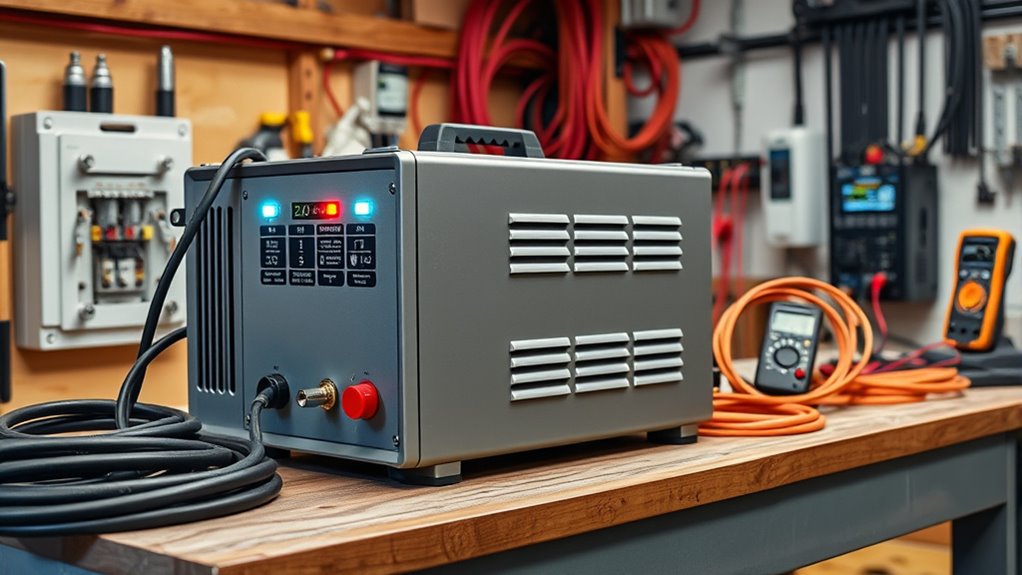

For a whole-home circuit, the EF ECOFLOW DELTA Pro Ultra is my best overall pick in this lineup because its 6,144Wh capacity and 7,200W 120/240V output make it a strong fit for demanding backup needs. The Jackery Explorer 5000 Plus stands out for buyers who want a bundled smart transfer switch, while the PowerMax 6000 offers a simpler route to 120/240V output. The main tradeoffs are battery runtime, the power needed to start large appliances, and the cost and complexity of connecting a station safely to home circuits. A 240V outlet alone does not make a unit a whole-home backup system: transfer equipment, circuit limits, and installation matter too. Read on for the full breakdown and guidance on matching a station to your circuits.

Get audio and creator gear delivered free with Prime
- Fast, free delivery on millions of items
- Prime Video, Amazon Music and more included
- Member-only deals all year
Complete the kit


Key Takeaways
- 240V output is only the first test. The EcoFlow DELTA Pro Ultra, Jackery Explorer 5000 Plus, and ABOK Ark7200 Plus list 7,200W output, but buyers still need to check surge behavior and the limits of the intended circuit.
- Battery size changes outage runtime more than outlet count. The ABOK Ark7200 Plus lists 9,792Wh, the largest stated capacity in this group, while the EcoFlow DELTA Pro Ultra lists 6,144Wh; the larger pack can support longer use, subject to load and usable capacity.
- A transfer solution can matter as much as the power station. The Jackery bundle includes a smart transfer switch, and the Anker F3800 kit option includes transfer equipment; other packages may need compatible equipment sourced separately.
- Expandable or paired systems serve a different buyer than single units. The PECRON setup uses two E3800 units with a 240V hub, while the Anker F3800 options offer battery expansion paths; these approaches add capacity or configuration flexibility but may take more planning.
- Compact capacity means tighter load choices. The EF ECOFLOW Delta 3 Ultra lists 3,072Wh and 3,600W output, making it a more limited fit for broad circuit backup than the higher-capacity, 7,200W-class models.


| 240v power stations for whole home circuit | Battery capacity | Expandable capacity | Weight | Battery type |
|---|---|---|---|---|
| Anker SOLIX F3800 Plus Portabl | — | Up to 53.8kWh with 12 batteries | 135.6 pounds | — |
| PowerMax 6000 Portable Power S | 3,600Wh | — | — | LiFePO4 |
| PECRON Portable Power Station | 3,840Wh | Up to 53.76kWh | 87.3 pounds | LiFePO4 |
| Anker SOLIX F3800 Power Statio | — | Up to 26.9kWh | — | — |
| Jackery Explorer 5000 Plus wit | 5,040Wh | Up to 60kWh | — | — |
| EF ECOFLOW DELTA Pro Ultra 614 | 6,144Wh | Up to 90kWh | 70.9 lb | — |
| ABOK Ark7200 Plus Power Statio | 9,792Wh | — | 300 lb | LiFePO4 |
| Anker SOLIX F3800 Portable Pow | 3,840Wh | Up to 26.9kWh | 132.3 lb | LiFePO4 |
| EF ECOFLOW Delta 3 Ultra 3072W | 3,072Wh | — | 72.1 lb | LiFePO4 |
More Details on Our Top Picks
Anker SOLIX F3800 Plus Portable Power Station and 240V Generator Adapter
The F3800 Plus pairs 6,000W output with a path to as much as 53.8kWh of storage, making it a strong fit for buyers planning backup around 240V circuits and extended outages. Its listed generator adapter and dual-voltage support speak directly to connecting higher-voltage loads, while solar, generator, and AC charging give owners several ways to replenish the battery. Compared with the Jackery Explorer 5000 Plus, it starts with less battery capacity and lower rated output, but its stated expansion ceiling is substantial. The tradeoff is physical and practical: at 135.6 pounds, this is better treated as a stationary home backup unit than something to move often. Reaching its maximum capacity also means adding batteries and managing a larger system.
Pros:- Dual-voltage support and a listed 240V generator adapter suit higher-voltage backup needs.
- 6,000W output can support multiple loads within the station’s power limit.
- Expandable capacity reaches up to 53.8kWh with 12 batteries.
- Solar, generator, and AC charging provide several recharge options.
Cons:- At 135.6 pounds, moving the base unit is difficult.
- Maximum capacity requires multiple additional batteries and a more involved setup.
- The provided data does not specify a transfer switch or whole-home circuit installation details.
Best for: Homeowners planning a scalable backup system for selected 240V circuits and long outages, with room for additional battery modules.
Not ideal for: Buyers who need a lightweight unit, a simple one-box setup, or high stored energy without purchasing expansion batteries.
- Base battery capacity:3,840Wh
- Expandable capacity:Up to 53.8kWh with 12 batteries
- Output power:6,000W
- Voltage support:Dual voltage; 240V generator adapter included in product title
- Solar input:3,200W
- Recharge time:63 minutes via solar and generator, as listed
- Weight:135.6 pounds
- Warranty:5 years
Our verdict“Choose the F3800 Plus if you want a 240V-capable system that can grow substantially for longer outages and can accommodate its weight and expansion setup.”
PowerMax 6000 Portable Power Station 3600Wh, 120V/240V AC Outlets
The PowerMax 6000 is a 120V/240V option for buyers who want substantial output without committing to a large expansion ecosystem. Its 3,600Wh battery is close to the 3,840Wh base capacity of the Anker SOLIX F3800 Plus, and its 6,000W output matches that Anker’s stated rating. The listed 9,000W surge rating may help with brief startup demands, while app control and a 5–8 ms UPS switchover add monitoring and short-interruption support. The tradeoff is less room to plan for very long outages: no expandable capacity is specified here, unlike the Anker or Jackery Explorer 5000 Plus. Its two-year warranty is also shorter than the five-year terms listed for the Anker options. Buyers should confirm circuit connection requirements before treating it as whole-home backup.
Pros:- 120V/240V output and 6,000W rated power suit a range of household loads.
- 9,000W surge rating provides headroom for brief appliance startup demands.
- LiFePO4 battery is listed for up to 3,500 charge cycles.
- App monitoring and listed 5–8 ms UPS switchover add useful control and continuity features.
Cons:- No expandable capacity is specified, limiting its stated long-outage growth path.
- Two-year warranty is shorter than the five-year terms listed for the Anker F3800 models.
- App control may be a drawback for owners who want all key functions available without a phone.
Best for: Homeowners who want a 240V-capable, app-monitored station for short outages and selected essential circuits without planning a large battery expansion.
Not ideal for: Buyers seeking multi-day backup from expandable storage, a longer stated warranty, or controls that do not depend on a smartphone app.
- Battery capacity:3,600Wh
- Surge output:9,000W
- Voltage:120V/240V
- AC outlets:4
- Battery type:LiFePO4
- Charge cycles:Up to 3,500
- Warranty:2 years
Our verdict“Pick the PowerMax if you want 240V output, app monitoring, and a 6,000W rating in a fixed-capacity system for selected backup loads.”
PECRON Portable Power Station 2xE3800 LFP, 240V Double Voltage Hub 3840Wh
The PECRON’s defining feature is its 240V double-voltage hub, paired with a 3,840Wh LiFePO4 station that can expand to 53.76kWh. That modular approach gives buyers a clear route from a base setup toward longer backup, much like the Anker SOLIX F3800 Plus. Its 87.3-pound listed weight is notably lower than the Anker’s 135.6 pounds, though it is still a substantial unit rather than an easy carry. PECRON lists 4,200W AC outlets and 3,200W AC input, but its data also describes the unit as 120 volts and does not clearly state the combined 240V output wattage. For whole-home circuit planning, that ambiguity matters: verify the hub’s supported output and connection method before choosing it. The separate shipment of station and hub adds setup coordination.
Pros:- Dedicated 240V double-voltage hub is central to the product’s home-backup design.
- Capacity can expand from 3,840Wh to 53.76kWh.
- LiFePO4 battery and listed overcurrent, voltage, temperature, and short-circuit protections.
- WiFi and Bluetooth support remote monitoring.
Cons:- Provided specifications do not clearly state combined 240V output wattage, so circuit compatibility needs confirmation.
- The power station and hub ship separately, adding coordination to setup.
- At 87.3 pounds, the base unit is still difficult to move frequently.
Best for: Technically minded homeowners who want expandable storage, a dedicated 240V hub, and are willing to verify system output and installation details before purchase.
Not ideal for: Buyers who need clearly documented combined 240V output, a ready-to-connect circuit solution, or a lightweight portable station.
- Battery capacity:3,840Wh
- Expandable capacity:Up to 53.76kWh
- Battery type:LiFePO4
- AC outlets:4 x 4,200W listed
- AC input:3,200W
- Solar input:3,000W
- Weight:87.3 pounds
- Connectivity:WiFi and Bluetooth
Our verdict“Choose PECRON if you want a modular, expandable system built around a 240V hub and are prepared to confirm its exact circuit output before buying.”
Anker SOLIX F3800 Power Station with Transfer Kit and Expansion Battery
This F3800 bundle is the most directly installation-oriented Anker option in this group: the title includes a transfer kit and expansion battery, alongside 6,000W dual-voltage 120V/240V output. That combination makes it more immediately relevant to circuit backup than the F3800 Plus listing, which highlights a generator adapter and a much higher stated expansion ceiling. Here, storage starts at 3.84kWh and expands to 26.9kWh, enough for buyers prioritizing a defined home setup over maximum system scale. The listed 45dB noise level is useful if the unit will operate near living areas, while the five-year warranty adds a clear support term. The tradeoff is that the bundle remains heavy and may involve multiple components. The data does not specify transfer-kit circuit capacity, so match the kit to the circuits and installation plan.
Pros:- Product title includes a transfer kit and expansion battery for a more circuit-focused bundle.
- 6,000W dual-voltage output supports both 120V and 240V loads.
- Expandable capacity reaches 26.9kWh with additional battery packs.
- Listed 45dB noise level and five-year warranty suit fixed home backup use.
Cons:- Expansion to the stated maximum involves additional components and setup.
- The base station and battery system are heavy and bulky for frequent relocation.
- Provided data does not specify transfer-kit circuit capacity or installation requirements.
Best for: Homeowners seeking a bundled transfer-kit route to selected 120V and 240V circuits, with moderate expansion plans and a quiet operating profile.
Not ideal for: Buyers who want the highest stated storage ceiling, a lightweight setup, or detailed transfer-kit capacity information before purchase.
- Base battery capacity:3.84kWh
- Expandable capacity:Up to 26.9kWh
- AC output:6,000W
- Voltage:Dual-voltage 120V/240V
- Expansion batteries:Up to 12 battery packs
- Noise level:45dB
- Warranty:5 years
- Outlets:15 total power outlets
Our verdict“Choose this F3800 bundle if a transfer-kit package and quiet dual-voltage backup matter more than the F3800 Plus’s larger stated expansion ceiling.”
Jackery Explorer 5000 Plus with Smart Transfer Switch, 5040Wh, 7200W Output
The Explorer 5000 Plus leads this group on the listed base battery size and rated output: 5,040Wh and 7,200W, with support for 120V and 240V. That gives it more starting capacity and output headroom than either Anker F3800 model, which are listed at 3.84kWh and 6,000W. Its stated expansion ceiling of 60kWh also exceeds the F3800 Plus’s 53.8kWh, giving buyers a larger growth path for prolonged outages. A smart transfer switch is part of the product description, making this a particularly relevant choice for planned circuit backup. The tradeoff is a heavier, more involved system, and the provided data lists only three outlets on the station. Buyers should confirm transfer-switch compatibility and the limits of the intended circuit setup before relying on it for a home.
Pros:- 5,040Wh base capacity is higher than the listed 3,840Wh Anker F3800 models.
- 7,200W rated output and 120V/240V support suit demanding household backup loads.
- Expandable capacity is listed up to 60kWh.
- Smart transfer switch compatibility supports a circuit-focused backup setup.
Cons:- Heavy construction can make placement and movement difficult.
- The station lists three total power outlets, fewer than the Anker F3800 bundle’s 15.
- Provided data does not state transfer-switch circuit capacity or charging time.
Best for: Homeowners who want higher base capacity and output than the Anker F3800 options, plus a smart transfer-switch path for selected 240V circuits.
Not ideal for: Buyers prioritizing easy relocation, a simple outlet-rich standalone unit, or a clearly stated recharge time and transfer-switch circuit rating.
- Battery capacity:5,040Wh
- Starting wattage:14,400W
- Voltage support:120V and 240V
- Expandable capacity:Up to 60kWh
- Outlets:3 total power outlets
- Frequency:60Hz
- Transfer switch:Smart transfer switch compatible
Our verdict“Pick the Jackery if higher starting capacity, 7,200W output, and smart transfer-switch compatibility outweigh portability and the limited listed outlet count.”
EF ECOFLOW DELTA Pro Ultra 6144Wh Power Station, 120/240V, 7200W AC Output
The DELTA Pro Ultra pairs 120/240V output with 7,200W of AC power, making it a strong fit for selected whole-home circuits when connected through compatible transfer equipment. Its 6,144Wh starting capacity can support a useful reserve, while expansion to 90kWh gives it a longer-backup path than the Anker SOLIX F3800, which is listed as expandable to 26.9kWh. Multiple charging routes, including wall, solar, and vehicle charging, add flexibility during outages. The tradeoff is that the listed unit weighs 70.9 pounds and expansion can mean a more involved setup with separate components. I’d favor it for buyers planning a scalable home system, not for someone seeking a simple grab-and-go station.
Pros:- 120/240V output and 7,200W AC rating suit compatible higher-load circuits.
- 6,144Wh capacity provides a substantial starting reserve.
- Expandable capacity up to 90kWh supports longer backup plans.
- Wall, solar, and vehicle charging offer multiple replenishment options.
Cons:- At 70.9 pounds, the unit is difficult for many people to move regularly.
- Expansion and separate component deliveries can make setup more involved.
- A large-capacity system may be more than buyers need for a few essential circuits.
Best for: Homeowners who want 240V circuit backup now and a path to substantially greater stored capacity later.
Not ideal for: Buyers seeking a lightweight, ready-to-use portable unit or a simple setup without separate expansion components.
- Battery capacity:6,144Wh
- AC output:7,200W
- Output voltage:120/240V
- Expandable capacity:Up to 90kWh
- Charging options:Solar, wall outlet, and electric vehicle charger
- Weight:70.9 lb
- Dimensions:27.2 × 18.9 × 8.4 in
Our verdict“Choose the DELTA Pro Ultra if you want 240V output with a clear route to much larger home-backup capacity.”
ABOK Ark7200 Plus Power Station, 120/240V 7200W AC Output, 9792Wh LiFePO4
For buyers prioritizing stored energy and a durable enclosure over portability, the ABOK Ark7200 Plus combines 9,792Wh of LiFePO4 capacity with 120/240V output rated at 7,200W. Its six outlets include an L14-30 and a 14-50, giving it connection options relevant to larger loads, though whole-home circuit use still depends on compatible transfer equipment and installation. Compared with the EF ECOFLOW DELTA Pro Ultra, the ABOK starts with more battery capacity but has no stated expansion ceiling in the supplied specifications. Its IP54 protection and rugged wheels suit demanding sites, yet 300 pounds makes it a stationary appliance in practice, not a portable backup you can casually reposition. I’d pick it for a fixed home or worksite location where its weight is manageable.
Pros:- 9,792Wh LiFePO4 capacity offers the largest stated starting reserve in this batch.
- 120/240V output rated at 7,200W supports substantial compatible loads.
- Includes NEMA L14-30 and NEMA 14-50 outlets alongside four NEMA 5-20 outlets.
- IP54 protection and rugged wheels are suited to tougher environments.
Cons:- At 300 pounds, moving it may require assistance despite the wheels.
- Its large dimensions demand a dedicated storage and installation space.
- The provided specifications do not state an expansion capacity.
Best for: Homeowners or contractors who need a high-capacity 240V unit for a fixed backup location or demanding worksite.
Not ideal for: People who need to carry or frequently reposition a power station, or buyers seeking a documented modular expansion path.
- Battery capacity:9,792Wh
- Battery type:LiFePO4
- Charge cycles:6,000+
- AC output:7,200W
- Output voltage:120/240V
- Outlets:Four NEMA 5-20, one NEMA L14-30, one NEMA 14-50
- Weight:300 lb
- Dimensions:34.9 × 20.7 × 21.6 in
Our verdict“Choose the Ark7200 Plus for a rugged, high-capacity 240V installation where moving a 300-pound unit is not part of the plan.”
Anker SOLIX F3800 Portable Power Station, 3840Wh, LiFePO4 Batteries, 6000W AC Output, Solar Generator for Home Backup and Outdoor Camping (Renewed)
The Anker SOLIX F3800 is a middle-ground choice for buyers who want 120/240V output without starting with a very large battery. Its 3,840Wh capacity and 6,000W AC output can suit selected home circuits, while expansion to 26.9kWh lets owners build more reserve as needs change. That is less maximum expansion than the EF ECOFLOW DELTA Pro Ultra’s stated 90kWh, but the F3800’s listed 132.3-pound weight is far below the ABOK Ark7200 Plus’s 300 pounds. It also supports app control over Wi-Fi or Bluetooth. The key caveat is the renewed condition: buyers should check the specific warranty and return terms, and a single 3,840Wh unit may not provide long runtimes for multiple large loads.
Pros:- 120/240V output and 6,000W AC rating fit a range of larger appliance needs.
- 3,840Wh capacity can expand to 26.9kWh with additional batteries.
- LiFePO4 battery chemistry and app control support a managed backup setup.
- Listed weight is lower than the 300-pound ABOK Ark7200 Plus.
Cons:- The renewed condition may come with different warranty coverage than a new unit.
- The base 3,840Wh capacity may limit runtime when several circuits are backed up.
- Expansion requires additional batteries and increases system size.
Best for: Buyers who want an expandable 120/240V home-backup platform with a lower starting capacity and are comfortable purchasing a renewed unit.
Not ideal for: Those who need a large reserve out of the box, want a new product, or plan to move the station frequently.
- Battery capacity:3,840Wh
- Expandable capacity:Up to 26.9kWh
- AC output:6,000W
- Output voltage:120/240V
- Battery type:LiFePO4
- Weight:132.3 lb
- Connectivity:Wi-Fi and Bluetooth app control
- Condition:Renewed
Our verdict“Choose this renewed F3800 if you want expandable 120/240V backup and accept checking warranty terms before buying.”
EF ECOFLOW Delta 3 Ultra 3072Wh Portable Power Station with 3600W AC Output
The EF ECOFLOW Delta 3 Ultra is the lower-output option in this group: its 3,600W AC rating and 3,072Wh battery make more sense for a limited set of essential loads than broad whole-home coverage. Its stated 7200W surge power may help with brief startup demands, while the automatic UPS feature is useful for equipment that needs a rapid handoff during an outage. Unlike the 120/240V-capable DELTA Pro Ultra and Anker SOLIX F3800, the supplied product data does not specify 240V output. That distinction matters for buyers targeting 240V circuits, so I would not treat it as a direct whole-home 240V substitute without confirming the required output and connection setup. Its 72.1-pound weight also makes “portable” a relative term.
Pros:- 3,072Wh capacity provides a useful reserve for selected essential loads.
- 3,600W AC output is paired with a stated 7,200W surge rating.
- Automatic UPS operation supports uninterrupted backup for connected equipment.
- Charging options include wall outlet, solar, car input, and EcoFlow Smart Generator.
Cons:- The supplied specifications do not state 120/240V or confirm 240V output.
- Its 3,072Wh capacity is modest beside the DELTA Pro Ultra and ABOK Ark7200 Plus.
- At 72.1 pounds, it is heavy to carry despite its portable-station format.
Best for: Buyers seeking UPS-style backup for essential equipment and modest loads who do not require confirmed 240V output.
Not ideal for: Homeowners specifically shopping for a verified 240V source to supply whole-home circuits or larger 240V appliances.
- Battery capacity:3,072Wh
- AC output:3,600W
- Surge power:7,200W
- Battery type:LiFePO4
- Weight:72.1 lb
- Dimensions:24.6 × 12.9 × 15.6 in
- Number of outlets:3
- Charging methods:Wall outlet, solar panels, car input, and EcoFlow Smart Generator
Our verdict“Choose the Delta 3 Ultra for essential-load and UPS backup, but skip it for 240V circuits unless the output is independently confirmed.”

How We Picked
I ranked these options around the needs behind 240V whole-home circuit backup, not general portable-power use. I compared listed 120/240V support, continuous output, stated battery capacity, expansion potential, and whether a transfer switch or kit is part of the package. I also considered setup complexity: paired stations and separate hubs can suit a planned installation, while an included transfer solution may reduce the number of decisions a buyer must make.
The ranking favors models that combine meaningful 240V output with practical capacity and a clear path to connecting home circuits. That puts the EcoFlow DELTA Pro Ultra first for its 7,200W output and 6,144Wh capacity, with the Jackery close behind for its included smart transfer switch. Larger stated capacity, package contents, and value-oriented simplicity shape the positions that follow. I treat the renewed Anker as a more conditional choice, and the Delta 3 Ultra ranks lower for whole-home ambitions because its listed output and capacity are more limited. Actual compatibility depends on the exact panel, transfer equipment, and installation; product specifications alone do not establish safe or code-compliant connection.
| 240v power stations for whole home circuit | Expandable capacity |
|---|---|
| Anker SOLIX F3800 Plus Portabl | Up to 53.8kWh with 12 batteries |
| PowerMax 6000 Portable Power S | — |
| PECRON Portable Power Station | Up to 53.76kWh |
| Anker SOLIX F3800 Power Statio | Up to 26.9kWh |
| Jackery Explorer 5000 Plus wit | Up to 60kWh |
| EF ECOFLOW DELTA Pro Ultra 614 | Up to 90kWh |
| ABOK Ark7200 Plus Power Statio | — |
| Anker SOLIX F3800 Portable Pow | Up to 26.9kWh |
| EF ECOFLOW Delta 3 Ultra 3072W | — |
Factors to Consider When Choosing 240v Power Stations For Whole Home Circuits
Choosing a station for home circuits is different from choosing one to charge devices or run a few appliances. I would start with the circuits you want to back up, then check power delivery, connection hardware, runtime, and installation requirements as one system.
Start With the Circuits, Not the Station
Write down which circuits matter during an outage: refrigeration, lighting, a boiler, well equipment, or selected outlets. A 240V circuit may feed an appliance that also needs substantial startup power, so its voltage alone says little about whether a station can run it. Check each appliance’s running watts and starting demand, then compare those figures with the station’s continuous and surge ratings. Avoid assuming that a unit labeled for whole-home backup can power every circuit in a panel at once. Most buyers get a more useful result by backing up a chosen set of loads and managing what runs at the same time. If you cannot identify circuit loads confidently, ask a licensed electrician to review the panel and intended setup.
Treat Transfer Equipment as Part of the System
A power station should not be connected to house wiring through an improvised cord or a method that can feed power back toward utility lines. A compatible transfer switch or other approved connection method separates the home circuits from the grid when the station is supplying power. Bundled equipment can simplify purchasing, but check that it matches your panel, voltage, and installation plan rather than assuming any transfer switch will work. When a kit is sold separately, include its compatibility and installation in your planning before choosing the station. Have a qualified electrician confirm the connection method and applicable local requirements. That planning can change which product is the better fit, even when another model has a higher output rating.
Compare Continuous Output, Surge, and Load Sharing
Continuous output tells you how much power a station can provide while loads are running; surge capability addresses brief startup demands. Compressors, pumps, and some motor-driven equipment can need a sharp burst of power before settling into a lower running draw. A station’s 7,200W headline figure does not answer whether it can handle every startup combination on a 240V circuit. Ask how the manufacturer specifies output across 120V and 240V, and whether the stated rating applies to one outlet, combined outlets, or a particular configuration. Leave capacity for overlapping loads rather than planning around a best-case total. This helps avoid buying a large unit that still trips or shuts down when several appliances start together.
Estimate Runtime From Real Use
Battery capacity is stated in watt-hours, but your usable runtime depends on the loads connected and conversion losses. Estimate the energy used by each essential appliance over an hour, then multiply by the hours you want to cover; treat the result as a planning estimate, not a guaranteed runtime. A refrigerator cycles on and off, while heating equipment or pumps may draw power in less predictable bursts. More capacity can extend an outage window, but it also tends to mean more weight, floor space, and upfront system complexity. Buyers focused on short outages may prefer a manageable setup over the largest possible battery bank. For longer outages, decide which loads can be switched off before paying for capacity you may rarely use.
Choose Between One Unit, Expansion, and Paired Stations
Some systems add batteries to a central power station; others use multiple stations with a hub to create 240V output. Expansion can extend runtime, while paired setups can provide a different route to voltage and capacity, but either approach adds equipment and connection steps. Check whether the added battery or hub is included, sold separately, or required for the configuration you plan to use. Also ask whether the system can be expanded later without replacing core equipment. A single unit may be easier to store and explain to other household members, even if it offers less flexibility. Choose modularity when you have a clear reason to grow the system, not simply because an expansion path appears on the specification sheet.
Plan for Placement, Charging, and Maintenance
A station intended for home backup needs a safe, practical location with room for ventilation, access to its connections, and a manageable path to the transfer equipment. Check the unit’s dimensions and weight before deciding where it will live, especially if you expect to move it during an outage. Think through how you will recharge it between uses: wall charging, solar input, or another supported method can affect how quickly the system is ready again. Read the manufacturer’s guidance on storage charge, temperature, and periodic checks rather than assuming a battery can sit untouched indefinitely. If charging outdoors with solar panels, confirm input limits and cable compatibility for the exact model. A setup that is easy to maintain and reach is more useful than one with impressive capacity stored somewhere inconvenient.
Frequently Asked Questions
Can a 240V power station run my whole house?
Usually, “whole-home” describes a way to connect selected home circuits, not a promise to power every load at once. Whether a station can run your household depends on its continuous and surge output, the circuits selected, and how much battery capacity you have. Large heating loads, electric ranges, dryers, and air conditioning can use substantial power and may exceed a portable system’s limits. Ask an electrician to identify which circuits can be backed up and what loads should be managed during an outage. Treat the product’s 240V label as a starting point, not proof that it can supply your entire panel.
Do I need a transfer switch if the station has 240V outlets?
A 240V outlet does not by itself provide a safe connection to a home’s electrical panel. Panel backup requires compatible transfer equipment or another approved method that prevents the home from feeding power back to utility lines. A bundled switch or kit can reduce shopping uncertainty, but it still has to match your panel and be installed as required. Do not connect a station to household wiring with a homemade backfeed cord. Have a qualified electrician confirm the equipment and installation plan before relying on it in an outage.
How do I know whether a station can start my well pump or air conditioner?
Find the appliance’s running wattage and startup or locked-rotor demand from its label, manual, or manufacturer. Compare the startup requirement with the station’s surge rating and confirm that the rating applies to the output and configuration you will use. A 240V appliance can still be a poor match if its startup draw is too high or if other loads are running at the same time. Some equipment also needs a specific type of connection, which an electrician can check against the station and transfer setup. When specifications are unclear, ask the appliance and power-station manufacturers before buying around an assumed fit.
Should I choose more battery capacity or higher output?
Choose based on the problem you need to solve: output determines what can run at a given moment, while battery capacity helps determine how long it can run. A high-output station with a smaller battery may handle demanding appliances but provide shorter runtime. A larger battery with inadequate output may last longer on modest loads yet fail to start a large motor or run overlapping circuits. Make a list of essential loads, their startup needs, and the number of hours you want to cover. If you cannot meet both targets, prioritize the loads that matter most rather than buying capacity or output without a use plan.
Is a paired 240V system a better choice than a single power station?
It depends on whether you value modular capacity and configuration options more than a simpler setup. A paired system may provide a route to 240V power and let you build around multiple units, but it can add a hub, more connections, and more details to verify. A single station can be easier to place and manage, though its capacity and expansion options may be more limited. Confirm how the pair shares loads, what equipment is required, and whether the complete arrangement works with your intended transfer setup. Choose paired equipment when the added flexibility serves a specific circuit or runtime need.
Conclusion
For the broadest balance of 240V output and battery capacity, I recommend the EF ECOFLOW DELTA Pro Ultra as best overall. Buyers who want transfer equipment included should look first at the Jackery Explorer 5000 Plus, while the ABOK Ark7200 Plus is my pick for buyers whose priority is the largest stated battery capacity in this lineup. The PowerMax 6000 is the best value-oriented choice for someone seeking a straightforward 120/240V station, subject to confirming connection needs and specifications for the intended loads. For beginners, I would favor the Jackery bundle because its smart transfer switch makes the home-circuit plan more explicit, though professional installation still matters. For modular or paired-system needs, compare the PECRON E3800 pair and Anker F3800 expansion options; choose the Delta 3 Ultra only when its more limited listed output and capacity suit a smaller, carefully selected group of loads. Before deciding, verify appliance startup demands, panel compatibility, and installation requirements with a qualified electrician.
Halloween Picks
halloween
As an affiliate, we earn on qualifying purchases.