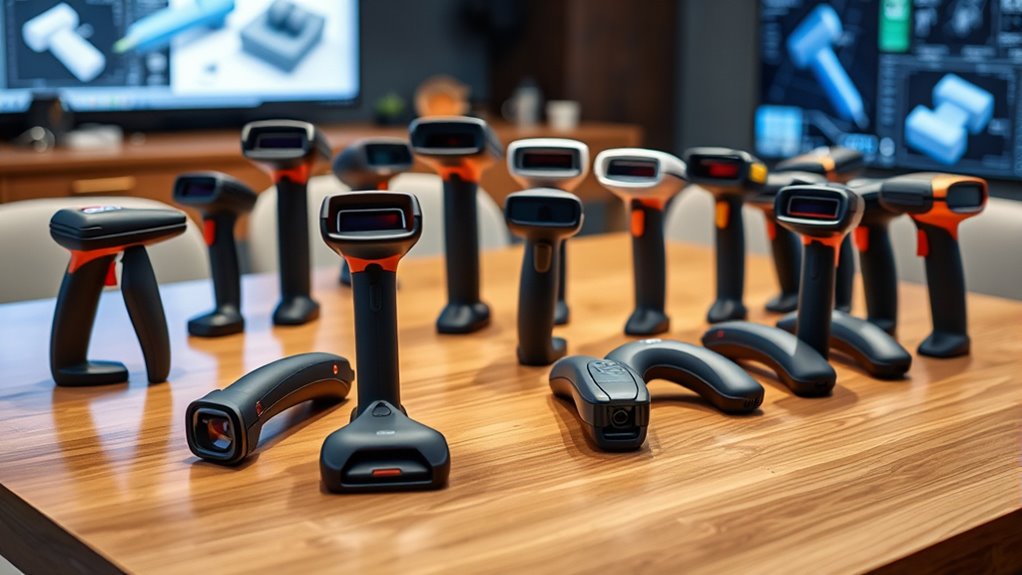
Handheld 3D scanners vary most in how they capture a surface, how easily they track an object, and which workflows they support. My best overall pick is the Creality CR-Scan Raptor, whose blue laser and infrared modes give it broader scanning options than the lighter consumer-focused models. The Revopoint MetroX Pro is a standout for buyers specifically seeking blue laser scanning, while the Creality Otter Lite family offers approachable wireless options for general projects. The main tradeoff is between specialized capture capability and a simpler, more portable setup. Read on for how the 13 options differ and which type of buyer each suits.

Get audio and creator gear delivered free with Prime
- Fast, free delivery on millions of items
- Prime Video, Amazon Music and more included
- Member-only deals all year
Complete the kit


Key Takeaways
- Laser capability is concentrated in a few picks: the CR-Scan Raptor and Revopoint MetroX Pro are the clearest fits when blue laser scanning is a priority; the other models should not be treated as laser alternatives.
- The Raptor earns the lead position through versatility: its combination of blue laser and infrared scanning gives buyers more ways to approach different objects than a single-mode choice.
- Several listings describe closely related Creality Otter Lite configurations: compare the included kit and connection details carefully, since repeated model names do not by themselves establish a different scanning capability.
- Moose Lite listings overlap heavily in their stated core specs: the Premium and Premium Kit names call for checking package contents and compatibility before paying for a bundle.
- Portability and scanning specialization pull in different directions: wireless options such as the Ferret Pro and INSPIRE 2 suit mobile workflows, while laser-focused models make more sense when capture method leads the decision.
| Creality CR-Scan Ferret Pro Wireless Handheld 3D Scanner |  | Best for Portable Full-Color Scanning | Connection: Wi-Fi 6 | Accuracy: Up to 0.1 mm | Color depth: 24 bits per pixel | VIEW ON AMAZON | See Our Full Breakdown |
| Creality Otter Lite Wireless 3D Scanner, Handheld High Precision 0.05mm for 3D Printing | 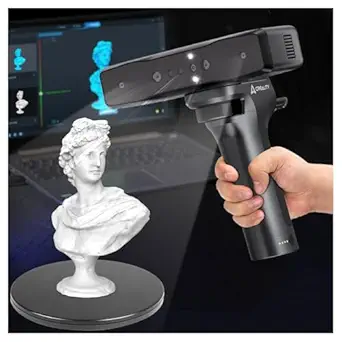 | Best for Adaptive-Lighting Flexibility | Accuracy: 0.05 mm | Scan volume: 20 mm³ to 2000 mm³ | Frame rate: 30 fps | VIEW ON AMAZON | See Our Full Breakdown |
| Creality Otter Lite Wireless 3D Scanner |  | Best for Untethered Long Sessions | Connectivity: Wi-Fi 6, Pogo Pin | Scanning speed: 30 FPS | Weight: 330 g (0.73 lb) | VIEW ON AMAZON | See Our Full Breakdown |
| Creality CR-Scan Raptor Handheld 3D Scanner |  | Best for Laser Detail | Scanning technologies: Blue laser and NIR infrared | Accuracy: Up to 0.02 mm | Fine-detail resolution: 0.1 mm | VIEW ON AMAZON | See Our Full Breakdown |
| 3DMakerpro Handheld 3D Scanner – 0.05 mm Precision, 10 FPS, Android/iOS/Windows/macOS compatible, Moose Lite Premium |  | Best for Cross-Platform Workflows | Precision: 0.05 mm | Scanning speed: 10 FPS | Compatibility: Android, iOS, Windows, macOS | VIEW ON AMAZON | See Our Full Breakdown |
| 3DMakerpro Moose Lite Premium Kit |  | Best for Fine Detail in a Lightweight Scanner | Accuracy: 0.05 mm | Resolution: 0.10 mm | Capture speed: 10 FPS | VIEW ON AMAZON | See Our Full Breakdown |
| Revopoint INSPIRE 2 Wireless 3D Scanner |  | Best for Outdoor Multi-Mode Scanning | Scanning modes: Infrared structured light and multi-line laser | Accuracy: Up to 0.05 mm | Precision: Up to 0.03 mm | VIEW ON AMAZON | See Our Full Breakdown |
| Creality CR-Scan Ferret Handheld 3D Scanner |  | Best for Faster Color Capture | Scanning modes: Wide-range and high-accuracy | Precision: Up to 0.1 mm | Resolution: 0.16 mm | VIEW ON AMAZON | See Our Full Breakdown |
| Revopoint POP 4 3D Scanner |  | Best for Broad Object Coverage | Scanning modes: Five | Single-frame accuracy: Up to 0.03 mm | Volumetric accuracy: 0.03 mm + 0.05 mm × L(m) | VIEW ON AMAZON | See Our Full Breakdown |
| Creality Otter Lite Basic 3D Scanner |  | Best for Cross-Platform Laser Workflows | Accuracy: 0.05 mm | Scanning speed: Up to 30 FPS | Camera system: Quad-camera | VIEW ON AMAZON | See Our Full Breakdown |
| 3DMakerpro Fox Handheld Medium-Format 3D Scanner |  | Best for Beginners | Scanner type: Handheld, medium-format 3D scanner | Accuracy: 0.07 mm | Resolution: 0.10 mm | VIEW ON AMAZON | See Our Full Breakdown |
| Revopoint MetroX Pro Blue Laser 3D Scanner |  | Best for Laser Detail | Single-frame precision: Up to 0.01 mm | Single-frame accuracy: Up to 0.02 mm | Volumetric accuracy: 0.02 mm + 0.04 mm × L (m) | VIEW ON AMAZON | See Our Full Breakdown |
| Creality Pika Portable 3D Scanner |  | Best Compact Laser Pick | Scanning modes: 7-line blue laser and NIR structured light | Accuracy: Up to 0.03 mm | 3D resolution: 0.1 mm | VIEW ON AMAZON | See Our Full Breakdown |
| 3d scanner handheld | Accuracy |
|---|---|
| Creality CR-Scan Ferret Pro Wi | Up to 0.1 mm |
| Creality Otter Lite Wireless 3 | 0.05 mm |
| Creality Otter Lite Wireless 3 | — |
| Creality CR-Scan Raptor Handhe | Up to 0.02 mm |
| 3DMakerpro Handheld 3D Scanner | — |
| 3DMakerpro Moose Lite Premium | 0.05 mm |
| Revopoint INSPIRE 2 Wireless 3 | Up to 0.05 mm |
| Creality CR-Scan Ferret Handhe | — |
| Revopoint POP 4 3D Scanner | — |
| Creality Otter Lite Basic 3D S | 0.05 mm |
| 3DMakerpro Fox Handheld Medium | 0.07 mm |
| Revopoint MetroX Pro Blue Lase | — |
| Creality Pika Portable 3D Scan | Up to 0.03 mm |
More Details on Our Top Picks
Creality CR-Scan Ferret Pro Wireless Handheld 3D Scanner
The Ferret Pro pairs Wi-Fi 6 portability with full-color capture, making it a practical pick for scanning medium and large objects without staying tethered to a computer. Its 105 g scanner and included phone holder, tripod, power bank, and case support a mobile workflow, while anti-shake tracking can help maintain a scan as you move around an object. Compared with the Creality CR-Scan Raptor, it is easier to carry but does not offer the same blue-laser detail or stated accuracy. Its 0.1 mm accuracy and 50–2000 mm object range suit general props and household objects better than tiny precision parts. Dark, shiny, and transparent surfaces can also make capture difficult, so buyers should expect to prepare challenging objects.
Pros:- Wi-Fi 6 supports wireless scanning
- Captures 24-bit color textures
- Anti-shake tracking supports movement around an object
- Lightweight 105 g design with travel accessories included
Cons:- Less precise on paper than the Raptor’s stated 0.02 mm accuracy
- Reflective, transparent, very dark, and tiny detailed objects may be difficult to scan
- Requires compatible hardware and minimum system specifications
Best for: Makers who want a lightweight, phone-compatible scanner for full-color scans of objects roughly 50–2000 mm in size
Not ideal for: Jewelers and reverse-engineering users who need dependable detail on tiny, reflective, transparent, or very dark parts
- Connection:Wi-Fi 6
- Accuracy:Up to 0.1 mm
- Color depth:24 bits per pixel
- Export formats:OBJ, STL, PLY
- Platforms:Windows, macOS, Android, iOS
- Recommended object size:50–2000 mm
- Weight:105 g
- Warranty:1 year
Our verdict“Choose the Ferret Pro for lightweight wireless color scanning of everyday objects, and look to the Raptor for finer laser detail.”
Creality Otter Lite Wireless 3D Scanner, Handheld High Precision 0.05mm for 3D Printing
Adaptive lighting and 30 fps capture give this Otter Lite a useful case for scanning across changing environments, including outdoor sessions. The listed 0.05 mm accuracy is finer than the Ferret Pro’s stated 0.1 mm, which may suit buyers seeking more detailed models for 3D printing. Wireless operation and mobile control also make repositioning easier than a computer-tethered workflow. Compared with the other Creality Otter Lite in this roundup, this listing provides more explicit capture details, including 30 fps, dual LED fill lights, and a stated scan-volume range. The tradeoff is setup: full functionality depends on a compatible phone or computer, and new users may need time to learn the scanning process. Check the size-range wording with the seller before buying, since the supplied cubic millimeter figures are unusual.
Pros:- Stated 0.05 mm accuracy for detailed model capture
- 30 fps scanning supports responsive capture
- Adaptive lighting and dual LED fill lights support varied lighting conditions
- Wireless connectivity with mobile control
Cons:- Full functionality depends on compatible smartphone or computer hardware
- The listed scan-volume range is stated in cubic millimeters and may need clarification
- New users may face a learning curve
Best for: 3D-printing hobbyists who scan indoors and outdoors and have a compatible phone or computer for wireless control
Not ideal for: Buyers who need a clearly specified object-size range or a simple plug-and-scan workflow without learning new software
- Accuracy:0.05 mm
- Scan volume:20 mm³ to 2000 mm³
- Frame rate:30 fps
- Connectivity:Wi-Fi, mobile control
- Platforms:Windows, macOS
- Color capture:Yes
- Lighting:Dual LED fill lights
Our verdict“Pick this Otter Lite for wireless, adaptive-lit scanning and stated 0.05 mm accuracy, after confirming the size range fits your objects.”
Creality Otter Lite Wireless 3D Scanner
With Wi-Fi 6, a 3400 mAh battery, and up to three hours of use, this Otter Lite is aimed at scanning away from a desk. Its quad-lens arrangement combines long- and short-focus lenses, giving it a stated ability to cover small detailed objects as well as larger items. Anti-shake tracking and backtracking can help recover a scan when tracking slips, a useful workflow feature compared with the simpler portability pitch of the Ferret Pro. At 330 g, it remains portable, though it is substantially heavier than that 105 g scanner. The listing does not give an accuracy figure or explicit supported object-size range, so buyers focused on measurable precision should compare it with the other Otter Lite listing, which states 0.05 mm accuracy. Battery runtime also puts a ceiling on long field sessions.
Pros:- Wi-Fi 6 and Pogo Pin connectivity support wireless use
- Up to three hours of battery life
- Quad-lens system includes long- and short-focus lenses
- Anti-shake tracking and scan backtracking support scan recovery
Cons:- Battery runtime is limited to up to three hours per charge
- This listing does not state an accuracy figure or object-size range
- At 330 g, it is heavier than the Ferret Pro
Best for: Makers who need a rechargeable wireless scanner for mobile sessions involving both small details and larger objects
Not ideal for: Buyers who need a published accuracy figure, a clearly defined object-size range, or a full workday of scanning on one charge
- Connectivity:Wi-Fi 6, Pogo Pin
- Scanning speed:30 FPS
- Weight:330 g (0.73 lb)
- Battery capacity:3400 mAh
- Battery life:Up to 3 hours
- Charging:40 W HyperCharge; 0% to 80% in 60 minutes
- Lenses:Quad-lens system with dual long- and short-focus lenses
- Software:CrealityScan, lifetime use
- Warranty:1 year
Our verdict“Choose this Otter Lite for a rechargeable, untethered workflow, but compare the other Otter Lite listing if stated accuracy is a deciding factor.”
Creality CR-Scan Raptor Handheld 3D Scanner
The Raptor is the lineup’s laser-focused pick: blue laser scanning reaches up to 60 fps, while NIR infrared scanning adds a second mode for different object sizes. Its stated accuracy of up to 0.02 mm and fine-detail resolution of 0.1 mm make it the clearest choice here for buyers prioritizing fine capture over light weight or simple mobile use. Compared with the Ferret Pro, it supports much smaller objects and provides a blue-laser mode, but the computer requirements are more demanding. Feature-rich objects can be scanned without markers, which can reduce preparation, and 24-bit textures add color. Windows use calls for a dedicated NVIDIA GPU with 6 GB VRAM; Android compatibility also depends on specific hardware and software support. This is a specialist tool, not the easiest entry point.
Pros:- Blue laser and NIR infrared scanning support different object sizes
- Stated accuracy reaches up to 0.02 mm
- Blue-laser mode scans at up to 60 fps
- Marker-free scanning for feature-rich objects and 24-bit color textures
Cons:- Windows use calls for a dedicated NVIDIA GPU with 6 GB VRAM
- Android support depends on compatible processor, Wi-Fi 6, and software
- Fine-detail capabilities may be more than casual scanning requires
Best for: Reverse-engineering and 3D-printing users who need blue-laser detail on small parts as well as scans of larger objects
Not ideal for: Casual users with basic computers or anyone who values a lightweight, low-setup scanner over fine laser capture
- Scanning technologies:Blue laser and NIR infrared
- Accuracy:Up to 0.02 mm
- Fine-detail resolution:0.1 mm
- Blue laser scanning speed:Up to 60 fps
- NIR scanning speed:Up to 20 fps
- Supported object size:5 × 5 × 5 mm to 2,000 × 2,000 × 2,000 mm
- Color depth:24 bits per pixel
- Compatibility:Windows, macOS, and supported Android devices
Our verdict“Choose the Raptor when laser detail and small-object capture matter more than low hardware demands or easy portability.”
3DMakerpro Handheld 3D Scanner – 0.05 mm Precision, 10 FPS, Android/iOS/Windows/macOS compatible, Moose Lite Premium
Broad device compatibility is this Moose Lite Premium listing’s clearest advantage: it supports Android, iOS, Windows, and macOS, giving buyers more ways to fit scanning into an existing setup. Its stated 0.05 mm precision and 10 fps capture target detailed modeling, while AI visual tracking, anti-shake optics, and marker-free scanning are intended to reduce manual effort during capture. Compared with the Creality Otter Lite, this option lists mobile and desktop platforms but has a slower stated frame rate than that scanner’s 30 fps. The listed 3.65-pound weight and package dimensions also make it less compelling for extended handheld sessions than the lightweight Ferret Pro. Buyers should check that the JMStudio software workflow fits their needs; the supplied description makes it central to full functionality.
Pros:- Stated 0.05 mm precision
- Supports Android, iOS, Windows, and macOS
- AI visual tracking and anti-shake optics support steadier capture
- Marker-free scanning and lifetime OTA software updates
Cons:- Listed item weight of 3.65 pounds may tire users during extended handheld scanning
- 10 fps is slower than the Otter Lite’s stated 30 fps
- Full functionality relies on proprietary JMStudio software
Best for: Hobbyists or professionals who want one scanner that supports their Android or iOS device as well as a Windows or Mac computer
Not ideal for: Users who scan for long periods by hand, need a lightweight field scanner, or prefer to avoid proprietary scanning software
- Precision:0.05 mm
- Scanning speed:10 FPS
- Compatibility:Android, iOS, Windows, macOS
- Item weight:3.65 pounds
- Package dimensions:10.47 × 10.31 × 3.94 inches
- Manufacturer:3DMakerpro
- Software:JMStudio
Our verdict“Choose the Moose Lite Premium for broad device support and stated 0.05 mm precision if its weight and JMStudio workflow suit your scanning setup.”
3DMakerpro Moose Lite Premium Kit
The Moose Lite pairs stated 0.05 mm accuracy with a 250 g handheld design, making it a focused pick for people who want detailed scans without carrying a heavier setup. Its listed range of 15 mm to 1,500 mm suits small and medium objects, while support for Android, iOS, Windows, and macOS gives it broader platform flexibility than the Windows-only Revo Design workflow for the Revopoint INSPIRE 2. The tradeoff is speed: at 10 FPS, it captures more slowly than the Creality CR-Scan Ferret’s stated 30 FPS, which may make moving around a subject less fluid. The software interface may also take time to learn, and battery life is unspecified. I’d choose it for careful, portable object capture, including laser-focused workflows only when the product’s listed scanning details meet the specific job’s needs.
Pros:- Stated 0.05 mm accuracy and 0.10 mm resolution suit detail-oriented scanning.
- At 250 g, it is easy to carry between work areas.
- Supports Android, iOS, Windows, and macOS.
- AI tracking and point-cloud processing are listed features.
Cons:- 10 FPS is slower than the Creality CR-Scan Ferret’s stated 30 FPS.
- The listed scan range limits suitability for very large objects.
- Battery life is not specified, and the software interface may feel complex.
Best for: Mobile or desktop makers scanning small and medium objects who prioritize stated accuracy and a light handheld body.
Not ideal for: Buyers scanning large subjects or prioritizing faster capture; its listed range tops out at 1,500 mm and capture speed is 10 FPS.
- Accuracy:0.05 mm
- Resolution:0.10 mm
- Capture speed:10 FPS
- Scan range:15 mm to 1,500 mm
- Weight:250 g
- Platform support:Android, iOS, Windows, macOS
Our verdict“Choose the Moose Lite for portable, detail-focused scanning across mobile and desktop platforms, provided its 10 FPS pace fits your workflow.”
Revopoint INSPIRE 2 Wireless 3D Scanner
The INSPIRE 2 stands out for combining infrared structured light and multi-line laser modes in a 190 g wireless scanner. Its stated outdoor tolerance of up to 20,000 lux makes it more suited to bright locations than a scanner whose data does not specify outdoor performance. For laser-oriented buyers, the multi-line laser mode is a meaningful reason to shortlist it; the stated accuracy reaches 0.05 mm, with precision up to 0.03 mm. It also captures full-color textures and connects over Wi-Fi 6 or USB-C. Compared with the broader five-mode Revopoint POP 4, the INSPIRE 2 has fewer listed modes, but its included calibration and scanning accessories make the kit more ready to use. The main catch is the separate Revo Design software, which supports Windows only, alongside demanding computer requirements.
Pros:- Multi-line laser and infrared structured light provide two scanning modes.
- Stated outdoor operation up to 20,000 lux supports brighter work areas.
- Captures full-color textures and can connect over Wi-Fi 6 or USB-C.
- Lightweight at 190 g, with calibration and scanning accessories included.
Cons:- Revo Design is sold separately and supports Windows only.
- Listed Windows requirements include 16 GB RAM and a dedicated RTX 3060 GPU.
- The POP 4 offers five listed scanning modes for a wider range of tasks.
Best for: Makers who need a light scanner for indoor and bright outdoor work and want a dedicated multi-line laser mode.
Not ideal for: Buyers who need an all-in-one Windows-independent editing workflow or have a computer below the listed hardware requirements.
- Scanning modes:Infrared structured light and multi-line laser
- Accuracy:Up to 0.05 mm
- Precision:Up to 0.03 mm
- Fused point distance:0.1 mm
- Outdoor lighting:Up to 20,000 lux
- Connection:USB-C, Wi-Fi 6
- Weight:190 g
- Compatibility:Windows, macOS, Android, iPhone, iPad
Our verdict“Pick the INSPIRE 2 if outdoor capability and multi-line laser scanning matter more than bundled editing software or broad mode selection.”
Creality CR-Scan Ferret Handheld 3D Scanner
The CR-Scan Ferret makes a practical case for buyers who value capture pace and flexible power: it records point clouds at up to 30 FPS and can run from a compatible Android device or a 5V power bank. Wide-range and high-accuracy modes let you switch between covering larger objects and preserving finer detail, though its stated precision is up to 0.1 mm, less precise on paper than the 0.05 mm figures listed for the Moose Lite and Otter Lite Basic. Full-color capture adds useful surface information for visualization. The compromise is mobile compatibility: the Ferret supports Android, while iPhone support is listed for the separate Ferret Pro. Compared with the Otter Lite Basic, this model has a clearer portable-power option, but the Basic lists broader mobile platform support.
Pros:- Captures point clouds at up to 30 FPS.
- Wide-range and high-accuracy modes address different object sizes and detail needs.
- Records 24-bit color textures.
- Can use a compatible Android device or 5V power bank for power.
Cons:- Mobile scanning with this Ferret model is limited to Android.
- Stated precision of up to 0.1 mm is less fine than the 0.05 mm accuracy listed for some alternatives.
- Supported devices need compatible operating systems, hardware, memory, and Wi-Fi 6.
Best for: Android users and makers who want quick full-color scans with the option to power the scanner from a portable bank.
Not ideal for: iPhone-first buyers or users who need the finer stated accuracy listed for the Moose Lite or Otter Lite Basic.
- Scanning modes:Wide-range and high-accuracy
- Precision:Up to 0.1 mm
- Resolution:0.16 mm
- Point-cloud capture speed:Up to 30 FPS
- Image processing speed:Up to 60 FPS
- Color depth:24 bpp
- Connection:Wi-Fi 6
- Computer compatibility:Windows 10/11 (64-bit), macOS 11.7.7+
Our verdict“Choose the CR-Scan Ferret for faster portable color capture if your mobile setup is Android-compatible.”
Revopoint POP 4 3D Scanner
The POP 4 earns its place through range: its five listed modes cover objects from 10 × 10 × 10 mm to 2 × 2 × 2 m, a broader span than the Moose Lite’s stated range. For laser-focused jobs, its multi-line laser mode is listed at up to 105 FPS, and the product data says dark and reflective surfaces can be scanned without spray in the specified laser mode. A 5,500 mAh battery grip supports wireless sessions of up to four hours. Those capabilities come with a demanding computer setup: the listed Windows requirements include an RTX 3060 and 16 GB RAM, while AI segmentation and the separately sold Revo Design and Revo Measure are Windows-only. Compared with the INSPIRE 2, the POP 4 offers more modes and longer stated battery runtime, but it is heavier at 286 g.
Pros:- Five scanning modes span small parts to objects up to 2 m.
- Multi-line laser mode reaches a listed maximum of 105 FPS.
- Specified laser mode supports dark and reflective surfaces without scanning spray.
- Wireless battery grip is listed for up to four hours of use.
Cons:- Windows requirements call for 16 GB RAM and an RTX 3060-class GPU; listed macOS support requires M1 Pro, Max, or Ultra.
- AI segmentation and the separately sold Revo Design and Revo Measure are Windows-only.
- At 286 g, it weighs more than the 190 g INSPIRE 2.
Best for: Experienced makers scanning varied object sizes and surfaces who have compatible computer hardware and value a multi-line laser mode.
Not ideal for: Casual or low-spec computer users who want simple software access, minimal setup, or a lighter scanner.
- Scanning modes:Five
- Single-frame accuracy:Up to 0.03 mm
- Volumetric accuracy:0.03 mm + 0.05 mm × L(m)
- Scan volume:10 × 10 × 10 mm to 2 × 2 × 2 m
- Maximum frame rate:Up to 105 FPS in Multi-line Laser mode
- Battery grip capacity:5,500 mAh
- Battery life:Up to 4 hours
- Weight:286 g
- Connection:USB, Wi-Fi 6
Our verdict“Choose the POP 4 for broad size coverage and laser-mode versatility if your computer meets its demanding requirements.”
Creality Otter Lite Basic 3D Scanner
The Otter Lite Basic is the strongest cross-platform pick here for buyers prioritizing the stated 0.05 mm accuracy and support spanning Windows, macOS, iOS, and Android. Its quad-camera system handles objects from 0.8 to 78 inches, while the product description says it can capture dark and metallic surfaces without spray and record 24-bit color textures. That gives it a broader size claim than the Moose Lite and faster listed capture than the Moose Lite’s 10 FPS. Unlike the Revopoint POP 4, however, the provided data does not specify a multi-line laser mode or a laser capture rate, so I would not choose it on laser capability alone. Alignment by marker, geometry, or texture and common export formats help adapt it to different models. The optional Scan Bridge handle is sold separately.
Pros:- Lists 0.05 mm accuracy and up to 30 FPS scanning.
- Supports Windows, macOS, iOS, and Android.
- Captures 24-bit color and is described as scanning dark and metallic surfaces without spray.
- Offers marker, geometry, and texture alignment plus several common export formats.
Cons:- The provided specifications do not identify a laser scanning mode.
- The optional Scan Bridge handle is sold separately.
- Its 0.8-to-78-inch object range may not fit scanning needs outside those stated sizes.
Best for: Makers who need a 0.05 mm stated accuracy, broad mobile and desktop compatibility, and varied object alignment options.
Not ideal for: Buyers whose main requirement is a documented multi-line laser mode or who need the optional Scan Bridge handle in the box.
- Accuracy:0.05 mm
- Scanning speed:Up to 30 FPS
- Camera system:Quad-camera
- Object size range:0.8 in to 78 in
- Color depth:24 bits
- Connection:Wi-Fi
- Alignment modes:Marker, geometry, texture
- Export formats:PLY, OBJ, STL, ASC, 3MF, GLTF, FBX
- Software platforms:Windows, macOS, iOS, Android
Our verdict“Choose the Otter Lite Basic for accurate, cross-platform handheld scanning, but select the POP 4 or INSPIRE 2 when a documented laser mode is essential.”
3DMakerpro Fox Handheld Medium-Format 3D Scanner
The 3DMakerpro Fox suits hobbyists who want a straightforward route from physical object to printable or editable model. Its markerless AI tracking can resume a scan after the scanner moves too quickly, which may make learning handheld capture less frustrating than relying on marker placement. The stated 0.07 mm accuracy and 0.10 mm resolution give it a practical mix for general modeling and measurement, though the Revopoint MetroX Pro lists substantially finer precision and more specialized scan modes for demanding detail work. The Fox keeps its pitch simpler: it runs at 10 FPS and uses JMStudio for scanning and model processing. That streamlined setup is appealing, but the available product details do not establish how it handles difficult surfaces or provide independent user feedback.
Pros:- Markerless AI tracking can help recover a scan after tracking is lost
- 0.07 mm stated accuracy supports general modeling and measurement
- JMStudio combines scanning and model processing
- Designed for several hobby and workshop uses, including 3D printing and inspection
Cons:- 10 FPS is modest compared with the Creality Pika’s stated maximum of 110 FPS
- Product details provide no independent feedback or evidence about challenging scan conditions
Best for: First-time scanner buyers and hobbyists making models for 3D printing, basic measurement, or inspection
Not ideal for: Reverse-engineering professionals who need very fine stated precision, specialized surface modes, or documented real-world performance
- Scanner type:Handheld, medium-format 3D scanner
- Accuracy:0.07 mm
- Resolution:0.10 mm
- Scan speed:10 FPS
- Tracking:Markerless AI visual tracking
- Software:JMStudio
- Item weight:2.39 pounds
Our verdict“Choose the Fox for approachable handheld scanning and a single included software workflow; pick the MetroX Pro when fine-detail capability and specialized modes matter more.”
Revopoint MetroX Pro Blue Laser 3D Scanner
For buyers prioritizing laser scanning, the Revopoint MetroX Pro offers the most explicit mode selection in this group: cross-line and parallel-line blue lasers sit alongside full-field blue structured light and automated turntable scanning. Its stated single-frame precision up to 0.01 mm and accuracy up to 0.02 mm make it a more detail-focused choice than the 3DMakerpro Fox, whose listed accuracy is 0.07 mm. Certain modes can capture shiny or dark surfaces without scanning spray, a useful advantage when surface preparation would complicate a job. The tradeoff is a more involved workflow: tracking options vary by task, and the optional Revo Design and Revo Measure software is sold separately and supports Windows only. Buyers should check that their intended workflow works with the included Revo Metro software.
Pros:- Multiple blue-laser and structured-light modes support different capture tasks
- States up to 0.01 mm single-frame precision and up to 0.02 mm single-frame accuracy
- Certain modes scan shiny and dark surfaces without scanning spray
- Automated dual-axis turntable scanning and HD RGB color capture are supported
Cons:- Revo Design and Revo Measure are paid separately
- Those optional software products support Windows only
- At 14.82 pounds package weight, the listed package is less travel-friendly than the 260 g Creality Pika
Best for: Workshop users and reverse-engineering practitioners seeking blue-laser modes, fine stated precision, and turntable capture
Not ideal for: Beginners seeking a simple, lightweight wireless workflow or users who need the optional design and measurement software on macOS
- Single-frame precision:Up to 0.01 mm
- Single-frame accuracy:Up to 0.02 mm
- Volumetric accuracy:0.02 mm + 0.04 mm × L (m)
- Scanning modes:30 cross-line lasers, 15 parallel lines, 62-line full-field blue structured light, and auto turntable
- Maximum scan speed:Up to 7 million points/second in full-field mode
- Tracking modes:Feature, marker, and global marker
- Software compatibility:Revo Metro; optional Revo Design and Revo Measure support Windows only
Our verdict“Choose the MetroX Pro if laser mode options and fine stated precision lead your decision and its software requirements fit your setup.”
Creality Pika Portable 3D Scanner
The Creality Pika stands out for buyers who want blue-laser capability in a highly portable scanner. It pairs seven-line blue laser with NIR structured light, while its stated accuracy of up to 0.03 mm is finer than the 3DMakerpro Fox’s 0.07 mm figure. A maximum 110 FPS and Wi-Fi 6 connectivity make it the more mobile-oriented option on paper; its 260 g listed weight and swappable batteries also suit jobs away from a desk. AI tools for texture mapping and filling scan holes may help with cleanup, though they do not guarantee a complete capture. One limitation changes the wireless story: marker-free scanning is specified for wired PC mode. Compared with the laser-focused MetroX Pro, the Pika emphasizes portability and platform breadth over listed specialized tracking modes and precision.
Pros:- Combines seven-line blue laser and NIR structured-light modes
- Portable 260 g design with Wi-Fi 6 and USB connectivity
- Dual swappable 3350 mAh batteries support continued work between charges
- AI tools can assist with texture mapping and filling scan holes
Cons:- Marker-free scanning is specified for wired PC mode
- Maximum 110 FPS is a stated capability and does not describe scan quality across all modes
- Product details provide no independent review feedback
Best for: Mobile makers and small-workshop users who want laser and NIR scanning, swappable batteries, and support across common platforms
Not ideal for: Users who require marker-free scanning while wireless or need the MetroX Pro’s more detailed laser and tracking mode specifications
- Scanning modes:7-line blue laser and NIR structured light
- Accuracy:Up to 0.03 mm
- 3D resolution:0.1 mm
- Frame rate:Up to 110 FPS
- Connectivity:Wi-Fi 6 and USB
- Weight:260 g (9.12 oz)
- Battery:Dual swappable 3350 mAh batteries
- Supported platforms:Windows, macOS, iOS, and Android
Our verdict“Choose the Pika for a portable laser-capable setup with broad device support, provided wired PC use is acceptable for marker-free scanning.”

How We Picked
I ranked these handheld 3D scanners by how well their stated capture methods, precision claims, portability, and software compatibility match practical buyer needs. For this roundup, laser suitability carries extra weight when the product data explicitly identifies a blue laser; I did not assign that capability to models whose descriptions do not support it. I also considered whether a scanner appears aimed at general-purpose use, medium-format objects, or a more portable workflow.
The CR-Scan Raptor ranks first because its stated laser and infrared modes make it the most flexible lead recommendation for this search. The MetroX Pro follows for buyers who want a specifically laser-oriented option. Wireless and broadly compatible models come next for buyers who value convenience, while near-duplicate listings are grouped by the buyer question they raise: what is in the box, and does the configuration change the actual scanner? Product names and supplied details do not provide a complete basis for judging scan quality, tracking reliability, or software experience, so I treat advertised specifications as claims rather than proof of real-world results.
Factors to Consider When Choosing 3d Scanner Handhelds
Before choosing a handheld 3D scanner, I would match the capture method and working setup to the objects I need to digitize. The model name alone rarely tells the whole story: project size, surface finish, connection needs, and the included accessories can change whether a scanner fits your workflow.
Choose the capture method around the object
Start with the surfaces and shapes you need to capture, then look for a scanning method explicitly suited to that work. A blue laser designation makes the Raptor and MetroX Pro relevant candidates for laser-focused buyers, while the other products in this list should be compared on their stated methods instead. Do not assume every handheld scanner handles dark, shiny, or featureless surfaces equally well; the product details here do not settle those performance questions. Check the manufacturer’s guidance for your specific materials and whether surface preparation is recommended. That preparation can add time and may affect delicate or finished parts. A method that suits your object is more useful than a headline precision number detached from the intended task.
Match the scanner’s format to your project size
Think about the smallest feature you need to retain and the overall dimensions of the object before comparing precision claims. A scanner described as medium-format, such as the 3DMakerpro Fox, signals a different intended scale from a general-purpose or compact portable pick, but the label alone does not guarantee a particular scanning result. Large objects can make tracking and capture coverage more demanding, while tiny parts call for attention to detail and resolution information. Confirm the supported scanning range and recommended object size in the full specifications. Buyers often focus on a single accuracy figure and overlook whether the scanner can comfortably cover the whole object. Use the scale of your actual projects as the first filter.
Treat connectivity as a workflow choice
Wireless scanning can make it easier to move around an object or work away from a desk, which helps explain the appeal of the Ferret Pro and INSPIRE 2. A wired setup may suit a fixed workspace where a direct computer connection matters more than freedom of movement. Compatibility claims spanning Android, iOS, Windows, and macOS are useful only if the software features you need are available on your device. Check the supported operating system versions, connection requirements, and whether processing happens on the scanner, phone, or computer. A common mistake is to see a platform listed and assume every device on it will work equally well. Confirm the complete hardware and software chain before committing.
Compare package contents when names repeat
This roundup includes multiple Otter Lite and Moose Lite listings, so I would compare their exact included accessories and kit contents before treating one as an upgrade. Similar names and matching headline specifications do not establish that the scanner itself differs. Check whether a bundle adds a turntable, tripod, markers, cables, or other items you would otherwise need to source. Those extras can make setup easier, but they matter only if they support your workflow. Also verify the seller’s exact model identifier and software compatibility to avoid ordering a configuration that does not match your computer or phone. When listings look nearly identical, package details are often the deciding factor.
Decide how much setup you want to manage
A beginner should account for the time needed to learn scanning, align captures, and export a usable model, rather than judging ease by the word handheld. Software workflow, tracking aids, and included accessories can affect setup as much as scanner weight. Before choosing, look for clear setup instructions, supported export formats, and a software workflow that fits your modeling or printing tools. Buyers who expect to scan occasionally may value a simpler path more than a specialized feature they will rarely use. A technical user with repeatable jobs may accept more setup in exchange for a capture method tailored to the task. Verify what the listing says about software access and ongoing compatibility.
Pay for a capability you can name
Specialized scanning modes can be worthwhile when they address a recurring project need, such as the laser-focused use case represented by the Raptor and MetroX Pro. For occasional general-purpose scanning, portability or broad device compatibility may matter more than adding a specialized capture method. Avoid paying extra based only on a higher precision claim unless the manufacturer explains how it was measured and under what conditions. Consider the full workflow too: required accessories, a compatible computer or phone, and any surface preparation all affect the effort involved. If your projects span different object types, flexibility may justify a more capable device. If they are narrow and predictable, a simpler match can be the more sensible choice.
Frequently Asked Questions
Which scanner in this roundup should I shortlist for blue laser scanning?
I would start with the Creality CR-Scan Raptor and Revopoint MetroX Pro, since their product names or descriptions explicitly identify blue laser capability. The Raptor also lists infrared scanning, which gives it a broader stated set of modes. The MetroX Pro is the more direct shortlist choice if your main requirement is a blue laser scanner. Confirm supported object types, operating requirements, and the manufacturer’s guidance before deciding. The other listings do not provide enough laser-specific information to recommend them on that basis.
Does a 0.05 mm precision claim mean I will get that accuracy on every scan?
No. A headline precision figure should be read as a manufacturer claim tied to particular conditions, not a guarantee for every object or workflow. Object size, surface finish, scanning distance, tracking, and the way scans are aligned can all affect the result. Ask how the figure is defined and whether it refers to single-frame precision, volumetric accuracy, or another measurement. If fit or dimensional inspection matters, look for test conditions and independent validation that match your intended use. A smaller number alone is not enough to choose between scanners.
Should I choose a wireless handheld scanner over a wired one?
Choose wireless when moving around an object or scanning away from a desk is central to your work; the Ferret Pro and INSPIRE 2 are the wireless listings here. A wired setup can be a better fit for a fixed station where connection simplicity and a computer-based workflow matter more than mobility. Check whether wireless operation changes supported features, processing, or capture time for the exact model. Also confirm battery or power requirements and device compatibility. The best choice depends on where you scan and how you want to handle data afterward.
How do I choose between the repeated Otter Lite and Moose Lite listings?
Compare the exact model identifier, accessories, and software support shown in each listing. Several Otter Lite entries and two Moose Lite entries have overlapping names or stated core specifications, so the listing title alone may not indicate a different scanner. Look for what is included in the box, such as a tripod, turntable, or other scanning aids, and whether those items suit your projects. Confirm the supported devices and operating systems for the exact package. If the scanner specifications match, choose based on the configuration and workflow details you can verify.
What should I check before buying a scanner for 3D printing?
Check that the scanner supports the size and surface types of the objects you want to reproduce, and that its software can export a format your modeling or slicing workflow accepts. Scans may need cleanup, hole filling, scaling, or mesh repair before printing, so a scanner does not automatically produce a print-ready model. Find out whether the software runs on your computer or phone and what hardware it requires. Small parts and large objects can present different capture challenges, even if a scanner’s headline precision looks suitable. If dimensional fit matters, plan to verify the finished model with a separate measurement process.
Conclusion
For the best overall match to this laser-focused roundup, I would start with the Creality CR-Scan Raptor, whose stated laser and infrared modes offer the widest range of capture options here. Choose the Revopoint MetroX Pro as the best premium-leaning specialist if blue laser scanning is your main requirement; confirm its full workflow and specifications before buying. For a value-minded general-purpose choice, compare the Creality Ferret and Otter Lite configurations by included kit and compatibility, since the supplied details do not establish a price-based value winner. Beginners who want a portable starting point can shortlist the Creality CR-Scan Ferret Pro or Revopoint INSPIRE 2 and check setup guidance for their device. For medium-format work, consider the 3DMakerpro Fox; for broad platform support, compare the Moose Lite packages. Your best pick depends on whether laser capability, mobility, object scale, or device compatibility is the constraint that shapes your projects.
Halloween Picks
halloween
As an affiliate, we earn on qualifying purchases.