Among these affordable solar panel kits, my best overall pick is the Renogy 400W Premium Solar Kit, which pairs substantial panel capacity with an MPPT controller for RV and off-grid use. For smaller portable charging jobs, the SOLPERK 50W kit offers an adjustable mount, while the Renogy 100W Starter Kit is a more approachable step into a basic solar setup. The main tradeoff is scale: compact maintainers suit batteries and light upkeep, but they cannot replace a larger system built for daily power needs. Larger kits bring more capacity, yet also demand more space, setup, and careful component matching. Read on for the full comparison and guidance on choosing a kit that fits your load and installation plans.

Get audio and creator gear delivered free with Prime
- Fast, free delivery on millions of items
- Prime Video, Amazon Music and more included
- Member-only deals all year
Complete the kit


Key Takeaways
- The 400W Renogy Premium Solar Kit leads for broad usefulness: its MPPT controller and substantial capacity make it a stronger fit for RV or off-grid loads than the 100W starter kit, though it needs more installation space.
- Small panels in this lineup are battery maintainers, not household power systems: the 20W, 25W, and 50W options suit upkeep or modest charging, while buyers seeking regular appliance power should look at larger kits.
- The included controller changes the value of a kit: MPPT models in the Renogy and ECO-WORTHY 400W options offer a different system tier from PWM bundles, but buyers still need to verify battery compatibility.
- Portable use favors manageable scale and mounting flexibility: a 50W kit with an adjustable mount may be easier to position than a four-panel 400W package, while neither is a substitute for checking transport and setup needs.
- The ECO-WORTHY 10kW system is a different class of purchase: its battery and inverter make it a substantial off-grid setup, not a simple low-cost portable kit, so it suits buyers planning a full installation.




| affordable solar panel kit | Maximum power | Output voltage |
|---|---|---|
| SOLPERK 100W 12V Solar Battery | 100W | 12V |
| ECO-WORTHY 200W 12V/24V Monocr | — | — |
| Renogy 400W Premium Solar Kit | — | — |
| Renogy 100W 12V Monocrystallin | 100W | 12V |
| Voltset 50W 12V Solar Panel Ba | 50W | 12V |
| SOLPERK 20W Solar Panel Kit wi | 20 watts | 12 volts |
| 100W Solar Panel Kit 12V Batte | 100 watts | 12 volts |
| ECO-WORTHY 25W 12V Solar Panel | 25 watts | 12 volts |
| 12V Solar Battery Charger Main | 20 watts | 18 volts |
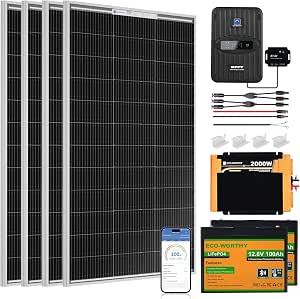
| ECO-WORTHY 1.6KWH Complete Sol | 400 watts | 12 volts |
| 200 Watt Solar Panel Kit | 200W | — |
| ECO-WORTHY 400 Watt 12 Volt Pr | — | — |
| ECO WORTHY 10kW Off-Grid Solar | — | 120V/240V |
| SOLPERK 50W 12V Solar Panel Ki | 50W | 12V |
More Details on Our Top Picks
SOLPERK 100W 12V Solar Battery Charger Waterproof Solar Battery Maintainer
For buyers who need to keep a 12V battery topped up while a vehicle or boat sits unused, this SOLPERK kit is a more portable, maintenance-focused choice than the larger ECO-WORTHY 200W kit. Its 100W output suits trickle charging better than running several appliances, while the included MPPT controller manages charging without requiring a separate controller purchase. Pre-drilled mounting holes and plug-and-play cables simplify setup on an RV, trailer, or boat, though the panel still needs secure placement and correct wiring. The listed 30% conversion efficiency is a claimed spec, not a guarantee of real-world output; sunlight and panel angle still affect charging. I would choose it for battery upkeep and skip it if I needed meaningful off-grid household power.
Pros:- MPPT charge controller is included for battery charging
- Pre-drilled holes and plug-and-play cables simplify installation
- 100W output is suited to maintaining compatible 12V batteries
- Monocrystalline silicon and tempered-glass construction
Cons:- 100W output is limited for substantial appliance use or large battery banks
- Mounting and wiring still require care for a dependable installation
- Charging performance depends on available sunlight and panel placement
Best for: RV, trailer, and boat owners who want a relatively compact kit to maintain a 12V battery during storage
Not ideal for: Campers seeking enough output to run multiple appliances or build a larger off-grid power system
- Maximum power:100W
- Output voltage:12V
- Maximum voltage:20V
- Listed efficiency:30%
- Number of cells:54
- Controller:SOLPERK MPPT charge controller
- Materials:Monocrystalline silicon, tempered glass, aluminum, polymer backsheet
Our verdict“Choose this SOLPERK for portable 12V battery maintenance, not for the higher daily energy needs better served by the ECO-WORTHY 200W kit.”
ECO-WORTHY 200W 12V/24V Monocrystalline Solar Panel Kit with PWM Charge Controller for RV and Off-Grid Applications
This ECO-WORTHY kit earns its place for buyers who want a ready-to-mount system with more usable capacity than a battery maintainer. It bundles two 100W panels, a 30A PWM controller, brackets, cables, and connectors, so there are fewer separate pieces to source than with the Renogy 100W starter kit. Its 12V/24V flexibility also gives RV owners more wiring options as their setup changes. The tradeoff is weight: at 31.6 pounds for the listed kit, installation can take more effort than mounting the single-panel SOLPERK 100W. And although 200W is a practical step up for modest off-grid needs, it is not a substitute for a larger system when power demands grow. The controller is PWM rather than MPPT, a simpler approach than the controller included with the 400W Renogy kit.
Pros:- Two 100W panels provide more capacity than the 100W starter and maintainer kits
- Includes PWM controller, brackets, cables, and connectors
- Supports 12V and 24V configurations with series or parallel connections
- Aluminum alloy frame and stated snow and wind load capacities
Cons:- Listed kit weight of 31.6 pounds makes handling and installation less convenient
- PWM controller is less advanced than the MPPT controller in the Renogy 400W kit
- 200W may not meet high-demand off-grid power needs
Best for: RV and camper owners who want a bundled 200W setup, mounting hardware, and the option to wire for 12V or 24V
Not ideal for: Buyers who need a lightweight portable panel or enough capacity for sustained high-demand appliance use
- System voltage:12V/24V
- Panel efficiency:21.5%
- Maximum voltage:27.4V
- Amperage capacity:11A
- Charge controller:30A PWM
- Kit weight:31.6 lb
- Included components:Two panels, charge controller, mounting brackets, cables, connectors
Our verdict“Pick this ECO-WORTHY kit for a bundled, moderately sized RV system with flexible wiring, but choose a lighter maintainer for storage charging or a larger kit for heavier loads.”
Renogy 400W Premium Solar Kit with 40A MPPT Charge Controller
Among these five, this Renogy kit is the clearest choice for buyers who need more than battery maintenance or occasional charging: four 100W panels provide a stated 400W total, paired with a 40A MPPT controller. That makes it a stronger fit for a fixed RV or off-grid installation than the two-panel ECO-WORTHY 200W kit, which offers half the stated panel capacity and a PWM controller. Renogy also includes Bluetooth monitoring, Z-brackets, cables, and an adaptor kit, helping buyers track system information and assemble the listed setup. Those gains come with a real portability cost: the kit weighs 56.4 pounds, and its listed configuration is 12V only. I would skip it for a vehicle battery that only needs a small maintainer; the SOLPERK 100W is a more compact match for that job.
Pros:- Four 100W panels provide substantially more capacity than the 100W and 200W kits
- 40A MPPT controller is included
- Bluetooth module supports remote system monitoring
- Includes Z-brackets, cables, adaptor kit, and a five-year panel warranty
Cons:- 56.4-pound listed weight makes transport and installation more demanding
- Designed for a 12V system rather than higher-voltage configurations
- Larger panel array is excessive for simple battery maintenance
Best for: RV owners and off-grid users building a 12V system who need more panel capacity and want Bluetooth monitoring
Not ideal for: Buyers who prioritize a portable, light setup, need a higher-voltage system, or only want to maintain a small battery
- Total panel capacity:400W (four 100W panels)
- System output voltage:12V
- Charge controller:40A MPPT
- Maximum battery voltage:32V
- Kit weight:56.4 lb
- Included components:Four panels, controller, Bluetooth module, Z-brackets, cables, adaptor kit
- Panel warranty:5 years for material and workmanship
Our verdict“Choose the Renogy 400W kit for a more capable fixed 12V off-grid setup, not when portability or simple battery upkeep is the main goal.”
Renogy 100W 12V Monocrystalline Solar Panel Starter Kit with 30A PWM Controller
This Renogy starter kit suits buyers who want a familiar 100W starting point with a path to a larger array. Its 30A PWM controller and listed support for expansion up to 400W give it more growth potential than the SOLPERK 100W battery maintainer, which is framed around trickle charging. The panel’s stated 22.5% efficiency and 14.1-pound weight make it a manageable choice for an RV or camper roof, though it is not a portable folding kit. Renogy also lists Bluetooth monitoring and long panel-output coverage, but buyers should check what additional components their intended system needs: the description says the kit may require parts for a full setup. Compared with the ECO-WORTHY 200W bundle, this has less starting capacity and a PWM controller, but it asks less of the buyer in panel handling.
Pros:- 100W monocrystalline panel with listed 22.5% efficiency
- 30A PWM controller is included
- Expansion is listed up to 400W
- Panel warranty includes 10 years for materials and workmanship and 25 years for power output
Cons:- Additional components may be needed for a complete system
- Single 100W panel offers less capacity than the ECO-WORTHY 200W kit
- Limited to 12V systems and depends on suitable sunlight for output
Best for: RV and camper owners starting with a 12V system who want a single panel and the option to expand later
Not ideal for: Buyers who need a complete higher-output system out of the box or want a lightweight panel to carry between locations
- Maximum power:100W
- Output voltage:12V
- Panel efficiency:22.5%
- Controller:30A PWM
- Panel dimensions:43.58 × 22.72 × 2.95 in
- Panel weight:14.1 lb
- Expansion capacity:Up to 400W
- Warranty:10 years panel materials and workmanship; 2 years controller; 25 years power output
Our verdict“Choose this Renogy starter kit if you want a 12V foundation that can expand, but select the ECO-WORTHY 200W kit for more capacity and bundled mounting accessories from the start.”
Voltset 50W 12V Solar Panel Battery Charger Trickle Maintainer Kit
When the job is simply keeping a compatible 12V battery topped up, the Voltset’s 50W output and 8-pound listed weight make it a more compact alternative to the SOLPERK 100W maintainer. Its smart three-stage charging and LED indicators give owners a way to check charging status, while compatibility with lithium, AGM, and lead-acid batteries broadens its use across vehicles and equipment. That versatility does not change the basic limit: 50W is for maintenance, not supplying substantial appliance loads or charging a large battery bank quickly. The kit also lacks included mounting hardware, so buyers must plan their own secure installation. Compared with the ECO-WORTHY 200W kit, this is easier to match to a small battery-maintenance task but far less suited to powering an RV off-grid.
Pros:- Compact 50W output is suited to battery maintenance
- Three-stage charging with LED status indicators
- Compatible with lithium, AGM, and lead-acid 12V batteries
- Weather-resistant construction using monocrystalline cells, aluminum, and tempered glass
Cons:- No mounting hardware is included
- 50W output is too limited for substantial off-grid loads or large battery banks
- Best performance depends on direct sunlight
Best for: Owners of vehicles, boats, or equipment with compatible 12V batteries who want a smaller outdoor maintenance charger
Not ideal for: RV users looking to run appliances, charge a large battery bank, or install a kit with mounting hardware included
- Maximum power:50W
- Output voltage:12V
- Listed efficiency:30%
- Amperage capacity:10A
- Dimensions:14.6 × 12.8 × 1.7 in
- Weight:8 lb
- Compatible battery types:Lithium, AGM, lead-acid
- Charging features:Three-stage charging with LED indicators
Our verdict“Choose the Voltset for compact 12V battery upkeep across several battery types, but pick the SOLPERK 100W or ECO-WORTHY 200W kit when you need more charging capacity.”
SOLPERK 20W Solar Panel Kit with MPPT Controller and Mounting Bracket
I’d choose this kit when compact size and an adjustable mount matter more than generating substantial power. Its 20W monocrystalline panel and smart MPPT controller are aimed at maintaining a 12V battery, making it a fit for a parked motorcycle, boat, or vehicle with modest standby drain. Compared with the ECO-WORTHY 25W Trickle Maintainer, it supplies slightly less rated power but weighs less and lists an adjustable bracket, which can help when fitting a small, angled mounting spot. The tradeoff is its narrow role: 20W is for trickle charging, not running appliances or quickly replenishing a depleted battery. I’d also check the panel dimensions against the intended location, since a compact kit cannot serve as a substitute for a larger portable power setup.
Pros:- Smart MPPT controller is included for 12V battery charging.
- Adjustable mounting bracket supports varied installation angles.
- Waterproof construction suits outdoor vehicle and marine settings.
- Three-pound listed weight makes it lighter than the 25W ECO-WORTHY kit.
Cons:- 20W output is limited to maintenance and other small charging needs.
- Small panel may need to be supplemented for larger batteries or extended cloudy periods.
Best for: Vehicle, motorcycle, or small-boat owners who want a compact 12V battery maintainer with an adjustable mounting bracket.
Not ideal for: RV owners or off-grid users who need meaningful daily power, faster recovery of a depleted battery, or appliance charging.
- Maximum power:20 watts
- Output voltage:12 volts
- Maximum voltage:12 volts
- Amperage capacity:8 A
- Panel material:Monocrystalline silicon
- Dimensions:7 × 4 × 3 inches
- Weight:3 pounds
- Included equipment:Smart MPPT controller and adjustable mounting bracket
Our verdict“Choose this compact kit for maintaining a small 12V vehicle or marine battery, but pick a higher-output panel for broader power needs.”
100W Solar Panel Kit 12V Battery Maintainer
This 100W monocrystalline kit offers a useful step up from the small maintainers in this roundup: its rated output is five times the SOLPERK 20W kit, making it better suited to regular charging for an RV or boat battery. The included smart controller, LCD display, USB ports, and installation accessories give buyers more functionality than a bare panel, while the 11-pound aluminum-and-glass build is intended for outdoor use. Its listed 5.19A capacity still makes it a 12V-focused option, not a substitute for the larger ECO-WORTHY 400W complete system when a buyer needs substantial off-grid supply and storage. Setup may take some electrical know-how, and the panel’s stated dimensions and weight make it less convenient to move frequently than the compact kits. The two-year warranty is a useful listed support detail.
Pros:- 100W output provides substantially more charging capacity than the 20W and 25W maintainer kits.
- Smart charge controller includes an LCD display and USB ports.
- Aluminum, monocrystalline silicon, and tempered-glass construction is suited to outdoor installation.
- Includes installation accessories and lists a two-year warranty.
Cons:- Limited to 12V battery systems.
- At 11 pounds, it is less convenient to reposition or carry than smaller kits.
- Installation and controller setup may require technical knowledge.
Best for: RV and boat owners seeking a 100W panel kit for maintaining or charging a 12V battery, with a controller and installation accessories included.
Not ideal for: Buyers who need a lightweight panel to carry often, a system for non-12V batteries, or a complete setup with battery storage and inverter.
- Maximum power:100 watts
- Output voltage:12 volts
- Maximum voltage:19.28 volts
- Amperage capacity:5.19 A
- Efficiency:A++
- Dimensions:20.1 × 1 × 39.8 inches
- Weight:11 pounds
- Materials:Aluminum, monocrystalline silicon, and tempered glass
- Warranty:2 years
Our verdict“Pick this kit for a fixed or semi-permanent 12V RV or boat setup when 100W is enough and you do not need included battery storage.”
ECO-WORTHY 25W 12V Solar Panel Battery Charger Trickle Maintainer Kit
I’d put this kit ahead of the SOLPERK 20W for buyers who want a little more panel output and an all-in-one set of basic connection hardware. Its 25W monocrystalline panel is rated for up to 23% efficiency, and the package lists a waterproof controller, alligator clips, and mounting hardware—practical details for someone maintaining a trailer, boat, or RV battery without assembling separate parts. That extra five watts over the SOLPERK is a modest gain, not a leap into appliance power; both are small-battery maintainers, not full off-grid systems. At 2.34 kg, it is also heavier than the SOLPERK’s listed three pounds, so it is not the clearest choice for frequent carrying. Buyers need to mount it well for useful exposure, and no battery storage is included.
Pros:- 25W output is a small step above the SOLPERK 20W maintainer.
- Includes a waterproof controller, alligator clips, and mounting hardware.
- Monocrystalline panel is specified at up to 23% efficiency.
- Weather-resistant construction suits outdoor battery maintenance.
Cons:- 25W output remains limited to small-battery maintenance.
- Listed weight of 2.34 kg makes it heavier than the SOLPERK 20W kit.
- Panel requires suitable mounting and sunlight; no battery storage is included.
Best for: First-time solar users maintaining a small 12V battery in a trailer, boat, or RV who want the controller and connection hardware in one kit.
Not ideal for: People seeking a truly lightweight portable panel, substantial charging output, or a kit with battery storage included.
- Maximum power:25 watts
- Output voltage:12 volts
- Panel efficiency:Up to 23%
- Weight:2.34 kg
- Materials:Aluminum, monocrystalline silicon, and tempered glass
- Included components:Solar panel, waterproof controller, alligator clips, and mounting hardware
Our verdict“Choose this kit for straightforward 12V trickle maintenance with included connection hardware, not for portable high-output charging.”
12V Solar Battery Charger Maintainer 20W Solar Panel Kit
This kit is a practical pick when extension cables and pre-drilled mounting holes matter more than maximizing output. Its 20W panel, 10A PWM controller, and included cables let a buyer separate the panel from the battery location, which can help when a vehicle or boat battery sits in a shaded compartment. Against the SOLPERK 20W kit, this model lists a larger 16 × 13.1-inch panel and a 10A PWM controller, while SOLPERK offers an MPPT controller and adjustable bracket. Neither is suited to substantial loads; the 20W rating confines this to small-scale 12V battery maintenance. The listed output voltage is 18V, so buyers should follow the controller and wiring instructions rather than treat the panel as a direct 12V battery connection. Its 12-month warranty is also shorter than the 100W kit’s stated coverage.
Pros:- Includes a 10A PWM charge controller and extension cables.
- Pre-drilled holes simplify fixed mounting.
- Corrosion-proof aluminum frame is suited to outdoor use.
- Larger listed panel dimensions than the SOLPERK 20W kit.
Cons:- 20W output is intended for small-scale charging and maintenance.
- Uses a PWM controller rather than the MPPT controller included with the SOLPERK 20W kit.
- Lists a 12-month warranty and requires attention to controller and wiring setup.
Best for: Boat, RV, and vehicle owners who need extension cables to place a small solar panel in sun while keeping the battery elsewhere.
Not ideal for: Buyers who want higher charging output, an MPPT controller, or a portable kit with a compact panel and adjustable bracket.
- Maximum power:20 watts
- Output voltage:18 volts
- Maximum voltage:12 volts
- Amperage capacity:1.11 A
- Cell count:40
- Dimensions:16 × 13.1 × 0.8 inches
- Weight:3.8 pounds
- Controller:10A PWM charge controller
- Warranty:12 months
Our verdict“Choose this 20W kit when cable reach and fixed mounting suit your setup better than MPPT control or higher output.”
ECO-WORTHY 1.6KWH Complete Solar Panel Kit 400W 12V for RV Off Grid
Unlike the battery-maintainer kits above, this 400W system includes energy storage and conversion: two 12V 100Ah lithium batteries, a 40A MPPT controller, and a 2000W pure sine wave inverter. That makes it the clearest choice here for an RV, cabin, or shed where the goal is to power equipment, not just keep a battery topped up. Its bifacial panels list 23% efficiency, and the stated daily output is 1.6kWh, though actual generation depends on sunlight and installation. Compared with the 100W 12V Maintainer, this ECO-WORTHY package offers much more system capacity but also brings a more involved installation and a higher upfront commitment. It is not a lightweight portable kit: buyers must plan for mounting, wiring, battery placement, and the space needed for the full setup.
Pros:- 400W panel capacity is far beyond the 20W–100W maintainer kits in this group.
- Includes two 12V 100Ah lithium batteries for energy storage.
- 40A MPPT controller and 2000W pure sine wave inverter are included.
- Bifacial panels list 23% efficiency and are built with aluminum and tempered glass.
Cons:- Installation and system wiring may require technical knowledge.
- Performance depends on available sunlight and installation conditions.
- Its full-system size and setup make it unsuitable for buyers prioritizing portability or simple battery maintenance.
Best for: RV owners, cabin users, and shed operators who need a bundled 12V system with panels, lithium storage, an MPPT controller, and an inverter.
Not ideal for: Buyers seeking a small portable battery maintainer, a simple plug-and-play panel, or a low-complexity setup for occasional trickle charging.
- Maximum power:400 watts
- Stated daily output:1.6 kWh
- Output voltage:12 volts
- Panel efficiency:23%
- Battery type:Lithium
- Battery capacity:2 × 12V 100Ah
- Controller:40A MPPT
- Inverter:2000W pure sine wave
- Panel dimensions:35.63 × 23.03 × 1.18 inches
Our verdict“Choose this complete ECO-WORTHY system for an RV or small off-grid site needing generation, storage, and AC conversion, not for portable trickle charging.”
200 Watt Solar Panel Kit, 200W N-Type Solar Panels with 25% Efficiency
I’d place this kit between small battery maintainers and larger fixed installations: its 200W output gives campers and boat owners more charging capacity than the SOLPERK 50W kit, without the four-panel footprint and weight of the ECO-WORTHY 400W kit. The 25% stated conversion efficiency is a useful fit where panel space is limited, while the included 30A controller, cables, and mounting brackets reduce the need to source core parts separately. At 20.4 pounds, it is a more manageable portable option than the 400W ECO-WORTHY system, though it still needs a secure mounting location. Its stated generation figure depends on optimal sunlight, and the system’s three-panel connection limit makes it less suited to buyers planning a large expansion. I’d also account for cleaning and controller capacity when setting it up.
Pros:- 200W capacity offers more charging potential than the 50W SOLPERK kit while remaining smaller than a 400W array.
- Includes a 30A charge controller, cables, and mounting brackets.
- N-type panels are specified at 25% conversion efficiency.
- 20.4-pound listed weight is more manageable for portable use than the 400W ECO-WORTHY kit.
Cons:- Connection options are limited to a maximum of three panels in parallel or series.
- The controller can overheat if current capacity is exceeded.
- Panel performance benefits from regular cleaning and maintenance.
Best for: Camper and boat owners who want a portable 200W setup with the controller and basic mounting hardware included.
Not ideal for: Households planning a high-output off-grid system or buyers who need a kit designed for expansion beyond three panels.
- Maximum power:200W
- Panel type:N-type
- Stated conversion efficiency:25%
- Number of cells:60
- Charge controller:30A
- Item weight:20.4 lb
- Included accessories:Solar cables and mounting brackets
- Panel connection limit:Up to 3 panels
Our verdict“Choose this kit for portable camper or boat power when 200W and included accessories suit your setup better than a small maintainer or a heavier 400W array.”
ECO-WORTHY 400 Watt 12 Volt Premium Solar Panel Kit: 4pcs 100W Solar Panel, 40A MPPT Charge Controller, Bluetooth Module, Mounting Z Brackets, Off-Grid System for Home, RV, Boat
This ECO-WORTHY kit is the lineup’s more substantial choice for buyers building around a 12V battery system. Four 100W monocrystalline panels and a 40A MPPT controller provide twice the panel capacity of the 200W N-type kit, while Bluetooth monitoring lets owners check system information without relying only on controller indicators. Pre-drilled panels and included Z brackets can simplify mounting, but this is not a lightweight portable bundle: its listed weight is about 159 pounds, so installation calls for sturdy support and planning. Compared with the Renogy 400W kit named elsewhere in this roundup, this model’s distinguishing feature is the included Bluetooth module; the supplied data doesn’t establish a direct performance advantage. The 12V design also narrows its fit: it suits compatible RV, boat, or small off-grid systems, not higher-voltage installations.
Pros:- Four 100W monocrystalline panels provide 400W of listed solar capacity.
- 40A MPPT controller and Bluetooth module are included.
- Pre-drilled panels and Z brackets support a more straightforward mounting process.
- Aluminum frames and low-iron glass are specified for outdoor use.
Cons:- At about 159 pounds, the complete kit is heavy and needs robust mounting support.
- Its 12V configuration is unsuitable for systems requiring a higher system voltage.
- Four panels take more installation space than the 200W N-type kit.
Best for: RV, boat, and small off-grid system owners with a compatible 12V battery setup, sturdy mounting points, and interest in Bluetooth monitoring.
Not ideal for: Buyers seeking a lightweight portable kit or designing a higher-voltage system that cannot use a 12V configuration.
- Total panel power:400W
- System voltage:12V
- Panel configuration:4 × 100W
- Panel efficiency:21%
- Charge controller:40A MPPT
- Panel dimensions:35.2 × 23 × 1.37 in each
- Listed weight:Approximately 159 lb
- Monitoring:Bluetooth module included
Our verdict“Pick this for a fixed, compatible 12V RV, boat, or off-grid installation where 400W capacity and Bluetooth monitoring matter more than portability.”
ECO WORTHY 10kW Off-Grid Solar Panel Kit for Home with 48V 314Ah Battery and 10kW Inverter
This is a different scale of purchase from the portable kits: the ECO WORTHY system pairs a 48V, 16.1kWh battery with a 10,000W continuous inverter for substantial off-grid household use. Its battery storage and 120V/240V output make it more capable for home loads than the ECO-WORTHY 400W 12V kit, which is better matched to RVs and smaller systems. But the supplied figures need careful reading: the five 590W panels total 2,950W of listed panel power, not 10kW of solar generation. The 10kW figure describes inverter output, so buyers should not assume the array can supply that much power continuously from sunlight. This is also neither portable nor a simple starter kit; large components and professional installation make it a major project for homeowners with suitable space and electrical support.
Pros:- Includes a 48V LiFePO₄ battery with 16.1kWh listed capacity.
- 10,000W continuous pure sine wave inverter supports substantial household loads.
- 120V/240V output is suited to a broader range of home appliances than a 12V kit.
- Battery system is described as scalable with parallel battery units.
Cons:- The five 590W panels total 2,950W, well below the inverter’s 10kW continuous rating.
- Professional expertise is needed for installation and system integration.
- Large, heavy components make delivery, placement, and setup difficult for a typical portable-kit buyer.
Best for: Homeowners planning a professionally installed off-grid system who need 48V battery storage and 120V/240V inverter output.
Not ideal for: Campers, renters, and buyers seeking a portable starter kit, or anyone expecting 10kW of solar panel capacity from the included array.
- Listed maximum solar panel power:2,950W
- Solar panel configuration:5 × 590W
- Battery capacity:16.1kWh
- Battery voltage:48V
- Battery chemistry:LiFePO₄
- Inverter output:10,000W continuous; 20,000W peak
- Output voltage:120V/240V
- Panel material:Monocrystalline silicon, tempered glass, polymer, and aluminum
Our verdict“Choose this only for a planned, professionally installed off-grid home system; for RV or portable use, the ECO-WORTHY 400W kit is a far more fitting scale.”
SOLPERK 50W 12V Solar Panel Kit with Waterproof Controller and Adjustable Mount
The SOLPERK 50W is the compact end of this roundup: it is made for maintaining a compatible 12V battery, not powering a household or replacing a larger RV array. Its waterproof charge controller and adjustable mount help owners set up a small outdoor panel for a vehicle, boat, or similar battery, while the corrosion-resistant construction is a practical advantage where the equipment faces weather. Compared with the 200W N-type kit, this provides far less charging capacity but asks for a smaller installation and is a better fit for modest maintenance needs. It also gives up the higher output of the SOLPERK 100W maintainer in the wider lineup. The 50W limit is the defining tradeoff: buyers should treat it as a trickle-maintenance option, not a solution for substantial daily energy use.
Pros:- Compact 50W output suits battery maintenance rather than large power loads.
- Includes a waterproof charge controller with overcharge protection.
- Adjustable mounting bracket helps set the panel angle.
- Waterproof and corrosion-resistant construction is intended for outdoor conditions.
Cons:- 50W output is too limited for substantial household or RV energy needs.
- Installation may require some technical knowledge.
- Provides less capacity than the SOLPERK 100W maintainer and the 200W N-type kit.
Best for: Owners of cars, boats, or other 12V equipment who want a compact outdoor panel for maintaining a battery.
Not ideal for: RV owners running multiple appliances or households needing meaningful daily power, since 50W is limited compared with the 200W and 400W kits.
- Maximum power:50W
- Maximum voltage:12V
- Output voltage:12V
- Panel material:Monocrystalline silicon
- Dimensions:21.3 × 21.3 × 4.45 in
- Charge controller:Waterproof, with overcharge protection
- Mount:Adjustable bracket
- Listed lifespan:Up to 25 years
Our verdict“Choose this compact SOLPERK kit for maintaining a 12V vehicle or boat battery; step up to a higher-wattage option if you need to run loads.”

How We Picked
I compared these kits by their intended job rather than treating panel wattage as the only measure of value. The ranking favors useful balance: meaningful output for the stated application, a suitable charge controller where included, practical mounting or system components, and a clear fit for portable, RV, battery-maintenance, or off-grid use. I also weighed setup complexity and the chance that a buyer would need extra components before the kit could serve its purpose.
That logic puts the Renogy 400W Premium kit first for its blend of capacity and MPPT control, while smaller maintainers rank better for narrow battery-upkeep tasks than for general power. The ECO-WORTHY 400W MPPT kit and the complete 1.6kWh kit offer alternatives for buyers prioritizing included equipment or a more defined system package. The 10kW system is reserved for a specific whole-system need rather than ranked as a portable bargain. Product names and stated specifications guide this comparison; buyers should confirm package contents, electrical compatibility, and installation requirements before purchasing.
Factors to Consider When Choosing Affordable Solar Panel Kits
Before choosing among affordable solar panel kits, I would start with the job the system must do. A panel that maintains a parked vehicle battery and a kit intended to run an RV’s daily loads are not competing solutions, even if both use 12V components. These broader checks can prevent a low-cost bundle from turning into an incomplete or mismatched system.
Match Panel Output to the Job
Use the wattage as a starting point, not a promise of daily energy. A 20W or 25W panel is generally aimed at maintaining a battery or supporting small charging needs, while 100W and 200W kits offer more room for regular use. A 400W array is a more plausible starting point for broader RV or off-grid loads, but actual production changes with sunlight, angle, shade, and season. List the devices you intend to run and how many hours they operate before selecting a kit. If your needs include appliances with high startup or continuous draw, a small maintainer will not become suitable just because it has a controller. Leave some headroom for cloudy conditions and future needs rather than sizing exactly to a best-case estimate.
Check the Battery and Controller Match
A bundled controller can simplify setup, but it still has to suit the battery bank and array. Confirm whether the kit supports your battery’s voltage and chemistry, and check the controller’s current limit against the panel configuration. MPPT controllers can make better use of panel voltage differences than basic PWM designs in many installations, but that does not remove the need for correct wiring and settings. Do not assume that a kit described as 12V/24V automatically supports every battery arrangement. For an existing battery, verify its charging specifications before connecting panels. If the bundle leaves out a compatible battery or wiring, include those items in your system plan.
Choose Portability With Setup in Mind
Portable suitability depends on more than a product being small enough to carry. Think about panel size, mounting hardware, cable reach, and whether you can place the panel in direct sun while keeping the battery in a protected spot. Adjustable brackets can help with positioning, while multi-panel 400W kits usually call for a more fixed installation area and additional setup time. For frequent travel, a system that is easy to store and reconnect may be more useful than extra wattage that stays at home. Check the packed dimensions and included mounting parts rather than relying on wattage alone. Avoid placing panels where shade from a vehicle, roof feature, or nearby tree will cut output for much of the day.
Separate a Kit From a Complete Power System
The word “kit” can describe anything from a panel and maintainer to a package with an inverter, battery, and controller. Before buying, write down which components are included and which you still need, including a battery, inverter, fuse protection, cables, and mounting hardware. The ECO-WORTHY 1.6kWh and 10kW packages are more system-oriented than compact maintainers, but their scale and installation needs differ sharply. A panel kit without storage cannot supply power after sunset unless it connects to a suitable battery or another power source. Buyers can avoid false savings by comparing the full system bill of materials, not just the panel count. For a permanent installation, plan for safe wiring and professional help if the electrical work exceeds your skills.
Decide When More Capacity Is Worth the Added Complexity
Paying for a larger array makes sense when your measured energy use justifies it, not simply because a higher wattage sounds more capable. More panels can reduce charging time and support larger loads, but they also take more space and may require a higher-capacity controller, heavier wiring, and more careful installation. A 100W starter kit is easier to approach for modest needs, whereas 400W options better suit buyers who already know they need a wider energy supply. At the other end, a 10kW off-grid package should be treated as a major system project rather than an inexpensive portable upgrade. Make a load estimate and compare it with available sun and battery storage before stepping up. If your use is occasional, a smaller system may serve better than maintaining equipment sized for rare peak demand.
Frequently Asked Questions
Can a 20W or 25W solar kit run an RV refrigerator?
These compact kits are presented as battery chargers or maintainers, not as systems for running an RV refrigerator. A refrigerator can draw power repeatedly through the day and may have a startup surge, so its energy use can exceed what a small panel can replace. Check the refrigerator’s daily watt-hours and the battery capacity, then size the array to replenish that use under your local sunlight conditions. A small maintainer may still help keep a parked battery topped up when loads are minimal. For regular refrigerator use, consider a larger array and suitable storage rather than relying on a trickle-maintenance kit.
Is an MPPT kit always worth choosing over a PWM kit?
Not automatically: the better choice depends on the panel arrangement, battery, expected operating conditions, and system size. MPPT controllers can make more effective use of panel voltage and are commonly paired with larger kits in this lineup, such as the 400W options. A small battery maintainer may not gain enough practical benefit to justify a more capable controller. Compare the controller’s supported battery types, input limits, and setup requirements instead of choosing by acronym alone. If a kit’s controller is not compatible with your battery, its panel wattage will not solve the mismatch.
What should I buy if I want solar for occasional portable use?
Start by defining what you mean by portable: carrying a panel between locations, charging a parked vehicle, or supporting an RV while traveling. For light battery upkeep, a compact 20W to 50W kit may be more manageable than a 400W multi-panel bundle. If you want to power devices during trips, estimate their daily energy use and check whether the kit includes or can connect to a suitable battery and controller. An adjustable mount can help you place a panel in better sun, but it does not add storage capacity. Confirm the panel’s packed size and mounting method before choosing it for frequent transport.
Does a 400W kit include everything I need to power an off-grid setup?
Not necessarily. The two 400W kits in this roundup differ in their listed components, and even a package with panels, controller, and brackets may not include the battery, inverter, wiring, or protection devices your setup needs. First identify whether your appliances require AC power, which calls for a compatible inverter, and how much energy must be stored for use after dark. Check the controller’s limits against the panel array and battery bank. Treat “kit” as a bundle description, then verify each component in the package list before planning installation.
Should I choose a 400W kit or the 10kW off-grid package?
These are not close substitutes: the 400W kits are smaller solar packages suited to RV or modest off-grid applications, while the 10kW package includes a large battery and inverter for a much broader system plan. Choose based on your expected daily energy use, peak power demand, installation space, and whether you need a permanent home setup. A larger package can be excessive for occasional travel or battery maintenance, and it brings greater installation and electrical planning needs. A 400W kit may also fall short if you expect it to support substantial household loads without a careful energy calculation. Compare total system requirements, not panel wattage alone.
What are the best affordable solar panels?
The best affordable solar panels depend on how you plan to use them, how much power you need, and whether you want a portable setup or a more permanent one. The picks above offer options to compare for different needs, so consider each kit’s intended use, included components, and setup requirements before choosing. Check that the panel system suits your location and the devices or appliances you want to power. This can help narrow down affordable solar panels that fit your plans without paying for features you do not need.
Conclusion
For most buyers seeking one flexible starting point, I recommend the Renogy 400W Premium Solar Kit as the best overall choice, particularly for RV or off-grid plans that can use its capacity and MPPT controller. The best value depends on the job: choose a compact SOLPERK 50W kit for modest portable battery upkeep, or the Renogy 100W Starter Kit if you want a more approachable panel setup. For beginners, the Renogy 100W kit is the simpler scale to learn with before planning a larger array. Buyers seeking a premium, more system-oriented package should compare the ECO-WORTHY 400W MPPT kit with the Renogy 400W bundle by checking included parts and battery fit. For a full off-grid project, the ECO-WORTHY 10kW system is the specific-use pick; for basic battery maintenance, skip the large systems and choose a small maintainer matched to your battery.