A digital piano with weighted keys can make home practice feel closer to playing an acoustic piano, but the right choice depends on more than key weight alone. I’d put the Yamaha Arius YDP-105R first for a home setup that benefits from a built-in stand and bench, while the Yamaha P-145BT stands out for Bluetooth and the Donner DEP-20 for an all-in-one portable-style package. The main tradeoffs are furniture-style stability versus easier relocation, and straightforward piano practice versus extra sounds and connections. Compare the full list below to see which model’s action, setup, and features best match your space and playing plans.

Get audio and creator gear delivered free with Prime
- Fast, free delivery on millions of items
- Prime Video, Amazon Music and more included
- Member-only deals all year
Complete the kit



Key Takeaways
- Furniture-style models lead for a settled practice space: the Yamaha Arius YDP-105R and YDP-105 include a bench and upright cabinet-style setup, unlike portable options that need separate support.
- Portable bundles differ in what they include: the Donner DEP-20 listing with stand and three-pedal unit is more complete as a setup than the DEP-20 listing without those accessories.
- Bluetooth is a distinct convenience, not a substitute for piano feel: the Yamaha P-145BT adds wireless connectivity, while buyers should still compare key action and playing needs first.
- Weighted keys appear across very different designs: compact portable models, desk-style instruments, and full upright-style pianos all target different room and setup constraints.
- Extra features change the intended use: the Yamaha DGX-670B’s broader feature set suits players seeking more than basic piano practice, while simpler models keep the focus on playing.
| Yamaha Arius YDP-105R 88-Key Weighted Upright Digital Piano with Bench, Dark Rosewood |  | Best Upright Setup for Traditional Practice | Keys: 88 | Keyboard action: Graded Hammer Standard weighted keys with touch response | Voices: 10 | VIEW ON AMAZON | See Our Full Breakdown |
| Donner DEP-20 88-Key Weighted Digital Piano with Stand and 3-Pedal Unit | 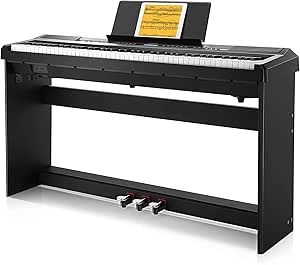 | Best for Features and Sound Variety | Keys: 88 | Key action: Full-size hammer action with adjustable touch response | Tones: 238 | VIEW ON AMAZON | See Our Full Breakdown |
| Yamaha Arius 88-Key Weighted Digital Piano (YDP-146B) with Bench and 3 Pedals – Full‑Size Upright Black |  | Best for Wireless App Connectivity | Keys: 88 | Action: Graded Hammer Standard weighted keys | Voices: CFX Grand Piano plus 9 other instruments | VIEW ON AMAZON | See Our Full Breakdown |
| KUMENG KU-1181 88-Key Weighted Digital Piano with Desk |  | Best Multi-Use Furniture Design | Keys: 88 full-size weighted hammer-action keys | Tones: 800 | Polyphony: 128 notes | VIEW ON AMAZON | See Our Full Breakdown |
| Yamaha P-143 Digital Piano Bundle with Stand and Bench |  | Best Compact Weighted-Key Bundle | Keys: 88 | Key type: Weighted and touch-sensitive | Weight: 25 pounds | VIEW ON AMAZON | See Our Full Breakdown |
| UISCOM 88-Key Weighted Digital Piano with Wooden Desk Design and Triple Pedals |  | Best for a Furniture-Style Setup | Keys: 88 | Key action: Weighted hammer action | Instrument voices: 8 | VIEW ON AMAZON | See Our Full Breakdown |
| Donner DEP-20 88-Key Weighted Digital Piano |  | Best for Tone Variety | Keys: 88 | Key action: Full-size hammer action with adjustable touch response | Tones: 238 | VIEW ON AMAZON | See Our Full Breakdown |
| Yamaha Arius Series YDP-105 88-Key Weighted Action Upright Digital Piano with Bench – Black |  | Best Upright Piano Setup | Keys: 88 | Key action: Graded hammer standard | Weight: 82.7 pounds | VIEW ON AMAZON | See Our Full Breakdown |
| Yamaha P71 88-Key Weighted Action Digital Piano with Sustain Pedal and Power Supply |  | Best Straightforward Portable Pick | Keys: 88 | Key action: Fully weighted hammer action | Instrument voices: 10 | VIEW ON AMAZON | See Our Full Breakdown |
| Yamaha P-145BT 88-Key Digital Piano with Weighted Keys and Bluetooth |  | Best for Playing Along with Audio | Keys: 88 | Key action: Graded Hammer Compact | Connectivity: Bluetooth | VIEW ON AMAZON | See Our Full Breakdown |
| Donner DDP-95 88-Key Weighted Digital Piano |  | Best for Practice Features | Keys: 88 | Key action: Fully weighted hammer action | Touch sensitivity: 16 levels | VIEW ON AMAZON | See Our Full Breakdown |
| Eastar EUP-100 88-Key Weighted Digital Piano with Three Pedals and Accessories |  | Best Beginner Bundle | Keys: 88 | Key action: Weighted hammer action | Voices: 13 | VIEW ON AMAZON | See Our Full Breakdown |
| Yamaha DGX-670B 88-Key Weighted Digital Piano, Black |  | Best for Versatile Performance | Keys: 88 | Key action: Weighted hammer action | Sound engine: Yamaha CFX stereo sampled sound engine | VIEW ON AMAZON | See Our Full Breakdown |
| digital piano with weighted key | Keys | Connectivity | Weight | Key action |
|---|---|---|---|---|
| Yamaha Arius YDP-105R 88-Key W | 88 | — | 82.7 pounds | — |
| Donner DEP-20 88-Key Weighted | 88 | MIDI, USB, and auxiliary | 24.75 kg | Full-size hammer action with adjustable touch response |
| Yamaha Arius 88-Key Weighted D | 88 | Bluetooth audio and MIDI | — | — |
| KUMENG KU-1181 88-Key Weighted | 88 full-size weighted hammer-action keys | USB and MIDI | 24.49 kg | — |
| Yamaha P-143 Digital Piano Bun | 88 | Bluetooth and USB | 25 pounds | — |
| UISCOM 88-Key Weighted Digital | 88 | USB Type A or Type B; MIDI | — | Weighted hammer action |
| Donner DEP-20 88-Key Weighted | 88 | 6.35 mm jack, auxiliary input/output, and headphone jack | 11.6 kg | Full-size hammer action with adjustable touch response |
| Yamaha Arius Series YDP-105 88 | 88 | 3.5 mm headphone jack and auxiliary input | 82.7 pounds | Graded hammer standard |
| Yamaha P71 88-Key Weighted Act | 88 | USB and auxiliary | 25 pounds | Fully weighted hammer action |
| Yamaha P-145BT 88-Key Digital | 88 | Bluetooth | 24.5 pounds | Graded Hammer Compact |
| Donner DDP-95 88-Key Weighted | 88 | Bluetooth; USB-MIDI | 26.2 kg | Fully weighted hammer action |
| Eastar EUP-100 88-Key Weighted | 88 | USB; wireless; MIDI IN/OUT | 25 kg | Weighted hammer action |
| Yamaha DGX-670B 88-Key Weighte | 88 | Bluetooth; USB | 67.7 pounds | Weighted hammer action |
More Details on Our Top Picks
Yamaha Arius YDP-105R 88-Key Weighted Upright Digital Piano with Bench, Dark Rosewood
The Yamaha Arius YDP-105R makes the most sense for players who want a fixed home instrument with a familiar upright-piano layout. Its 88-key Graded Hammer Standard action gives the lower register a heavier feel than the upper register, supporting technique practice across the keyboard. Unlike the more feature-packed Donner DEP-20, this Yamaha keeps the sound selection modest at 10 voices, but adds a three-pedal unit, bench, and dual headphone jacks for a ready-to-use practice station or shared lessons. Built-in speakers suit everyday playing without extra equipment. The tradeoff is its 82.7-pound weight and corded power: this is a place-and-keep setup, not a piano to move between rooms often. Buyers seeking wireless app connectivity should compare it with the Yamaha YDP-146B instead.
Pros:- 88 weighted keys with graded hammer action
- Three-pedal unit and bench are included
- Dual headphone jacks support quiet practice or lessons for two
- Built-in speakers and 10 instrument voices cover everyday playing
Cons:- At 82.7 pounds, it is difficult to reposition frequently
- Corded power limits where it can be set up
- Its 10-voice selection is narrower than the Donner DEP-20’s 238 tones
Best for: Home learners and families who want an upright-style piano with graded weighted keys, a bench, and three pedals included.
Not ideal for: Players who need a lightweight instrument to move regularly or want Bluetooth connectivity and a larger set of built-in voices.
- Keys:88
- Keyboard action:Graded Hammer Standard weighted keys with touch response
- Voices:10
- Pedals:Three-pedal unit
- Headphone jacks:Dual 3.5 mm
- Included components:Bench and three-pedal unit
- Dimensions:53.44 x 16.63 x 38.13 inches
- Weight:82.7 pounds
Our verdict“Choose the YDP-105R for a traditional, fully equipped home practice station rather than portability or extensive sound options.”
Donner DEP-20 88-Key Weighted Digital Piano with Stand and 3-Pedal Unit
The Donner DEP-20 pairs full-size hammer-action keys with a broad set of tools for players who want more than a basic piano voice. Its adjustable touch response lets beginners tailor how readily notes sound, while 238 tones, dual-tone mode, and 128-note polyphony support experimentation beyond standard piano practice. Compared with the Yamaha Arius YDP-105R, it offers far more sounds and built-in recording and MP3 playback, but gives up the Yamaha’s more traditional upright presentation. Two 25W amplifiers are a useful advantage for room-filling practice without external speakers. The cost of this feature set is a weight of 24.75 kg, so the word “portable” should not be taken to mean easy to carry. Buyers wanting a simpler, lighter bundle may prefer the Yamaha P-143.
Pros:- 88 full-size hammer-action keys with adjustable touch response
- 238 tones and 128-note polyphony allow layered and varied sounds
- Includes a furniture stand and three-pedal unit
- Recording, MP3 playback, MIDI, USB, and two 25W amplifiers add practice options
Cons:- At 24.75 kg, it is cumbersome to move often
- Its broad feature set may be unnecessary for players focused only on piano technique
- The listing gives inconsistent phrasing around some pedal and audio connection details
Best for: Beginner and intermediate players who want weighted keys, many instrument sounds, recording features, and a stand-and-pedal setup for home use.
Not ideal for: Musicians who need a genuinely lightweight piano for frequent transport or who prefer a straightforward acoustic-piano-focused instrument.
- Keys:88
- Key action:Full-size hammer action with adjustable touch response
- Tones:238
- Maximum polyphony:128 notes
- Amplifiers:Two 25W amplifiers
- Connectivity:MIDI, USB, and auxiliary
- Included components:Furniture stand and three-pedal unit
- Weight:24.75 kg
Our verdict“Pick the DEP-20 if sound variety and built-in practice features matter more than easy portability or a traditional upright look.”
Yamaha Arius 88-Key Weighted Digital Piano (YDP-146B) with Bench and 3 Pedals – Full‑Size Upright Black
The Yamaha Arius YDP-146B combines a home-oriented cabinet and graded weighted keys with Bluetooth audio and MIDI, making it the strongest fit here for players who want to connect with apps or stream audio wirelessly. Its CFX concert grand voice, described with damper and string resonance, gives piano-focused practice more character than a feature-first instrument like the Donner DEP-20, whose appeal leans toward a much larger tone library. The YDP-146B includes a bench, three pedals, built-in speakers, and dual headphone jacks, so it is ready for lessons and quiet practice. That upright format comes with a substantial footprint, though, and its 10-voice selection is restrained beside the Donner’s 238 tones. I would choose it for piano practice and connectivity, not for compact rooms or extensive sound exploration.
Pros:- 88-key Graded Hammer Standard weighted action
- Bluetooth audio and MIDI support wireless playback and app connections
- CFX grand piano sound includes damper and string resonance
- Bench, three pedals, built-in speakers, and dual headphone jacks are included
Cons:- Full-size upright dimensions take up substantial room
- Its 10 included voices offer less variety than the Donner DEP-20
- Corded electric power restricts placement
Best for: Home pianists taking app-based lessons or using wireless audio who also want graded keys, a bench, and a three-pedal setup.
Not ideal for: Players with limited floor space or those who want a large library of built-in tones for varied arrangements.
- Keys:88
- Action:Graded Hammer Standard weighted keys
- Voices:CFX Grand Piano plus 9 other instruments
- Connectivity:Bluetooth audio and MIDI
- Headphone jacks:Dual 6.35 mm
- Included components:Bench and three-pedal unit
- Dimensions:56 x 21.35 x 16 inches
- Power source:Corded electric
Our verdict“Choose the YDP-146B if wireless app use and a piano-focused upright setup outweigh a small footprint or a large voice library.”
KUMENG KU-1181 88-Key Weighted Digital Piano with Desk
The KUMENG KU-1181 stands apart through a cabinet that converts into a desk, a practical choice when one room needs to serve more than one purpose. Its 88 weighted hammer-action keys keep the central requirement of this roundup in focus, while 800 tones and 128-note polyphony offer more sound options than the Yamaha Arius YDP-105R’s 10 voices. USB/MIDI, MP3 playback, recording, and split-keyboard functions add ways to practice or share the instrument. The package also includes headphones and a pedal, though it does not specify a three-pedal unit like the Yamaha upright models. At 24.49 kg, it is not a lightweight portable piano, and its wide feature list is less compelling for buyers who mainly want a refined, traditional piano setup. The desk conversion is the reason to choose it over simpler designs.
Pros:- 88 full-size weighted hammer-action keys
- 800 tones and 128-note polyphony support varied sounds and layered playing
- USB/MIDI, MP3 playback, recording, and split-keyboard functions
- Cabinet converts into a desk and the package includes headphones
Cons:- Its 24.49 kg weight makes regular relocation difficult
- The listed package includes a pedal but does not specify a three-pedal unit
- The large tone selection may add little value for players focused on acoustic-piano practice
Best for: Households that need a weighted-key piano and a desk in the same room, and want plenty of built-in tones and practice functions.
Not ideal for: Pianists seeking an upright cabinet with a three-pedal unit, a clearly piano-focused setup, or a piano they can carry easily.
- Keys:88 full-size weighted hammer-action keys
- Tones:800
- Polyphony:128 notes
- Connectivity:USB and MIDI
- Headphone jack:3.5 mm
- Included components:Sheet music stand, pedal, power adapter, headphones, portable legs, and flip key cover
- Dimensions:12.4 x 53 x 30.3 inches
- Weight:24.49 kg
Our verdict“Pick the KU-1181 when its desk-converting cabinet and broad sound selection solve a room or practice need that a standard upright cannot.”
Yamaha P-143 Digital Piano Bundle with Stand and Bench
The Yamaha P-143 is the most compact choice in this group for buyers who still want a full 88-key weighted, touch-sensitive keyboard. At 25 pounds, it is far easier to relocate than the 82.7-pound Yamaha Arius YDP-105R, while its included stand, bench, music rest, and sustain foot switch make it a practical starter setup. Bluetooth and USB connectivity, built-in speakers, and split mode give it useful flexibility for lessons and home practice. The tradeoff is a simpler pedal arrangement: its listed accessory is a sustain foot switch, not the three-pedal unit supplied with the Arius models. It also uses corded power, so compact size does not mean untethered operation. I would choose it for a flexible room setup, while players seeking a more furniture-like piano should look to the Arius models.
Pros:- 88 weighted, touch-sensitive keys in a compact 25-pound design
- Stand, bench, music rest, and sustain foot switch are included
- Bluetooth and USB connectivity support compatible devices and software
- Built-in speakers, multiple voices, and split mode add practice flexibility
Cons:- Includes a sustain foot switch rather than a three-pedal unit
- Requires corded electric power
- Less suited to buyers seeking the substantial upright presentation of the Yamaha Arius models
Best for: Beginners and progressing players who want a full-size weighted keyboard with a stand and bench, but need a more movable setup than an upright cabinet.
Not ideal for: Players who want a permanent upright-style cabinet, a three-pedal unit, or a piano that can operate without corded power.
- Keys:88
- Key type:Weighted and touch-sensitive
- Weight:25 pounds
- Connectivity:Bluetooth and USB
- Headphone jack:3.5 mm
- Special features:Built-in speaker, multiple voices, and split mode
- Included accessories:Stand, bench, music rest, sustain foot switch, and AC adapter
- Power source:Corded electric
Our verdict“Choose the P-143 bundle for a space-saving, easier-to-move weighted-key setup with essential accessories, rather than a full upright cabinet.”
UISCOM 88-Key Weighted Digital Piano with Wooden Desk Design and Triple Pedals
The UISCOM pairs 88-key weighted hammer action with a wooden desk-style cabinet and three functional pedals, making it a stronger fit for a dedicated home piano corner than a grab-and-go setup. Its eight voices offer less variety than the Donner DEP-20’s 238 tones, but the UISCOM adds reverb, chorus, and dual-tone mode for shaping its sounds. USB playback and a built-in MP3 player also make it easy to play along with audio, while MIDI connectivity supports computer-based music work. The tradeoff is its large footprint and reliance on AC power; the slimmer Yamaha P71 is easier to place in changing or space-limited setups. I’d choose this model when the built-in desk and full pedal set matter more than portability or a broad voice library.
Pros:- Weighted hammer-action keys provide a piano-style playing feel across all 88 keys.
- Triple pedals add soft and sostenuto functions alongside sustain.
- MIDI and USB connectivity support computer use and USB audio playback.
- Dual headphone jacks suit quiet practice or playing with another person.
Cons:- The wooden desk design takes more space than portable models such as the Yamaha P71.
- Requires continuous AC power, with no battery option.
- Eight instrument voices offer less tonal variety than the Donner DEP-20.
Best for: Home players who want a furniture-style instrument, three pedals, and USB or MIDI features in a permanent practice space.
Not ideal for: Apartment dwellers with little floor space or players who need a piano they can move and use away from an outlet.
- Keys:88
- Key action:Weighted hammer action
- Instrument voices:8
- Sound chip:French Dream5704
- Pedals:Three: sustain, sostenuto, and soft
- Connectivity:USB Type A or Type B; MIDI
- Headphone jacks:Two, 6.35 mm
- Power:Corded electric
Our verdict“Choose the UISCOM for a fixed home setup where a desk-style cabinet and triple pedals matter more than compact size or a large sound library.”
Donner DEP-20 88-Key Weighted Digital Piano
The Donner DEP-20 stands out for pairing full-size hammer-action keys with an unusually broad selection of 238 tones. That range makes it more adaptable for players who want to explore sounds beyond piano, while its 128-note polyphony helps sustain layered passages without notes cutting off as readily. Compared with the Yamaha P71, the DEP-20 offers far more voices and a backlit LCD, though the P71 is lighter and simpler to place. Adjustable touch response, MIDI recording, and an MP3 player add useful practice options; built-in 25W amplifiers provide a more substantial speaker setup than a bare-bones portable instrument. The compromises are its 11.6 kg weight and a single included sustain pedal rather than a full three-pedal unit. I’d favor it for sound exploration, not frequent carrying.
Pros:- Full-size hammer-action keys have adjustable touch response.
- Offers 238 tones and 128-note polyphony for varied sounds and layered playing.
- Includes MIDI recording, an MP3 player, and a backlit LCD.
- Two 25W amplifiers provide built-in sound without requiring external speakers.
Cons:- At 11.6 kg, it is less convenient to transport than lighter portable options.
- The included pedal is a sustain pedal, not a three-pedal unit like the UISCOM’s.
- Its wide range of functions may be more than a player seeking a straightforward piano needs.
Best for: Home learners and hobbyists who want weighted keys plus many instrument sounds, onboard recording, and built-in speakers.
Not ideal for: Musicians who regularly carry their keyboard or want a furniture-style cabinet and three-pedal setup out of the box.
- Keys:88
- Key action:Full-size hammer action with adjustable touch response
- Tones:238
- Maximum polyphony:128 notes
- Amplifiers:Two 25W amplifiers
- Weight:11.6 kg
- Connectivity:6.35 mm jack, auxiliary input/output, and headphone jack
- Included accessories:Sustain pedal, sheet music stand, power adapter, and instruction manual
Our verdict“Pick the DEP-20 if you want weighted keys and a large sound library more than minimal controls or easy portability.”
Yamaha Arius Series YDP-105 88-Key Weighted Action Upright Digital Piano with Bench – Black
The Yamaha Arius YDP-105 is the clearest choice here for buyers who want a full upright-style setup rather than a portable keyboard. Its graded hammer-standard action is designed to feel more like an acoustic piano, and the included bench and three-pedal unit mean the basic playing position and pedal functions are covered from the start. Unlike the lighter Yamaha P71, the YDP-105 is a substantial cabinet weighing 82.7 pounds, so it suits a room where the piano can stay put. Its built-in stereo speakers and dual headphone jacks support both open playing and quiet duet practice. The tradeoff is a limited voice selection and no dedicated recording feature; the Donner DEP-20 offers far more tones and recording functions. I’d pick the Arius for a conventional home piano experience, not feature-rich portability.
Pros:- Graded hammer-standard action gives the 88-key keyboard a piano-oriented response.
- Includes a bench and three pedals for a complete upright-style setup.
- Built-in stereo speakers and dual headphone jacks suit shared or quiet practice.
- Polished cabinet design works well as a permanent room fixture.
Cons:- The 82.7-pound cabinet is difficult to relocate compared with the Yamaha P71.
- Nine instrument voices provide less variety than the Donner DEP-20.
- No dedicated recording feature is listed.
Best for: Learners and households setting up a permanent practice area who want an upright cabinet, bench, and three pedals together.
Not ideal for: Players who need to move their piano often, want extensive instrument sounds, or rely on onboard recording.
- Keys:88
- Key action:Graded hammer standard
- Weight:82.7 pounds
- Dimensions:16.63 in D × 53.44 in W × 38.13 in H
- Instrument voices:9
- Speakers:Built-in stereo speakers
- Pedals:Three: soft, sostenuto, and sustain
- Included accessories:Bench
- Connectivity:3.5 mm headphone jack and auxiliary input
Our verdict“Choose the YDP-105 if you want an upright cabinet, bench, and three pedals for a settled home practice space.”
Yamaha P71 88-Key Weighted Action Digital Piano with Sustain Pedal and Power Supply
The Yamaha P71 keeps the focus on the essentials: 88 fully weighted keys, built-in speakers, and ten voices in a relatively slim case. That makes it a more direct choice than the Donner DEP-20 for players who would rather practice piano than sort through hundreds of tones. Its dual mode can layer two sounds, while USB connectivity supports a simple computer connection. At 25 pounds, it is far easier to reposition than the 82.7-pound Yamaha Arius YDP-105, though it is still not a featherweight instrument for frequent travel. The P71 includes a sustain pedal but lacks the Arius’s three-pedal unit and furniture-style cabinet. Its listed connections also omit MIDI ports, limiting compatibility with external gear compared with the UISCOM. I’d choose it for a compact, uncomplicated weighted-key instrument, not a broad production setup.
Pros:- Fully weighted 88-key action supports piano-style practice.
- Ten voices and dual-mode layering offer useful variety without an oversized sound library.
- Built-in speakers and a sustain pedal allow immediate basic practice.
- USB connectivity supports connection to a computer.
Cons:- At 25 pounds, it is heavier than some players may want for regular transport.
- Includes a sustain pedal rather than the three-pedal unit supplied with the Yamaha Arius YDP-105.
- No MIDI ports are listed, limiting connections to some external gear.
Best for: Beginners and returning players who want a compact, familiar piano layout for home practice and occasional repositioning.
Not ideal for: Players seeking a three-pedal upright setup, extensive sound editing, or dedicated MIDI ports for external equipment.
- Keys:88
- Key action:Fully weighted hammer action
- Instrument voices:10
- Modes:Dual mode and Duo mode
- Weight:25 pounds
- Dimensions:11.5 in D × 52.25 in W × 6 in H
- Connectivity:USB and auxiliary
- Headphone jack:3.5 mm
- Included accessories:Sustain pedal and power supply
Our verdict“The P71 suits players who want a simple weighted-key practice piano that is easier to place and move than an upright cabinet.”
Yamaha P-145BT 88-Key Digital Piano with Weighted Keys and Bluetooth
The Yamaha P-145BT is a compact pick for players who want weighted keys and Bluetooth audio in the same instrument. Its Graded Hammer Compact action and 88 touch-sensitive keys prioritize a piano-like response, while Bluetooth audio lets players stream accompaniment without relying on a separate wired source. That gives it a practical edge over the Yamaha P71 for play-along sessions, though the P71 lists ten voices and dual-mode layering while the P-145BT’s supplied data emphasizes piano sound rather than a broad voice set. At 24.5 pounds, it remains manageable to reposition, but its corded power means it still needs an outlet. The included foot switch is a basic sustain control, not the three-pedal arrangement of the Yamaha Arius YDP-105. I’d select it for compact practice with streamed music, not for a full upright setup.
Pros:- Graded Hammer Compact action and touch-sensitive keys support piano-style playing.
- Bluetooth audio enables play-along practice with streamed music.
- Compact dimensions and 24.5-pound weight make it easier to reposition than the Arius YDP-105.
- Includes a music rest, sustain foot switch, and AC adapter.
Cons:- Requires corded electric power rather than operating on batteries.
- The included foot switch does not provide the three-pedal functionality of the Yamaha Arius YDP-105.
- The listed features emphasize piano sound, offering less documented voice variety than the Yamaha P71.
Best for: Home learners who want weighted keys and an easy Bluetooth audio connection for playing along with streamed music.
Not ideal for: Buyers who need a built-in three-pedal unit, battery operation, or a broad range of documented instrument voices.
- Keys:88
- Key action:Graded Hammer Compact
- Connectivity:Bluetooth
- Speakers:Built-in
- Weight:24.5 pounds
- Dimensions:10.55 in × 52.21 in × 5.08 in
- Headphone jack:6.35 mm
- Power:Corded electric
- Included components:Music rest, sustain foot switch, and AC adapter
Our verdict“Choose the P-145BT if Bluetooth play-along and a compact weighted-key layout matter more than a three-pedal cabinet or extensive voice selection.”
Donner DDP-95 88-Key Weighted Digital Piano
The Donner DDP-95 makes the most sense for players who want a full 88-key weighted action and plenty of ways to structure practice. Its 16-level touch sensitivity lets players adjust how the keys respond, while three teaching modes and recording playback support self-guided study. Compared with the Eastar EUP-100, it offers a much larger selection of tones and rhythms, but Eastar is the more ready-to-play bundle because it includes a triple pedal, headphones, and a cover. The DDP-95 also has Bluetooth and USB-MIDI, useful for connecting to apps or a computer. Its 4.3-inch LCD helps with the many sound and rhythm choices, though the large library may be more distracting than useful for someone focused only on piano. The listed recording capacity is limited, and accessory details are not specified.
Pros:- 88 fully weighted hammer-action keys with 16 touch-sensitivity levels
- Three teaching modes support guided practice
- Bluetooth and USB-MIDI enable connections to compatible devices
- Recording and playback let players review practice
Cons:- Recording capacity is listed as only 5000 bytes
- Included accessories are not specified
- The extensive tone and rhythm selection can add complexity for piano-focused learners
Best for: Beginning and returning players who want adjustable weighted-key response, structured practice modes, and recording features in one instrument.
Not ideal for: Buyers seeking a complete starter bundle or a straightforward piano-only setup; included accessories are not specified, and its 610 tones and 600 rhythms may be more than they need.
- Keys:88
- Key action:Fully weighted hammer action
- Touch sensitivity:16 levels
- Tones and rhythms:610 tones; 600 rhythms
- Teaching and demo content:3 teaching modes; 100 demo songs
- Display:4.3-inch LCD
- Connectivity:Bluetooth; USB-MIDI
- Weight:26.2 kg
Our verdict“Choose the DDP-95 if adjustable weighted keys and built-in practice tools matter more than having accessories included.”
Eastar EUP-100 88-Key Weighted Digital Piano with Three Pedals and Accessories
The Eastar EUP-100 is a beginner-oriented choice for buyers who want weighted keys and several useful extras in the same package. Its 88-key hammer-action keyboard provides a full-range practice layout, and the included triple pedal gives learners access to more piano-style pedaling than a basic sustain pedal alone. The headphones and protective cover also make this a more complete starter setup than the Donner DDP-95, whose accessory details are not specified. Eastar keeps its sound library more restrained, with 13 voices and 128 rhythms rather than Donner’s hundreds of options; that can make practice simpler, though players wanting broad sound variety may prefer Donner or the Yamaha DGX-670B. Assembly is required, and at 25 kg this is better treated as a settled home instrument than something to move often.
Pros:- 88 weighted hammer-action keys provide a full-size practice layout
- Triple pedal, headphones, and protective cover are included
- Recording, MIDI, and wireless connectivity support practice and device connections
- 31 built-in songs and 128 rhythms offer practice material without an overwhelming sound library
Cons:- Assembly is required, with two people recommended
- At 25 kg, it is cumbersome to move regularly
- Its 13 voices provide less variety than the Donner DDP-95 or Yamaha DGX-670B
Best for: First-time piano learners and families who want weighted keys, three pedals, headphones, and a cover included for a home practice setup.
Not ideal for: Players who need a portable instrument, a broad selection of sounds, or a setup that does not require assembly.
- Keys:88
- Key action:Weighted hammer action
- Voices:13
- Rhythms and songs:128 rhythms; 31 built-in songs
- Connectivity:USB; wireless; MIDI IN/OUT
- Headphone jack:3.5 mm
- Included accessories:Triple pedal, headphones, protective cover, piano stickers
- Weight:25 kg
Our verdict“Pick the EUP-100 if you are starting at home and value an included triple pedal and accessories over portability or a large sound library.”
Yamaha DGX-670B 88-Key Weighted Digital Piano, Black
The Yamaha DGX-670B pairs weighted hammer-action keys with a wide range of sounds and accompaniment, making it the strongest fit here for players who want to perform beyond solo piano. Its CFX stereo sampled sound engine is paired with 630 instrument voices and 263 accompaniment styles, a much broader performance palette than the more practice-focused Donner DDP-95 or the beginner-minded Eastar EUP-100. A built-in microphone input with vocal effects adds another option for singers who play. Bluetooth and USB support connections to compatible devices and Yamaha music apps. The tradeoff is a substantial 67.7-pound weight, so it is less convenient to relocate than either Donner or Eastar. The package is piano-only: the stand and bench are not included, which adds setup needs for buyers starting from scratch.
Pros:- 88 weighted hammer-action keys pair with Yamaha CFX stereo sampled sound
- 630 instrument voices and 263 accompaniment styles support varied performance
- Built-in microphone input includes vocal effects
- Bluetooth and USB connectivity support compatible devices and music apps
Cons:- At 67.7 pounds, it is difficult to move
- Stand and bench are not included
- Its broad performance features may be unnecessary for learners seeking a simple piano-practice instrument
Best for: Home performers and songwriters who want weighted keys, varied accompaniment, many instrument sounds, and a microphone input for singing while playing.
Not ideal for: Buyers prioritizing easy transport or a complete furniture-style setup; the piano weighs 67.7 pounds, and its stand and bench are not included.
- Keys:88
- Key action:Weighted hammer action
- Sound engine:Yamaha CFX stereo sampled sound engine
- Voices and styles:630 instrument voices; 263 accompaniment styles
- Microphone input:Built-in input with vocal effects
- Connectivity:Bluetooth; USB
- Weight:67.7 pounds
- Included setup:Piano only; stand and bench not included
Our verdict“Choose the DGX-670B if you want weighted keys for performance with accompaniment and vocal features, and do not need a lightweight or complete furniture package.”

How We Picked
I ranked these pianos around the needs implied by weighted-key practice: an 88-key layout, a clearly stated weighted or weighted-action keyboard, and a setup that makes regular playing practical. I compared the listed form factor and included accessories, such as benches, stands, and pedal units, because those affect the real effort and space required to start playing. I also weighed connectivity and broader instrument features where the listings specify them, while keeping those extras secondary to the core keyboard and home-use fit.
The ranking favors models that make a convincing, straightforward choice for a defined type of buyer, rather than treating every added feature as an advantage. The Yamaha Arius YDP-105R leads for its home-oriented furniture setup; portable Yamaha models rise for compact use, and the Donner DEP-20 with stand and pedals offers a more complete package than its listing without those accessories. Desk-style instruments and feature-rich alternatives remain useful for particular needs, but land lower when their role or setup is less directly aligned with a simple weighted-piano purchase. Product names and included items can vary by bundle, so I distinguish listings rather than assuming accessories are interchangeable.
| digital piano with weighted key | Key action |
|---|---|
| Yamaha Arius YDP-105R 88-Key W | — |
| Donner DEP-20 88-Key Weighted | Full-size hammer action with adjustable touch response |
| Yamaha Arius 88-Key Weighted D | — |
| KUMENG KU-1181 88-Key Weighted | — |
| Yamaha P-143 Digital Piano Bun | — |
| UISCOM 88-Key Weighted Digital | Weighted hammer action |
| Donner DEP-20 88-Key Weighted | Full-size hammer action with adjustable touch response |
| Yamaha Arius Series YDP-105 88 | Graded hammer standard |
| Yamaha P71 88-Key Weighted Act | Fully weighted hammer action |
| Yamaha P-145BT 88-Key Digital | Graded Hammer Compact |
| Donner DDP-95 88-Key Weighted | Fully weighted hammer action |
| Eastar EUP-100 88-Key Weighted | Weighted hammer action |
| Yamaha DGX-670B 88-Key Weighte | Weighted hammer action |
Factors to Consider When Choosing Digital Piano With Weighted Keys
Before choosing a model, I’d match the keyboard to the way you will actually practice: where the piano will live, whether you need to move it, and how much of the setup you want included. These broader checks can prevent a common mismatch—buying a piano with weighted keys but overlooking the stand, pedals, room fit, or connections needed for your routine.
Decide Between a Fixed Cabinet and a Portable Setup
A cabinet-style piano is a strong fit when you have a dedicated practice spot and want the instrument to stay assembled. Portable models are easier to reposition or store, but the keyboard itself may be only one part of the setup: you may also need a stand, bench, and pedal. Measure the available floor space, including room to sit comfortably and move the bench, rather than measuring only the piano’s width. A portable instrument on an unstable stand can feel less settled during practice than a cabinet model. If you expect to move often, lighter setup and simpler packing may matter more than a built-in furniture look.
Look Beyond the Word “Weighted”
“Weighted keys” is a useful starting point, not a full description of how a keyboard responds. Key action, touch sensitivity, and how the instrument handles soft and forceful playing all shape the practice experience. If you are learning dynamics, check the product details for touch-response settings and whether the action is described more specifically than simply weighted. Try to compare models using the same kind of music and playing goals, since a beginner working on controlled finger strength may prioritize a different feel from a player focused on expressive performance. Do not choose by the label alone if realistic response is your main reason for buying.
Check the Pedal Setup Before Choosing a Bundle
A sustain pedal can support basic practice, but a three-pedal unit is more relevant if you want the layout associated with a traditional upright or plan to study music that uses the other pedals. Bundles differ, even when two listings share a model name, so check what is actually included rather than assuming the accessories match. Also consider pedal placement: a fixed unit can keep the pedals aligned, while a loose pedal may shift on a hard floor. If you are buying for lessons, ask whether your teacher expects a particular pedal arrangement. You may be better off spending attention on a reliable, compatible pedal setup than on a long list of extra sounds.
Choose Features That Match Your Practice Routine
Bluetooth and expanded sound selections can be useful, but only when they support how you play. Wireless connectivity may simplify pairing with a device, while recording or accompaniment features can help players who want to work beyond solo piano. For a learner focused on lessons and daily exercises, those extras may add complexity without improving the keyboard experience. Think about whether you will connect a phone, use headphones, record ideas, or explore other sounds often enough to justify prioritizing those features. A simpler piano can be the better choice when a clear, dependable practice setup matters more than versatility.
Plan for the Whole Playing Position
Comfort depends on the height and stability of the keyboard, the bench, and the pedal position together. A bundle with a bench can save setup work, but it may not offer the adjustment range every player needs. Sit with relaxed shoulders and elbows near keyboard height, and check that your feet can reach the pedals without stretching. For a household with multiple players, adjustability becomes more valuable than a matching finish. Treat the bench and stand as part of the instrument’s usability, not as minor accessories.
Know When Paying More for Features Makes Sense
Extra features are worthwhile when they solve a recurring need, such as making wireless connections easier or supporting a wider range of playing activities. They are less persuasive when the core purpose is learning piano and the added functions will rarely be used. Before moving to a more feature-rich model, decide whether the upgrade improves the keyboard feel, the day-to-day setup, or only the number of available options. If you are uncertain, prioritize a suitable action, a stable playing position, and the accessories you need. This keeps the purchase focused on the parts that will affect each practice session.
Frequently Asked Questions
Is a cabinet-style piano or a portable digital piano better for learning at home?
I’d choose a cabinet-style model if the piano will stay in one room and I want a stable, ready-to-play setup. A portable piano makes more sense when I need to move or store it, but I should check whether the stand, bench, and pedals are included. The weighted keys alone do not tell me which option is more convenient to live with. I would compare the full assembled footprint and the effort needed to set up before deciding. For a dedicated practice corner, the cabinet form can reduce accessory decisions; for a flexible room, portability may win.
Do I need three pedals, or is a sustain pedal enough?
A sustain pedal is enough for many early lessons and basic repertoire, so I would not rule out a piano solely because it lacks a three-pedal unit. The additional pedals matter more as repertoire and technique become more demanding, or when a player wants a traditional upright-style arrangement. Some listings bundle a three-pedal unit while similar model listings may not, so I would verify the exact package before ordering. If lessons are part of the plan, I’d ask the teacher what pedal setup is expected. A compatible upgrade may be an option, but compatibility and mounting should be checked first.
Should I prioritize Bluetooth over a simpler piano?
I’d prioritize Bluetooth only if wireless pairing supports something I will use regularly, such as connecting a device for practice materials or other compatible functions. It does not, by itself, make the key action more suitable for piano study. If my routine is mostly lessons, scales, and playing along with sheet music, a simpler model may meet the need just as well. I would also check what the Bluetooth connection actually supports, since wireless features can differ by instrument. Choose the connection for a specific task, not just because it appears on the feature list.
What should I check when two listings use the same piano model name?
I would compare the exact bundle contents and model suffix rather than treating the listings as identical. One package may include a stand and three-pedal unit, while another version of the same keyboard may come with fewer accessories. Check the keyboard, power supply, pedal, stand, bench, and any stated connection features line by line. This matters especially for portable pianos, where missing support or seating can add extra setup work. If a listing is unclear, confirm the included items before choosing between bundles.
Is an 88-key weighted piano too much for a beginner or a small room?
An 88-key layout is not too advanced for a beginner; it gives room to learn a broad range of repertoire from the start. The bigger question is whether the instrument and playing position fit the room. I would measure the piano, stand or cabinet, bench, and space needed to sit and move comfortably. In a small room, a portable model may be easier to reposition, though it still needs stable support. If space is tight, prioritize the assembled footprint rather than assuming every portable keyboard will take little room.
Conclusion
For a dedicated home practice space, I’d choose the Yamaha Arius YDP-105R as best overall because its bench and upright-style setup suit a piano that can stay in place. The Donner DEP-20 bundle with stand and three-pedal unit is my best value-style pick for buyers who want a more complete setup in one listing; compare it carefully with the DEP-20 listing that does not specify those accessories. Beginners who want a straightforward, home-oriented instrument can look to the Yamaha Arius YDP-105, while the Yamaha DGX-670B is my best premium-style choice for players seeking broader features beyond basic piano practice. For a more compact setup with wireless connectivity, the Yamaha P-145BT is the specific-use pick. Match the package to your space and routine, then verify the exact included pedals, stand, and bench before choosing.