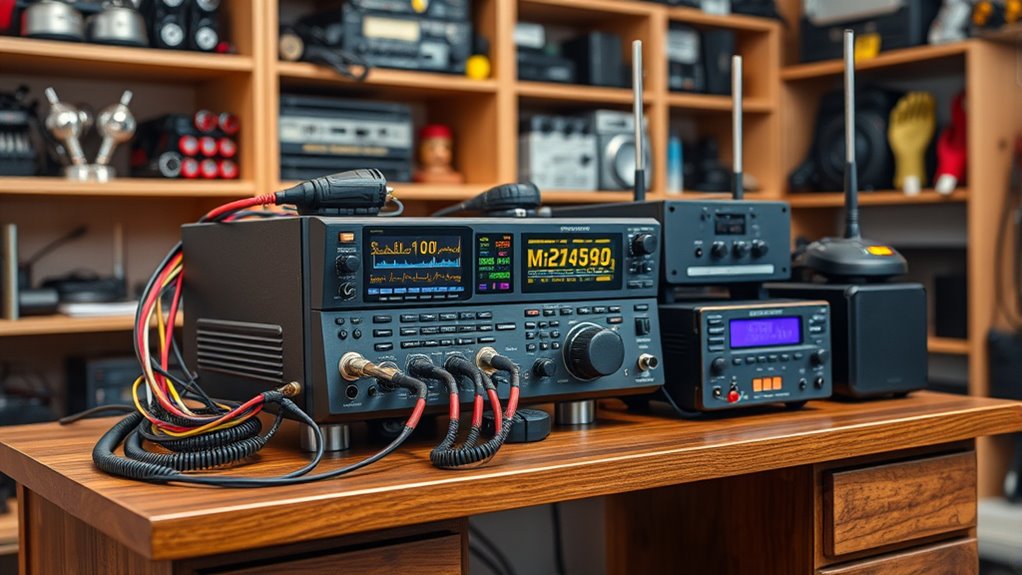

When preparing for emergency communications, selecting the right ham radio base station is critical. The best overall pick in 2026 is the BTECH UV-25X2 for its reliable dual-band performance and compact design. The Retevis RT95 stands out as a solid starter kit, ideal for newcomers, while the AnyTone AT-588Max offers high power and advanced features for more experienced operators. Each option balances performance, usability, and price, but tradeoffs include size, complexity, and feature set. Continue reading for a detailed breakdown to help you find the perfect station for your emergency needs.

Get audio and creator gear delivered free with Prime
- Fast, free delivery on millions of items
- Prime Video, Amazon Music and more included
- Member-only deals all year
Complete the kit


Key Takeaways
- Dual-band capability is essential for flexible emergency comms, making models like the BTECH UV-25X2 highly versatile.
- Power output varies significantly; higher wattage can extend range but may require more robust power sources.
- Ease of use and setup are crucial for emergency scenarios, favoring models with straightforward interfaces and minimal maintenance.
- Built-in features like NOAA alerts and SSB modes enhance preparedness, but add complexity and cost.
- Size and portability matter—compact units are easier to deploy in varied emergency situations, but may have fewer features.
| Retevis RT95 Dual Band Mobile Radio Ham Radio Base Station Starter Kit |  | Best Overall for Versatility and Ease of Use | Dimensions: 1.54″D x 4.88″W x 6.42″H | Bands: 2m/70cm | Channels: 200 | VIEW ON AMAZON | See Our Full Breakdown |
| Retevis MA1 Dual Band Ham Radio, Cross-Band Repeater Mobile Transceiver |  | Best for Extended Range with Cross-Band Functionality | Number of Channels: 999 | Additional Features: Cross-band relay, Detachable control panel, High power | Frequency Range: dual band | VIEW ON AMAZON | See Our Full Breakdown |
| BTECH UV-25X2 (Second Gen.) Mini Mobile 25 Watt Dual Band Base, Mobile Radio |  | Best for Amateur Enthusiasts Seeking Multi-Band Flexibility | Power: 25 Watt | Bands: VHF, UHF | Operation Modes: Multi-band, VHF-VHF, UHF-UHF | VIEW ON AMAZON | See Our Full Breakdown |
| Retevis Ailunce HS4 10 Meter Radio, SSB CW AM FM PA Ham Radio Base Station |  | Best for Multi-Mode, Long-Distance Capabilities | Communication modes: CW, SSB, FM, AM, PA | Power: High power | Channels: 6 bands with 60 channels each | VIEW ON AMAZON | See Our Full Breakdown |
| Ham Radio Base Station AT-778UV II with Car 20 in Magnetic Mount Antenna |  | Best for Dual-Band Simplicity and Mobility | Number of Channels: 200 | Power Output: 25W/15W/5W | Frequency Range: 144-148MHz/420-450MHz | VIEW ON AMAZON | See Our Full Breakdown |
| Radioddity QT40 10 Meter Mobile Ham Radio SSB/AM/FM/PA 40W with NOAA Alert |  | Best Overall Emergency Ham Radio for Long-Range Communication | Power: 40W | Frequency Range: 28.000-29.695MHz | FCC ID: T4K-ARESII | VIEW ON AMAZON | See Our Full Breakdown |
| AnyTone AT-588Max 70W VHF Mobile 2 Meter Ham Radio with Air Band RX |  | Best High-Power VHF Radio for Mobile and Repeater Use | Power Output: 70W | Frequency Range: 144–148 MHz | Noise Reduction: 5-level | VIEW ON AMAZON | See Our Full Breakdown |
| AnyTone AT-778UVII Transceiver Mobile Radio Dual Band 25W VOX Car Radio |  | Best Dual-Band Mobile for Vehicle Emergency Communications | Frequency Range: 144-148MHz/420-450MHz | Output Power: 25W/15W/5W | Channels: 200 | VIEW ON AMAZON | See Our Full Breakdown |
| ham radio base stations for emergency comm | Frequency Range |
|---|---|
| Retevis RT95 Dual Band Mobile | — |
| Retevis MA1 Dual Band Ham Radi | dual band |
| BTECH UV-25X2 | — |
| Retevis Ailunce HS4 10 Meter R | — |
| Ham Radio Base Station AT-778U | 144-148MHz/420-450MHz |
| Radioddity QT40 10 Meter Mobil | 28.000-29.695MHz |
| AnyTone AT-588Max 70W VHF Mobi | 144–148 MHz |
| AnyTone AT-778UVII Transceiver | 144-148MHz/420-450MHz |
More Details on Our Top Picks
Retevis RT95 Dual Band Mobile Radio Ham Radio Base Station Starter Kit
The Retevis RT95 stands out for its compact size and user-friendly features, making it ideal as a versatile base station or mobile setup in emergencies. Its high gain antenna ensures reliable long-distance communication, while the rotatable color screen enhances visibility in varied lighting conditions. Compared with the Ham Radio AT-778UV II, it offers a more straightforward setup for those who need quick deployment. However, it requires an external power supply, which can be a hurdle for portable emergency kits. Its limited to 2m/70cm bands, so it’s best for users focused on those frequencies. The inclusion of CHIRP compatibility allows for easy channel management, making it suitable for community or emergency groups needing reliable, adaptable comms. Overall, this makes the most sense for users seeking a balanced combination of portability, long-range capability, and software flexibility.
Pros:- Compact size and easy installation for vehicle or home use
- High gain antenna enhances long-distance communication
- Rotatable color screen improves visibility in all lighting conditions
- Compatible with CHIRP for flexible channel management
Cons:- Requires an external power source, limiting portability
- Setup may be complex for absolute beginners
- Limited to 2m/70cm bands, restricting frequency options
Best for: Emergency responders or community groups needing a reliable, easy-to-install base station with long-range capabilities
Not ideal for: Hikers or outdoor adventurers who require a fully portable, battery-powered unit — it needs external power and is not designed for rugged outdoor use
- Dimensions:1.54″D x 4.88″W x 6.42″H
- Bands:2m/70cm
- Channels:200
- Power Supply:13.8V/10A (not included)
Our verdict“This radio is well-suited for emergency teams and community groups who prioritize long-range, flexible communication with manageable setup.”
Retevis MA1 Dual Band Ham Radio, Cross-Band Repeater Mobile Transceiver
The Retevis MA1 excels in extending communication reach through its effective cross-band relay, making it a strong choice for emergency scenarios needing broader coverage. Its detachable control panel offers flexible installation, perfect for vehicle or fixed base setups. Unlike the BTECH UV-25X2, which focuses on multi-band operation, the MA1 emphasizes relay capabilities and additional features like air band reception. Its complex setup can be challenging for less technical users, and it’s not water resistant, limiting outdoor use. Its high power and noise reduction features ensure clearer long-distance channels, but the lack of water resistance makes it less suitable for harsh outdoor environments. This radio is best for users who need extended communication range and advanced features, willing to handle a slightly steeper learning curve.
Pros:- Effective cross-band relay extends communication range
- Detachable control panel allows flexible installation
- Includes air band reception and noise reduction
- Durable design with flip panel for ease of use
Cons:- Not water resistant, limiting outdoor use in rain
- Setup can be complex for beginners
- Limited to analog connectivity
Best for: Amateur radio operators or emergency teams needing extended coverage with relay capabilities
Not ideal for: Users seeking a simple, plug-and-play solution — setup complexity and lack of water resistance could be limiting
- Number of Channels:999
- Additional Features:Cross-band relay, Detachable control panel, High power
- Frequency Range:dual band
- Voltage:13.8 volts
Our verdict“This transceiver is best for experienced users who need reliable, extended-range relay capabilities in emergency communication networks.”
BTECH UV-25X2 (Second Gen.) Mini Mobile 25 Watt Dual Band Base, Mobile Radio
The BTECH UV-25X2 offers a well-rounded dual-band solution with 25W power, supporting both VHF and UHF frequencies. Its multi-band operation makes it adaptable for different emergency situations, especially when paired with additional accessories like the RJ45 to K1 Audio Adapter. Compared to the Retevis RT95, which is more streamlined, the UV-25X2 provides greater frequency flexibility, albeit with a more involved setup process. Its need for supplementary power supplies and accessories can be a downside for those seeking a plug-and-play device. The easy installation and support for multi-band operation make this a favorite among amateur enthusiasts who want a versatile, upgradeable setup for emergency comms.
Pros:- Supports multi-band operation (VHF and UHF)
- Easy to install with included hardware
- Upgraded audio I/O for better sound quality
- Versatile for mobile and fixed base station use
Cons:- Requires additional accessories like power supply and cables
- Power supply sold separately adds to total cost
- Setup can be complex for beginners
Best for: Amateur radio hobbyists who want a flexible, multi-band mobile/base station radio for emergency preparedness
Not ideal for: Users looking for a simple, all-in-one radio — it requires additional accessories and power supplies for full use
- Power:25 Watt
- Bands:VHF, UHF
- Operation Modes:Multi-band, VHF-VHF, UHF-UHF
- Included Accessories:RJ45 to K1 Audio Adapter, Speaker Mic, DC Cable
Our verdict“Ideal for amateur radio enthusiasts seeking a flexible, multi-band transceiver ready for emergency use with some technical setup involved.”
Retevis Ailunce HS4 10 Meter Radio, SSB CW AM FM PA Ham Radio Base Station
The Retevis Ailunce HS4 shines in supporting a broad range of modes, including CW, SSB, FM, and AM, making it suitable for both local and long-distance communications in emergency situations. Its high power output and multiple frequency bands allow for reliable long-range links, especially compared to simpler VHF/UHF models like the BTECH UV-25X2. The large backlit LCD and protections like SWR and voltage safeguards add to its rugged, professional appeal. However, its operation is complex and may require a learning curve, which could be a barrier for casual users. Designed mainly for vehicle or home use rather than portability, it’s less ideal for quick deployment in outdoor scenarios. This radio is best for users needing a versatile, high-power station capable of operating across multiple modes and bands.
Pros:- Supports multiple communication modes for versatility
- High power output and stable long-distance signals
- Noise reduction and dual watch features enhance clarity
- Multiple frequency bands and channels for wide coverage
Cons:- Complex operation with a learning curve
- Designed more for vehicle or fixed station use, not portable
- Size and setup may be cumbersome for casual users
Best for: Professional operators or advanced amateurs needing a multi-mode, long-distance capable base station for emergency comms
Not ideal for: Beginners or users requiring a portable, lightweight setup — its complexity and size limit quick outdoor deployment
- Communication modes:CW, SSB, FM, AM, PA
- Power:High power
- Channels:6 bands with 60 channels each
- Display:Large backlit LCD
Our verdict“This radio offers extensive mode and band support for experienced users needing reliable long-distance emergency comms.”
Ham Radio Base Station AT-778UV II with Car 20 in Magnetic Mount Antenna
The AT-778UV II provides a straightforward dual-band setup with a large, rotatable TFT LCD for easy monitoring, making it suitable for quick deployment in emergencies. Its 25W power output and 200 memory channels ensure reliable local communication, especially when paired with the included magnetic mount antenna for mobile use. Compared to the Retevis RT95, it offers a more dedicated amateur radio experience with a focus on user-friendly operation. The lack of water resistance limits outdoor use, and it doesn’t include a USB programming cable, which can be inconvenient for updates. Its comprehensive features make it ideal for users who need a reliable, easy-to-operate station primarily for indoor or sheltered outdoor scenarios.
Pros:- Large, rotatable LCD display simplifies operation
- Dual-band operation with 25W power output
- Includes accessories and mounting hardware
- Supports multiple call and VOX functions
Cons:- Does not include a USB programming cable
- Not water resistant, limiting outdoor use
- Limited to amateur use, not suitable for commercial applications
Best for: Amateur radio operators or emergency prepper groups seeking an easy-to-use, dual-band station with mobility options
Not ideal for: Outdoor hikers or field operators in harsh weather — the lack of water resistance and portability features limit outdoor ruggedness
- Number of Channels:200
- Power Output:25W/15W/5W
- Frequency Range:144-148MHz/420-450MHz
- Additional Features:VOX, CTCSS/DCS, rotatable TFT LCD
Our verdict“This transceiver is ideal for amateurs and emergency users who want a reliable, easy-to-operate dual-band station with mobility options for indoor and sheltered outdoor use.”
Radioddity QT40 10 Meter Mobile Ham Radio SSB/AM/FM/PA 40W with NOAA Alert
The Radioddity QT40 stands out as the best choice for those prioritizing long-distance capabilities during emergencies. Its 40W power output and wide 10-meter frequency range make it highly effective for reaching dispersed responders or isolated locations, especially when compared to the lower-power options like the AnyTone AT-778UVII. The built-in NOAA alerts add vital weather updates, crucial during storms or hurricanes. However, its complexity may challenge beginners, and it needs an external antenna to achieve optimal range. This model is ideal for seasoned operators who need reliable, extended-range comms and are comfortable with setup. It’s less suited for casual users or those seeking a simple plug-and-play device. Pros: High power for long-distance links, NOAA weather alerts, noise reduction technology, customizable features. Cons: Steeper learning curve, external antenna needed.
Verdict: Best for experienced users seeking robust emergency communication with weather alerts. Specs: Power: 40W, Frequency Range: 28.000-29.695MHz, FCC ID: T4K-ARESII, Weather Band: Yes, NOAA Alert: YesPros:- High transmission power for extended range
- Built-in NOAA weather alerts for timely updates
- Advanced noise reduction technology
- Customizable functions for tailored use
Cons:- Complex operation may intimidate newcomers
- Requires external antenna for maximum performance
Best for: Experienced ham operators and emergency responders needing reliable long-range communication with weather updates.
Not ideal for: Beginners or casual users who prefer simple, all-in-one solutions without complex setup.
- Power:40W
- Frequency Range:28.000-29.695MHz
- FCC ID:T4K-ARESII
- Weather Band:Yes
- NOAA Alert:Yes
Our verdict“This is the top pick for skilled users who need dependable, long-distance emergency comms with weather alerts.”
AnyTone AT-588Max 70W VHF Mobile 2 Meter Ham Radio with Air Band RX
The AnyTone AT-588Max excels as a powerful VHF mobile radio suited for those who need high wattage flexibility and aviation monitoring. Its 70W output surpasses many alternatives like the AnyTone AT-778UVII, making it ideal for repeater operation or covering large areas. The inclusion of air band receive adds a layer of versatility for aviation awareness during emergencies. While its adjustable power and noise reduction enhance clarity, the need for PC programming and terrain-dependent performance could hinder quick deployment. This radio is perfect for users who plan to operate in varied terrains and require the ability to listen to aircraft traffic, but less so for those who need a simple, quick-to-set-up device. Pros: High power output, air band receive, noise reduction, customizable channels. Cons: No transmit capability on air band, requires software for full setup, terrain affects performance.
Verdict: Suitable for advanced users needing high power, aviation monitoring, and flexibility in a mobile ham radio. Specs: Power Output: 70W, Frequency Range: 144–148 MHz, Noise Reduction: 5-level, Air Band Receive: Yes, Display: Adjustable LCD, Programmability: Supports PC softwarePros:- High adjustable power levels up to 70W
- Includes air band receive for aviation traffic
- Effective noise reduction features
- Supports PC programming for customization
Cons:- No transmit function on the air band
- Requires PC software and cables for full programming
- Performance depends heavily on antenna and terrain
Best for: Amateur radio operators who operate in mountainous or expansive areas and want both high power and aviation monitoring capabilities.
Not ideal for: Beginners or users seeking a straightforward, plug-and-play radio with minimal setup.
- Power Output:70W
- Frequency Range:144–148 MHz
- Noise Reduction:5-level
- Air Band Receive:Yes
- Display:32-level adjustable LCD
Our verdict“Best for experienced users needing high-power VHF communication with aviation monitoring in challenging terrains.”
AnyTone AT-778UVII Transceiver Mobile Radio Dual Band 25W VOX Car Radio
The AnyTone AT-778UVII offers a versatile dual-band solution with 25W power, making it well-suited for vehicle-based emergency setups. Its rotatable TFT LCD enhances visibility and flexibility in tight spaces, while the VOX function facilitates hands-free operation—especially useful during mobile emergencies. Compared with the single-band Radioddity QT40, it provides broader coverage across 2 meters and 70 centimeters, but at a lower maximum power. The extensive feature set, including programmable channels and signaling protocols, makes it appealing for those who want comprehensive control, though setup can be complex. This model is best for vehicle-mounted emergency comms, but less ideal for static base stations or outdoor fixed installations in rain due to lack of water resistance. Pros: Dual-band flexibility, rotatable LCD, VOX hands-free operation, wide signaling support. Cons: Not water resistant, complex setup, lower maximum power than some stationary units.
Verdict: The go-to choice for mobile, vehicle-based emergency communication with flexible display options. Specs: Frequency Range: 144-148MHz/420-450MHz, Output Power: 25W/15W/5W, Channels: 200, Display: Rotatable TFT LCD, Additional Features: VOX, CTCSS/DCS, DTMF, Squelch control, Keypad lock, Power Supply: 13.8VPros:- Dual-band operation for broader coverage
- Rotatable TFT LCD for flexible viewing
- Supports VOX hands-free operation
- Wide signaling protocol support
Cons:- Not water resistant, limiting outdoor use
- Setup can be complex for new users
- Lower maximum power compared to dedicated base stations
Best for: Vehicle owners and emergency responders needing reliable dual-band mobile radios for mobile or mobile-repeater setups.
Not ideal for: Stationary base station users or those requiring a water-resistant device for outdoor fixed installations.
- Frequency Range:144-148MHz/420-450MHz
- Output Power:25W/15W/5W
- Channels:200
- Display:Rotatable TFT LCD
- Additional Features:VOX, CTCSS/DCS, DTMF, Squelch control
Our verdict“Ideal for mobile emergency communications in vehicles that need dual-band flexibility and hands-free operation.”

How We Picked
These ham radio base stations were selected based on a combination of performance, usability, build quality, and value for emergency communications. Priority was given to models with reliable transmission power, clear audio, and versatile band support. We also considered ease of installation, user interface, and additional features like weather alerts or cross-band capabilities. The ranking reflects a balance between affordability and advanced functionality, ensuring options for beginners up to seasoned operators. Ultimately, the goal was to identify stations that perform well under stress, with minimal setup time and maximum reliability.Factors to Consider When Choosing Ham Radio Base Stations For Emergency Comms
Choosing a ham radio base station for emergency communications involves understanding several key factors. Not all radios are created equal, and the best fit depends on your specific needs, environment, and experience level. Carefully weighing these considerations can help you avoid common pitfalls and select a station that will perform reliably when it matters most.Power Output and Range
The transmission power of a ham radio directly impacts its communication range, especially in emergency scenarios where infrastructure may be compromised. While higher wattage radios like the AnyTone AT-588Max can reach farther, they also demand more power and can be more complex to operate. Conversely, lower wattage models are easier to manage and consume less energy but may require more repeaters or closer proximity to other stations. Consider your typical operating environment and whether portable or fixed stations better suit your needs.
Ease of Use and Setup
In emergency situations, simplicity can be lifesaving. Radios with intuitive controls, clear displays, and straightforward setup procedures reduce the risk of operator error. Units like the Retevis RT95 are designed with user-friendliness in mind, making them suitable for newcomers. More advanced models with extensive features might offer flexibility but can overwhelm less experienced users or slow deployment in critical moments. Balance your familiarity with technology against the complexity of the radio’s capabilities.
Band Support and Versatility
Support for multiple bands (VHF, UHF, 10-meter, etc.) enhances a station’s adaptability across different terrains and communication needs. Multi-band radios can connect to a broader network of operators and repeaters, vital during widespread emergencies. However, increased versatility often comes with added cost and complexity. Decide whether your primary need is reliable communication within a local area or broader regional coverage, and choose accordingly.
Additional Features
Features such as NOAA weather alerts, SSB modes, or cross-band repeaters can significantly boost your emergency preparedness. These extras enable proactive notifications and more flexible communication setups. Nonetheless, they can also increase the learning curve and price. Prioritize features that align with your expected scenarios—if weather alerts are crucial, look for radios with built-in NOAA support; for advanced operations, SSB capabilities might be worth the extra investment.
Portability and Installation
The physical size and mounting options of your radio influence how quickly you can deploy it in an emergency. Compact, lightweight units are ideal for mobile or temporary setups, but may have fewer features or lower power output. Larger, fixed stations tend to be more robust and offer higher performance but require more installation time and space. Consider whether your emergency plan involves mobile operation, fixed station setup, or both, and choose a model that fits your scenario.
Frequently Asked Questions
Can I use a ham radio station for emergency communication without a license?
In most countries, operating a ham radio station for emergency communication requires a license, which ensures operators understand regulations and technical standards. However, during genuine emergencies, some jurisdictions offer exemptions or simplified licensing options, but this varies. It’s advisable to obtain the appropriate license beforehand, as unlicensed operation can lead to interference issues or legal penalties. Being licensed also enhances your knowledge and credibility during critical situations.
What is the most important feature for a ham radio in an emergency kit?
The most vital feature is reliable, clear communication capability across multiple bands, coupled with straightforward operation. Power output matters, but so does battery life and the ability to connect to repeaters or direct point-to-point links. Additional features like NOAA weather alerts can provide early warnings, but the core requirement remains dependable transmission over a reasonable distance. Prioritize a radio that balances ease of use with solid performance in stressful conditions.
Should I prioritize higher wattage or better portability when choosing a station?
This depends on your typical emergency scenarios. Higher wattage radios extend communication range but tend to be larger and less portable, making them better suited for fixed stations or vehicle setups. If you need quick deployment or mobility, a compact, lower wattage unit might be preferable, even if it limits range somewhat. Balancing power with portability ensures your station can adapt to different situations without sacrificing essential functionality.
Are features like NOAA weather alerts essential for emergency ham radios?
While not strictly essential, NOAA weather alerts significantly enhance situational awareness during emergencies, providing early warnings of severe conditions. Radios with built-in NOAA support can automatically notify you of local weather changes, which is invaluable when infrastructure is compromised. However, relying solely on alerts isn’t enough—your station should still be capable of direct communication. Consider your environment and risk factors when deciding if this feature justifies a higher price.
How important is compatibility with existing repeater networks?
Compatibility with local repeater networks is often critical in extending your communication range and reaching other operators during emergencies. Repeaters can relay signals over longer distances, especially in urban or challenging terrains. Verify that your chosen station supports the frequency bands and protocols used by local repeaters. This compatibility can make the difference between isolated communication and being part of a coordinated response effort.
Conclusion
For general use and reliable performance, the BTECH UV-25X2 stands out as the best overall choice, offering a solid balance of power, ease of use, and versatility. If cost is a primary concern, the Retevis RT95 provides a dependable starter kit ideal for beginners or temporary setups. For those seeking premium features and maximum power, the AnyTone AT-588Max delivers advanced capabilities but at a higher price point. Beginners should focus on simple, user-friendly models like the RT95, while experienced operators needing extensive features might prefer the more powerful or feature-rich options. Select based on your operational environment, technical comfort, and budget to ensure your emergency comms remain reliable when it counts most.
Halloween Picks
halloween
As an affiliate, we earn on qualifying purchases.