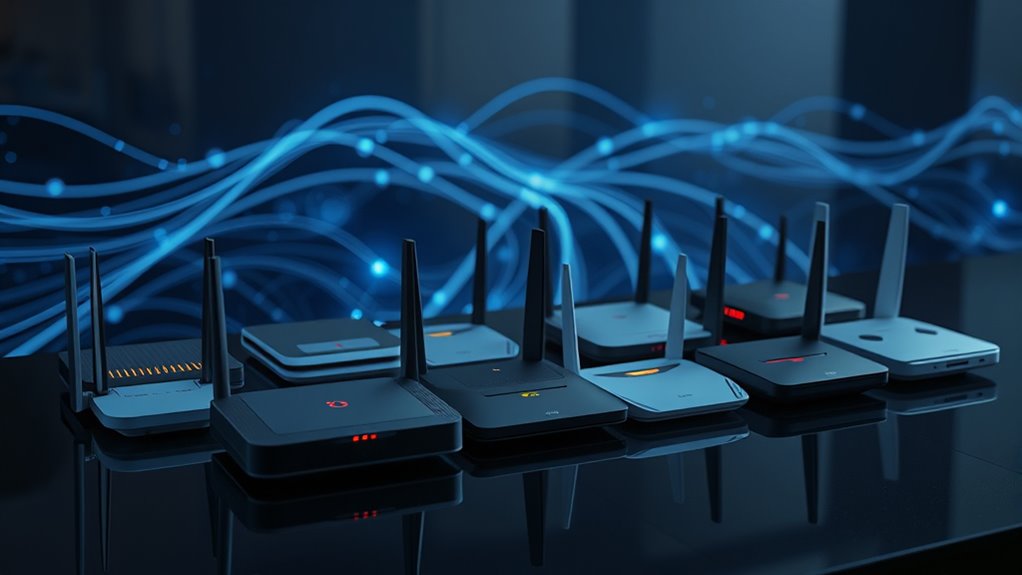

When shopping for routers for fast internet, the goal is clear: maximize speed, coverage, and reliability. The TP-Link BE6500 Dual-Band WiFi 7 Router stands out as the best overall pick for its future-proof WiFi 7 technology and strong performance. For those prioritizing gaming, the GL.iNet GL-MT6000 Flint 2 offers low latency and dual 2.5G ports, making it ideal. The main challenge lies in balancing speed, coverage, and cost—more features often mean higher prices or complexity. Continue reading to see how each model stacks up and which one fits your specific needs.
Complete the kit


Key Takeaways
- WiFi 7 routers like the TP-Link BE6500 deliver faster speeds and better device handling but come at a premium price.
- Dual-band routers are generally sufficient for most households, but tri-band models provide extra capacity for dense networks.
- The best routers balance speed with coverage—larger homes benefit from higher-powered units or mesh-compatible options.
- Gaming and streaming require low latency and reliable connections, favoring routers with dedicated gaming modes or QoS features.
- Budget models can still offer fast internet, but they may lack advanced features like WiFi 6E or multi-Gig ports, limiting future-proofing.
| TP-Link AC1200 WiFi Router Dual Band Wireless Internet Router (Archer A54) | 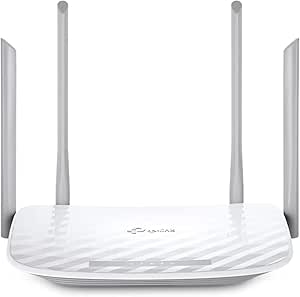 | Best Budget Dual-Band Router for Fast Home Internet | Wi-Fi Bands: Dual-band (2.4 GHz and 5 GHz) | Max Speed: 1200 Mbps | Coverage: Up to 1,000 sq. ft. | VIEW ON AMAZON | See Our Full Breakdown |
| TP-Link BE6500 Dual-Band WiFi 7 Router |  | Best High-Speed WiFi 7 Router for Large Homes | WiFi Technology: WiFi 7 | Max Speed: up to 5764 Mbps (5GHz), 688 Mbps (2.4GHz) | Coverage: Up to 2,400 sq. ft. | VIEW ON AMAZON | See Our Full Breakdown |
| TP-Link AX1800 WiFi 6 Router (Archer AX21 V5) |  | Best WiFi 6 Router for Multi-Device Streaming and Gaming | Technology: Wi-Fi 6 (802.11ax) | Bands: Dual-Band | Max Speed: 1.8 Gbps | VIEW ON AMAZON | See Our Full Breakdown |
| NETGEAR Nighthawk Dual-Band WiFi 7 Router (RS200) |  | Best High-Speed WiFi 7 Router for Large Homes and Multiple Devices | Wireless Speed: up to 6.5 Gbps | Coverage: 2,500 sq. ft. | Devices Supported: Up to 80 | VIEW ON AMAZON | See Our Full Breakdown |
| NETGEAR Nighthawk Dual-Band WiFi 7 Router (RS90) |  | Best for Moderate Speed Needs and Easy Management | Speed: up to 3.6 Gbps | Coverage: Up to 2,000 sq. ft. | Devices Supported: Up to 50 | VIEW ON AMAZON | See Our Full Breakdown |
| TP-Link AXE5400 Tri-Band WiFi 6E Router |  | Best Overall for Future-Proof High-Speed Home Networks | WiFi Speed: up to 5400 Mbps | Bands: Tri-Band (6 GHz, 5 GHz, 2.4 GHz) | Processor: 1.0 GHz dual-core CPU | VIEW ON AMAZON | See Our Full Breakdown |
| GL.iNet GL-MT6000 Flint 2 Wi-Fi 6 Gaming Router Dual 2.5G Ports |  | Best for Gaming and Large Device Support | Wi-Fi Standard: Wi-Fi 6 | Max Speed: 6 Gbps | RAM: 1GB DDR4 | VIEW ON AMAZON | See Our Full Breakdown |
| TP-Link AC1200 Gigabit Dual Band WiFi Router (Archer A6) |  | Best Budget Dual-Band for Reliable Home Use | WiFi Speed: 1200 Mbps | Bands: Dual band (2.4GHz and 5GHz) | LAN Ports: 4 Gigabit LAN | VIEW ON AMAZON | See Our Full Breakdown |
| TP-Link AX5400 WiFi 6 Router (Archer AX73) |  | Best for High-Speed Streaming and Gaming | WiFi Speed: 5400 Mbps | Frequency Bands: Dual-band (2.4 GHz & 5 GHz) | Antennas: 6 external antennas | VIEW ON AMAZON | See Our Full Breakdown |
| GL.iNet GL-BE9300 Flint 3 Tri-Band Wi-Fi 7 Router |  | Best for Cutting-Edge Wi-Fi 7 Performance | Wi-Fi Standard: Wi-Fi 7 | Speed: up to 9 Gbps | Coverage: up to 2,000 sq ft | VIEW ON AMAZON | See Our Full Breakdown |
| routers for fast internet | Coverage | Security |
|---|---|---|
| TP-Link AC1200 WiFi Router Dua | Up to 1,000 sq. ft. | WPA3 |
| TP-Link BE6500 Dual-Band WiFi | Up to 2,400 sq. ft. | HomeShield with parental controls and IoT security |
| TP-Link AX1800 WiFi 6 Router | Variable, depends on environment | Advanced security with VPN support |
| NETGEAR Nighthawk Dual-Band Wi | 2,500 sq. ft. | WPA3, NETGEAR Armor (trial) |
| NETGEAR Nighthawk Dual-Band Wi | Up to 2,000 sq. ft. | NETGEAR Armor (trial) |
| TP-Link AXE5400 Tri-Band WiFi | — | — |
| GL.iNet GL-MT6000 Flint 2 Wi-F | — | — |
| TP-Link AC1200 Gigabit Dual Ba | — | WPA3 |
| TP-Link AX5400 WiFi 6 Router | Up to 2,000 sq ft. | — |
| GL.iNet GL-BE9300 Flint 3 Tri- | up to 2,000 sq ft | — |
More Details on Our Top Picks
TP-Link AC1200 WiFi Router Dual Band Wireless Internet Router (Archer A54)
The TP-Link Archer A54 stands out for offering solid dual-band speeds of up to 1200 Mbps, making it a reliable choice for streaming and light gaming. Compared with the WiFi 6 options like the TP-Link AX1800, it doesn’t support the latest WiFi 6 standard or the 6 GHz band, which could limit future-proofing. Its four external antennas provide broad coverage, but performance may drop in environments with many obstacles. While it’s easy to set up and manage via the TP-Link Tether app, it requires a separate modem and doesn’t support the newer WiFi 6 or WiFi 7 technologies, making it less ideal for those seeking maximum speed and device capacity.
Pros:- Affordable price point with solid dual-band speeds
- Broad coverage with four external antennas
- Supports WPA3 security for better protection
- Easy to set up and manage via app
Cons:- No support for 6 GHz Wi-Fi band
- Limited future-proofing compared to WiFi 6/7 routers
Best for: Budget-conscious users who want reliable dual-band Wi-Fi for streaming and browsing in small to medium homes
Not ideal for: Tech enthusiasts or large households needing WiFi 6 or WiFi 7 speeds to handle multiple high-demand devices simultaneously
- Wi-Fi Bands:Dual-band (2.4 GHz and 5 GHz)
- Max Speed:1200 Mbps
- Coverage:Up to 1,000 sq. ft.
- Antennas:Four external antennas
- Security:WPA3
- Features:Access Point Mode, EasyMesh Compatibility
Our verdict“This router makes the most sense for users seeking reliable dual-band internet without the need for the latest WiFi standards.”
TP-Link BE6500 Dual-Band WiFi 7 Router
The TP-Link BE6500 is a standout for leveraging WiFi 7 technology with Multi-Link Operation and multi-gig ports, delivering speeds up to 5764 Mbps on the 5GHz band. Compared with the NETGEAR RS200, it offers higher maximum speeds and more advanced features, making it better suited for heavy streaming, gaming, and large device loads. Its wide coverage of up to 2,400 sq. ft. supports large homes, and setup is straightforward via the Tether app. However, it isn’t compatible with mesh systems like Deco and requires a separate modem, which could be a drawback for some users. Its advanced security and multi-gig ports make it a future-ready choice, but limited detailed review data might concern cautious buyers.
Pros:- WiFi 7 technology with speeds up to 5764 Mbps
- Extensive coverage for large homes
- Multi-gig ports for future-proof wired connections
- Easy management via mobile app
Cons:- Not compatible with mesh WiFi systems like Deco
- Requires a separate modem for internet connection
Best for: Large households or gamers needing the fastest WiFi 7 speeds and extensive coverage
Not ideal for: Small apartment dwellers or users with existing mesh systems that require compatibility with Deco
- WiFi Technology:WiFi 7
- Max Speed:up to 5764 Mbps (5GHz), 688 Mbps (2.4GHz)
- Coverage:Up to 2,400 sq. ft.
- Number of Devices:Up to 90
- Ports:1x 2.5 Gbps WAN/LAN, 1x 2.5 Gbps LAN, 3x 1 Gbps LAN
- Security:HomeShield with parental controls and IoT security
Our verdict“This pick is ideal for those wanting cutting-edge WiFi 7 speeds and wide coverage for demanding households.”
TP-Link AX1800 WiFi 6 Router (Archer AX21 V5)
The TP-Link AX1800 offers impressive dual-band WiFi 6 speeds up to 1.8 Gbps, making it a strong contender for households with multiple devices. It surpasses older WiFi 5 models like the Archer A54 by supporting OFDMA and beamforming, which improve efficiency and coverage. Compared to WiFi 7 routers like the NETGEAR RS200, it doesn’t deliver the same maximum speeds but provides a more affordable upgrade path for users wanting modern WiFi standards. Security features are robust, including support for VPNs, but it does not support the 6 GHz band, limiting its future scalability. This model provides excellent value for those needing reliable WiFi 6 performance without the latest tech’s premium price.
Pros:- Fast WiFi 6 speeds up to 1.8 Gbps
- Supports multiple devices efficiently with OFDMA
- Good coverage with beamforming and high-gain antennas
- Includes advanced security and VPN support
Cons:- No support for the 6 GHz band
- Less future-proof compared to WiFi 7 routers
Best for: Families with many devices seeking reliable WiFi 6 speeds for streaming, gaming, and browsing in medium to large homes
Not ideal for: Early adopters or those seeking WiFi 6E or WiFi 7 speeds; users wanting the newest 6 GHz band support
- Technology:Wi-Fi 6 (802.11ax)
- Bands:Dual-Band
- Max Speed:1.8 Gbps
- Coverage:Variable, depends on environment
- Antennas:4 high-gain antennas
- Security:Advanced security with VPN support
Our verdict“This router offers a balanced upgrade for users wanting WiFi 6 reliability at a reasonable price point.”
NETGEAR Nighthawk Dual-Band WiFi 7 Router (RS200)
The NETGEAR Nighthawk RS200 delivers impressive speeds up to 6.5 Gbps and covers large spaces up to 2,500 sq. ft., making it ideal for busy households. Its support for up to 80 devices and multiple wired ports offers flexibility, especially when compared to the NETGEAR RS90, which supports fewer devices. Setup via the Nighthawk app is straightforward, but some ISP gateways may require bridge mode for compatibility. While security features like WPA3 and NETGEAR Armor are included, they require a subscription after the trial period. This model balances raw speed and extensive coverage, but its reliance on subscriptions and potential compatibility issues with some ISPs are important considerations.
Pros:- Very high speeds up to 6.5 Gbps
- Supports up to 80 devices simultaneously
- Wide coverage suitable for large homes
- Multiple wired ports for high-speed wired connections
Cons:- Requires subscription for full security features after trial
- Potential compatibility issues with some ISP gateways
Best for: Large households or gaming setups requiring ultra-fast WiFi 7 speeds and extensive device support
Not ideal for: Users with simple internet needs or small homes where such high performance isn’t necessary
- Wireless Speed:up to 6.5 Gbps
- Coverage:2,500 sq. ft.
- Devices Supported:Up to 80
- WAN Port:2.5 Gig
- Ethernet Ports:4 x 1 Gig
- Security:WPA3, NETGEAR Armor (trial)
Our verdict“This router suits households that demand maximum speed and device capacity with advanced security, accepting ongoing subscription costs.”
NETGEAR Nighthawk Dual-Band WiFi 7 Router (RS90)
The NETGEAR Nighthawk RS90 offers reliable WiFi 7 performance with speeds up to 3.6 Gbps and coverage up to 2,000 sq. ft., making it suitable for medium-sized homes. It supports around 50 devices simultaneously, which is adequate for most families. Compared to the RS200, it provides lower maximum speeds but is easier to manage and less expensive. Its support for multiple wired connections and security features like NETGEAR Armor enhance home network safety. However, the need for a subscription after the trial period and potential size limitations in larger homes are factors to weigh. This model balances speed, coverage, and ease of use for typical home setups.
Pros:- Reliable WiFi 7 speeds up to 3.6 Gbps
- Simple setup and management via app
- Supports multiple devices with decent coverage
- Includes security features like NETGEAR Armor
Cons:- Requires subscription for ongoing security features
- Larger homes may need additional mesh systems
Best for: Families seeking a reliable WiFi 7 router with moderate speeds and straightforward management
Not ideal for: Large homes requiring extensive coverage or users needing the highest possible speed for gaming or streaming
- Speed:up to 3.6 Gbps
- Coverage:Up to 2,000 sq. ft.
- Devices Supported:Up to 50
- WAN Port:2.5 Gig
- Ethernet Ports:4 x 1 Gig
- Security:NETGEAR Armor (trial)
Our verdict“This router is well-suited for households that want good WiFi 7 performance with manageable complexity and cost.”
TP-Link AXE5400 Tri-Band WiFi 6E Router
This router stands out for its tri-band WiFi 6E technology, delivering speeds up to 5400 Mbps across 6 GHz, 5 GHz, and 2.4 GHz bands. Compared with the TP-Link AX5400 (Archer AX73), it offers lower latency and better handling of multiple smart devices thanks to the 6 GHz band, ideal for demanding gaming and streaming. However, its advanced features—mesh support, VPN, and security—come with added complexity, making it better suited for users comfortable with networking setups. The need for a separate modem and the steep learning curve for non-technical users are notable tradeoffs. If you want cutting-edge speed and future-ready features, this model is a top pick for a high-capacity, reliable home network.
Pros:- Supports tri-band WiFi 6E with speeds up to 5400 Mbps
- Includes the new 6 GHz band for low latency and high bandwidth
- Mesh-compatible for seamless whole-home coverage
- Built-in VPN server and client support
Cons:- Requires a compatible modem for most ISPs
- Advanced features can be overwhelming for non-technical users
Best for: Tech-savvy homeowners seeking the latest WiFi 6E technology for high-demand activities like gaming and 4K streaming
Not ideal for: Casual users or those unfamiliar with network setup, since advanced features may prove complex
- WiFi Speed:up to 5400 Mbps
- Bands:Tri-Band (6 GHz, 5 GHz, 2.4 GHz)
- Processor:1.0 GHz dual-core CPU
- Memory:512 MB High-Speed Memory
- Supports Mesh:Yes
- VPN Support:Yes (OpenVPN, PPTP, L2TP)
Our verdict“This router is best for users who need top-tier speed and are comfortable with complex network features.”
GL.iNet GL-MT6000 Flint 2 Wi-Fi 6 Gaming Router Dual 2.5G Ports
The GL.iNet GL-MT6000 Flint 2 is designed for gamers and heavy multi-device households, offering speeds up to 6 Gbps, which surpasses many traditional routers like the TP-Link AC1200 (Archer A6). Its Wi-Fi 6 standard and dual 2.5G ports enable low latency and fast wired connections, ideal for competitive gaming and streaming. The large capacity—supporting over 100 devices—makes it stand out in busy environments. However, its firmware may need updates for peak performance, and some users might find the initial setup technical. If your priority is high-speed gaming and connecting many devices simultaneously, this model provides excellent value, but it demands some technical familiarity.
Pros:- Supports Wi-Fi 6 speeds up to 6 Gbps
- Dual 2.5G ports for fast wired connections
- Capable of handling over 100 devices simultaneously
- Supports high-speed VPN and ad-blocking
Cons:- Requires firmware updates for optimal performance
- Setup process may be complex for non-technical users
Best for: Gamer households or users with many connected devices requiring low-latency internet
Not ideal for: Casual users seeking simple plug-and-play setup, due to firmware and configuration steps
- Wi-Fi Standard:Wi-Fi 6
- Max Speed:6 Gbps
- RAM:1GB DDR4
- Storage:8GB eMMC
- Ports:Dual 2.5G ports
- Device Capacity:Over 100 devices
Our verdict“Ideal for gamers and large households needing fast, reliable, multi-device connectivity with some technical setup required.”
TP-Link AC1200 Gigabit Dual Band WiFi Router (Archer A6)
The TP-Link Archer A6 offers a balanced mix of speed and affordability, providing up to 1200 Mbps across dual bands. Its four Gigabit LAN ports and external antennas with Beamforming improve coverage and wired device performance, making it suitable for typical streaming and browsing needs. Compared to higher-speed options like the AX5400 models, it’s less capable of handling multiple high-bandwidth activities simultaneously. Its simplicity is a plus for non-technical users who want a straightforward setup, but it lacks the advanced features needed for future-proofing. If your internet needs are moderate and budget-conscious, this router delivers dependable speed without complexity.
Pros:- Affordable dual-band WiFi up to 1200 Mbps
- Four Gigabit LAN ports for wired connections
- Beamforming and MU-MIMO improve coverage and device support
- Easy setup for non-technical users
Cons:- Requires a modem for most ISPs
- Lacks advanced features like WiFi 6 or mesh support
Best for: Small households or individuals needing reliable WiFi for streaming and browsing on a budget
Not ideal for: Power users or gamers requiring high speeds and advanced features for heavy multitasking
- WiFi Speed:1200 Mbps
- Bands:Dual band (2.4GHz and 5GHz)
- LAN Ports:4 Gigabit LAN
- Antennas:4 external antennas
- Technology:Beamforming, MU-MIMO
- Security:WPA3
Our verdict“A solid choice for budget-conscious households needing dependable WiFi for everyday use, with no frills or advanced features.”
TP-Link AX5400 WiFi 6 Router (Archer AX73)
The Archer AX73 provides speeds up to 5400 Mbps, matching the TP-Link AXE5400 in raw performance but without the 6 GHz band, making it a strong choice for gigabit internet plans. Its extensive coverage—up to 2,000 sq ft—thanks to six external antennas and beamforming technology, makes it suitable for larger homes. It supports MU-MIMO and OFDMA, allowing multiple devices to operate smoothly simultaneously, much like the AXE5400 but with slightly fewer advanced features. For users who don’t need WiFi 6E but want reliable, high-speed WiFi, this router offers excellent performance at a lower cost, though its setup may be complex for some.
Pros:- High-speed WiFi up to 5400 Mbps, ideal for streaming and gaming
- Large coverage area up to 2,000 sq ft
- Supports MU-MIMO and OFDMA for multiple device support
- USB port for media sharing
Cons:- Requires a modem for most ISPs
- Setup can be complex for less tech-savvy users
Best for: Home users with gigabit internet and multiple devices seeking fast WiFi without the need for WiFi 6E
Not ideal for: Users wanting the absolute latest in WiFi technology or with limited technical setup experience
- WiFi Speed:5400 Mbps
- Frequency Bands:Dual-band (2.4 GHz & 5 GHz)
- Antennas:6 external antennas
- Coverage:Up to 2,000 sq ft.
- Ports:1x USB 3.0
- Technology:MU-MIMO, OFDMA
Our verdict“A powerful WiFi 6 router suitable for large homes with high-speed internet needs, balancing performance and complexity.”
GL.iNet GL-BE9300 Flint 3 Tri-Band Wi-Fi 7 Router
The GL.iNet GL-BE9300 Flint 3 is the latest Wi-Fi 7 router, offering speeds up to 9 Gbps, far surpassing the other options like the AX5400 models. Its tri-band setup, including the new Wi-Fi 7 features like MLO and OFDMA, ensures minimal latency and extensive device support—perfect for demanding gaming, 4K streaming, and smart home integration. Its advanced security, parental controls, and easy setup make it a comprehensive choice. The major tradeoff is that Wi-Fi 7 is still new, and optimal performance depends heavily on your internet plan and environment. Firmware updates may be needed for best results, but for those wanting the fastest, most future-proof network, this is the clear leader.
Pros:- Blazing fast speeds up to 9 Gbps with Wi-Fi 7 features
- Supports over 100 devices with MLO and OFDMA
- Includes parental controls and VPN support
- Supports extensive coverage up to 2,000 sq ft
Cons:- Firmware may require updates for peak performance
- High-speed capabilities depend on ISP and environment
Best for: Early adopters and power users wanting the latest Wi-Fi 7 technology for maximum speed and device support
Not ideal for: Average households or users with limited technical skills due to setup complexity and early-stage firmware
- Wi-Fi Standard:Wi-Fi 7
- Speed:up to 9 Gbps
- Coverage:up to 2,000 sq ft
- VPN Speed:up to 680 Mbps
- Device Capacity:over 100 devices
- Ports:5 x 2.5G LAN
Our verdict“Best suited for users seeking the most advanced Wi-Fi technology and maximum future-proofing for demanding applications.”

How We Picked
Our selection process focused on performance, usability, build quality, and value. We evaluated each router’s maximum speed, coverage area, and ability to handle multiple devices simultaneously. Ease of setup and user interface were also key, as a complicated setup can deter less tech-savvy users. We prioritized models that support the latest WiFi standards like WiFi 6, 6E, and 7, which are designed to handle the fastest internet plans. Lastly, we considered the price-to-performance ratio, ensuring each pick offers a clear advantage for its target user.
| routers for fast internet | Security |
|---|---|
| TP-Link AC1200 WiFi Router Dua | WPA3 |
| TP-Link BE6500 Dual-Band WiFi | HomeShield with parental controls and IoT security |
| TP-Link AX1800 WiFi 6 Router | Advanced security with VPN support |
| NETGEAR Nighthawk Dual-Band Wi | WPA3, NETGEAR Armor (trial) |
| NETGEAR Nighthawk Dual-Band Wi | NETGEAR Armor (trial) |
| TP-Link AXE5400 Tri-Band WiFi | — |
| GL.iNet GL-MT6000 Flint 2 Wi-F | — |
| TP-Link AC1200 Gigabit Dual Ba | WPA3 |
| TP-Link AX5400 WiFi 6 Router | — |
| GL.iNet GL-BE9300 Flint 3 Tri- | — |
Factors to Consider When Choosing Routers For Fast Internet
Choosing the right router for fast internet involves more than just looking at maximum speed. It’s important to match your home’s size, number of connected devices, and internet plan with a router’s capabilities. Features like WiFi standards, ports, and security also play a role. Here are key factors to consider:
Speed Standards and Future-Proofing
Opt for routers supporting WiFi 6 or newer standards like WiFi 6E and WiFi 7 if you want to maximize speed and reduce latency. These standards are designed to handle gigabit plans and beyond, providing a buffer for future upgrades. Keep in mind that the maximum speed advertised often requires compatible devices and an internet plan that supports those speeds. Investing in a slightly faster router than your current plan can help future-proof your setup.
Coverage Area and Signal Strength
Your home’s size and layout determine how much coverage you need. Larger spaces may require routers with higher power output or mesh systems. Avoid models that claim high speeds but have limited range, as dead zones can negate the benefits of a fast connection. Consider whether a single router suffices or if a mesh system would better serve multi-story or sprawling homes.
Device Capacity and Network Traffic
If your household has many smart devices, gaming consoles, or streaming gear, look for routers that support multiple streams and have advanced QoS features. Routers with multi-Gig ports and support for WiFi 6/6E can better handle heavy traffic without slowdowns. Skipping this can lead to congestion, buffering, or lag during peak usage times.
Ease of Setup and Management
User-friendly interfaces, app-based setup, and simple management features are important, especially for less technical users. Some routers offer built-in security features and parental controls, adding value beyond raw speed. However, overly complex setups can discourage regular updates and maintenance, impacting long-term performance.
Price and Long-Term Value
Higher-priced models typically offer better future-proofing, advanced features, and stronger performance. But they might be unnecessary for smaller households with basic internet needs. Balance your current needs with potential future demands; sometimes a mid-tier model provides the best overall value for most users.
Frequently Asked Questions
Will a WiFi 6 router be enough for my gigabit internet plan?
Yes, a WiFi 6 router can support gigabit internet plans effectively, especially when paired with compatible devices. It provides faster speeds, lower latency, and better handling of multiple devices compared to older standards. However, the actual internet speed also depends on your modem and plan, so ensure your entire setup is optimized for gigabit performance. Upgrading to WiFi 6 now can also prepare your network for future internet upgrades and smart device expansion.
Is a tri-band router worth the extra cost for a typical home?
For most households, dual-band routers are sufficient, but tri-band models can provide additional capacity if you have many devices or experience congestion. The extra band helps reduce interference and improves overall stability during peak usage. If your home is large or has dense networks, a tri-band router can prevent slowdowns and improve streaming or gaming performance. Otherwise, a high-quality dual-band router often offers similar benefits at a lower price.
Should I prioritize speed or coverage when choosing a router?
Both matter, but coverage often takes precedence if your home is large or has multiple floors. A router with high speed but limited range may leave dead zones, negating some benefits of fast internet. Conversely, a router with excellent coverage but outdated speed standards might bottleneck your connection. Ideally, select a model that balances both, or consider a mesh system for extensive coverage combined with high speed.
How important are ports and wired options for fast internet?
Wired ports are essential for devices that require stable, high-speed connections, such as gaming PCs or network-attached storage. Multi-Gig ports support faster data transfer and future upgrades. Even if your primary internet is wireless, wired connections ensure reliable performance for critical tasks. Avoid routers with only basic ports if you need dedicated, high-speed wired connections in your setup.
Can I upgrade my router and see immediate improvements?
Upgrading to a newer, faster router can significantly improve your network’s speed, stability, and device capacity, especially if your current model is outdated. Modern routers support newer standards like WiFi 6 and WiFi 6E, which can handle higher throughput and more devices simultaneously. Keep in mind that your internet plan and modem also influence performance; an upgrade is most effective when your entire setup supports higher speeds.
Conclusion
For most users, the TP-Link BE6500 Dual-Band WiFi 7 Router offers the best balance of speed, coverage, and future-proofing, making it the top pick overall. If you’re on a budget but still want fast internet, a solid WiFi 6 model like the TP-Link AX1800 WiFi 6 Router provides excellent value. Gamers or heavy streamers should consider routers with low latency features, such as the GL.iNet GL-MT6000 Flint 2. For large homes or those seeking the most advanced tech, the TP-Link AXE5400 WiFi 6E Router is a premium choice. Ultimately, your ideal router depends on your specific needs, budget, and the size of your home.