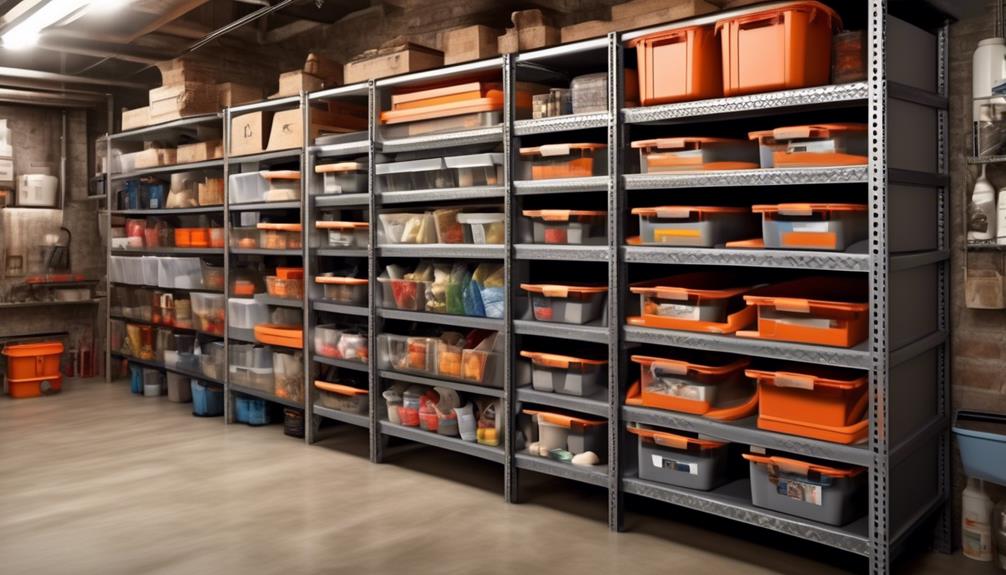

For most basements, I’d start with the VEVOR 5-Tier Adjustable Storage Shelves, 48 x 24 x 72 inches: its broad, deep shelves suit bulky bins and larger household items. The Plano 4-Shelf Plastic Storage Shelves are a practical alternative for lighter storage where moisture resistance matters, while the Amazon Basics 4-Shelf Wire Rack offers a shorter profile for low ceilings. Choosing basement shelves means balancing footprint, shelf material, height, and load capacity—and a high stated capacity does not replace checking the limits for each shelf. Read on for my full comparison and recommendations by basement layout and storage needs.

Get audio and creator gear delivered free with Prime
- Fast, free delivery on millions of items
- Prime Video, Amazon Music and more included
- Member-only deals all year
Complete the kit


Key Takeaways
- The 48-inch-wide VEVOR rack is my best overall pick because its 24-inch depth and five adjustable tiers offer room for bulky basement bins without reaching the extra-wide footprints of the 71- and 79-inch units.
- The Plano plastic unit stands apart for moisture-conscious, lighter-duty storage; it is a different kind of choice from the metal racks, not a substitute for a high-capacity shelving system.
- Several metal racks are tall and narrow. The two Sakugi options and the 36-inch VEVOR can suit tight floor plans, but their shallower footprints may be less accommodating for large totes.
- The widest and highest-capacity claims do not automatically make the best basement shelf. The 71.3-inch, 79-inch, and REIBII heavy-duty options need enough wall space and careful attention to load limits and assembly.
- Low ceilings change the ranking. The 54-inch Amazon Basics wire rack is easier to place under obstructions than the six-foot-tall models, though it offers fewer tiers and less vertical storage.




| storage shelves for basement | Shelves | Dimensions | Material | Finish |
|---|---|---|---|---|
| Sakugi 2-Pack 5-Tier Steel Gar | — | — | Metal | Powder coated, waxed |
| VEVOR 5-Tier Adjustable Storag | 5 | 18" D x 35.43" W x 71.38" H | — | — |
| Plano 4-Shelf Plastic Storage | 4 | 47.5" H x 23" L x 14" W | Impact-resistant plastic | — |
| VEVOR 5-Tier Adjustable Storag | 5 | 48" D x 24" W x 72" H | SPCC carbon steel | — |
| Amazon Basics 5-Shelf Adjustab | 5 | 36" L x 14" W x 72" H | Alloy steel | Black powder coated |
| CX 4-Tier Heavy Duty Plastic S | 4 adjustable tiers | 55 in H x 48 in W x 20 in D | Plastic | — |
| REIBII 3200LBS Heavy Duty 5-Ti | 5 adjustable tiers | 55.5 in W x 18 in D x 71 in H | Alloy steel | Powder coated |
| Sakugi 5-Tier Heavy Duty Metal | 5 adjustable tiers | 33 in W x 12.6 in D x 72 in H | Metal | Matte black |
| 71.3" Wide Heavy-Duty Garage S | 4 adjustable levels | 71.3 in W x 24 in D x 70 in H | Steel | Powder-coated matte black |
| REIBII 2400 LBS Garage Shelvin | 5 adjustable, splittable shelves | 72 in H x 35.5 in W x 11.9 in D | Metal | Powder coated |
| Storage Shelves | 5 | 13.8" D x 71.2" W x 31.5" H | Metal | Powder coated |
| 79" W Garage Heavy Duty Metal | 4 | 79" W x 24" D x 73" H | Cold-rolled steel | Powder coated, rust-proof |
| 45.6" W Garage Shelving | 5 | 45.6" W x 17.7" D x 71.2" H | — | — |
| Amazon Basics 4-Shelf Adjustab | 4 | 36" L x 14" W x 54" H | Alloy steel | Black |
| ROOMFAVE Heavy Duty Garage She | 5 | 72" H x 35.56" W x 16" D | — | — |
More Details on Our Top Picks
Sakugi 2-Pack 5-Tier Steel Garage Storage Shelves, 33.5″x12.6″x72″, Black
For basements where floor space is tight, I’d favor the Sakugi two-pack over the wider VEVOR 48-by-24-inch rack. Each unit is only 12.6 inches deep, so it can fit along a narrow wall or leave more room for walking past stored supplies. Five tiers and a stated 1,000-pound capacity per shelf suit substantial loads, while leveling feet and wall-fixing kits help address uneven floors and tall-unit stability. The finish is described as waterproof and rust-resistant, a useful combination for a basement that sees humidity. The tradeoff is the shallow shelf depth: large bins may overhang, and these units offer less front-to-back storage than the VEVOR 36-by-18-inch rack. I’d also plan for time and help to assemble and position both units.
Pros:- Two five-tier units provide storage across separate basement zones.
- Shallow 12.6-inch depth helps preserve walkway space.
- Stated capacity of 1,000 pounds per shelf supports heavy stored items.
- Leveling feet and wall-fixing kits add stability on uneven or busy basement floors.
Cons:- Shallow shelves may not fit large storage bins without overhang.
- The steel units are bulky to move, and assembling two takes time.
- The black finish is the only listed color.
Best for: Basement owners who need two tall shelving units for heavy supplies but have limited floor depth along the walls.
Not ideal for: People storing deep, oversized totes or anyone who needs a lightweight rack that is easy to move after assembly.
- Units:2
- Shelves per unit:5
- Dimensions per unit:12.6″ D x 33.5″ W x 72″ H
- Listed shelf capacity:Up to 1,000 lbs per shelf
- Material:Metal
- Finish:Powder coated, waxed
- Color:Black
- Weight per unit:19 lbs
Our verdict“Choose this two-pack if you need tall, heavy-duty shelving with a slim footprint; pick a deeper rack for large bins.”
VEVOR 5-Tier Adjustable Storage Shelves, Heavy Duty Metal Utility Rack, 36″x18″x72″
The VEVOR 36-by-18-inch rack is a practical middle ground between the narrow Sakugi units and the much broader VEVOR 48-by-24-inch model. Its 18-inch depth gives common storage bins more support, while adjustable shelves spaced in 1.5-inch increments make it easier to accommodate changing loads. The stated 400-pound shelf limit and 2,000-pound total capacity suit a basement mix of tools, containers, and heavier supplies. Another useful difference is that the rack can split into two shorter units, which can help when a full-height shelf will not fit beneath ductwork or stairs. The shelves use MDF boards rather than open wire, so they provide a more continuous surface, but the unit weighs 43 pounds and may be awkward to reposition once assembled.
Pros:- Adjustable tiers allow storage heights to match bins and equipment.
- 18-inch depth offers more support for containers than the shallow Sakugi shelves.
- Can be split into two separate racks for lower-clearance areas.
- Powder-coated carbon steel is specified as rust-resistant.
Cons:- MDF shelf boards are not all-metal construction.
- At 43 pounds, the rack can be difficult to move after assembly.
- Assembly still takes effort despite included tools.
Best for: Homeowners who want adjustable shelf spacing, room for medium-sized bins, and the option to divide one rack into two shorter sections.
Not ideal for: Basement users who need very wide shelves, prefer all-metal shelf surfaces, or expect to move the assembled rack frequently.
- Shelves:5
- Dimensions:18″ D x 35.43″ W x 71.38″ H
- Shelf load:400 lbs per shelf
- Total load capacity:2,000 lbs
- Materials:SPCC carbon steel and MDF boards
- Shelf spacing adjustment:1.5-inch increments
- Finish and color:Black powder coat
- Product weight:43 lbs
Our verdict“Pick this VEVOR when adjustable spacing and split-rack flexibility matter more than the extra width of its larger counterpart.”
Plano 4-Shelf Plastic Storage Shelves, 48” x 23” x 14”, 200lb Capacity, Durable Plastic Shelving Unit
The Plano plastic shelf makes more sense for lighter basement goods than the steel VEVOR or Sakugi racks. Its impact-resistant plastic construction avoids exposed metal shelf surfaces, and tool-free assembly keeps setup simple. At 47.5 inches tall, it is also shorter than the six-foot metal options, which can suit a low-ceiling corner or a spot beneath basement utilities. Four shelves hold up to 50 pounds each, so this is a home for cleaning supplies, pantry overflow, and lighter bins—not dense equipment or heavy bulk storage. The interlocking design lets buyers connect multiple units, but it does not make each shelf stronger. Compared with the Amazon Basics wire rack, Plano gives up height and load capacity in exchange for a plastic build and straightforward assembly.
Pros:- Impact-resistant plastic construction suits lightweight household storage.
- Tool-free assembly keeps setup straightforward.
- Interlocking design allows units to connect for expanded storage.
- Shorter height can fit beneath some basement obstructions.
Cons:- 50-pound shelf capacity rules out many heavy basement items.
- The 14-inch width may be awkward for larger storage containers.
- No wheels are listed for moving the loaded unit.
Best for: Basement users organizing lighter household supplies who want a shorter, tool-free plastic unit that can connect with another shelf.
Not ideal for: People storing heavy tools, dense supplies, or large loads that exceed 50 pounds on a shelf.
- Shelves:4
- Dimensions:47.5″ H x 23″ L x 14″ W
- Capacity per shelf:50 lbs
- Total capacity:200 lbs
- Material:Impact-resistant plastic
- Shelf thickness:1.5 inches
- Color:Black
- Assembly:Tool-free
Our verdict“Choose Plano for light supplies and simple assembly, but select a steel rack for heavier loads or taller storage.”
VEVOR 5-Tier Adjustable Storage Shelves, 2000 lbs Capacity, 48x24x72 inches
If basement storage means large bins, equipment, or stacks of supplies, this 48-by-24-inch VEVOR gives each tier considerably more room than the 36-by-18-inch VEVOR. Its five adjustable shelves are rated for 400 pounds each, with a stated 2,000-pound total capacity, making it the strongest fit in this group for bulky, heavy loads. The press-to-assemble design and ability to split the unit into two racks add flexibility, though this is still a substantial structure at 64.8 pounds. That weight helps explain why it is not a shelf I’d choose for frequent relocation. It also takes up much more floor area than the slim Sakugi units, so measure the basement path and available wall space before choosing this high-capacity option.
Pros:- Wide, deep shelves accommodate larger items than the smaller VEVOR rack.
- Each shelf is rated for 400 pounds, with 2,000 pounds total capacity stated.
- Adjustable tiers help fit varied item heights.
- Can be split into two racks to suit different storage areas.
Cons:- The 48-by-24-inch footprint consumes substantial basement floor space.
- At 64.8 pounds, moving the assembled unit is difficult.
- Assembly may still take effort despite the press-to-assemble design.
Best for: Basement owners with ample floor space who need wide, deep adjustable shelves for heavy equipment and bulky storage bins.
Not ideal for: People with narrow basement walkways, tight stair access, or a need to move shelving often.
- Shelves:5
- Dimensions:48″ D x 24″ W x 72″ H
- Shelf capacity:400 lbs per shelf
- Total load capacity:2,000 lbs
- Material:SPCC carbon steel
- Shelf thickness:1.2 mm
- Finish and color:Black powder coat
- Item weight:64.8 lbs
- Assembly:Press-to-assemble; tools included
Our verdict“Choose this model when wide, deep shelving and heavy-load capacity matter more than a compact footprint or easy relocation.”
Amazon Basics 5-Shelf Adjustable Heavy Duty Steel Wire Storage Shelves for Garage, Kitchen, 36″ x 14″ x 72″, Black
For a basement shelf that needs to go together without a separate tool kit, the Amazon Basics wire rack has a clear advantage over both VEVOR models, which use more involved assembly. Its five adjustable tiers and 1,750-pound stated capacity offer substantial storage in a 36-by-14-inch footprint, narrower than the larger VEVOR rack and deeper than the Sakugi units. The open wire shelves suit items that do not need a solid surface, but small objects or loose parts may need bins to keep them from slipping through. At 72 inches tall, it uses vertical space efficiently; the tradeoff is that the listing calls for two-person assembly, and no casters are included for moving it around the basement. I’d choose it for adaptable utility storage, not for frequent repositioning.
Pros:- Five adjustable shelves allow storage heights to change as needs evolve.
- Stated 1,750-pound total capacity supports substantial storage loads.
- Tool-free assembly avoids a separate tool setup.
- 36-by-14-inch dimensions use vertical space without the broad footprint of the 48-inch VEVOR.
Cons:- Two-person assembly is specified, despite the tool-free design.
- Open wire surfaces may not suit small loose items without bins.
- No casters are included for moving the rack.
Best for: Basement organizers who want adjustable steel wire shelving, a relatively narrow footprint, and assembly that does not require tools.
Not ideal for: Anyone storing small loose items directly on shelves, needing solid shelf surfaces, or planning to roll the loaded rack between rooms.
- Shelves:5
- Dimensions:36″ L x 14″ W x 72″ H
- Material:Alloy steel
- Finish:Black powder coated
- Weight capacity:1,750 lbs
- Shelf thickness:1 inch
- Assembly:No tools needed
- Unit weight:27.3 lbs
Our verdict“Pick this rack for adjustable, tool-free wire shelving in a compact footprint, provided open shelves suit what you plan to store.”
CX 4-Tier Heavy Duty Plastic Storage Shelves for Garage Organization
For a basement where damp air or occasional splashes make metal feel like a risk, the CX four-tier plastic rack offers a rust-proof alternative with 200 pounds of capacity per shelf. Its 48-inch width gives it more room than the narrower Sakugi five-tier unit, while the plastic construction keeps the rack lighter to move and easier to wipe down. The shelves adjust, and the included wall-mount option can help secure the setup; its modular design also suits buyers who may add storage later. The tradeoff is less confidence for unusually bulky loads: shelf thickness is not specified, and the interior dimensions may rule out larger bins. Choose it for moisture resistance and flexible household storage, not as the strongest option for dense equipment.
Pros:- Rust-proof plastic construction suits damp basement conditions better than unprotected metal.
- Each of the four shelves is rated for up to 200 pounds.
- Adjustable, modular design supports changing storage needs.
- Lightweight build and roughly 10-minute assembly make it easier to reposition than the large steel racks.
Cons:- Shelf thickness is not specified, leaving less detail for buyers judging rigidity under concentrated loads.
- Interior dimensions may not fit larger storage totes.
- Four tiers provide less vertical sorting than five-tier options such as the Sakugi unit.
Best for: Basement organizers storing household supplies, bins, or laundry items in a space where rust resistance and easy cleaning matter.
Not ideal for: Buyers storing very heavy machinery or oversized containers who need documented shelf construction and generous interior clearance.
- Shelves:4 adjustable tiers
- Capacity:200 lb per shelf
- Dimensions:55 in H x 48 in W x 20 in D
- Interior dimensions:14.68 in H x 42 in W x 16.2 in D
- Material:Plastic
- Item weight:31.4 lb
- Mounting:Wall mount included
- Assembly:Approximately 10 minutes
Our verdict“Choose the CX if rust resistance and easy handling matter more than maximum load capacity or large-bin clearance.”
REIBII 3200LBS Heavy Duty 5-Tier Adjustable Wire Shelving Unit, 55.5″ W x 18″ D x 71″ H
When basement storage needs to handle dense supplies across several levels, the REIBII five-tier wire rack offers a stated 3,200-pound total capacity, or 640 pounds per shelf. That gives it a much higher listed shelf rating than the CX plastic unit, while its five adjustable tiers create more ways to separate equipment, seasonal bins, and household stock. The powder-coated alloy-steel frame is designed to resist rust, though it is not the same moisture-proof choice as plastic for a persistently damp basement. Its 55.5-inch width and 18-inch depth also require a sizable footprint, and the assembled rack may be hard to shift. I’d pick it for heavy, organized storage, but not where narrow aisles or frequent rearranging are priorities.
Pros:- Five adjustable shelves offer more storage levels than the CX four-tier rack.
- Stated capacity of 640 pounds per shelf supports heavier loads than the plastic alternatives in this group.
- Powder-coated alloy steel is intended to resist corrosion.
- Tool-free assembly is listed at about 10 minutes.
Cons:- The 55.5-inch width and 18-inch depth need substantial floor space.
- Its heavy, bulky frame can be difficult to move once assembled.
- Powder-coated steel is not as rust-proof as the CX plastic rack in damp conditions.
Best for: Homeowners with a roomy basement who need adjustable metal shelving for heavy bins, tools, or bulk household supplies.
Not ideal for: People with narrow basement aisles, frequent layout changes, or a persistently damp area where plastic shelving is preferable.
- Shelves:5 adjustable tiers
- Total capacity:3,200 lb
- Capacity per shelf:640 lb
- Dimensions:55.5 in W x 18 in D x 71 in H
- Material:Alloy steel
- Finish:Powder coated
- Mounting:Freestanding
- Assembly:Tool-free; approximately 10 minutes
Our verdict“Choose this REIBII when heavy loads and five adjustable tiers matter more than a compact footprint or plastic’s moisture resistance.”
Sakugi 5-Tier Heavy Duty Metal Storage Shelves, 33″ W x 12.6″ D x 72″ H, Black
The Sakugi five-tier rack is the space-conscious choice here: at just 12.6 inches deep, it can fit along a basement wall or in a tighter utility area where the 18-inch-deep REIBII rack may crowd the walkway. Its 33-inch width is also easier to place than the 71.3-inch-wide steel unit in this group. The listed capacity of up to 1,000 pounds gives it useful strength for ordinary bins and supplies, and leveling feet plus a wall-fixing kit help address uneven floors and tip risk. That smaller footprint has a cost: it offers less shelf area than the REIBII and far less stated capacity than the 5,000-pound wide rack. I’d favor it for compact storage, not a basement inventory of bulky or exceptionally heavy items.
Pros:- 12.6-inch depth is shallower than the REIBII and wide 5,000-pound steel rack.
- Five adjustable shelves provide multiple storage levels in a compact area.
- Leveling feet and included wall-fixing kit support stability.
- Listed capacity reaches up to 1,000 pounds.
Cons:- Narrow shelves limit the size of bins and bulky items that can fit.
- Its listed capacity is lower than the REIBII high-capacity rack and the wide 5,000-pound model.
- Metal construction may be less suitable than the CX plastic rack for persistently damp conditions.
Best for: Basement owners fitting shelves into narrow wall runs or utility zones who need several tiers without a deep footprint.
Not ideal for: Buyers storing oversized containers or very heavy equipment who need broad shelves and a clearly higher load rating.
- Shelves:5 adjustable tiers
- Dimensions:33 in W x 12.6 in D x 72 in H
- Capacity:Up to 1,000 lb
- Material:Metal
- Finish:Matte black
- Shelf thickness:0.9 in
- Item weight:8 kg
- Stability features:Leveling feet and wall-fixing kit
Our verdict“Pick the Sakugi when basement floor space is tight and compact depth matters more than wide shelves or maximum load capacity.”
71.3″ Wide Heavy-Duty Garage Shelving Unit – 5000 lbs Capacity, Black Steel Shelf, 4 Adjustable Levels
For a basement that needs one broad, heavy-duty storage wall, this 71.3-inch steel unit pairs a 24-inch depth with a stated 5,000-pound maximum capacity. Its reinforced uprights and extra lateral bars make it the strongest listed option in this group, ahead of the REIBII five-tier rack’s 3,200-pound total rating. The four adjustable levels suit large equipment, stacked containers, or other loads that benefit from wide shelves, while the powder-coated finish is intended to resist corrosion. The tradeoffs are substantial: the 80-pound unit is difficult to move, and its width can complicate both placement and doorway access. With only four levels, it also offers less vertical separation than the five-tier choices. I’d select it for heavy, oversized storage in a roomy basement, not a tight one.
Pros:- Highest stated total capacity in this group at 5,000 pounds.
- Reinforced uprights and extra lateral bars are designed to add stability under heavy loads.
- Wide, deep shelves accommodate larger items than the Sakugi compact rack.
- Adjustable levels and interconnectable design allow configuration and expansion.
Cons:- At 80 pounds, the unit is difficult to reposition after assembly.
- Its 71.3-inch width and 24-inch depth demand considerable basement space and access clearance.
- Four shelves provide fewer separate storage levels than the five-tier options.
Best for: Homeowners with a wide, accessible basement area who need broad shelves for bulky containers, tools, or heavy equipment.
Not ideal for: People with narrow doorways, limited floor space, or a need to move or reconfigure shelving often.
- Shelves:4 adjustable levels
- Maximum capacity:5,000 lb
- Dimensions:71.3 in W x 24 in D x 70 in H
- Material:Steel
- Finish:Powder-coated matte black
- Item weight:80 lb
- Expandable configuration:Interconnectable with additional units
- Adjustability:Shelf heights adjustable
Our verdict“Choose this wide steel rack for bulky, heavy loads when your basement has the room and access to accommodate it.”
REIBII 2400 LBS Garage Shelving for Basement, Adjustable Shelving Unit
At just 11.9 inches deep, this REIBII is the shallowest option in the group, making it a practical fit beside a basement walkway or in a narrow storage zone. Its 35.5-inch width gives it more shelf span than the similarly shallow Sakugi, while the five adjustable, splittable shelves can be rearranged into two or three tiers when taller items need room. The metal frame has a powder-coated finish, and the interlocking design assembles without tools. Its 2,400-pound total capacity is substantial on paper, but the listing does not specify how that load is distributed across individual shelves. Compared with the deeper REIBII 3,200-pound rack, this model sacrifices depth and total capacity for a slimmer footprint. It suits lighter, narrow items better than deep totes or bulky equipment.
Pros:- 11.9-inch depth is the slimmest listed footprint among these five options.
- Five shelves adjust and split into alternative two- or three-tier layouts.
- Tool-free interlocking design is listed for quick assembly.
- Powder-coated metal construction is intended to resist rust.
Cons:- Shallow shelves limit fit for deep storage totes and bulky items.
- The listing does not specify how the 2,400-pound total capacity is distributed per shelf.
- Its total stated capacity is below the deeper REIBII 3,200-pound model and the wide steel rack.
Best for: Basement owners who need tall, narrow shelving for supplies, smaller bins, or utility items while keeping walkways clear.
Not ideal for: Buyers storing deep totes or bulky equipment, or those who need a stated per-shelf capacity for carefully planned heavy loads.
- Dimensions:72 in H x 35.5 in W x 11.9 in D
- Shelves:5 adjustable, splittable shelves
- Total capacity:2,400 lb
- Material:Metal
- Finish:Powder coated
- Assembly:Tool-free interlocking design
- Color:Black
- Listed room uses:Garage, basement, warehouse, kitchen, pantry, closet, living room, and office
Our verdict“Choose this REIBII for a narrow basement footprint and flexible shelf layouts, but look elsewhere for deep bins or clearly stated per-shelf load limits.”
Storage Shelves, Adjustable Garage Shelving, 5-Tier Metal Utility Rack
The main advantage here is adjustable shelving with a split design: I’d pick it when basement storage needs to change as boxes, tools, or seasonal gear rotate. At 71.2 inches wide and just 13.8 inches deep, it offers a long storage run without reaching as far into the room as the 79-inch-wide, 24-inch-deep unit in this lineup. That slimmer footprint can help preserve a walkway, though the product data does not state a weight capacity, so I would not make it my first choice for a basement full of very heavy equipment. Its rust- and scratch-resistant powder-coated metal suits utility storage, but assembly may take more effort than the no-tool Amazon Basics wire rack. The 25-pound weight also makes repositioning less convenient once it is assembled.
Pros:- Adjustable shelf heights accommodate containers and items of different sizes.
- Split-design option gives more flexibility for placement than a single fixed-length rack.
- Shallow 13.8-inch depth helps leave more open floor space than deeper heavy-duty units.
- Powder-coated metal is described as rust- and scratch-resistant.
Cons:- No weight capacity is provided, making it harder to judge suitability for heavy basement loads.
- Assembly may take effort, particularly for first-time shelving buyers.
- Limited color choice and 25-pound weight reduce flexibility after setup.
Best for: Basement organizers who want a long, shallow shelving run and may need to split the unit for separate storage areas.
Not ideal for: People storing very heavy equipment who need a published load limit, or beginners looking for the simplest no-tool assembly.
- Shelves:5
- Dimensions:13.8″ D x 71.2″ W x 31.5″ H
- Material:Metal
- Finish:Powder coated
- Adjustability:Adjustable shelf height; split design supported
- Mounting:Floor mount
- Weight:25 pounds
- Color:Black
Our verdict“Choose this rack for adaptable, shallow basement storage, but pick a unit with a stated load capacity for especially heavy items.”
79″ W Garage Heavy Duty Metal Shelving Unit, 4 Tiers, Adjustable, Black
For basement storage that means dense equipment, bulk supplies, or large containers, this rack stands apart with a stated 6,000-pound total capacity and four shelves rated up to 1,500 pounds each. Its 79-inch width and 24-inch depth offer substantially more shelf area than the ROOMFAVE 5-tier unit, making it better suited to broad, heavy loads; the tradeoff is a much larger footprint and one fewer shelf level. Adjustable shelves and cold-rolled steel make the layout useful for changing storage needs, while the rust-proof powder coating is a practical feature in a basement environment. At 69 pounds, it is far less convenient to shift after assembly than the 22-pound Amazon Basics wire rack. I’d reserve enough floor space before choosing it, since the size and lack of wheels make frequent rearranging impractical.
Pros:- Published capacity of up to 1,500 pounds per shelf and 6,000 pounds total.
- Wide, deep shelves provide substantial room for large containers and equipment.
- Adjustable shelf positions help accommodate items of different heights.
- Powder-coated, rust-proof finish is suited to utility storage.
Cons:- 79-by-24-inch footprint takes up considerable basement floor space.
- At 69 pounds, it is difficult to move once assembled.
- No wheels are included, limiting mobility and layout changes.
Best for: Homeowners with a clear, roomy basement storage zone who need high-capacity shelving for heavy tools, supplies, or bulky containers.
Not ideal for: People with narrow basement aisles, frequent layout changes, or mostly light items that do not need this rack’s size and capacity.
- Shelves:4
- Dimensions:79″ W x 24″ D x 73″ H
- Material:Cold-rolled steel
- Capacity:Up to 1,500 pounds per shelf; 6,000 pounds total
- Shelf thickness:0.75 inches
- Finish:Powder coated, rust-proof
- Weight:69 pounds
- Color:Black
Our verdict“Pick this unit when your basement needs broad, high-capacity storage and you can dedicate a permanent floor area to it.”
45.6″ W Garage Shelving, 2200LBS Heavy Duty Storage Shelves
This is a useful middle ground for basement owners who want five adjustable shelves without committing to the broad footprint of the 79-inch metal unit. At 45.6 inches wide and 17.7 inches deep, it has more depth than the slim 13.8-inch Storage Shelves rack, but its published 2,200-pound capacity gives buyers a clearer load limit than that model does. The mix of powder-coated metal framing and MDF shelves offers a practical storage surface for bins, tools, and household supplies, with a rust- and scratch-resistant finish listed for the frame. Its 71.2-inch height makes room for vertical storage, though the product data also lists a weight of just 14.8 pounds; I’d follow the assembly and loading instructions closely rather than treating the capacity figure alone as a guarantee of stability. It is floor-mounted, with no wall-mount option stated.
Pros:- Five adjustable tiers provide more separated storage levels than the four-tier wide steel unit.
- 45.6-inch width fits more readily into many basement layouts than the 79-inch rack.
- Published total capacity of 2,200 pounds helps buyers evaluate intended loads.
- Powder-coated frame is described as rust- and scratch-resistant.
Cons:- MDF shelves are not an all-metal surface.
- No wall-mount option is listed for added restraint.
- The stated 14.8-pound unit weight may make careful setup and adherence to loading guidance especially important.
Best for: Basement users who need five adjustable levels, a moderate-width footprint, and a published capacity for general household and workshop storage.
Not ideal for: Buyers who need a very wide shelf for oversized items or prefer an all-metal shelving surface rather than MDF.
- Shelves:5
- Dimensions:45.6″ W x 17.7″ D x 71.2″ H
- Capacity:2,200 pounds
- Materials:Powder-coated metal and MDF
- Shelf thickness:0.75 inches
- Mounting:Floor mount
- Weight:14.8 pounds
- Color:Black
Our verdict“Choose this for adjustable, mid-size basement storage with a stated capacity, provided MDF shelves suit the items you plan to store.”
Amazon Basics 4-Shelf Adjustable Heavy Duty Steel Wire Rack Storage Shelving, 36″ x 14″ x 54″, Black
The Amazon Basics rack is the straightforward choice when I want adjustable basement storage without a tool-heavy build. Its no-tool assembly and 22-pound weight make it easier to set up or reposition than the 69-pound, 79-inch steel unit, while its 36-by-14-inch footprint is more manageable in a compact storage area. The four wire shelves hold up to 350 pounds each, giving a clear load guideline, although its 54-inch height and 1,400-pound total capacity offer less room and capacity than the taller, higher-capacity options in this batch. Wire construction may also be less suitable than solid MDF shelves for small loose items that need a flat surface. For basement bins and larger household supplies, its simple assembly is a real advantage; for dense or oversized loads, I’d favor the wider 6,000-pound rack instead.
Pros:- No-tool assembly makes setup approachable for first-time shelving buyers.
- Four adjustable shelves allow the spacing to suit different storage items.
- Each shelf has a stated 350-pound capacity.
- Compact 36-by-14-inch footprint is easier to place in a smaller basement area.
Cons:- 54-inch height provides less vertical storage than the taller racks in this lineup.
- Wire shelves may not suit small items that need a solid, level surface.
- No wheels are included for moving the rack.
Best for: Basement beginners and renters who want a compact, adjustable rack that can be assembled without tools and moved more easily.
Not ideal for: People storing very heavy equipment, small loose items that need a solid shelf surface, or tall containers needing more than 54 inches of shelf height.
- Shelves:4
- Dimensions:36″ L x 14″ W x 54″ H
- Material:Alloy steel
- Capacity:350 pounds per shelf; 1,400 pounds total
- Assembly:No tools required
- Weight:22 pounds
- Finish:Black
Our verdict“Choose this compact wire rack for easy setup and moderate basement loads, not for maximum capacity or solid-shelf storage.”
ROOMFAVE Heavy Duty Garage Shelving, 5-Tier, 72″ H x 35.56″ W x 16″ D, Black
With a 35.56-inch width and 16-inch depth, the ROOMFAVE gives basement owners five storage levels in a relatively compact footprint. It is a better fit for narrow utility areas than the 45.6-inch-wide 2,200-pound rack, while its five tiers provide more vertical separation than the four-shelf Amazon Basics model. The listed 2,250-pound total capacity is substantial for its size, and the adjustable, split-design setup can help adapt the rack to changing storage arrangements. Its steel-and-MDF construction gives it a mixed-material shelf surface rather than an all-wire design. One caution is that the listed unit weight is only 10 pounds despite the heavy-load claim, so I would prioritize careful assembly and follow the maker’s loading and stability guidance. This is not the pick for buyers who need the deepest shelf or a clearly documented per-shelf limit.
Pros:- Compact 35.56-inch width and 16-inch depth suit tighter basement spaces.
- Five adjustable tiers provide flexible separation for different item heights.
- Published total capacity is 2,250 pounds.
- Split-design configuration offers additional placement flexibility.
Cons:- No per-shelf capacity is specified in the supplied product data.
- At 16 inches deep, the shelves may not fit larger equipment or oversized containers.
- The stated 10-pound unit weight makes careful assembly and attention to stability important.
Best for: Basement organizers with limited floor space who want five adjustable levels for bins, household supplies, and general storage.
Not ideal for: Buyers who need a stated per-shelf load rating, deep shelves for oversized equipment, or a rack primarily for very heavy concentrated loads.
- Shelves:5
- Dimensions:72″ H x 35.56″ W x 16″ D
- Materials:Powder-coated steel and MDF boards
- Capacity:2,250 pounds total
- Shelf thickness:5 millimeters
- Configuration:Adjustable; split design
- Weight:10 pounds
- Color:Black
Our verdict“Choose ROOMFAVE when compact dimensions and five adjustable tiers matter most, but favor a rack with a per-shelf rating for concentrated heavy loads.”

How We Picked
I compared these 15 shelves through the lens of basement use: usable footprint, shelf dimensions, height, material, adjustability, stated capacity, and assembly needs. Basement storage often means fitting bins around pipes, stairs, or low ceilings, so I gave practical dimensions and adaptable layouts more weight than large capacity claims alone. I also considered whether each shelf type fits its likely job, from lightweight seasonal items to heavier equipment.
The order favors racks that balance useful storage space with flexibility for common basement layouts. The 48 x 24-inch VEVOR leads for its broad, adjustable five-tier format; compact and plastic options rank well for specific constraints rather than all-purpose capacity. Very wide or high-capacity units can make sense for larger rooms and heavier loads, but their space demands and the need to verify per-shelf limits keep them from outranking more versatile picks. Where a listing does not provide detailed specifications, I avoid treating its capacity or construction as directly comparable to models with clearer details.
Factors to Consider When Choosing Storage Shelves For Basement
Basement shelving works best when it matches the room as well as the items going on it. I’d measure the route into the room, map out obstructions, and decide which items need frequent access before choosing a rack. These factors help prevent a common mistake: buying for maximum capacity when the real constraint is space, moisture, or safe access.
Measure the whole footprint, not just the wall
Record the intended shelf width, depth, and height, then include the room needed to walk past it and reach stored items. A deep rack can hold larger bins but may narrow a basement aisle or block access to a utility panel. Check stair landings, doorways, and tight turns too; a unit that fits its final position may still be awkward to bring downstairs. Mark pipes, ducts, windows, sump access, and electrical equipment before selecting a location. For storage that changes seasonally, leave room to pull bins out without shifting neighboring items.
Match the shelf material to basement conditions
Basements can have damp air, condensation, or occasional water exposure, and shelving materials respond differently. Plastic shelves can make sense for lighter items in moisture-prone areas, while metal racks offer a sturdier structure but should be kept away from standing water and checked for finish damage. Neither material solves active leaks or persistent dampness; address the moisture source before storing belongings. Keep cardboard, fabric, and important documents in sealed containers rather than relying on an open shelf to protect them. A small air gap between shelving and a wall can also help with access and airflow.
Read capacity claims at the shelf level
A total capacity figure may describe the entire unit rather than the load each tier can safely carry. Look for a stated per-shelf limit and note whether the manufacturer specifies evenly distributed weight. Dense items such as books, tools, or canned goods put more stress on a shelf than bulky but light seasonal decorations. Put heavier objects on lower tiers to reduce the risk of a top-heavy rack, and avoid placing concentrated loads at the center of a shelf unless its instructions allow it. If the listing leaves capacity details unclear, choose a model with specifications that better match the load you plan to store.
Choose adjustability for the objects you own
Adjustable tiers help when one shelf needs room for tall storage tubs and another holds smaller supplies. Before buying, measure the tallest items and their lids, handles, or wheels rather than estimating from the container label. Closely spaced shelves can waste vertical space, while large gaps may reduce the number of usable levels. Think about how the contents may change: a basement rack that stores holiday decorations now might later hold sports gear or household supplies. Adjustable shelves add flexibility, but they do not guarantee that every configuration will fit your room or meet the load limit.
Treat assembly and stability as part of the purchase
Check how the rack is assembled and whether the instructions call for tools, wall anchoring, or help from another person. Large steel units can be cumbersome to position once built, so assembly location matters in a narrow basement. A rack should sit on a level, suitable floor; uneven concrete or a floor drain can affect stability and shelf alignment. Follow the manufacturer’s guidance on anchoring and load placement rather than assuming a heavy unit cannot tip. If you expect to move the shelves often, a smaller or lighter unit may be more practical than a wide, high-capacity frame.
Pay for capacity only when your storage plan uses it
Wide, deep racks can store more, but they also take up valuable floor area and can make basement access harder. Estimate how many bins or items you will actually store, then compare that with the rack’s usable shelf dimensions. A compact rack may serve better when the room has narrow aisles or several competing uses. Spend more attention on fit, adjustability, and clear load information than on the largest capacity number in a listing. If your storage needs are uncertain, a flexible five-tier unit can be a more useful choice than an oversized rack that leaves little room to move.
Frequently Asked Questions
Are metal or plastic shelves a better choice for a damp basement?
Neither material makes a basement safe for storage if water is pooling or humidity is persistently high. Plastic shelving can be a sensible choice for lighter items where incidental moisture is a concern, while metal racks offer more options for heavy-duty storage but should be protected from standing water and inspected for damage to their finish. Keep stored goods in sealed containers and correct leaks or drainage problems first. For a damp area, the Plano plastic unit is a more relevant option than a high-capacity steel rack, but its stated capacity and intended use still matter.
Can I store heavy bins on a shelf with a large total capacity rating?
Check the per-shelf limit rather than relying on the total figure alone. A unit’s total capacity may assume weight is spread across every tier, and some listings do not make that distinction clear. Confirm whether the limit applies to evenly distributed loads, then compare it with the weight of a full bin. Place dense items on lower shelves and avoid stacking heavy containers above their stated limits. If the manufacturer’s load guidance is missing, a large advertised number is not enough to establish that the shelf suits your storage plan.
How much depth do I need for standard storage totes?
Measure the actual tote from front to back, including any lid overhang or handles, and compare that measurement with the shelf’s usable depth. A 12.6- or 14-inch-deep rack may suit smaller containers, while the 18- to 24-inch options provide more room for larger bins. Deeper shelves can hold bulkier items but may intrude into a basement walkway. Also check that you can pull a tote out without hitting a wall, pipe, or neighboring rack. Using the bins you already own as the measuring reference is more reliable than choosing by shelf depth alone.
Should I choose a taller rack or a wider one for basement storage?
Choose based on the room’s constraints and what you need to store, not on capacity figures alone. A tall, narrow unit makes better use of limited floor space when the ceiling is clear, while a wider rack can be easier to organize for large bins and items used often. Low ceilings, ducts, and stair slopes may make a shorter rack such as the 54-inch Amazon Basics model a better fit. Wider units need enough clearance to assemble and reach the shelves. Measure the full installation area and keep access to utilities in mind before choosing either shape.
Do basement storage shelves need to be anchored to a wall?
Follow the specific manufacturer’s instructions, since anchoring guidance can vary by design and setup. A tall, loaded rack may be more vulnerable to tipping if weight is placed high or unevenly, and anchoring can reduce that risk when the wall and hardware are suitable. Do not assume a heavy frame is stable on its own, especially on an uneven floor or in a household where children may climb. Place the unit on a level surface, load heavier items low, and use the recommended hardware. If the wall is concrete or finished with unusual materials, use an anchoring method rated for that surface.
Conclusion
For most buyers, I recommend the 48 x 24-inch VEVOR five-tier rack as the best overall: it balances adjustable storage with room for bulky basement bins. The Plano plastic shelves are my best value-style pick for lighter, moisture-conscious storage, while buyers prioritizing a smaller footprint should compare the narrow Sakugi racks and the 36 x 18-inch VEVOR. For a premium, high-capacity direction, look at the wide 71.3-inch rack or the REIBII heavy-duty models only if your basement has the floor space and your loads justify that scale. Beginners should favor a clearly sized, adjustable rack and verify assembly and load instructions before filling it. If your main constraint is a low ceiling, the 54-inch Amazon Basics unit is the specific-fit choice; measure first, then select the rack that solves your actual space or storage problem.