
Choosing a NAS for a WiFi 6E home is less about finding a NAS with WiFi 6E and more about matching storage capacity and wired networking to your wireless setup. Neither enclosure listed here has built-in WiFi 6E; both connect to a router or switch over Ethernet, so wireless performance depends on the network equipment and client devices around them. My best overall pick is the UGREEN NAS DXP2800, whose newer Intel N100 platform, 2.5GbE port, and two M.2 slots suit a capable home server without an eight-bay footprint. For buyers who need room to grow and have fast wired infrastructure, the ASUSTOR Lockerstor 8 brings eight drive bays and dual 10GbE ports. The tradeoff is straightforward: UGREEN is the more approachable choice for mixed home workloads, while ASUSTOR prioritizes capacity and network throughput at the cost of more drive planning and higher stated power consumption.

Get audio and creator gear delivered free with Prime
- Fast, free delivery on millions of items
- Prime Video, Amazon Music and more included
- Member-only deals all year
Complete the kit


Key Takeaways
- Neither model has built-in WiFi 6E; both need a wired Ethernet connection to the router or network switch.
- The UGREEN DXP2800 is the more balanced home pick, with Intel N100 processing, 8GB DDR5, 2.5GbE, and dual M.2 slots.
- The ASUSTOR Lockerstor 8 is the capacity-first choice, offering eight drive bays and dual 10GbE ports for a suitably equipped network.
- A WiFi 6E router cannot make a NAS connection faster than its Ethernet port; the UGREEN‘s listed 2.5GbE and ASUSTOR‘s 10GbE interfaces set different wired ceilings.
- Both are diskless, so the final storage budget and usable capacity depend on the drives and RAID or storage configuration you choose.
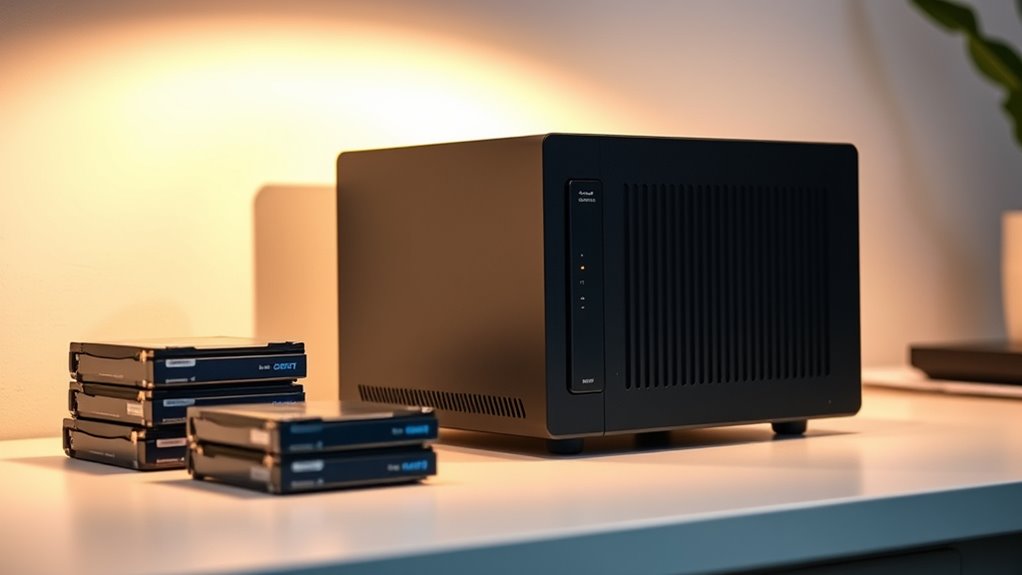
| UGREEN NAS DXP2800 2-Bay for Advanced Home Users, Remote Workers & Creators |  | Best Overall for Advanced Home Users | Drive bays: 2 SATA bays | Processor: Intel N100 quad-core | Memory: 8GB DDR5 | VIEW ON AMAZON | See Our Full Breakdown |
| Asustor Lockerstor 8 (AS6508T) 8-Bay NAS – Network Storage Enclosure with Quad-Core 2.1 GHz CPU, 8 GB DDR4 RAM, M.2 NVMe SSD Cache |  | Best for High-Capacity, Fast Wired Networks | Drive bays: 8 x 3.5-inch SATA | Processor: Intel Atom C3538 quad-core, 2.1GHz | Memory: 8GB DDR4-2133 | VIEW ON AMAZON | See Our Full Breakdown |
| wifi 6e nas enclosure | Drive bays | Processor | Memory | Listed maximum capacity |
|---|---|---|---|---|
| UGREEN NAS DXP2800 2-Bay for A | 2 SATA bays | Intel N100 quad-core | 8GB DDR5 | Up to 80TB; verify supported drive and configuration limits |
| Asustor Lockerstor 8 | 8 x 3.5-inch SATA | Intel Atom C3538 quad-core, 2.1GHz | 8GB DDR4-2133 | Up to 144TB; usable capacity depends on drive and storage configuration |
More Details on Our Top Picks
UGREEN NAS DXP2800 2-Bay for Advanced Home Users, Remote Workers & Creators
The UGREEN DXP2800 is my best overall choice because it pairs a sensible two-bay footprint with enough processing and expansion headroom for more than basic file sharing. Its Intel N100 quad-core processor and 8GB DDR5 RAM suit home users who want to run a media library, backup jobs, Docker applications, or supported virtual machines alongside everyday storage. Compared with the Lockerstor 8, it is a more compact and less capacity-heavy direction rather than a high-throughput, many-disk appliance.
For a WiFi 6E household, the important network detail is its 2.5GbE connection. That is faster than a standard gigabit link when the NAS, router or switch, and client path all support multi-gig Ethernet. It does not make the enclosure a WiFi 6E device, and a wireless client will still depend on signal quality, router capability, and network congestion. If your network only offers gigabit Ethernet, the port’s extra headroom will not by itself produce faster transfers.
Two M.2 NVMe slots add flexibility for cache or other supported storage uses, while the two SATA bays keep the main drive setup manageable. The supplied description cites up to 80TB, but actual capacity and redundancy depend on the drives and storage configuration. UGREEN also lists AI-assisted surveillance features and cross-device access; those may matter to creators or households centralizing recordings and media, though they are not substitutes for checking software compatibility with your specific cameras and workflow.
The main compromise is scale. Two bays leave less room to expand than the ASUSTOR’s eight, and buyers must provide the drives. This is the better fit for someone building a versatile home NAS, not for an organization planning a large multi-disk archive or needing dual 10GbE. I would choose it over the Lockerstor 8 when processing flexibility and a modest footprint matter more than maximum drive count.
Pros:- Intel N100 quad-core processor and 8GB DDR5 suit varied home-server tasks.
- 2.5GbE can exceed gigabit transfer limits when the rest of the wired network supports it.
- Dual M.2 NVMe slots add storage or cache flexibility.
- Docker, virtual-machine, and media-server support broaden its role beyond file storage.
Cons:- Diskless design means drives must be selected and purchased separately.
- Two drive bays offer less expansion room than the ASUSTOR Lockerstor 8.
- Its 2.5GbE port is not a WiFi 6E connection and is slower on paper than the ASUSTOR’s 10GbE ports.
Best for: Home creators, remote workers, and advanced users who want a two-bay NAS for backups, media serving, and light Docker or VM workloads on a multi-gig home network.
Not ideal for: Buyers who need eight drive bays, dual 10GbE networking, a ready-to-use unit with drives included, or a basic storage box with minimal setup.
- Drive bays:2 SATA bays
- Processor:Intel N100 quad-core
- Memory:8GB DDR5
- Ethernet:2.5GbE
- M.2 slots:2 NVMe slots
- Listed maximum capacity:Up to 80TB; verify supported drive and configuration limits
- Drive inclusion:Diskless; drives sold separately
- Platform:x86
Our verdict“I recommend the UGREEN DXP2800 for a flexible home NAS that balances processing, 2.5GbE networking, and a manageable two-bay setup.”
Asustor Lockerstor 8 (AS6508T) 8-Bay NAS – Network Storage Enclosure with Quad-Core 2.1 GHz CPU, 8 GB DDR4 RAM, M.2 NVMe SSD Cache
The ASUSTOR Lockerstor 8 takes the opposite approach to the UGREEN: it prioritizes drive count and wired network capability over a compact, two-bay home-server format. Eight 3.5-inch SATA bays give buyers more room to build a large storage pool, separate projects, or plan for future capacity changes. Its listed maximum is up to 144TB, though usable space depends on the installed drives and chosen storage layout rather than the headline figure alone.
The standout feature for a WiFi 6E setup is not wireless hardware but dual 10GbE ports, plus two 2.5GbE ports. Those interfaces can serve a fast wired network, but they are most useful when the NAS connects to compatible switches, routers, or computers. Link aggregation can combine links for supported networking scenarios; it should not be mistaken for a promise that one device will see a single transfer at the combined headline rate. Compared with the UGREEN’s 2.5GbE port, the ASUSTOR offers substantially more wired headroom, provided the rest of the network can use it.
The Intel Atom C3538 quad-core processor and 8GB DDR4 memory are paired with M.2 NVMe SSD cache support. That makes the enclosure more compelling for a growing shared archive or a busy wired environment than for a buyer seeking the newest-feeling small home server. The supplied details do not establish that its processor is a better fit for every application than the UGREEN’s N100; I would select this model primarily for its bays and ports, not assume it wins every compute workload.
There are practical costs to that capacity-first design. The unit is larger and weighs 6.2kg, its listed power consumption is 66.9W, and it arrives without drives. It is also more appliance-like than a modest two-bay setup, so a casual user may pay in space, drive planning, and ongoing energy use for capacity they never need. I would choose it over the UGREEN when eight bays and dual 10GbE are genuine requirements, not simply because the numbers are bigger.
Pros:- Eight SATA bays provide far more drive-bay capacity and expansion room than the UGREEN.
- Dual 10GbE and dual 2.5GbE ports offer broad wired-network options.
- M.2 NVMe cache support can help suit workloads with repeated data access.
- ADM operating system and two expansion slots support a more expandable NAS setup.
Cons:- Listed power consumption is 66.9W, making it a less appealing fit for a low-power, always-on setup.
- Diskless design requires a separate investment in compatible drives.
- Its larger, heavier eight-bay chassis is more than many simple home-storage setups need.
Best for: Small offices, media teams, and experienced home-lab users who need eight bays and can connect the NAS to a compatible multi-gig or 10GbE wired network.
Not ideal for: Casual home users who only need a few terabytes, buyers focused on low power use or a small enclosure, and anyone expecting built-in WiFi 6E or included drives.
- Drive bays:8 x 3.5-inch SATA
- Processor:Intel Atom C3538 quad-core, 2.1GHz
- Memory:8GB DDR4-2133
- Network interfaces:2 x 10GbE and 2 x 2.5GbE
- M.2 support:NVMe SSD cache
- Listed maximum capacity:Up to 144TB; usable capacity depends on drive and storage configuration
- Power consumption:66.9W listed
- Operating system:ASUSTOR Data Master (ADM)
- Drive inclusion:Diskless; drives sold separately
Our verdict“I recommend the Lockerstor 8 when drive capacity and 10GbE connectivity matter more than size, power draw, and a simpler two-bay setup.”

How We Picked
I ranked these two products for buyers searching for a WiFi 6E NAS enclosure by focusing on what actually shapes a NAS experience on a modern home network: its wired Ethernet capability, number of drive bays, processor and memory, expansion options, and likely fit for the owner’s workload. A WiFi 6E access point handles wireless links for phones and laptops, but these NAS units connect to the network by Ethernet. I do not treat either product as a WiFi 6E device, because the supplied details do not list built-in WiFi 6E.
The UGREEN ranks first because it balances home-server flexibility with a compact two-bay design. Its Intel N100 processor, 8GB DDR5 memory, 2.5GbE, and dual M.2 slots make it the more adaptable fit for file storage, media serving, and light virtualization. The ASUSTOR ranks second overall, but first for capacity and high-speed wired networking: its eight bays and dual 10GbE ports are meaningful advantages when a household or small office has many drives and compatible network gear. Its stated 66.9W power consumption and larger chassis make it a less natural fit for a simple home backup target.
I also weighed the practical caveats. Both models are diskless, so neither is ready for storage until drives are bought and installed. Drive-bay count alone does not establish usable capacity or data protection; those depend on drive sizes and the chosen storage layout. I use the listed specifications and descriptions as supplied, and avoid treating advertised maximum capacity or link aggregation figures as guaranteed real-world transfer speeds.
| wifi 6e nas enclosure | Processor | Listed maximum capacity |
|---|---|---|
| UGREEN NAS DXP2800 2-Bay for A | Intel N100 quad-core | Up to 80TB; verify supported drive and configuration limits |
| Asustor Lockerstor 8 | Intel Atom C3538 quad-core, 2.1GHz | Up to 144TB; usable capacity depends on drive and storage configuration |
Factors to Consider When Choosing Wifi 6e Nas Enclosures
When I compare NAS enclosures for a WiFi 6E home, I separate the wireless network from the storage device. WiFi 6E connects wireless clients to an access point; these enclosures use wired Ethernet to join the local network. The best match depends on whether your priority is a balanced home server or a large, fast wired storage system.
WiFi 6E does not replace Ethernet planning
Neither listed NAS has built-in WiFi 6E in the supplied specifications. Plan to connect the enclosure by Ethernet to your router or a switch. A WiFi 6E laptop can access files over its wireless link, but its speed is limited by the whole path: wireless conditions, access-point capabilities, router or switch connections, and the NAS port. The UGREEN’s 2.5GbE port is a practical step above gigabit when the network supports it. The ASUSTOR’s 10GbE ports offer more wired headroom, but only make sense with compatible networking equipment and clients.
Choose bay count for the storage plan you have
The UGREEN has two SATA bays, which keeps a straightforward home setup relatively manageable but limits room for future drives. The ASUSTOR has eight bays, which suits larger archives and buyers who want more options for drive selection and storage layouts. More bays do not automatically mean more protected or usable capacity. I would decide based on the amount of data, backup strategy, and storage configuration you need, then check supported drive capacities before buying. Both products are diskless, so add drive selection to the planning process.
Match processing and expansion to your workload
For a mixed home-server role, the UGREEN’s Intel N100 and 8GB DDR5 are paired with stated Docker, virtual-machine, and media-server support. That makes it the stronger fit here for buyers who want applications as well as shared files. ASUSTOR’s Atom C3538, 8GB DDR4, and NVMe cache support belong to a design centered on multiple drives and fast network links. Cache may help with recurring access patterns, but it does not replace adequate RAM, network capacity, or a sensible storage layout. Check software compatibility for your intended services before choosing either enclosure.
Account for size, power, and drive costs
A diskless NAS needs compatible drives before it can provide storage, and an eight-bay system can require more drives to realize its capacity advantage. The ASUSTOR’s listed 66.9W power consumption is a relevant planning detail for an always-on system; actual usage varies by configuration and activity. The UGREEN is the smaller two-bay path, though its drive costs still depend on what you install. I would avoid choosing a larger chassis solely for future flexibility if the added bays and networking would remain unused.
Frequently Asked Questions
Do either of these NAS enclosures have built-in WiFi 6E?
The supplied specifications do not list WiFi 6E for either model. Both connect to a network through Ethernet. A WiFi 6E router or access point can still let wireless devices reach the NAS, but the NAS itself is not a WiFi 6E client or access point based on the information provided.
Which enclosure is the better fit for a WiFi 6E home network?
For most advanced home users, I would start with the UGREEN DXP2800 because its 2.5GbE port, Intel N100 processor, and two M.2 slots balance home-server features with a two-bay design. Choose the ASUSTOR Lockerstor 8 if you need eight bays and have compatible 10GbE networking. A WiFi 6E router alone does not make the ASUSTOR’s faster Ethernet useful; the rest of the wired path needs to support it.
Are hard drives included with either NAS?
No. Both products are described as diskless enclosures, so you need to buy and install drives separately. Before purchasing drives, check each manufacturer’s supported drive information and plan the storage layout around your capacity, backup, and redundancy needs. The advertised maximum capacity is not the same as usable capacity after configuration.
Is 10GbE worth choosing over 2.5GbE for a home NAS?
It depends on the wired network and the work involved. The UGREEN’s 2.5GbE can improve transfers over gigabit when the NAS, switch or router, and client path all support multi-gig Ethernet. The ASUSTOR’s dual 10GbE ports are more appropriate for compatible high-throughput networks and larger shared workloads. For ordinary wireless access, a faster NAS port may not change the experience if WiFi conditions or another network link is the limiting factor.
Should I choose two bays or eight bays?
Pick two bays if your planned storage needs are modest and you want a simpler home setup; the UGREEN also brings strong application flexibility for its category. Pick eight bays if you need a larger drive pool, expect substantial growth, or have a specific multi-drive storage plan. More bays bring added hardware and drive planning, and they do not remove the need for a separate backup strategy.
Conclusion
I would choose the UGREEN DXP2800 for an advanced home setup that needs a capable processor, 2.5GbE, and room for media or application workloads without eight drive bays. It is the clearest all-around fit in this comparison, as long as you are comfortable buying drives separately. For a small office, media archive, or home lab with a compatible fast wired network, the ASUSTOR Lockerstor 8 is the more suitable capacity-first choice: its eight bays and dual 10GbE ports make its larger chassis and higher stated power use easier to justify. If your only goal is basic storage over WiFi 6E, either may be more NAS than you need; neither includes WiFi 6E, and the network’s Ethernet path matters as much as the wireless router.