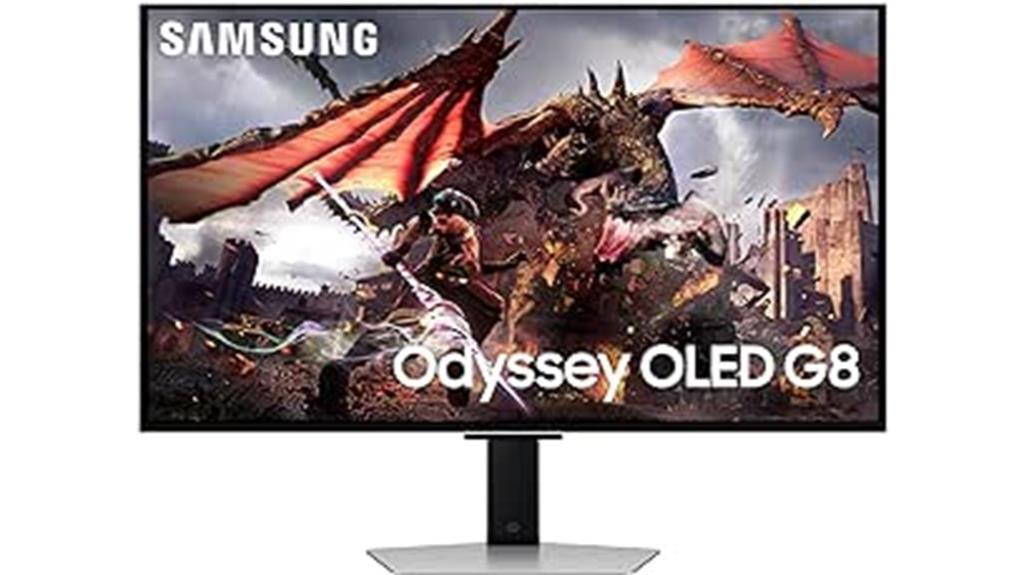

Choosing a Samsung Odyssey G8 means deciding what you want the screen to prioritize: sharper desktop detail, fast competitive play, immersive contrast, or a wider cinematic view. In this comparison, the 27-inch G80HF stands out for its 5K-and-QHD dual modes, while the 32-inch Neo G8 pairs 4K with a curved VA panel and a 240Hz refresh rate. The 34-inch OLED G8 is my pick for ultrawide OLED immersion, and the 32-inch G80HS aims furthest into high-resolution territory with 6K.

Get audio and creator gear delivered free with Prime
- Fast, free delivery on millions of items
- Prime Video, Amazon Music and more included
- Member-only deals all year
Those strengths come with different compromises. Resolution and refresh-rate figures do not tell the whole story: panel type changes contrast and motion character, screen size affects desk fit, and the OLED model has a different long-term care concern from the IPS and VA options. I rank these monitors by how clearly each serves a distinct buyer, not by treating the highest specification as an automatic win.
Complete the kit


Key Takeaways
- Best all-round dual-mode balance: The 27-inch G80HF switches between 5K at 180Hz and QHD at 360Hz, making it the clearest choice for someone who alternates between detail-focused games and competitive play.
- Best curved 4K gaming fit: The 32-inch Neo G8 combines 4K, 240Hz, a 1000R curve, and VA contrast, but its compact-screen alternatives are easier to fit on a small desk.
- Best OLED ultrawide experience: The 34-inch G85SD offers a 21:9 OLED screen and 0.03ms response time; buyers who leave static interface elements displayed for long periods should weigh its burn-in risk.
- Best for maximum pixel detail: The 32-inch G80HS reaches 6K resolution and has a 330Hz 3K mode, but the supplied specifications do not name the 6K-mode refresh behavior beyond 165Hz.
- Choose by panel and use, not just resolution: Fast IPS favors wide viewing angles and dual-mode versatility, VA emphasizes contrast and curvature, and OLED delivers its own ultrawide visual character with a distinct upkeep tradeoff.
| Samsung 27″ Odyssey G8 (G80HF) Gaming Monitor – 5K Resolution, Fast IPS |  | Best Overall: the most adaptable resolution-and-refresh combination | Screen size: 27 inches | Resolution: 5120 x 2880 (5K) | Refresh modes: 180Hz at 5K; 360Hz at QHD | VIEW ON AMAZON | See Our Full Breakdown |
| Samsung 32″ Odyssey Neo G8 (G85NB) 4K UHD 240Hz 1ms G-Sync Curved Gaming Monitor |  | Best Curved 4K Pick: a focused, high-refresh VA gaming display | Screen size: 32 inches | Resolution: 3840 x 2160 (4K UHD) | Refresh rate: 240Hz | VIEW ON AMAZON | See Our Full Breakdown |
| Samsung 34″ Odyssey OLED G8 G85SD Curved Gaming Monitor Bundle with Accessories |  | Best OLED Ultrawide: a cinematic format for games and entertainment | Screen size: 34 inches | Resolution: Ultra-WQHD | Aspect ratio: 21:9 | VIEW ON AMAZON | See Our Full Breakdown |
| Samsung 32″ Odyssey G8 (G80HS) Gaming Monitor, 6K Resolution, Fast IPS |  | Best for Maximum Pixel Detail: 6K clarity with a high-speed secondary mode | Screen size: 32 inches | Resolution: 6144 x 3456 (6K) | Refresh modes: 165Hz at 6K; 330Hz at 3K | VIEW ON AMAZON | See Our Full Breakdown |
| samsung odyssey g8 monitor review | Screen size | Resolution | Panel | Response time |
|---|---|---|---|---|
| Samsung 27" Odyssey G8 | 27 inches | 5120 x 2880 (5K) | Fast IPS | 1ms |
| Samsung 32" Odyssey Neo G8 | 32 inches | 3840 x 2160 (4K UHD) | VA | 1ms GTG |
| Samsung 34" Odyssey OLED G8 G8 | 34 inches | Ultra-WQHD | OLED | 0.03ms |
| Samsung 32" Odyssey G8 | 32 inches | 6144 x 3456 (6K) | Fast IPS | 1ms |
More Details on Our Top Picks
Samsung 27″ Odyssey G8 (G80HF) Gaming Monitor – 5K Resolution, Fast IPS
I rank the 27-inch G80HF first because its dual-mode approach gives buyers a practical choice between two very different priorities. At 5K and 180Hz, it targets crisp detail for high-resolution games and work; switching to QHD at up to 360Hz shifts the emphasis toward exceptionally fast play. Neither mode is a universal answer, but this range makes the G80HF more adaptable than the fixed 4K-and-240Hz emphasis of the Neo G8.
Its Fast IPS panel and 178-degree viewing angle suit shared viewing and setups where consistent color across the screen matters. G-SYNC and FreeSync Premium support add options for reducing tearing with compatible systems. The 27-inch footprint is easier to place than the 32-inch G80HS, though the very high pixel count still makes the source computer and connection choices part of the buying decision. The listed DisplayPort 2.1 and HDMI 2.1 inputs give it a modern connection mix, while height, pivot, tilt, and swivel adjustments help with positioning.
The tradeoff is that this is a feature-dense monitor whose value depends on using its modes. Buyers who want a simple plug-in 4K display may prefer the Neo G8’s more straightforward resolution and refresh pairing. I would also avoid assuming that 360Hz applies at 5K: the supplied details associate that maximum with QHD, while 5K is listed at 180Hz. It is my best overall pick for flexibility, not for people who want the largest picture or OLED contrast.
Pros:- Dual modes pair 5K at 180Hz with QHD at 360Hz
- Fast IPS panel and 178-degree viewing angle
- G-SYNC and FreeSync Premium support
- Height, pivot, tilt, and swivel adjustments
Cons:- The 360Hz mode is listed at QHD, not 5K
- Its many modes and high-end capabilities may be unnecessary for simpler setups
- The 27-inch screen is less immersive than the 32- and 34-inch alternatives
Best for: Players who switch between visually detailed games and high-refresh competitive titles, and who want an adjustable 27-inch IPS display.
Not ideal for: Buyers seeking a large curved screen, OLED contrast, or a straightforward fixed-resolution monitor without mode choices.
- Screen size:27 inches
- Resolution:5120 x 2880 (5K)
- Refresh modes:180Hz at 5K; 360Hz at QHD
- Panel:Fast IPS
- Response time:1ms
- Sync support:G-SYNC and FreeSync Premium
- Connections:DisplayPort 2.1, HDMI 2.1, USB hub
- Stand adjustment:Height, pivot, tilt, and swivel
Our verdict“I recommend the G80HF to buyers who want one G8 that can favor either 5K detail or QHD speed, provided they are comfortable choosing between those modes.”
Samsung 32″ Odyssey Neo G8 (G85NB) 4K UHD 240Hz 1ms G-Sync Curved Gaming Monitor
The Neo G8 G85NB is the strongest choice for someone who wants a large, curved 4K gaming screen without moving to the OLED ultrawide format. Its 32-inch panel runs at 240Hz, and its 1000R curve wraps the viewing area more closely than the flatter IPS options here. That curve is a meaningful part of its appeal: it makes this model feel designed around sitting directly in front of the screen, rather than serving as a flexible shared-viewing display.
Unlike the G80HF and G80HS, this model uses a VA panel and lists Quantum Matrix Technology and Quantum HDR2000. Its stated 1,000,000:1 contrast ratio points to a different visual emphasis from the IPS G8 models, while the matte finish is intended to reduce reflections. FreeSync Premium Pro and G-SYNC support broaden its appeal across compatible systems. Compared with the G80HF, you give up dual resolution modes and a 360Hz option, but gain a larger curved 4K presentation with a defined 240Hz target.
The main drawback is physical commitment. At 32 inches with a pronounced curve, it asks for enough desk space and a viewing position that suits its shape; it is less adaptable than the 27-inch G80HF for varied seating. The supplied details also list 40.8 watts of power consumption, a point worth factoring into a setup used for long sessions. I place it second because its 4K-and-240Hz package is compelling, but less versatile than the G80HF’s two-mode design.
Pros:- 4K UHD resolution with a 240Hz refresh rate
- 1000R curve creates a close, immersive viewing position
- VA panel with Quantum Matrix Technology and listed 1,000,000:1 contrast
- FreeSync Premium Pro and G-SYNC support
Cons:- 32-inch curved format needs space and a suitable central viewing position
- Does not offer the dual-mode 5K/QHD choice of the G80HF
- Listed power consumption is 40.8 watts
Best for: Gamers who sit centrally, have room for a 32-inch curved display, and want 4K at 240Hz with VA contrast.
Not ideal for: People with narrow desks, viewers who regularly share the screen from different angles, or players who want dual-mode refresh flexibility.
- Screen size:32 inches
- Resolution:3840 x 2160 (4K UHD)
- Refresh rate:240Hz
- Panel:VA
- Curvature:1000R
- Response time:1ms GTG
- HDR and contrast:Quantum HDR2000; listed 1,000,000:1 contrast ratio
- Connections:2 HDMI, 2 USB
Our verdict“I would choose the Neo G8 over the G80HF when a curved 32-inch 4K experience matters more than dual-mode flexibility.”
Samsung 34″ Odyssey OLED G8 G85SD Curved Gaming Monitor Bundle with Accessories
The 34-inch Odyssey OLED G8 G85SD takes a different route from the first two picks: it trades the G80HF’s resolution switching and the Neo G8’s 4K 16:9 layout for an 21:9 Ultra-WQHD OLED screen. That wider shape suits games and media that can use the extra horizontal space, and it gives desktop work more room for side-by-side windows. Its 175Hz refresh rate is lower than the Neo G8’s 240Hz and the G80HF’s QHD 360Hz mode, so I see it as an immersion-first option rather than the ranking leader for maximum listed speed.
OLED is the defining distinction. The listed 0.03ms response time and wide-color description make this the specialist choice for buyers who prize rapid response and OLED presentation. HDMI, DisplayPort, and USB are listed, and this bundle includes cables, a remote, and a 26-month extended protection plan. Those extras may be useful, but they do not change the underlying display format: buyers should choose it for the ultrawide OLED screen, not simply for the accessory package.
There is a real ownership tradeoff. The product information flags potential OLED burn-in, so people who keep static interface elements on screen for extended periods should weigh their habits before choosing it. It also has a narrower appeal than the IPS G80HF: the G85SD does not offer the same listed high-refresh dual modes, and its ultrawide aspect ratio may not suit every game or application. I rank it third because it has a clear, distinctive purpose, but it is less broadly adaptable than the two leading picks.
Pros:- 34-inch OLED display in a wide 21:9 format
- 175Hz refresh rate and listed 0.03ms response time
- HDMI, DisplayPort, and USB connectivity
- Bundle includes cables, a remote, and a 26-month extended protection plan
Cons:- OLED burn-in is a potential ownership concern
- 175Hz is below the Neo G8’s 240Hz and the G80HF’s QHD 360Hz mode
- Ultra-WQHD and 21:9 may not fit every game or workspace
Best for: Gamers and entertainment viewers who want a 34-inch OLED ultrawide with a fast listed response time and value the included bundle accessories.
Not ideal for: Buyers who leave static content displayed for long stretches, need a conventional 16:9 layout, or prioritize the highest refresh modes in this lineup.
- Screen size:34 inches
- Resolution:Ultra-WQHD
- Aspect ratio:21:9
- Panel:OLED
- Refresh rate:175Hz
- Response time:0.03ms
- Connections:HDMI, DisplayPort, USB
- Bundle protection:26-month extended protection plan
Our verdict“I recommend the G85SD for buyers who put OLED ultrawide immersion ahead of burn-in concerns and maximum refresh-rate flexibility.”
Samsung 32″ Odyssey G8 (G80HS) Gaming Monitor, 6K Resolution, Fast IPS
The 32-inch G80HS is the most resolution-focused monitor here. Its 6K panel provides more stated pixels than the 5K G80HF, while its dual modes offer 165Hz at 6K and 330Hz at 3K. That pairing makes it an appealing specialist for someone who wants very fine detail for supported content but also wants a faster mode available for games. Compared with the G80HF, it gives you a larger screen and higher top resolution, while the G80HF has the higher listed refresh figure in its QHD mode and a smaller footprint.
Fast IPS, a 1ms response time, and 178-degree viewing angles place it closer to the G80HF than to the VA Neo G8 or OLED G85SD. G-SYNC and FreeSync compatibility are listed, as is HDR10+ support, so its brief is broad gaming capability around high resolution rather than a curved or ultrawide presentation. At 32 inches, it gives 6K detail more room to occupy than the 27-inch G80HF, though its 16:9 shape remains conventional compared with the G85SD’s 21:9 canvas.
I place the G80HS fourth not because its resolution is modest, but because the supplied information leaves buyers with more uncertainty around the practical fit. It lists HDMI, DisplayPort, and one USB port, but the feature description gives less detail about additional connectivity and convenience than the G80HF. Its 100-watt power consumption is also the highest stated in this lineup. Buyers should confirm that their computer and intended connection can support their chosen mode; those who do not specifically need 6K may find the G80HF’s clearer flexibility or the Neo G8’s defined 4K 240Hz setup an easier match.
Pros:- 6K resolution at 6144 x 3456
- Dual modes list 165Hz at 6K and 330Hz at 3K
- Fast IPS panel with 1ms response time and wide viewing angles
- G-SYNC, FreeSync, and HDR10+ support are listed
Cons:- Listed power consumption is 100 watts
- The supplied information provides less detail on convenience features than the G80HF listing
- Its 6K capability may be unnecessary for buyers who prefer a defined 4K 240Hz or OLED ultrawide setup
Best for: Buyers who want a 32-inch 6K IPS display and value having a 3K high-refresh mode for supported games.
Not ideal for: Anyone who does not need 6K, wants a curved or OLED screen, or prefers a monitor with more fully described connection and convenience features.
- Screen size:32 inches
- Resolution:6144 x 3456 (6K)
- Refresh modes:165Hz at 6K; 330Hz at 3K
- Panel:Fast IPS
- Response time:1ms
- HDR and synchronization:HDR10+, G-SYNC, and FreeSync compatibility
- Connections:2 HDMI, 1 DisplayPort, 1 USB
- Power consumption:100 watts
Our verdict“I would pick the G80HS only when 6K detail is the main goal and the 3K 330Hz mode is a useful bonus rather than a substitute for the G80HF’s broader clarity.”

How We Picked
I compared these four Odyssey G8 listings by the decisions that most affect daily use: screen size and shape, resolution, available refresh modes, panel type, and gaming synchronization support where the supplied specifications name it. I also considered practical fit, including stand adjustment, ports, and how much desk space a 27-, 32-, or 34-inch display is likely to claim. That makes the ranking useful to buyers choosing a monitor for a real setup rather than simply comparing headline numbers.
The list spans different generations and formats, so I did not assume every model is a direct substitute for every other one. The G80HF and G80HS are fast IPS displays with dual modes; the Neo G8 is a curved VA monitor designed around 4K and 240Hz; and the G85SD is an OLED ultrawide bundle. I give each a distinct role based on that identity. Features absent from the supplied product information are not treated as confirmed, and I do not infer performance beyond the stated specifications. The ordering favors the option with the broadest clearly described balance first, followed by more specialized choices.
| samsung odyssey g8 monitor review | Panel |
|---|---|
| Samsung 27" Odyssey G8 | Fast IPS |
| Samsung 32" Odyssey Neo G8 | VA |
| Samsung 34" Odyssey OLED G8 G8 | OLED |
| Samsung 32" Odyssey G8 | Fast IPS |
Factors to Consider When Choosing Samsung Odyssey G8 Monitor Review
I would narrow this group by asking three questions: which screen format suits your desk, which panel tradeoff matches your use, and which refresh mode you can actually use with your gaming system. A headline resolution or response-time figure cannot answer all three.Match resolution and refresh mode to your games
The G80HF and G80HS both use dual modes, so their headline refresh figures apply to different resolutions. The G80HF lists 5K at 180Hz and QHD at 360Hz; the G80HS lists 6K at 165Hz and 3K at 330Hz. If you mainly play competitive games, the lower-resolution high-refresh mode may be the more relevant one. If fine detail matters more, compare the stated high-resolution mode instead. The Neo G8 offers a simpler 4K-and-240Hz pairing, while the G85SD’s 175Hz sits within a wider OLED format.
Before choosing, check your graphics hardware, connection, and game settings against the mode you plan to use. A monitor’s maximum listed figure does not mean every game or setup will reach it. This is especially important for the 5K and 6K choices, where a buyer may prioritize sharpness but need to adjust settings to reach high frame rates.
Choose a panel for the tradeoff you prefer
Fast IPS is the shared foundation of the G80HF and G80HS, with wide viewing angles and dual-mode flexibility. The Neo G8’s VA panel is paired with a 1000R curve and a high stated contrast ratio, making it the more focused choice for a seated, immersive 4K setup. The G85SD’s OLED panel and 0.03ms listed response time are aimed at buyers who want an ultrawide OLED experience, but the product information flags burn-in as a possible concern.
There is no need to pick a panel type by reputation alone. Think about where the screen will sit, whether people will view it off-axis, how much static content stays open, and whether a pronounced curve or 21:9 shape suits your games and applications.
Measure the desk and think about screen shape
The 27-inch G80HF is the most compact option here, while both the Neo G8 and G80HS use 32-inch screens and the G85SD stretches to 34 inches in a 21:9 format. A bigger panel can make games feel more involving, but it also takes up more visual and physical space. The Neo G8’s 1000R curve particularly suits a central viewing position; the G85SD’s ultrawide shape gives more horizontal room but may not be equally useful in every application.
Measure the usable desk width and depth, check your seating distance, and decide whether you need a height-adjustable stand. The G80HF explicitly lists height, pivot, tilt, and swivel adjustments. Do not treat screen size alone as a measure of fit: curvature, aspect ratio, and the space needed for a comfortable viewing position matter too.
Check connections and ownership details
Connection details differ across the listings. The G80HF names DisplayPort 2.1, HDMI 2.1, and a USB hub; the Neo G8 lists HDMI and USB ports; the G85SD lists HDMI, DisplayPort, and USB; and the G80HS lists two HDMI ports, one DisplayPort, and one USB port. Match those inputs to your computer or console and to any other devices you plan to leave connected. For dual-mode monitors, confirm support for the mode and refresh rate you intend to run.
Also account for the supplied ownership details. The G80HS lists 100 watts of power consumption, while the Neo G8 lists 40.8 watts. The G85SD listing includes extended protection and accessories, but OLED burn-in remains a distinct concern. These details do not determine image quality, yet they can make one model a more sensible fit for a particular desk and usage pattern.
Frequently Asked Questions
Which Samsung Odyssey G8 is the best all-round choice in this comparison?
I would start with the 27-inch G80HF for the broadest mix of uses. It offers 5K at 180Hz and QHD at 360Hz, plus a Fast IPS panel, G-SYNC and FreeSync Premium support, and several stand adjustments. It is not the best fit for buyers who want a large curved screen or OLED, but its two refresh-and-resolution modes give it the clearest role across different kinds of games.
Is the Neo G8 better than the G80HF for 4K gaming?
The Neo G8 is the more direct pick if you want a 32-inch curved 4K screen running at 240Hz, and its VA panel and 1000R curve give it a more immersive, centrally viewed character. The G80HF is more adaptable if you want to move between 5K detail and QHD at 360Hz, but its listed 5K mode is 180Hz. I would choose based on whether fixed 4K curvature or dual-mode flexibility matters more.
Should I choose the OLED G8 if I play games with static interface elements?
The G85SD OLED may suit you, but the supplied product details flag potential burn-in. If the same interface or desktop elements remain on screen for long periods, weigh that ownership concern against the appeal of a 34-inch 21:9 OLED display and its listed 0.03ms response time. Buyers who want to avoid that specific concern may prefer one of the IPS or VA models in this lineup.
What is the difference between the 5K G80HF and 6K G80HS?
The G80HF is 27 inches and lists 5K at 180Hz plus QHD at 360Hz; the G80HS is 32 inches and lists 6K at 165Hz plus 3K at 330Hz. Both are Fast IPS models with 1ms response times and wide viewing angles. I would favor the G80HS if 6K and a larger screen are central goals, and the G80HF if its smaller footprint and higher listed QHD refresh mode are more useful.
Which Odyssey G8 is easiest to fit on a smaller desk?
The 27-inch G80HF is the most natural starting point because it is smaller than the 32-inch and 34-inch options. It also lists height, pivot, tilt, and swivel adjustments, which can help tailor its position. The 32-inch Neo G8’s pronounced curve and the 34-inch G85SD’s ultrawide format need more deliberate placement, while the G80HS is also a 32-inch display.
Conclusion
My recommendation depends on what you want your Odyssey G8 to do. For the widest balance of sharpness, gaming speed, and positioning options, I would choose the 27-inch G80HF. For a curved 4K screen at 240Hz, the Neo G8 is the clearer match, especially if you sit directly in front of your monitor and have room for 32 inches. Pick the 34-inch G85SD if OLED ultrawide immersion is your priority and you accept the burn-in concern. Choose the 32-inch G80HS only if 6K detail is the specific reason you are shopping. I would let screen format and intended refresh mode make the final decision, rather than choosing on resolution alone.