
(and how to copy the structure to build E‑E‑A‑T signals—even without credentials)

Get audio and creator gear delivered free — and shop member deals
- Fast, free delivery on millions of items
- Access to Prime Big Deal Days deals on October 6–7
- Prime Video, Amazon Music and more included
What to publish
1) The pillar post (this one)
Goal: make the differences visibly obvious with side‑by‑side examples, then give readers a reusable “expert template.”
Format that performs well:
- Short hook + immediate before/after example
- A simple comparison rubric (4 dimensions)
- 2–3 mini case studies (same topic, rewritten “expert style”)
- A downloadable template (lead magnet)
- A clear “rewrite / template” offer at the end
2) A “Rewrite Series” (5 posts over 2–3 weeks)
Each post focuses on one dimension:
- Framing: “Experts start with constraints, not tips”
- Evidence: “Experts show receipts (and what counts as evidence)”
- Depth: “Experts model the system, not the surface”
- Opinion strength: “Experts calibrate confidence”
- Putting it together: “Expert outline template + checklist”
3) A swipe file: “E‑E‑A‑T content examples”
A curated page that contains:
- Screenshots / excerpts of great “expert structure” pages you admire
- Your annotations (“what they did structurally”)
- A mini rubric score for each
(This becomes linkable and product-adjacent.)
As an affiliate, we earn on qualifying purchases.
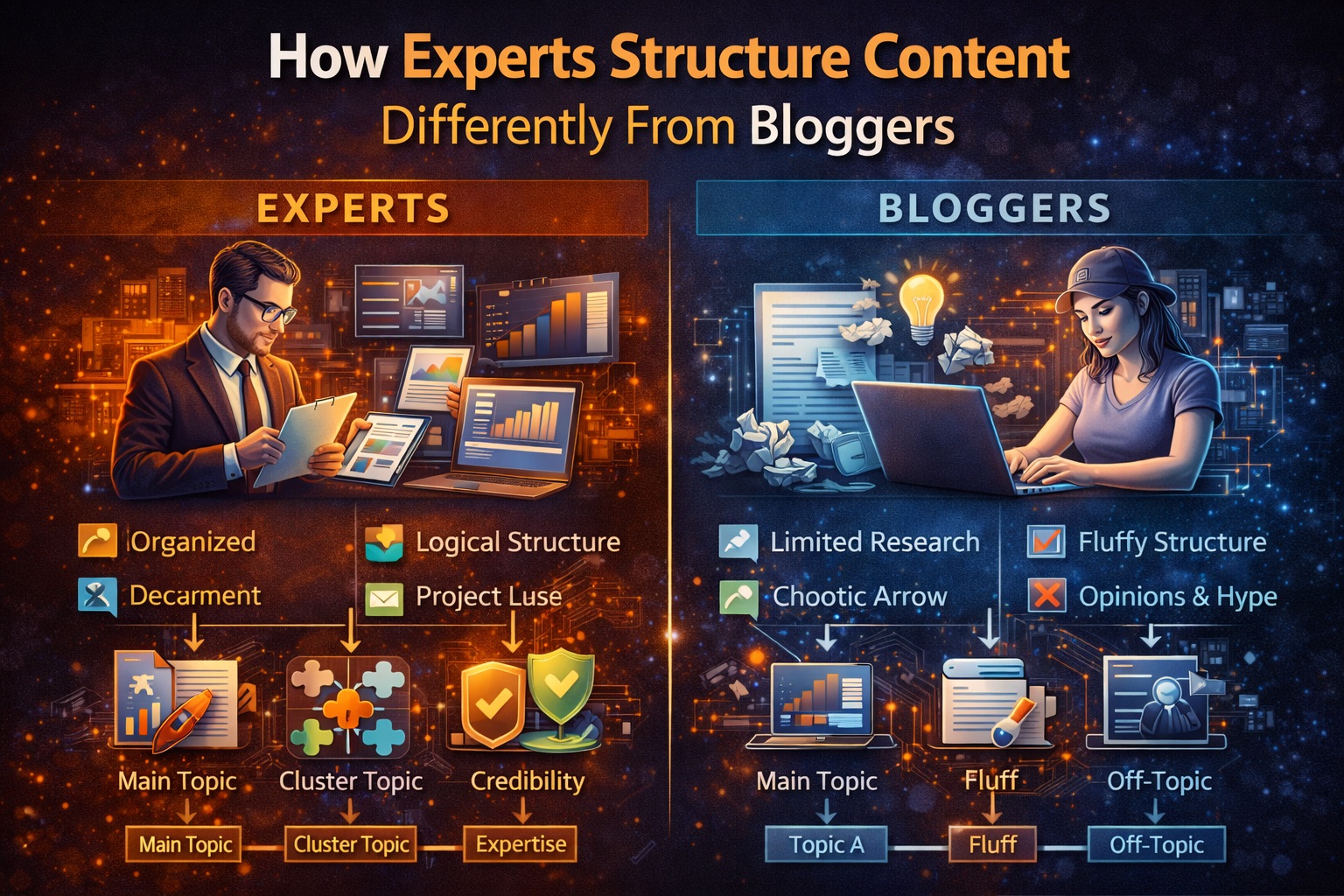
The core comparison: Experts vs. bloggers
Use this as your on-page “rubric” (and as a service audit tool).
| Dimension | Blogger pattern | Expert pattern | The move you make |
|---|---|---|---|
| Framing | “Here are 7 tips for X.” Broad audience. | Defines the decision + who it’s for + constraints. | Start with: “If you are ___ and your constraint is ___, do ___.” |
| Evidence | Vibes + generic claims + affiliate blurbs. | Cites sources, shows methodology, separates fact vs interpretation. | Add an Evidence Box: sources + what you observed + limitations. |
| Depth | Covers “what” + “how” at surface level. | Explains “why,” tradeoffs, failure modes, edge cases. | Add tradeoffs + counterexamples + decision tree. |
| Opinion strength | Strong takes to sound confident (“the best,” “always”). | Calibrated confidence (“usually,” “in these conditions,” “here’s when not”). | Add a Confidence Label + “what would change my mind.” |
This mirrors how Google talks about “helpful, reliable” content: content that appears to demonstrate experience, expertise, authoritativeness, and trustworthiness (E‑E‑A‑T)—even though E‑E‑A‑T itself isn’t a single “ranking factor.” Google for Developers+2Google Help+2
Show the differences with side-by-side examples
Pick a topic in your niche and write the same section twice.
Example topic: “Choosing a project management tool for a 10-person remote team”
Blogger-style framing (what it sounds like):
“Project management tools help teams stay organized. Here are the top tools and why they’re great.”
Expert-style framing (what it looks like):
“If your team is ~10 people, remote, and you’re losing time to status updates, your real problem isn’t ‘project management software’—it’s work visibility with minimal admin overhead.
This guide compares tools for that job under two constraints:
- Setup time ≤ 2 hours, and
- Non-technical teammates must adopt it without training.”
What changed (call it out in the post):
- The expert version names a decision + constraint
- It narrows the scope so the advice can be specific and testable
Do the same in each dimension:
- Evidence: “here are the sources + what I tested”
- Depth: “here are tradeoffs and failure modes”
- Opinion strength: “here’s my confidence and conditions”
“Expert structure” building blocks you can copy
1) The Expert Opening (steal this)
Put this directly under your intro.
Who this is for
- You are ___
- You want ___
- You’re constrained by ___
Who this is not for
- If you need ___, use ___ instead
What we’re optimizing for
- Metric / outcome
- Time horizon
- Cost of mistakes
This instantly increases “trust signals” because it reduces mismatch and shows you’re not trying to please everyone.
2) The Evidence Ladder (simple + memorable)
Use a 5-level ladder in the post so readers learn how experts think:
- Level 0: Assertion (“X is best.”)
- Level 1: Anecdote (“Worked for me.”)
- Level 2: Reference (“Studies say…” but no links)
- Level 3: Cited sources + clear claim boundaries
- Level 4: Original testing / data / screenshots / benchmarks
Then add a rule:
“Any strong recommendation must be supported by Level 3+ evidence.”
3) The Depth Pattern: “Model → tradeoffs → edge cases”
Experts tend to do three things bloggers skip:
- Model the system (“here’s what drives outcomes”)
- Explain tradeoffs (“if you gain X, you lose Y”)
- Cover edge cases (“this breaks when…”)
A quick plug‑in section you can reuse:
- “What actually drives results here”
- “The two common failure modes”
- “When the usual advice is wrong”
4) Opinion calibration (this is the cheat code)
Add a small “calibration box” in every post:
Recommendation: ___
Confidence: High / Medium / Low
Works best when: ___
Avoid when: ___
What would change my mind: ___
This is how you sound like an expert without pretending certainty you can’t support.
Why it works: “E‑E‑A‑T signals without credentials”
You’re not trying to “claim” expertise—you’re trying to demonstrate it through structure.
Google’s own guidance frames E‑E‑A‑T as a way to think about what high-quality content looks like, and notes that quality rater feedback doesn’t directly set rankings but helps evaluate search systems. Google for Developers+1
Google also reiterates that E‑E‑A‑T isn’t a single ranking signal by itself, but high-performing sites usually show expertise, trust, transparency, etc. Google Help
Practically, this structure creates E‑E‑A‑T “surface area”:
- Experience: screenshots, first-hand process, what you tried, what happened
- Expertise: precise definitions, correct reasoning, scoped claims
- Authority: consistent high-quality methodology + citations + external mentions over time
- Trust: limitations, disclosures, update logs, corrections
That’s how you “look expert” to readers and align with quality expectations—without needing letters after your name.
Fall Picks
fall essentials
As an affiliate, we earn on qualifying purchases.