
📊 Full opportunity report: Mac vs GPU Tower for Local LLMs: The Heat-and-Noise Tradeoff on ThorstenMeyerAI.com — validation score, market gap, and execution plan.

Get audio and creator gear delivered free with Prime
- Fast, free delivery on millions of items
- Prime Video, Amazon Music and more included
- Member-only deals all year
TL;DR
This article compares Mac Studio with Apple Silicon and GPU towers for running local large language models. The key difference lies in heat, noise, and capacity, influencing which setup suits different AI workloads.
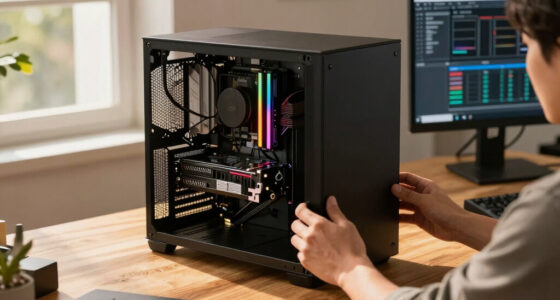
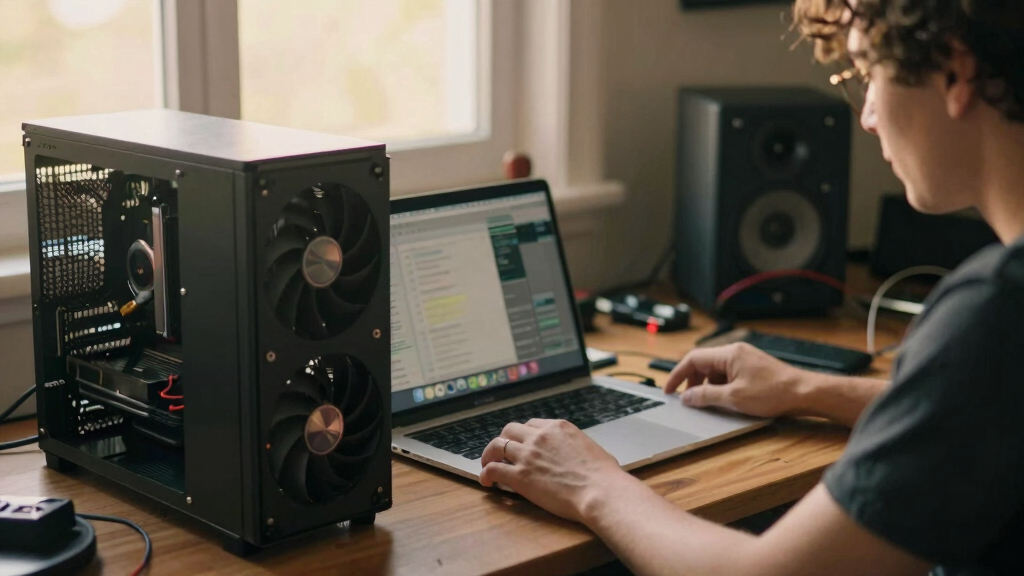
Apple Silicon-based Macs, like the Mac Studio M3 Ultra, are inherently quiet and low-power, contrasting sharply with high-performance GPU towers that generate significant heat and noise when running large language models locally.
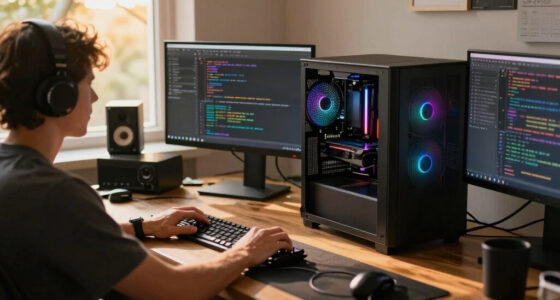
Recent analyses, including insights from Thorsten Meyer, reveal that GPU towers with high-bandwidth cards such as the RTX 5090 produce extensive heat and noise, requiring active thermal management. In contrast, Apple Silicon devices operate with minimal heat and noise due to their integrated architecture and power efficiency, but at the cost of slower inference speeds for models that fit in their unified memory pools.
The core architectural difference is that GPU towers optimize memory bandwidth, enabling faster inference for models within VRAM limits, while Macs optimize memory capacity, allowing larger models to be loaded despite slower read speeds. This fundamental tradeoff influences the choice of hardware depending on workload size and performance needs.
While GPU towers excel in throughput and fine-tuning capabilities, they demand complex cooling solutions and generate noise, making them less suitable for quiet or always-on environments. Conversely, Macs provide a near-silent operation ideal for continuous use but are limited in maximum throughput for models that fit within their large unified memory pools.
Mac vs GPU tower
for local LLMs.
What if you sidestep the heat entirely with a different kind of machine? A tower is a high-bandwidth furnace you spend five levers quieting. Apple Silicon is near-silent by design — but asks for different tradeoffs. Match your priority in Part 2.
Put the loud, hot machine where its noise doesn’t matter, and the quiet one where you do. SSH into the tower when you need raw power; let the Mac handle everything else, silently.
Implications for AI Hardware Selection
This comparison clarifies that the decision between a GPU tower and a Mac Silicon machine depends on workload size and operational environment. For high-throughput tasks involving models within VRAM limits, GPU towers remain superior despite their thermal challenges. For larger models exceeding VRAM, or for users prioritizing silent, power-efficient operation, Macs offer a compelling alternative. Understanding these tradeoffs informs hardware investments for AI practitioners and organizations, especially as AI workloads become more diverse and hardware options evolve.
Products Worth Considering

Apple iPad Air (4th Generation, 10.9-inch, Wi-Fi, 256GB) - Space Gray

Apple iPad Air (2025) 13‑inch Wi‑Fi 256 GB – Space Gray (M3 chip)

Apple iPad Air 11-inch (M2), 512GB, Wi-Fi, Space Gray
As an affiliate, we earn on qualifying purchases.
Hardware Architectures and Performance Tradeoffs
Traditional GPU towers leverage high-bandwidth graphics cards like the RTX 5090, which deliver around 1,792 GB/sec of memory bandwidth, enabling rapid inference on models that fit within VRAM. However, they consume high power (575W+ per card) and produce substantial heat, necessitating elaborate cooling and noise management. Multi-GPU setups can scale performance but increase thermal complexity.
Apple Silicon devices, such as the Mac Studio M3 Ultra, use unified memory architecture reaching up to 512GB, allowing large models (e.g., 70B parameters) to run on-device. While their memory bandwidth (~819 GB/sec) is lower, their power consumption is minimal, and they operate nearly silently. This design favors load capacity over raw speed, making them suitable for models that are too large for GPU VRAM but manageable within their unified memory.
Prior developments have focused on optimizing GPU cooling and noise reduction, but the fundamental architectural differences remain. The choice hinges on whether the workload demands maximum throughput or the ability to handle larger models within a quiet, power-efficient system.
"The heat and noise profile of GPU towers is a significant factor, but the real question is whether your models fit in VRAM or not. Macs change the game for larger models, despite slower inference speeds."
— Thorsten Meyer
Unresolved Questions About Performance and Scalability
It remains unclear how future GPU architectures might alter the heat and noise profiles, or whether upcoming Apple Silicon models will improve inference speeds sufficiently to challenge GPU towers for more workloads. Additionally, the ecosystem support for Mac-based AI inference is still developing, and real-world performance for diverse models needs further testing.
Next Steps in Hardware Development and Testing
Expect ongoing comparisons as new GPU and Apple Silicon hardware are released. Developers and users will need to evaluate their specific model sizes, throughput requirements, and operational preferences. Further empirical testing will clarify the performance limits and practical advantages of each platform, guiding future investments and configurations.
Key Questions
Can a Mac run large language models as effectively as a GPU tower?
Macros can run larger models that don't fit into GPU VRAM due to their unified memory, but inference speeds are generally slower. The choice depends on whether capacity or speed is more critical for your workload.
How does heat and noise impact the usability of GPU towers?
GPU towers generate significant heat and noise, requiring active cooling and noise management. They can be made quieter but demand ongoing effort and thermal engineering.
Will future Apple Silicon models improve inference speeds for large models?
Potentially, as Apple continues to optimize their chips, but current models prioritize capacity and low power consumption over raw inference speed for very large models.
Is the choice between Mac and GPU tower purely about hardware?
No, it also involves operational preferences, such as noise tolerance, power consumption, model size, and whether the workload is latency-sensitive or batch-oriented.
Source: ThorstenMeyerAI.com