
📊 Full opportunity report: Parental Consent Management From Signup To Recordkeeping on IdeaNavigator AI — validation score, market gap, and execution plan.

Get audio and creator gear delivered free — and shop member deals
- Fast, free delivery on millions of items
- Access to Prime Big Deal Days deals on October 6–7
- Prime Video, Amazon Music and more included
TL;DR
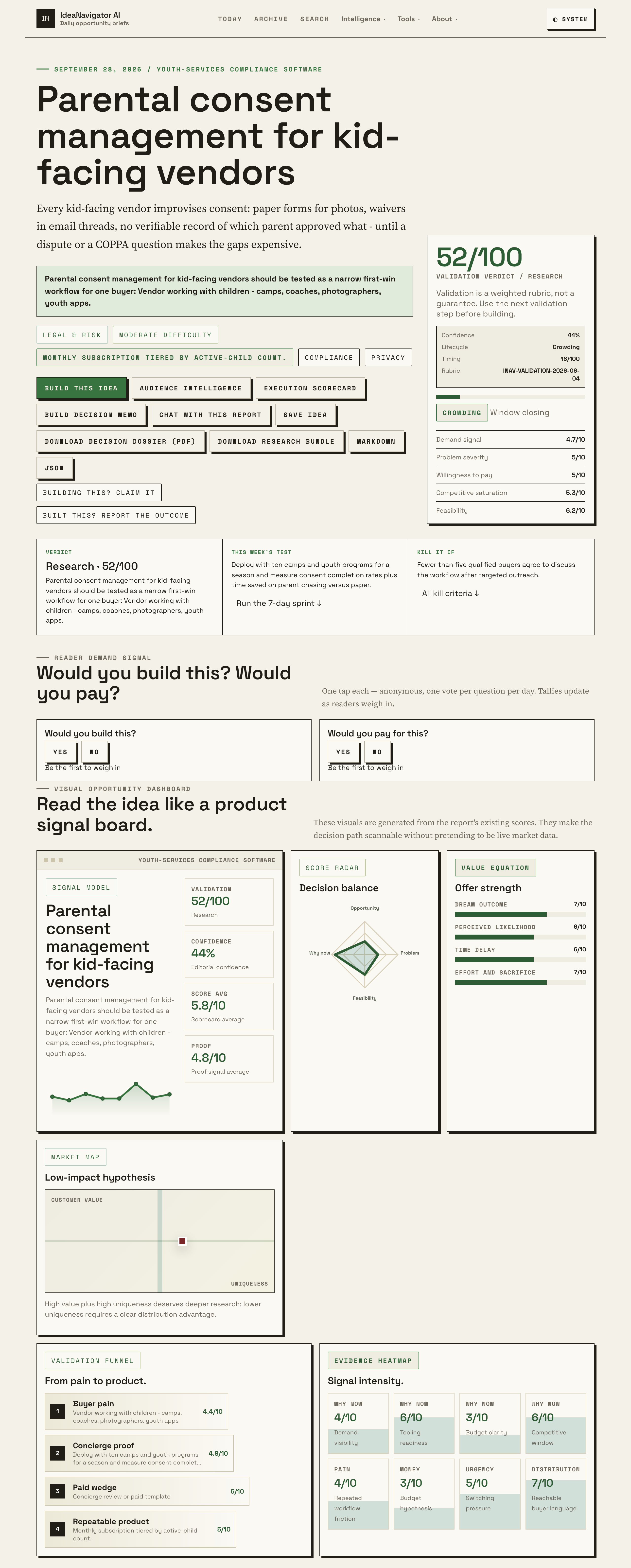
IdeaNavigator AI has outlined a proposed parental-consent service for camps, coaches, photographers and youth apps. The concept would bring mobile consent forms, per-child records and audit exports into one system, but no launch, customer results or pilot findings are reported.
IdeaNavigator AI has outlined a proposed parental-consent management service for businesses and programs that work with children, including camps, coaches, photographers and youth apps. The concept would replace scattered paper forms and email approvals with phone-friendly forms and organized records; a pilot with ten youth programs over one season is suggested, but no trial launch or results are reported.
The proposal describes a recurring problem for child-facing vendors: consent for photographs, data collection, medical information and liability may be gathered through separate forms or email conversations. It says vendors can lack a readily verifiable record showing which parent approved which use. The outline does not document particular disputes or quantify how often records are missing.
The proposed minimum product would let vendors offer branded consent forms that parents complete on their phones. It would keep a consent ledger for each child, track when approvals expire, and provide an export for audits. The concept also calls for identity checks matched to the risk of each consent request, but does not specify verification methods or how risk tiers would be defined.
For revenue, the proposal suggests a monthly subscription priced by active-child count. Its suggested validation is to deploy the service with ten camps or youth programs for a season and measure consent completion and time spent following up with parents, compared with paper processes. No participating organizations, prices, measured outcomes or product availability are identified.
A Recordkeeping Gap for Youth Vendors
If the problem is as common as the proposal suggests, a shared system could make it easier for small organizations to find and review consent records. That matters when a parent asks how a child’s image or information may be used, or when a program needs to establish what permission it received. Centralized, child-specific records could also help staff notice expired approvals before relying on them.
The practical case still needs evidence. Vendors would have to weigh subscription costs and staff setup against the time spent collecting forms and chasing missing responses. Parents would need a clear explanation of each request and a straightforward way to make choices. The proposal gives no results showing that a dedicated service improves completion, reduces follow-up work, or prevents disputes.
For readers evaluating youth services, the idea points to a concrete operational question: can a program show what each parent agreed to, when they agreed, and whether that approval still applies? A digital ledger may make those details easier to retrieve, but recordkeeping alone does not establish legal compliance. The adequacy of consent depends on the applicable rules and how the organization collects and uses information.
From Paper Forms to Digital Ledgers
The proposal is framed around a narrow first customer group: vendors that work directly with children, such as camps, coaches, photographers and youth apps. It describes forms for photo use, data collection, medical matters and liability, which can involve different information and permissions. Its suggested product would gather those requests into a branded parent-facing flow and retain responses by child.
The outline cites expanding children’s privacy enforcement, updates to the federal Children’s Online Privacy Protection Act, state laws and parent challenges to photo or data use as reasons to explore the opportunity. It provides no legal analysis, dates, enforcement examples or state-by-state detail. Those references are the proposal’s rationale, not evidence that a particular vendor has violated a rule or that every listed business has the same legal duties.
Rather than target the whole youth-services market at once, IdeaNavigator AI recommends testing the workflow with ten camps and youth programs during one season. That design would let operators assess completion rates and staff time spent following up against paper-based processes. No earlier product version, pilot cohort or timeline is described.
Pilot Results and Rules Remain Open
No product launch or pilot is confirmed. The proposal does not name participating programs, provide a schedule, or report customer interviews, completion data or time savings. It is also unclear what vendors would pay, how many active children each pricing tier would cover, and whether smaller organizations would find the service affordable.
Key product details remain unspecified, including how parents’ identities would be checked, how a child would be linked to a guardian, how consent could be withdrawn, and how sensitive medical details would be protected. The outline does not say what happens to records after a child leaves a program or how long each type of record would be kept. Its mention of privacy laws and COPPA updates is not accompanied by a legal assessment of which requirements apply to each prospective customer.
A Season of Testing Would Follow
The next step proposed by IdeaNavigator AI is a season-long test with ten camps and youth programs. To evaluate the concept, the organizations would need to track how many parents complete requests, how long staff spend pursuing outstanding forms, and how those results compare with their paper-based process. The proposal does not say when recruitment would start or whether a product is ready for use.
Further reporting would be needed to establish whether vendors are adopting the service, what safeguards and consent controls it provides, and whether the suggested measures improve in practice. Until a pilot or launch is documented, the service remains a business concept under consideration, rather than a proven product or a confirmed response to a specific regulatory action.
Source: IdeaNavigator AI
Key Questions
Has a parental-consent platform launched?
The proposal describes a product concept, but does not report a launch, release date or available service.
Who is the proposed service for?
It is aimed at vendors working with children, including camps, coaches, photographers and youth apps.
What features are proposed?
Phone-friendly branded consent forms, identity checks matched to request risk, per-child records, expiry tracking and audit exports.
What would the pilot measure?
A suggested seasonal test with ten youth programs would measure consent completion rates and staff time spent following up with parents compared with paper processes. No results are available.
Source: IdeaNavigator AI
Fall Picks
fall essentials
As an affiliate, we earn on qualifying purchases.