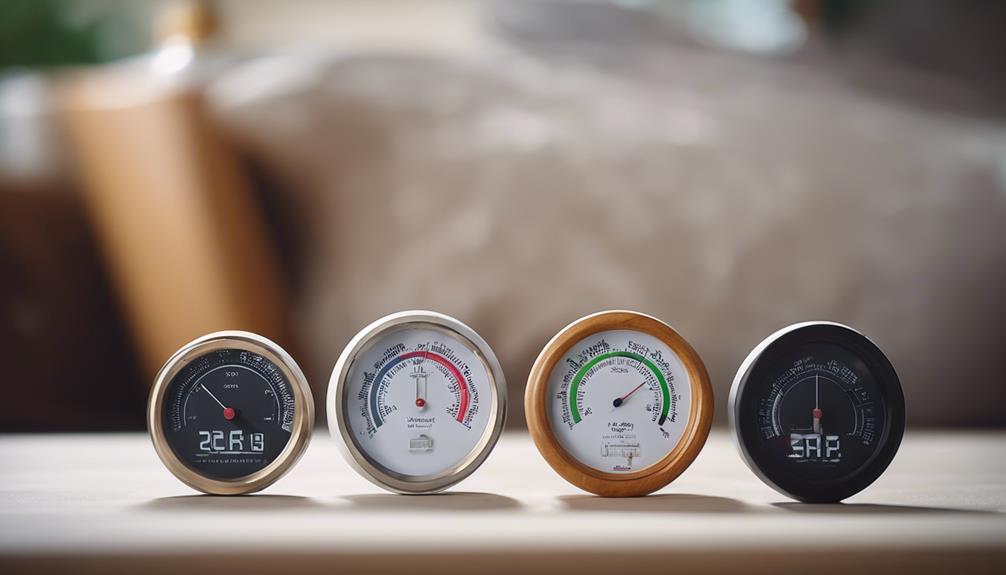

For most buyers, I recommend the Govee H5075 as the best overall hygrometer because Bluetooth app access makes room readings easier to track over time. The Protimeter Hygromaster L is the standout for professional moisture investigations, while the TempPro TP50 3-Piece set suits anyone who wants to compare conditions in several rooms. The main tradeoff is between simple, affordable spot checks and added features such as remote monitoring, fast-response sensors, or professional measurement tools. This lineup ranges from pocket-sized instruments to basic indoor displays, so the right pick depends on where and how often you need readings. Read on for the full comparison and a guide to choosing a hygrometer that fits your use.

Get audio and creator gear delivered free with Prime
- Fast, free delivery on millions of items
- Prime Video, Amazon Music and more included
- Member-only deals all year
Complete the kit


Key Takeaways
- The Govee H5075 leads for ongoing home monitoring: Bluetooth app access makes it more useful for checking changing readings than a display-only meter, though it depends on a compatible phone and app.
- The Protimeter Hygromaster L serves a different job from room gauges: its QuikStick sensor and professional focus make it better suited to investigative work than casual household checks.
- Multi-room coverage is a clear strength of the TempPro TP50 3-Piece: separate units let you compare rooms at once, while single-device options are easier to manage in one location.
- Pocket and handheld models favor access over passive monitoring: the Extech 445580 and Protmex PT6508 suit users who carry a meter between locations, rather than those who want a set-and-forget room display.
- Basic digital meters dominate the home-focused choices: options such as the DOQAUS, Antonki two-pack, and TempAir prioritize at-a-glance readings, while buyers needing logs, app access, or professional functions should look beyond the simplest displays.
| Protimeter BLD7751L Hygromaster L with Short QuikStick Humidity Sensor |  | Best for Flood Restoration | Measurement range: 0–100% RH | Application: Flood damage restoration | Included sensor: Short QuikStick humidity sensor (POL8751) | VIEW ON AMAZON | See Our Full Breakdown |
| Extech 445580 Humidity and Temperature Pen with Fast Response Sensor, Min/Max Memory, Dual LCD, Pocket-Sized Hygrometer for HVAC, Labs, Storage Rooms, Indoor Air Monitoring |  | Best Pocket Hygrometer | Sensor type: Fast-response sensor | Display: Dual LCD | Min/max memory: Yes | VIEW ON AMAZON | See Our Full Breakdown |
| YH606 Digital Temperature and Humidity Meter with LCD Backlight |  | Best for Multiple Psychrometric Readings | Sensor: SWITZERLAND STH 45 | Measurement modes: Ambient temperature, relative humidity, dew point, wet bulb | Display: Backlit LCD | VIEW ON AMAZON | See Our Full Breakdown |
| Protmex PT6508 Digital Temperature and Humidity Meter |  | Best Range Details | Humidity range: 0%–100% RH | Temperature range: -20°C (-4°F) to 60°C (140°F) | Dew-point range: -50°C (-58°F) to 60°C (140°F) | VIEW ON AMAZON | See Our Full Breakdown |
| TempPro TP50 3-Piece Digital Hygrometer Indoor Thermometer and Humidity Gauge |  | Best for Multi-Room Home Monitoring | Set quantity: 3 digital hygrometers | Accuracy: ±2–3% RH and ±1°F | Display records: High/low temperature and humidity | VIEW ON AMAZON | See Our Full Breakdown |
| DOQAUS Digital Hygrometer Indoor Thermometer Humidity Meter, Black |  | Best for Flexible Placement | Mounting: Hanging hole, tabletop stand, and magnetic attachment | Operating humidity: 10% to 99% | Temperature accuracy: ±1 °F | VIEW ON AMAZON | See Our Full Breakdown |
| Temperature Humidity Meter, High Precision Thermometer Hygrometer with Dual Display and Backlight |  | Best for HVAC and Technical Readings | Humidity range: 0%–99% RH | Temperature range: -4 °F to 140 °F | Dew-point range: -58 °F to 140 °F | VIEW ON AMAZON | See Our Full Breakdown |
| TempPro TP50 Digital Hygrometer Indoor Thermometer |  | Best for Simple Room Tracking | Humidity accuracy: ±2 to 3% RH | Temperature accuracy: ±1 °F | Response time: 2 seconds | VIEW ON AMAZON | See Our Full Breakdown |
| Govee Indoor Hygrometer Thermometer H5075 with Bluetooth App Control |  | Best for Connected Monitoring | Model: H5075 | Connectivity: Bluetooth, up to 164 feet | Temperature accuracy: ±0.54 °F | VIEW ON AMAZON | See Our Full Breakdown |
| Room Thermometer Indoor Hygrometer Digital Humidity Meter |  | Best for At-a-Glance Trends | Operating humidity range: 10%–99% RH | Temperature range: -58 °F to 158 °F | Temperature accuracy: ±1.8 °F | VIEW ON AMAZON | See Our Full Breakdown |
| Antonki 2 Pack Indoor Hygrometer Thermometer |  | Best for Monitoring Two Rooms | Temperature range: -58 to 158 °F (-50 to 70 °C) | Humidity range: 10% to 99% RH | Temperature accuracy: ±2 °F (±1 °C) | VIEW ON AMAZON | See Our Full Breakdown |
| TempPro TempAir Digital Hygrometer Indoor Thermometer |  | Best for Quick Temperature Checks | Temperature accuracy: ±1 °F | Upper temperature range: 158 °F | Refresh interval: 10 seconds | VIEW ON AMAZON | See Our Full Breakdown |
More Details on Our Top Picks
Protimeter BLD7751L Hygromaster L with Short QuikStick Humidity Sensor
For restoration work where a quick, dependable humidity reading matters, the Protimeter Hygromaster L is the specialist pick in this group. It measures across a 0–100% RH range and is supplied with a Short QuikStick sensor, case, battery, and screwdriver, giving it a more job-focused setup than the room-oriented TempPro TP50 3-Piece. Its fast response and replaceable humidity and temperature sensors are useful when equipment needs servicing or readings are part of repeated site work. The simple interface also suits users who want direct measurements rather than extra monitoring features. The tradeoff is a narrower feature set: it focuses on humidity and dew point, while the Protmex PT6508 also reports wet-bulb temperature. It runs on a 9V battery, so it is less suited to unattended, long-term monitoring.
Pros:- Measures relative humidity across a 0–100% RH range
- Fast response and high accuracy suit restoration measurements
- Replaceable humidity and temperature sensors support ongoing professional use
- Includes a case and Short QuikStick sensor
Cons:- Limited to humidity and dew-point measurements
- Requires a 9V battery
- More specialized than room-focused options such as the TempPro TP50 3-Piece
Best for: Flood-restoration technicians and building professionals who need fast humidity readings and replaceable sensors for repeated site measurements.
Not ideal for: Home users seeking several low-cost room monitors or anyone needing wet-bulb readings, temperature tracking features, or continuous unattended monitoring.
- Measurement range:0–100% RH
- Application:Flood damage restoration
- Included sensor:Short QuikStick humidity sensor (POL8751)
- Sensor serviceability:Replaceable humidity and temperature sensors
- Included items:Meter, sensor, case, 9V battery, screwdriver
- Measurement focus:Humidity and dew point
- Power:9V battery
Our verdict“Choose the Hygromaster L for responsive, serviceable humidity measurement on restoration jobs, not for simple whole-home monitoring.”
Extech 445580 Humidity and Temperature Pen with Fast Response Sensor, Min/Max Memory, Dual LCD, Pocket-Sized Hygrometer for HVAC, Labs, Storage Rooms, Indoor Air Monitoring
The Extech 445580 is the most portable choice here for technicians who need to check conditions in several rooms or storage areas without carrying a larger meter. Its pocket-sized format and dual LCD show humidity and temperature together, while the fast-response sensor and min/max memory make brief inspections more informative than a single snapshot. Compared with the larger, more measurement-focused Protmex PT6508, this pen-style meter favors easy carry and quick checks over dew-point and wet-bulb functions. That makes it a sensible fit for HVAC rounds, labs, and stockrooms, but not a substitute for continuous tracking. Its role is spot measurement: it does not provide ongoing monitoring, and battery replacement will be part of ownership. Buyers who want several monitors stationed around a home should look instead at the TempPro TP50 3-Piece.
Pros:- Pocket-sized design is easy to carry between inspection points
- Dual LCD presents humidity and temperature together
- Fast-response sensor supports quick spot checks
- Min/max memory helps reveal recent environmental extremes
Cons:- Designed for spot measurements rather than continuous monitoring
- Requires battery replacement over time
- Does not list dew-point or wet-bulb measurement modes like the Protmex PT6508
Best for: HVAC technicians, lab staff, and storage-room managers who carry a hygrometer between locations and want quick min/max checks.
Not ideal for: Buyers who need continuous logging, several fixed room displays, or psychrometric readings such as dew point and wet-bulb temperature.
- Sensor type:Fast-response sensor
- Display:Dual LCD
- Min/max memory:Yes
- Form factor:Pocket-sized
- Measurements:Humidity and temperature
- Monitoring style:Spot measurements
Our verdict“Pick the Extech for portable, quick humidity and temperature checks; choose a multi-unit home set for monitoring several rooms at once.”
YH606 Digital Temperature and Humidity Meter with LCD Backlight
The YH606 suits users who need more than room humidity and temperature: its modes include dew point and wet-bulb temperature, alongside ambient temperature and relative humidity. A Swiss STH 45 sensor, backlit display, and selectable Celsius or Fahrenheit make it more flexible for field measurements than the simpler Extech 445580, which centers on portable humidity and temperature checks. The anti-drop, anti-skip ABS case also gives it a practical advantage when readings happen in varied indoor or outdoor settings. There is a patience tradeoff, though: after a change in conditions, the meter may need 10 minutes to stabilize. Its 30-minute auto-shutdown can also interrupt extended monitoring unless disabled. For stationary home readings, the TempPro TP50 3-Piece is easier to distribute across rooms.
Pros:- Measures ambient temperature, relative humidity, dew point, and wet-bulb temperature
- Swiss STH 45 sensor is specified for accurate, quick measurement
- Backlit display and °C/°F selection help across lighting and unit preferences
- ABS case includes anti-dust, anti-skip, and anti-drop protection
Cons:- May require 10 minutes to stabilize after environmental changes
- 30-minute auto-shutdown may interrupt extended monitoring unless cancelled
- More measurement modes may be unnecessary for basic room checks compared with the TempPro TP50 3-Piece
Best for: Field technicians, greenhouse operators, and environmental-monitoring users who need humidity, temperature, dew-point, and wet-bulb readings in one handheld meter.
Not ideal for: People who need instant readings immediately after moving between environments or want a simple, always-on room display without shutdown settings.
- Sensor:SWITZERLAND STH 45
- Measurement modes:Ambient temperature, relative humidity, dew point, wet bulb
- Display:Backlit LCD
- Temperature units:°C and °F
- Auto shutdown:30 minutes; cancellable
- Battery indicator:Yes
- Housing protection:Anti-dust, anti-skip, anti-drop ABS case
- Warranty:12 months
Our verdict“Choose the YH606 when you need several psychrometric readings in a portable meter and can allow time for stable measurements.”
Protmex PT6508 Digital Temperature and Humidity Meter
The Protmex PT6508 is a strong fit when a hygrometer needs to report humidity alongside the conditions that shape how moisture behaves. It measures dew point and wet-bulb temperature, with stated ranges for humidity and temperature, making it a practical psychrometer for HVAC, agriculture, and weather-related readings. Like the YH606, it offers several measurement modes and a backlit display; the YH606, however, specifies a Swiss sensor and protective case, while the PT6508 provides clear measurement ranges and maximum/minimum recording. Data hold helps preserve a reading while a user notes it down. The limitations are less reassuring for outdoor work: waterproofing is not specified, and automatic shutdown could interrupt longer sessions. For ordinary indoor tracking across multiple locations, the TempPro TP50 3-Piece is the more room-oriented alternative.
Pros:- Measures humidity, temperature, dew point, and wet-bulb temperature
- Humidity range is specified from 0% to 100% RH
- Backlit LCD aids reading in dim work areas
- Data hold and maximum/minimum recording support field checks
Cons:- Waterproofing and weather resistance are not specified
- Automatic shutdown may interrupt longer monitoring sessions
- Battery-life details are not provided
Best for: HVAC, agriculture, and weather-monitoring users who need stated humidity, temperature, dew-point, and wet-bulb ranges in one meter.
Not ideal for: People working in wet or exposed conditions who require stated weather resistance, or those seeking unattended, continuous monitoring.
- Humidity range:0%–100% RH
- Temperature range:-20°C (-4°F) to 60°C (140°F)
- Dew-point range:-50°C (-58°F) to 60°C (140°F)
- Wet-bulb range:-20°C (-4°F) to 60°C (140°F)
- Display:Dual backlit LCD
- Data functions:Data hold and maximum/minimum recording
- Power behavior:Automatic shutdown
Our verdict“Choose the PT6508 for a range-specified psychrometer with useful recording functions, provided your work does not require stated weather protection.”
TempPro TP50 3-Piece Digital Hygrometer Indoor Thermometer and Humidity Gauge
For home users who want to check several locations at once, the TempPro TP50 3-Piece offers a different kind of value from the handheld meters in this group: three gauges can be placed in separate rooms, a greenhouse, or a refrigerator. Each unit shows temperature and humidity with high/low records and a wellness indicator, so the set helps flag changes without carrying a meter from space to space. Its stated accuracy is ±2–3% RH and ±1°F. Compared with the single-unit Extech 445580, it favors broad household coverage over pocket portability and specialist readings. The compromise is a more basic measurement range: it does not list dew-point or wet-bulb modes like the Protmex PT6508. The display may also feel small, and each unit needs AAA batteries.
Pros:- Three gauges allow monitoring in separate rooms or storage spaces
- High/low temperature and humidity records help surface recent extremes
- Wellness indicator provides a quick visual cue for indoor conditions
- Tabletop stand and magnetic back allow flexible placement
Cons:- Requires three AAA batteries, which are not rechargeable
- Display may be small for some users
- Does not list dew-point or wet-bulb modes available on the Protmex PT6508
Best for: Homeowners, greenhouse growers, and household managers who want simultaneous temperature and humidity checks in three separate locations.
Not ideal for: Technicians who need a portable professional meter, psychrometric modes, or a larger display for readings at a distance.
- Set quantity:3 digital hygrometers
- Accuracy:±2–3% RH and ±1°F
- Display records:High/low temperature and humidity
- Power:3 AAA batteries included
- Indicator:Wellness indicator
- Temperature units:°F/°C selector
- Placement:Tabletop stand and magnetic back
- Refresh:Quick updates
Our verdict“Pick the TP50 3-Piece for straightforward monitoring across several home spaces, not for professional psychrometric measurements.”
DOQAUS Digital Hygrometer Indoor Thermometer Humidity Meter, Black
The DOQAUS is a straightforward choice when I want a compact hygrometer that can move between a shelf, metal surface, or hanging spot. Its tabletop stand, magnet, and hanging hole give it more placement flexibility than the tabletop-only Govee H5075, while readings update every five seconds for a frequent check of changing room conditions. The comfort indicator adds a quick visual cue without requiring an app or extra interpretation. Its temperature accuracy is listed as ±1 °F, but the supplied specs do not state a humidity accuracy figure, so I would not choose it for work that depends on documented humidity precision. It also lacks the Govee’s Bluetooth alerts and data history, and manual calibration may be needed in some environments. This suits everyday indoor monitoring, not connected tracking or outdoor use.
Pros:- Three placement options make it easy to position around a room.
- Five-second refresh provides frequent updates.
- LCD and comfort indicator make basic readings easy to check.
- Compact 1.8-by-2.3-inch body weighs only 0.03 kg.
Cons:- No smart connectivity, alerts, or data history.
- Humidity accuracy is not specified in the supplied product data.
- Manual calibration may be needed for precision in some environments.
Best for: Homeowners who want a small, battery-powered hygrometer they can place on a shelf, attach to a metal surface, or hang in a room.
Not ideal for: Greenhouse or lab users who need app-based logging, documented humidity accuracy, or a device specified for outdoor conditions.
- Mounting:Hanging hole, tabletop stand, and magnetic attachment
- Operating humidity:10% to 99%
- Temperature accuracy:±1 °F
- Upper temperature range:158 °F
- Refresh rate:Every 5 seconds
- Dimensions:1.8 in W × 2.3 in H
- Weight:0.03 kg
- Color:Black
Our verdict“Choose the DOQAUS for simple indoor checks and flexible placement, but pick the Govee H5075 if you need Bluetooth monitoring and stored readings.”
Temperature Humidity Meter, High Precision Thermometer Hygrometer with Dual Display and Backlight
The INSTRODOTS TH10 is the most measurement-focused option in this group: alongside temperature and relative humidity, it reports dew point and wet-bulb temperature. Those extra values give HVAC technicians and controlled-environment users more context than the TempPro TP50’s basic temperature, humidity, and high/low records. A backlit dual LCD helps when reading conditions in dim equipment areas, and the compact handheld design favors moving between measurement points rather than leaving a gauge on a shelf. The tradeoff is that it is less of a set-and-forget room monitor than the Govee H5075, which offers app alerts and data export. The supplied specifications also omit numerical accuracy tolerances and do not establish outdoor suitability, so I would verify those needs before relying on it for formal measurements.
Pros:- Measures dew point and wet-bulb temperature as well as humidity and temperature.
- Backlit dual display supports reading in low-light work areas.
- Compact ergonomic design is suited to carrying between locations.
- Humidity range is specified from 0% to 99% RH.
Cons:- Numerical accuracy tolerances are not provided in the supplied specifications.
- Requires battery replacement over time.
- Best accuracy is described for indoor or controlled environments.
Best for: HVAC technicians, agricultural operators, and lab users who need dew-point and wet-bulb readings in addition to temperature and humidity.
Not ideal for: Home users who want a stationary monitor with remote alerts, saved history, or clearly stated accuracy tolerances.
- Humidity range:0%–99% RH
- Temperature range:-4 °F to 140 °F
- Dew-point range:-58 °F to 140 °F
- Wet-bulb range:-4 °F to 140 °F
- Display:Dual LCD with backlight
- Power feature:Low-battery indicator
- Form:Compact ergonomic handheld design
Our verdict“Pick the TH10 for handheld technical checks that need dew-point or wet-bulb data, rather than basic room monitoring like the TempPro TP50 provides.”
TempPro TP50 Digital Hygrometer Indoor Thermometer
The TempPro TP50 earns its place as a practical room monitor by combining current readings with high/low records and a wellness indicator. That record feature helps reveal whether a room has drifted beyond its usual conditions while nobody was watching—something the simpler DOQAUS display does not offer. It responds in two seconds, faster than the five-second refresh listed for the DOQAUS and the room meter, and its stand and magnetic back make placement straightforward. The Govee H5075 goes further with Bluetooth history and alerts, so I would choose the TP50 when I want useful local tracking without an app. Its stated humidity accuracy is ±2 to 3% RH, and it runs on an AAA battery; the product data also gives no warranty details. It is a sensible indoor gauge, not a connected monitoring system.
Pros:- High/low temperature and humidity records show recent extremes.
- Two-second response time provides quick updates.
- Stand and magnetic back allow flexible placement.
- Includes an AAA battery for use out of the box.
Cons:- No Bluetooth, app alerts, or data export.
- Requires periodic AAA battery replacement.
- Warranty information is not specified in the supplied data.
Best for: People who want a no-app bedroom, nursery, or living-room hygrometer with at-a-glance comfort guidance and daily high/low records.
Not ideal for: Buyers who need remote alerts, exported long-term data, or monitoring outside indoor spaces.
- Humidity accuracy:±2 to 3% RH
- Temperature accuracy:±1 °F
- Response time:2 seconds
- Upper temperature range:158 °F
- Display:Digital
- Power:One AAA battery included
- Placement:Tabletop stand and magnetic back
- Weight:0.06 kg
Our verdict“Choose the TP50 for useful local readings and high/low tracking; choose the Govee H5075 if remote access and longer-term data matter more.”
Govee Indoor Hygrometer Thermometer H5075 with Bluetooth App Control
The Govee H5075 is the strongest pick here when checking the display is not enough. Its Bluetooth app, alerts, and data export let me follow temperature and humidity changes remotely within the stated 164-foot range, giving it a clear advantage over the non-connected TempPro TP50 and DOQAUS. A bright LCD and max/min records still make it useful as a stand-alone room gauge, while the listed ±0.54 °F temperature accuracy is the tightest stated temperature tolerance among these five products. The main compromise is dependence on Bluetooth rather than a longer-range network connection; monitoring from beyond its range is not promised. App setup may also feel like extra work for someone who only wants a glanceable reading, and it runs on batteries. For wine-cellar, nursery, or greenhouse checks where trend history matters, the added connectivity has a practical purpose.
Pros:- Bluetooth app supports alerts and remote checks within the stated range.
- Temperature and humidity data can be stored, analyzed, and exported.
- Listed temperature accuracy is ±0.54 °F.
- Bright display includes current readings and max/min records.
Cons:- Bluetooth monitoring is limited to a stated range of 164 feet.
- App setup may be more involved than using a basic standalone meter.
- Battery-powered operation requires eventual battery replacement.
Best for: Homeowners and greenhouse, nursery, or wine-cellar users who want phone alerts and a record of changing indoor conditions.
Not ideal for: Buyers who prefer a no-app gauge, need monitoring beyond Bluetooth range, or want a device specified for outdoor use.
- Model:H5075
- Connectivity:Bluetooth, up to 164 feet
- Temperature accuracy:±0.54 °F
- Operating humidity:10%–90% relative humidity
- Upper temperature range:140 °F
- Mounting:Tabletop
- Dimensions:2.5 in W × 3.1 in H
- Weight:0.1 kg
- Color:Black
Our verdict“Choose the Govee H5075 if alerts and stored readings are worth app setup; the TP50 is simpler for local checks without connectivity.”
Room Thermometer Indoor Hygrometer Digital Humidity Meter
This compact room meter emphasizes quick visual interpretation over tracking or connectivity. Its large digits, one-hour trend, and wet/dry icons help me spot a change or rough comfort condition without reading a separate log. Auto-calibration and a five-second refresh are useful for regular household checks, though the product data does not explain the calibration method. Compared with the TempPro TP50, this model adds a stated one-hour trend display, while the TP50 responds in two seconds and records high and low readings. The room meter is also more limited in its placement: it is tabletop-only, unlike the DOQAUS with its magnet and hanging hole. Its ±1.8 °F temperature accuracy is specified, but no humidity accuracy figure is supplied. It is a compact, easy-to-read choice, not the best fit for buyers who need placement flexibility or app-based history.
Pros:- Large display and wet/dry icons make quick checks easy.
- One-hour trend offers context beyond the current reading.
- Auto-calibration and five-second refresh support regular monitoring.
- Compact tabletop design measures 2.1 by 2.6 inches.
Cons:- Tabletop is the only listed mounting option.
- Humidity accuracy is not specified in the supplied product data.
- Only one AAA battery is included, so replacement will eventually be needed.
Best for: People who want a small tabletop hygrometer with clear digits and an at-a-glance hourly humidity and temperature trend.
Not ideal for: Users who need wall or magnetic mounting, documented humidity accuracy, or Bluetooth alerts and data storage.
- Operating humidity range:10%–99% RH
- Temperature range:-58 °F to 158 °F
- Temperature accuracy:±1.8 °F
- Refresh rate:Every 5 seconds
- Display features:Large digits, one-hour trend, wet/dry icons
- Calibration:Auto-calibration
- Mounting:Tabletop
- Dimensions:2.1 in W × 2.6 in H
- Power:AAA alkaline battery included
Our verdict“Choose this meter for clear tabletop readings and a short-term trend, but prefer the TP50 for faster response and high/low records.”
Antonki 2 Pack Indoor Hygrometer Thermometer
The two-unit format is the main reason I’d choose the Antonki: it lets me check separate indoor spaces, such as a nursery and a bedroom, without moving one gauge back and forth. Each unit shows temperature and humidity on a large LCD, and the tabletop, magnetic, and hanging options make placement flexible. Compared with the single TempPro TempAir, Antonki gives me coverage in two locations, though the TempAir specifies tighter temperature accuracy and adds a comfort icon for quick interpretation. Antonki’s stated humidity accuracy is ±5% RH, so it suits general room checks better than precision-sensitive monitoring. Initial readings may fluctuate before settling, and the units are intended for indoor use. The included CR2032 batteries are convenient, but they will eventually need replacement.
Pros:- Two gauges allow simultaneous checks in separate rooms.
- Large LCD is easier to read than the TempPro TempAir’s small display.
- Tabletop stand, magnetic back, and hanging hole offer flexible placement.
- Includes a CR2032 battery in each unit.
Cons:- Humidity accuracy is specified at ±5% RH, limiting suitability for precision monitoring.
- Readings may fluctuate before stabilizing.
- Indoor-only use and eventual battery replacement limit long-term flexibility.
Best for: People who want to monitor humidity and temperature in two indoor rooms, such as a nursery and a greenhouse.
Not ideal for: Buyers who need a single highly precise reference instrument or readings from outdoor conditions; the stated humidity accuracy is ±5% RH and the units are indoor-only.
- Temperature range:-58 to 158 °F (-50 to 70 °C)
- Humidity range:10% to 99% RH
- Temperature accuracy:±2 °F (±1 °C)
- Humidity accuracy:±5% RH
- Battery:1 CR2032 per unit, included
- Dimensions:2.3 in W × 2.76 in H
- Weight:1.5 oz
- Quantity and mounting:2 units; tabletop, magnetic back, or hanging hole
Our verdict“Choose the Antonki pair if you want straightforward readings in two indoor spaces and value coverage over tighter stated temperature accuracy.”
TempPro TempAir Digital Hygrometer Indoor Thermometer
The TempPro TempAir suits buyers who want a compact single-room gauge with a clearer temperature accuracy specification than the Antonki pair. Its stated temperature accuracy is ±1 °F, and updates every 10 seconds help the display keep pace with changing indoor conditions. A face icon gives a quick comfort cue, which is useful when I want a glanceable signal rather than relying only on the numbers. Compared with Antonki, however, this model covers just one location per device and its small display may be harder to read from across a room. The listed details do not provide a humidity range or humidity accuracy, so I would not pick it over models with those figures when humidity precision is the priority. It is indoor-only and requires alkaline batteries.
Pros:- Stated temperature accuracy of ±1 °F supports closer temperature checks than the Antonki’s ±2 °F specification.
- Face icon offers a fast visual indication of comfort conditions.
- 10-second update interval keeps readings responsive to indoor changes.
- Compact body supports tabletop or wall placement.
Cons:- Small display may be difficult to read from a distance.
- Only one device is included, unlike the two-unit Antonki set.
- Provided specifications do not state humidity range or humidity accuracy.
Best for: People who need a compact indoor monitor for a desk, nursery, or office and value precise stated temperature readings plus a quick comfort indicator.
Not ideal for: Buyers who need documented humidity accuracy, a large display for viewing across a room, or simultaneous monitoring in multiple spaces.
- Temperature accuracy:±1 °F
- Upper temperature range:158 °F
- Refresh interval:10 seconds
- Display feature:Face icon comfort indicator
- Battery type:Alkaline
- Voltage:1.5 V
- Dimensions:0.7 in W × 2.6 in H
- Weight and mounting:35 g; tabletop or wall mount
Our verdict“Pick the TempPro TempAir for a compact, quick-reading indoor monitor when temperature accuracy and a comfort cue matter more than a large screen or a documented humidity-accuracy figure.”

How We Picked
I ranked these hygrometers by how well their stated features match distinct measurement tasks: everyday room checks, monitoring several spaces, portable HVAC work, and professional moisture assessment. I gave weight to sensor and response features, reading visibility, memory or connected tracking, portability, and the practical value of each configuration. A specialized instrument can be a stronger pick for field work without being the best choice for a bedroom or living room.
The order reflects usefulness for the broadest likely buyer first, then more specialized tools and simpler room meters. That puts the Govee H5075 first for its app-connected monitoring, the Protimeter high for professional use, and the TP50 three-piece set high for multi-room coverage. Where product details do not establish a particular accuracy tolerance or calibration method, I avoid treating those as proven advantages; buyers with strict measurement requirements should check the manufacturer’s specifications before choosing.
Factors to Consider When Choosing Hygrometer
I’d start with the job you need the hygrometer to do, not the longest feature list. A display for checking a room now and then has different requirements from a meter used for building investigations or tracking humidity changes while you are away.
Match the sensor to the measurement job
For general indoor awareness, a basic room meter can show whether conditions are changing without adding much setup. If you need readings for HVAC troubleshooting or building work, look for a sensor design and response behavior suited to repeated measurements across locations. A professional-oriented probe is not automatically a better household monitor: it may add cost and handling needs without improving a quick room check. Check whether the stated measurement range and accuracy meet your intended use, especially for controlled storage or sensitive materials. Avoid comparing models based only on a “high precision” label unless the manufacturer provides a meaningful accuracy specification.
Decide whether you need a snapshot or a record
A screen-only hygrometer answers what the conditions are near the device when you look at it. App connectivity, memory, or min/max tracking can help reveal patterns that a single glance misses, such as overnight swings or changes during travel. Those extras also bring dependencies: a phone app, wireless connection, batteries, or a setup process. If you only check a closet or office occasionally, a simple display may be easier to live with. If you are trying to identify recurring humidity changes, choose a model with a practical way to review readings over time.
Choose one meter or several
One unit is usually enough when you only care about a single room or want a portable reference meter. Multi-unit packs let you compare rooms at the same time, which is more useful than moving one device around and trying to remember readings taken at different moments. However, separate meters can vary slightly, so do not assume small differences between units prove that one room has a real problem. Place them together briefly to see whether their readings are broadly consistent before spreading them around. Buy multiple devices when simultaneous comparison matters, not simply because more displays seem reassuring.
Prioritize display and placement
A readable screen matters when the meter sits across a room, in a dim corner, or on a shelf that is hard to reach. Backlighting can help with quick checks, but it does not improve the underlying measurement and may affect battery life depending on the device. Before choosing a compact model, check whether its screen size and controls suit the location where you plan to use it. Sensor placement also affects what a reading represents: direct sunlight, vents, exterior walls, and damp surfaces can distort a room-level picture. Pick a stable location that reflects the space you want to monitor rather than a convenient but misleading spot.
Treat accuracy claims and calibration as separate questions
Humidity readings can differ between devices, and a displayed decimal place does not prove greater accuracy. For ordinary home checks, consistency and a clear view of changes may matter more than extremely fine increments. For work where a small error could affect a decision, review the published tolerance, calibration guidance, and any service options before buying. Rechecking a meter against another device can reveal disagreement, but it does not identify which one is correct. Do not pay extra for a precision claim unless the specifications and support match the stakes of your measurement.
Count the upkeep and ownership tradeoffs
Battery access, sensor care, app support, and replacement parts affect how useful a hygrometer remains after setup. A connected model can offer richer tracking but may rely on software and wireless features you do not want to maintain. A professional instrument may call for more careful handling than a basic indoor gauge. Consider where the device will live and whether you can reach it easily for battery changes or checks. For several rooms, simple units may be easier to distribute; for repeated field measurements, a portable instrument designed for handling can be the more practical choice.
Frequently Asked Questions
Should I choose an app-connected hygrometer or a display-only model?
Choose app connectivity when you need to review readings without standing beside the device or want to follow changes over time. The Govee H5075 is the lineup’s clearest fit for that kind of home monitoring. A display-only meter is simpler when you just want a quick local reading and do not need phone setup or connected features. Before choosing an app-based unit, check what the app records and whether the connection method works for your intended placement. If you mainly glance at humidity once in a while, the extra layer may not add much value.
Is a professional hygrometer worth buying for home use?
Usually, a professional instrument makes sense only when your task calls for its specialized sensor, response, or measurement workflow. The Protimeter Hygromaster L is positioned for more investigative work than a standard room display, so it is a better match for professionals or serious building assessments. For routine awareness in a bedroom, office, or storage room, a straightforward digital meter is easier to use. Compare the published specifications with the decisions you need to make before paying for professional features. A specialized tool can be the wrong fit if you only need a room-level reading.
Do I need a multi-pack to monitor humidity in several rooms?
A multi-pack is useful when you want readings from several spaces at the same time, especially if you are comparing rooms with different uses or conditions. The TempPro TP50 three-piece set is a direct fit for that need in this lineup. A single meter can be moved from room to room, but readings taken at different times are harder to compare because conditions may have changed. Keep in mind that separate units may not show identical values even when placed together. If you only need a general sense of one room, multiple devices can add clutter without answering a new question.
How much accuracy do I need for household humidity checks?
For everyday room monitoring, the ability to notice broad changes may matter more than a highly granular display. If you are making decisions about sensitive storage, building materials, or professional work, check the manufacturer’s stated accuracy and range rather than relying on product labels alone. A meter with more displayed digits is not necessarily more accurate. Differences between two devices can reflect sensor variation as well as real room conditions. When measurement error could change what you do, favor published specifications and calibration guidance over extra screen features.
Where should I place a hygrometer for a useful room reading?
Place it in a representative part of the room, away from direct sunlight, heating or cooling vents, and surfaces that may be unusually cold or damp. A reading next to a bathroom door, window, or humidifier may reflect a local condition rather than the wider room. Keep the meter where air can circulate around its sensor instead of pressing it against a wall or burying it among objects. If you are comparing two spaces, try to use similar placement in each. Give the device time to settle after moving it before interpreting a new reading.
Conclusion
For the broadest home use, I’d choose the Govee H5075: its connected monitoring sets it apart from the lineup’s simpler displays. My best value for several rooms is the TempPro TP50 3-Piece set, while the best premium, professional-focused pick is the Protimeter Hygromaster L for buyers who need a specialized measurement tool. Beginners who want an uncomplicated indoor readout can start with a basic display model such as the TempPro TP50 Digital or DOQAUS. For portable field checks, look at the Extech 445580 or Protmex PT6508; choose among them by checking the sensor and response specifications against your work. Match the device to how you will use the readings, and the choice becomes clearer: room display, multi-room comparison, connected tracking, or professional measurement.
Fall Picks
fall essentials
As an affiliate, we earn on qualifying purchases.