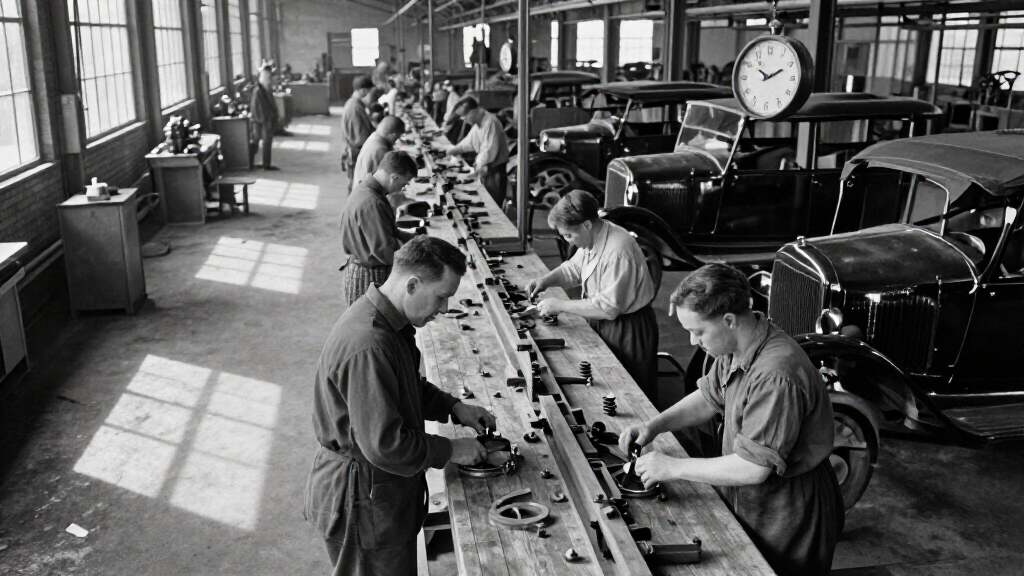

🔍 Read the full analysis: The Assembly Line Before And After The Five-Dollar Day on ThorstenMeyerAI.com

Get audio and creator gear delivered free with Prime
- Fast, free delivery on millions of items
- Prime Video, Amazon Music and more included
- Member-only deals all year
TL;DR
Ford’s moving assembly line cut the labor time to assemble a Model T chassis from 12 hours 28 minutes to 1 hour 33 minutes by early 1914, according to company figures. But fast, repetitive work coincided with severe turnover: Ford hired 50,448 people in 1913 to maintain an average workforce of 13,623. On Jan. 5, 1914, the company shortened the workday and raised eligible workers’ minimum daily pay to $5.
Ford Motor Co. cut its standard workday from nine hours to eight and raised minimum daily pay to $5 on Jan. 5, 1914, after a year in which the company struggled to retain workers for its new moving assembly line. The pay change followed a steep rise in production efficiency: Ford’s own figures put labor time for assembling a Model T chassis at 1 hour 33 minutes by early 1914, down from 12 hours 28 minutes when the chassis remained stationary.
The production change and the labor problem developed together. In 1913, Ford hired 50,448 people to keep an average workforce of 13,623, a turnover rate reported as 370% in research by economists Daniel Raff and Lawrence Summers. The company’s scale of hiring reflected workers leaving, being dismissed or failing to return, rather than evidence that Ford lacked buyers for its cars.
Ford’s account says the company first tested a moving line on the Model T’s flywheel magneto in April 1913. Workers divided the assembly into separate operations as the part moved past them. Ford reported that labor time for the magneto fell from about 20 minutes to 13 minutes and 10 seconds, and then to five minutes after further changes to the line.
The chassis experiment began with a rope pulling the car frame along a 250-foot track while workers walked beside it to install parts. That reduced the reported labor time to 5 hours 50 minutes. Further changes, including raising the line and breaking the work into smaller tasks, brought it to 1 hour 33 minutes. Ford’s published figures also show engine assembly time falling from 9 hours 54 minutes in October 1913 to 5 hours 56 minutes six months later.
The five-dollar rate was not an unconditional daily wage for every employee. Ford described it as “profit sharing” and attached strict conditions. The company also cut the workday to eight hours. The source account reports that turnover fell to 54% in 1914, though the figures alone do not establish how much of that decline was caused by the pay policy rather than other changes.
Pay Responded to a Labor Crisis
The episode complicates the familiar story that Ford raised wages mainly so workers could afford the cars they built. The source account argues that the immediate pressure was high turnover: the company needed to recruit repeatedly to maintain its workforce as production methods changed. Ford’s later recollection of hiring roughly 53,000 people annually to keep about 14,000 jobs filled is consistent with that account, though it is a company-side statement.
The figures also show why productivity gains do not automatically mean fewer jobs in the short term. Ford’s new line required less labor time per chassis, while the company was expanding output and struggling to keep workers. Across the United States, factory employment grew by about a third between 1910 and 1920, according to the source material. That broader statistic offers context, but it does not by itself show that assembly lines caused the increase.
For readers considering automation today, the historical distinction matters: a change in how work is organized can raise output and alter job tasks without immediately reducing total employment. The Ford case also shows that employers may change pay and hours when the cost of recruiting and losing workers becomes a production problem.
Products Worth Considering

Apple iPad 11-inch (A16 Chip, 128GB, Wi-Fi, Pink)

Amazon Kindle Scribe (64GB) with Premium Pen, Metallic Jade

Sony WH-1000XM5 Premium Noise Cancelling Wireless Headphones, Midnight Blue
As an affiliate, we earn on qualifying purchases.
From Stationary Cars to Moving Lines
Before the moving line, workers assembled a car around a chassis that stayed in one place, bringing parts and tools to it. Ford’s reported best average for that method at its Highland Park plant was 12 hours 28 minutes of labor per chassis. The production figures come principally from Henry Ford’s 1922 book, My Life and Work, written with journalist Samuel Crowther. They should be read as Ford’s account, not as an independent audit of factory output.
Ford credited the general idea for the line to overhead rails used by Chicago meatpackers, where carcasses moved past workers. The company tested the method on a small component before applying it to the chassis and engine. This step-by-step adoption matters: the full moving line was not a single overnight invention, but a series of experiments in dividing tasks, positioning parts and setting a workable speed.
The Model T was already being produced and sold before the line’s introduction. Ford’s account gives a price of $950 for the touring car in the 1909–10 model year and production of 18,664 cars. By around 1914, the source estimates Ford had about 14,000 workers and built about 250,000 cars annually. Those figures suggest a rapidly expanding operation, but do not establish the precise causes of turnover or the profitability of the wage plan.
““The reduction of the necessity for thought on the part of the worker and the reduction of his movements to a minimum.””
— Henry Ford, in My Life and Work
Limits of Ford’s Production Figures
Several central numbers come from Ford’s own published account, including the labor-time comparisons and descriptions of how the line developed. They are not presented in the source as independently verified production records. Raff and Summers’ 1987 study provides a separate research basis for the 1913 hiring and turnover figures, drawing on earlier labor research and company surveys.
The reported drop in turnover to 54% in 1914 does not, on its own, prove that the five-dollar day caused the decline. The source describes the pay increase as conditional profit sharing, but does not set out all eligibility rules or explain how many employees received the full rate. It also does not provide comparable figures isolating the effects of the eight-hour day, changing work conditions or other company policies.
The account’s claim that Ford’s immediate problem was workers leaving rather than a shortage of customers is an interpretation based on its production, employment and turnover figures. The available material does not provide detailed sales records or a full account of the company’s finances for the period.
The Line’s Longer Work Legacy
The historical sequence ends with the 1914 pay change and the reported fall in turnover that year. The source material does not identify a further near-term company decision or a scheduled next milestone. The main point for following the story is whether additional records can clarify how Ford set the conditions for profit-sharing and how wage, hours and factory practices each affected retention.
The account connects the early assembly line to modern factories, where robots now perform some tasks once done by workers. That comparison is broad rather than a direct forecast: it does not establish what current automation will do to employment or pay. The Ford episode offers a historical example of productivity gains arriving alongside workforce pressures, but present-day outcomes depend on circumstances not covered by the 1914 figures.
Key Questions
What changed at Ford on Jan. 5, 1914?
Ford cut its workday from nine hours to eight and raised minimum daily pay to $5 through a conditional profit-sharing plan, according to the source account.
How much faster did the moving line make chassis assembly?
Ford’s figures put labor time at 1 hour 33 minutes by early 1914, compared with 12 hours 28 minutes when the chassis was assembled in a stationary position.
Why did Ford need to hire so many workers in 1913?
The reported turnover rate was 370%: the company hired 50,448 people to maintain an average workforce of 13,623. The figures indicate extensive departures and replacement hiring, but do not establish every reason workers left.
Was the five-dollar day an unconditional wage for every worker?
No. The source describes it as conditional “profit sharing”, with strict requirements. It does not provide a full breakdown of eligibility or how many employees received the full amount.
Did the higher pay cause turnover to fall?
The source reports that turnover fell to 54% in 1914, after the pay and hours changes. That timing does not by itself prove the policy caused the drop, and the material does not separate its effects from other factors.
Source: ThorstenMeyerAI.com