For guitarists comparing Black Friday guitar pedals, the right choice depends less on the sale label and more on whether you need one reliable sound or a broader set of tools. I’d put the Valeton GP-5 at the top for its compact multi-effects format and NAM/IR loading, while the BOSS DS-1 is a straightforward pick for classic distortion and the LEKATO CUBE BABY suits players who want rechargeable, portable multi-effects. These options differ sharply in setup, range, and how much control they give you. Single-effect pedals can be easier to fit into a familiar rig, while multi-effects units offer more sounds but may take more time to configure. Read on for the full breakdown, buying advice, and picks by player type.

Get audio and creator gear delivered free with Prime
- Fast, free delivery on millions of items
- Prime Video, Amazon Music and more included
- Member-only deals all year
Complete the kit


Key Takeaways
- The Valeton GP-5 leads for versatility in a small footprint: NAM and IR loading give it a different role from basic multi-effects units, but its expanded options may ask more of players who want simple plug-and-play controls.
- The BOSS DS-1 and Pro Co RAT 2 serve different distortion needs: the DS-1 is the direct, familiar choice, while the RAT 2 brings a broader distortion-to-fuzz character; neither replaces a multi-effects pedal.
- Portable multi-effects are not interchangeable: the Flatsons KMF-1, MOOER GE100, and rechargeable LEKATO CUBE BABY differ in format and features, so buyers should prioritize workflow and portability rather than counting effects alone.
- Specialized pedals can be smarter than all-in-one units: the LEKATO tuner, SONICAKE Vexpress, and Donner Vowel target tuning, expression, and wah/volume duties without requiring a larger effects setup.
- Distortion choices vary by control and character: the SONICAKE Thump QDS-09 adds boost and a noise gate, the JOYO UZI R-03 offers three-band EQ, and the JOYO Splinter leans toward fat distortion and fuzz.
| Flatsons KMF-1 Multi-Effects Guitar Pedal |  | Best All-in-One Practice Pick | Effects: 77 across 8 modules | Amp models: 18 | Cabinet simulations: 18 | VIEW LATEST PRICE | See Our Full Breakdown |
| SONICAKE Thump QDS-09 High-Gain Distortion Pedal with Boost and Noise Gate |  | Best High-Gain Control | Circuit: Analog | Effects: Distortion and noise gate | Tone modes: Modern and Vintage | VIEW LATEST PRICE | See Our Full Breakdown |
| SONICAKE Vexpress Passive Volume and Expression Pedal |  | Best Passive Control Pedal | Functions: Volume and expression control | Power: No power required | Connector: 1/4-inch (6.35 mm) TRS | VIEW LATEST PRICE | See Our Full Breakdown |
| FLAMMA FC05 Mini Modulation Effects Pedal |  | Best Compact Modulation Pick | Effects: 11 modulation effects | Effect types: Chorus, flanger, tremolo, phaser, vibrato, rotary, liquid, auto wah, stutter, ring, and low bit | Signal format: Digital | VIEW LATEST PRICE | See Our Full Breakdown |
| Valeton GP-5 Compact Multi-Effects Processor and NAM/IR Loader Pedal |  | Best Compact Digital Platform | Effects: Over 100 | Customizable modules: 9 | NAM file capacity: Up to 80 | VIEW LATEST PRICE | See Our Full Breakdown |
| Donner Vowel Mini Wah and Volume Pedal |  | Best Compact Wah and Volume Combo | Effects: Wah and volume | Signal format: Analog | Power: 9V adapter required; not included | VIEW LATEST PRICE | See Our Full Breakdown |
| MOOER GE100 Multi-Effects Guitar Pedal |  | Best All-in-One Practice and Tone Workstation | Effect modules: 8 | Effect types: 66 | Patches: 80 preset and 80 user patches | VIEW LATEST PRICE | See Our Full Breakdown |
| BOSS DS-1 Distortion Guitar Pedal |  | Best Straightforward Distortion Classic | Effect: Distortion | Signal format: Analog | Power: 9V | VIEW LATEST PRICE | See Our Full Breakdown |
| Donner Blues Drive Overdrive Guitar Pedal with Warm and Hot Modes |  | Best Value Two-Mode Overdrive | Effect: Overdrive | Modes: Warm and Hot | Controls: Level, Tone, Gain | VIEW LATEST PRICE | See Our Full Breakdown |
| Pro Co RAT 2 Distortion Pedal |  | Best for Distortion That Can Push an Amp | Effect: Distortion | Signal format: Analog | Audio output: 1/4-inch | VIEW LATEST PRICE | See Our Full Breakdown |
| LEKATO CUBE BABY Rechargeable Multi-Effects Guitar Pedal with IR Loading and Bluetooth |  | Best for Portable Practice and Recording | Amp models: 9 | Built-in IR cabinet models: 8 | Third-party IR support: Up to 8 files | VIEW LATEST PRICE | See Our Full Breakdown |
| LEKATO Chromatic Guitar and Bass Tuner Pedal with True Bypass |  | Best Essential Board Utility | Instrument compatibility: Electric guitar and bass | Tuner type: Chromatic | Display: Color LCD | VIEW LATEST PRICE | See Our Full Breakdown |
| Donner Morpher High-Gain Distortion Guitar Pedal |  | Best Simple High-Gain Pick | Effect: Distortion | Tone modes: Natural, Tight, and Classic | Controls: 3 knobs | VIEW LATEST PRICE | See Our Full Breakdown |
| JOYO UZI R-03 Distortion Guitar Pedal with 3-Band EQ and True Bypass |  | Best for Hands-On Tone Shaping | Effect type: Distortion, metal | Controls: Gain, Bias, Volume, Low, Mid, and High | Bypass: True bypass | VIEW LATEST PRICE | See Our Full Breakdown |
| JOYO Splinter JF-21 Fat Distortion and Fuzz Guitar Pedal |  | Best Distortion-and-Fuzz Range | Effect type: Distortion and fuzz | Circuit: Analog | Controls: Distortion, filter, and volume | VIEW LATEST PRICE | See Our Full Breakdown |
More Details on Our Top Picks
Flatsons KMF-1 Multi-Effects Guitar Pedal
For a Black Friday shortlist aimed at broad capability rather than one signature sound, the Flatsons KMF-1 packs a lot into a single floor unit: 77 effects, 18 amp models, 18 cabinet simulations, and 50 presets. Its tuner, 30-second looper, and 42 drum rhythms also make it a self-contained practice setup, while the assignable expression pedal can control six effects. Compared with the Valeton GP-5, the KMF-1 adds built-in rhythms and can run on AA batteries, but the GP-5 is lighter and offers Bluetooth editing, USB-C audio, and NAM loading. The KMF-1’s tradeoff is its nearly 1.1 kg weight and short battery runtime of up to 2.5 hours. I’d also plan the cabinet-simulation settings carefully when connecting to a real cabinet or speaker.
Pros:- Combines 77 effects with 18 amp models and 18 cabinet simulations
- Built-in tuner, looper, drum rhythms, and AUX input support practice without extra gear
- Assignable expression pedal and stomp/edit modes provide flexible control
- Runs from a 9V adapter or six AA batteries
Cons:- Battery life is limited to up to 2.5 hours
- At 1065 g, it is heavier than the compact Valeton GP-5
- Cabinet simulation needs appropriate setup with real cabinets or speakers
Best for: Players who want one unit for home practice, varied tones, and basic looping without assembling several pedals
Not ideal for: Gigging players prioritizing a lightweight, app-editable processor or long battery sessions
- Effects:77 across 8 modules
- Amp models:18
- Cabinet simulations:18
- Preset patches:50
- Looper:30 seconds
- Drum rhythms:42
- Expression pedal:2-in-1; supports 6 assignable effects
- Power:9V DC adapter or 6 AA batteries
Our verdict“Choose the KMF-1 if you want a feature-packed practice hub with rhythms and looping, and favor the Valeton GP-5 if compactness and app-based editing matter more.”
SONICAKE Thump QDS-09 High-Gain Distortion Pedal with Boost and Noise Gate
The SONICAKE Thump QDS-09 is the focused choice here for players who want high-gain distortion with tools to manage the noise and shape the response. Its independent boost and noise gate can be switched separately or together, while a three-band EQ and Modern/Vintage modes let players adjust the voice instead of settling for a single distortion character. That makes it more targeted than the FLAMMA FC05, which covers modulation effects rather than drive, and more specialized than the Valeton GP-5’s broad digital effects range. The tradeoff is exactly that focus: this pedal is built for high gain, not a flexible clean-to-crunch palette. Its 9V center-negative supply is also not included, so it may require an additional power purchase to join a board.
Pros:- Analog distortion circuit with Modern and Vintage tone modes
- Independent boost and noise gate add useful control around high-gain sounds
- Three-band EQ provides direct tone-shaping options
- True bypass preserves the dry signal when disengaged
Cons:- Designed around high-gain distortion, limiting its fit for cleaner tones
- 9V center-negative power supply is not included
Best for: Guitarists or bassists building a high-gain setup who want separate boost and noise-gate control plus hands-on EQ
Not ideal for: Players seeking clean, subtle overdrive or an all-purpose pedal with modulation and time-based effects
- Circuit:Analog
- Effects:Distortion and noise gate
- Tone modes:Modern and Vintage
- Controls:Gain, 3-band EQ, noise gate, and boost
- Bypass:True bypass
- Power requirement:9V DC, center-negative; supply not included
- Current draw:44 mA
- Audio connection:1/4-inch
Our verdict“Pick the QDS-09 when high-gain tone shaping and noise control outrank versatility; choose the Valeton GP-5 for a wider range of effects in one unit.”
SONICAKE Vexpress Passive Volume and Expression Pedal
The SONICAKE Vexpress earns its place by solving a different problem from the effect processors in this roundup: it adds foot control rather than another bank of tones. It works as a passive volume or expression pedal, detects the connected function, and needs no battery or power supply. That makes it simpler to maintain than the Flatsons KMF-1, whose expression pedal is part of a much larger powered effects unit. The Vexpress is also compact, though its expression function depends on the connected device and requires a TRS cable plus any needed configuration or calibration. Buyers should check their gear’s compatibility before choosing it; unlike the Valeton GP-5, it does not provide effects, presets, or app editing. This is a practical control add-on, not a standalone tone solution.
Pros:- Combines volume and expression control in one pedal
- Automatically detects the function based on the connection
- Needs no battery or power supply
- Compact and lightweight for transport or a crowded pedalboard
Cons:- Expression use requires a TRS cable and may need device configuration or calibration
- Compatibility depends on the connected instrument or controller
Best for: Players with a compatible effects unit, keyboard, or synthesizer who want passive volume or expression control in a small footprint
Not ideal for: Buyers looking for standalone effects, or players whose expression device requires a control setup they cannot configure
- Functions:Volume and expression control
- Power:No power required
- Connector:1/4-inch (6.35 mm) TRS
- Dimensions:5.85 × 2.58 × 2.4 inches
- Weight:0.2 kg
- Compatible instruments:Guitar, bass, keyboard, synthesizer, workstation, and controller
Our verdict“Choose the Vexpress as a compact, power-free control add-on for compatible gear, not as an alternative to an effects pedal such as the Valeton GP-5.”
FLAMMA FC05 Mini Modulation Effects Pedal
For a board that needs movement effects without giving up much space, the FLAMMA FC05 condenses 11 modulation voices into a mini pedal: chorus, flanger, tremolo, phaser, vibrato, rotary, and several less conventional options. It offers a narrower job than the Flatsons KMF-1, which includes modulation alongside amps, cabinets, and practice tools, but the FC05 can make more sense when the rest of a rig is already built and only needs modulation. Its metal shell and small footprint suit a compact board; the compromise is a single-knob control approach rather than the deeper editing available on the Valeton GP-5. It is digital, and a 9V, 150mA supply is required but not included, so check your board’s available power before adding it.
Pros:- Provides 11 modulation effects in a compact format
- Metal shell is designed for durability
- Small, lightweight enclosure is suited to portable pedalboards
- Includes both familiar modulation types and more unusual options such as ring and low bit
Cons:- Requires a 9V, 150mA power supply, which is not included
- Single-knob control offers less detailed adjustment than the Valeton GP-5’s editing setup
Best for: Players with a crowded pedalboard who want several modulation flavors from one small pedal
Not ideal for: Players who need detailed parameter editing, an included power supply, or a broad multi-effects processor
- Effects:11 modulation effects
- Effect types:Chorus, flanger, tremolo, phaser, vibrato, rotary, liquid, auto wah, stutter, ring, and low bit
- Signal format:Digital
- Power requirement:9V, 150mA
- Power supply:Not included
- Material:Metal shell
- Dimensions:3.27 × 1.85 × 2.05 inches
- Weight:0.19 kg
Our verdict“Choose the FC05 for space-saving modulation variety, while the Valeton GP-5 is a better fit if you want broader effects and deeper editing.”
Valeton GP-5 Compact Multi-Effects Processor and NAM/IR Loader Pedal
The Valeton GP-5 is the most forward-looking compact processor in this group for players who want to shape a rig around loaded tones as well as built-in effects. It offers over 100 effects and nine customizable modules, with capacity for up to 80 NAM files and 20 cabinet IRs. Bluetooth app control and USB-C audio-interface connectivity add editing and recording options that the Flatsons KMF-1 does not match, while stereo TRS output gives the GP-5 a more flexible connection setup. The KMF-1 counters with built-in drum rhythms, a 30-second looper, and AA-battery operation, so it may suit practice-first buyers better. The GP-5’s tradeoffs are its small format, which may not suit every player’s editing preferences, finite file capacity, and a power supply that is not included.
Pros:- Over 100 effects and nine customizable modules in a compact processor
- Loads NAM files and third-party cabinet IRs
- Bluetooth 5.0 app control and USB-C audio-interface connectivity
- Metal casing weighs 237 g and the outputs support stereo TRS
Cons:- Power supply is not included
- NAM and cabinet IR storage is limited to 80 and 20 files, respectively
- Does not list the built-in drum rhythms and 30-second looper offered by the Flatsons KMF-1
Best for: Players who want a lightweight multi-effects unit with NAM and IR loading, app editing, and USB-C recording connectivity
Not ideal for: Practice-focused buyers who want built-in drum rhythms and a looper, or players who prefer a larger control surface
- Effects:Over 100
- Customizable modules:9
- NAM file capacity:Up to 80
- Third-party cabinet IR capacity:Up to 20
- Included presets:50 factory patches
- Wireless connectivity:Bluetooth 5.0
- Outputs:Stereo TRS
- Power options:9V DC or USB 5V; power supply not included
Our verdict“Pick the GP-5 for a compact, connected platform built around editable effects and loaded tones; choose the KMF-1 if onboard practice tools matter more.”
Donner Vowel Mini Wah and Volume Pedal
For a Black Friday board refresh where space matters, the Donner Vowel pairs wah and active volume control in one compact pedal. Its resonant filter and smooth sweep make it the more expressive pick compared with the simpler volume function offered by the SONICAKE Vexpress, while combining both roles can save a spot for another effect. Indicator lights help show its operating state at a glance. The tradeoff is its plastic housing: the metal hinge adds support, but players seeking a more substantial enclosure may prefer a sturdier design. It also needs an external 9V adapter, which is not included, and has no battery compartment. I’d choose it for a small board that needs both functions, not for a player who wants a dedicated, battery-ready wah.
Pros:- Combines wah and active volume functions in one compact unit.
- Resonant filter and smooth sweep offer expressive wah control.
- Lightweight design is easy to fit on a crowded pedalboard.
- Indicator lights show the pedal’s operating state.
Cons:- 9V power adapter is not included.
- No battery compartment, so external power is required.
- Plastic housing may not suit players seeking a fully metal enclosure.
Best for: Guitarists with a space-limited pedalboard who want both wah expression and active volume control in one unit.
Not ideal for: Players who need battery operation, already own a dedicated wah or volume pedal, or prefer an all-metal housing.
- Effects:Wah and volume
- Signal format:Analog
- Power:9V adapter required; not included
- Current draw:22 mA
- Audio connector:1/4-inch monaural jack
- Housing:Plastic with metal hinge
- Dimensions:2.6 × 2.2 × 5.47 in
- Weight:0.38 kg
Our verdict“Choose the Donner Vowel if you want wah and volume control while keeping your pedalboard compact, and skip it if battery power or a metal body is a must.”
MOOER GE100 Multi-Effects Guitar Pedal
The MOOER GE100 is the broadest practice-and-tone package in this group: 66 effect types across eight modules let players explore sounds without buying separate pedals, while 80 preset and 80 user patches make it easier to save and revisit setups. Its 180-second looper, 40 drum rhythms, and assignable expression pedal add practice and performance tools that the focused BOSS DS-1 distortion cannot match. Adjustable output mode also supports playing without an amplifier, and the option to use four AA batteries can help when an outlet is unavailable. The tradeoff is that a multi-effects unit takes more setup than a single-purpose pedal, and its scale and chord functions are guitar-learning tools rather than general effects. I’d pick it for exploration and practice, not for someone who only needs one straightforward drive sound.
Pros:- Offers 66 effect types across eight modules for broad tone experimentation.
- Stores 80 preset patches and 80 user-created patches.
- Built-in looper and drum rhythms support practice and idea building.
- Can run from a 9V adapter or four AA batteries and supports output without an amp.
Cons:- More features and patch options require more setup than a single-effect pedal.
- Scale and chord learning functions have limited appeal beyond guitar practice.
- Battery operation requires four AA batteries.
Best for: Newer players and home practice setups that need varied tones, saved patches, looping, and rhythm accompaniment in one unit.
Not ideal for: Players who want a simple, dedicated distortion pedal or prefer to build a board from individual effects.
- Effect modules:8
- Effect types:66
- Patches:80 preset and 80 user patches
- Looper:180 seconds
- Drum rhythms:40
- Expression pedal:Assignable to 6 parameters
- Power:9V DC adapter or 4 AA batteries
- Dimensions:9.06 × 2.36 × 5.51 in
Our verdict“Choose the GE100 if you want one pedal for tone exploration and structured practice, but pick a dedicated effect such as the BOSS DS-1 for a simpler signal chain.”
BOSS DS-1 Distortion Guitar Pedal
The BOSS DS-1 suits players who want a dedicated distortion voice instead of the GE100’s many effects and practice tools. Its hard-edged attack and smooth sustain can cover punchy rhythm parts and sustained leads, while the wide-range tone control gives players room to adjust brightness for different guitars and pickups. At lower distortion settings, it can also serve as a booster, making it more flexible than its single-effect label suggests. Compared with the Pro Co RAT 2, the DS-1 is the pick for someone focused on this particular distortion character rather than a pedal described for rhythm, leads, and pushing a clean amp into warm overdrive. The tradeoff is that it remains a focused distortion pedal, and it requires 9V power. The supplied product data also lists dimensions and weight that appear inconsistent, so I would not rely on those figures for board planning.
Pros:- Hard-edged attack and smooth sustain suit rhythm and lead playing.
- Wide-range tone control supports a range of brightness settings.
- Low-distortion settings can work as a booster.
- Analog signal format and a five-year BOSS warranty.
Cons:- Focused on distortion rather than offering multiple effect types.
- Requires 9V power.
- Listed dimensions and weight appear inconsistent in the product data.
Best for: Guitarists who want a dedicated analog distortion with broad tone adjustment and the option to use lower-gain settings as a boost.
Not ideal for: Players seeking multi-effects flexibility, wah or modulation, or dependable size and weight information before arranging a tightly packed board.
- Effect:Distortion
- Signal format:Analog
- Power:9V
- Current draw:20 mA
- Controls:Knobs
- Power source:Battery powered
- Warranty:Five-year BOSS warranty
Our verdict“Choose the DS-1 for a direct, dedicated distortion sound with useful tone shaping, and choose the MOOER GE100 if you need a wider range of effects and practice features.”
Donner Blues Drive Overdrive Guitar Pedal with Warm and Hot Modes
The Donner Blues Drive makes sense for players who want to shape an overdrive sound without stepping up to a multi-effects unit like the MOOER GE100. Its Warm and Hot modes provide two distinct approaches: a classic TS-style character or a louder, tighter tone. Level, Tone, and Gain controls let players adjust output, brightness, and drive rather than relying on a fixed voicing. True bypass is intended to preserve the signal when the effect is off, and the aluminum alloy chassis offers a more substantial shell than the Donner Vowel’s plastic body. The tradeoff is a narrower job: this is an overdrive pedal, not a full distortion or practice setup. It also requires a 9V DC adapter that is not included, so it is not ready to run on its own out of the box.
Pros:- Warm and Hot modes provide contrasting overdrive voices.
- Level, Tone, and Gain controls allow output and drive adjustments.
- True bypass is designed to preserve the signal when the effect is off.
- Aluminum alloy chassis.
Cons:- 9V DC adapter is not included.
- Limited to overdrive rather than providing multiple effect types.
- No battery power option is listed.
Best for: Players adding a dedicated overdrive to a pedalboard who want both a warmer classic voice and a tighter, louder mode.
Not ideal for: Buyers who need an included power supply, battery operation, or a single pedal that covers several effect categories.
- Effect:Overdrive
- Modes:Warm and Hot
- Controls:Level, Tone, Gain
- Bypass:True bypass
- Signal format:Analog
- Power:9V DC adapter required; not included
- Current draw:8 mA
- Chassis:Aluminum alloy
Our verdict“Choose the Blues Drive if you want a compact, adjustable two-mode overdrive, but look to the MOOER GE100 for a broader effects-and-practice package.”
Pro Co RAT 2 Distortion Pedal
The Pro Co RAT 2 earns its place for players who want a distortion pedal that can do more than supply a hard-edged sound. Its analog design is described for rock rhythms, lead tones, and solo boosts, and it can push a high-headroom amplifier from a clean sound into warm overdrive. That makes it a broader fit for amp-based players than the BOSS DS-1, which is framed around a hard attack, smooth sustain, and tone shaping. The RAT 2 is still a dedicated drive effect, though; it cannot replace the MOOER GE100’s stored patches, looper, or range of effect types. It also requires a 9V power supply, and no adapter is listed as included. I’d choose it for a guitar-and-amp setup where drive character is the priority, not for a player seeking a self-contained practice station.
Pros:- Suited to rhythm distortion, lead tones, and solo boosts.
- Can push a high-headroom amplifier into warm overdrive.
- Analog signal format.
- More amp-focused drive uses than a practice-oriented multi-effects unit.
Cons:- Requires a 9V power supply.
- Dedicated to distortion and drive rather than covering multiple effect categories.
- No power supply is listed among the provided product details.
Best for: Rock and lead guitarists who want one analog pedal for rhythm distortion, solo boosts, and pushing a clean, high-headroom amp.
Not ideal for: Players who need multiple effect types, built-in practice tools, or an included 9V power supply.
- Effect:Distortion
- Signal format:Analog
- Audio output:1/4-inch
- Power:9V
- Current draw:30 mA
- Dimensions:4.5 × 3.3 × 4.8 in
- Weight:16 oz
- Warranty:2-year limited
Our verdict“Choose the RAT 2 if you want a versatile drive pedal for a guitar-and-amp setup, and choose the GE100 if effects variety and practice features matter more.”
LEKATO CUBE BABY Rechargeable Multi-Effects Guitar Pedal with IR Loading and Bluetooth
For a Black Friday board upgrade that can also serve as a self-contained practice setup, the LEKATO CUBE BABY packs amp and cabinet simulation, effects, playback, and recording into one rechargeable unit. Its nine amp models and eight built-in IRs give it a broader range of ready-to-play tones than the Donner Morpher, which focuses on high-gain distortion. Bluetooth playback and a headphone output make it easier to practice along quietly, while recording to a phone or PC adds a basic capture option without another processor.
The tradeoff is that this is a multi-purpose digital tool, not a dedicated stompbox with the focused controls of the JOYO UZI R-03. Loading third-party IRs also requires a computer and Cube-Suite software, and its headphone jack is 3.5 mm. I’d choose it for flexibility and portability, but skip it if I only need one straightforward live effect.
Pros:- Nine amp models and eight built-in cabinet IRs cover a range of practice tones.
- Bluetooth playback and headphone output support quiet play-along sessions.
- Rechargeable battery runs for a stated 6–8 hours and can power the unit while charging.
- Supports third-party IRs, editable presets, and recording to a PC or phone.
Cons:- Importing third-party IR files requires a computer and Cube-Suite software.
- The 3.5 mm headphone output may need an adapter for some headphones.
- Its multi-function digital setup is less direct than a dedicated distortion pedal.
Best for: Guitarists who want an all-in-one portable practice rig with amp simulation, headphone practice, Bluetooth playback, and basic recording.
Not ideal for: Players building a simple live board who want a dedicated distortion pedal with immediate, hands-on tone controls.
- Amp models:9
- Built-in IR cabinet models:8
- Third-party IR support:Up to 8 files
- Effects:Distortion, overdrive, delay, and reverb
- Battery life:6–8 hours
- Headphone output:3.5 mm
- Connectivity:Bluetooth 5.0
- Recording:PC or mobile phone
- Dimensions:6.37 × 2.4 × 0.9 inches
Our verdict“Choose the CUBE BABY if one compact rechargeable unit needs to handle practice, amp simulation, effects, and recording.”
LEKATO Chromatic Guitar and Bass Tuner Pedal with True Bypass
A tuner won’t add a new effect, but it can make every other pedal on a Black Friday board more useful by keeping the instrument in tune and muting the signal during adjustment. The LEKATO AT-07 is a dedicated guitar-and-bass tuner with a color LCD, adjustable calibration, and four half-flat settings. Those options make it more adaptable than the Donner Morpher, which is an effect rather than a tuning tool, and its true bypass passes the signal directly when the tuner is switched off.
The tradeoff is practical rather than tonal: it needs a DC 9V connection, so it won’t add battery-powered flexibility to a board. Its stated tuning tolerance is approximately 0.499%, which may be less appealing to players seeking especially fine adjustment. I’d put it on a utility-focused board, but the JOYO distortion pedals make more sense for shoppers whose priority is changing their sound.
Pros:- Color LCD is designed for visibility in bright and dim conditions.
- 430–450 Hz calibration and four half-flat settings accommodate alternate tuning needs.
- True bypass routes the signal directly when the pedal is off.
- Aluminum construction offers a sturdy enclosure for board use.
Cons:- Requires a DC 9V power connection.
- The stated tuning tolerance is approximately 0.499%.
- As a dedicated tuner, it does not add an audible effect to the signal.
Best for: Guitarists and bassists who need a dedicated pedal tuner with alternate tuning settings and a display suited to different lighting.
Not ideal for: Players seeking a new tone effect or a tuner that can operate without a DC 9V power connection.
- Instrument compatibility:Electric guitar and bass
- Tuner type:Chromatic
- Display:Color LCD
- Calibration range:430–450 Hz
- Flat tuning:Four half-flat settings
- Tuning tolerance:Approximately 0.499%
- Bypass:True bypass
- Construction:Aluminum
- Connectors:1/4-inch input and output; DC 9V input
Our verdict“Pick the AT-07 if reliable pedalboard tuning and alternate tuning options matter more than adding another sound effect.”
Donner Morpher High-Gain Distortion Guitar Pedal
The Donner Morpher suits players who want high-gain distortion without the extra tone-shaping layout of the JOYO UZI R-03. Its three modes—Natural, Tight, and Classic—offer distinct starting points for riffs and lead parts, while three knobs keep adjustments uncomplicated. Compared with the UZI’s gain, bias, and three-band EQ, the Morpher gives up detailed frequency control in favor of a smaller, more direct pedal.
That simplicity is useful when I want to choose a broad distortion character quickly, but it limits fine tuning for a particular amp or room. The metal-alloy housing and true bypass suit a compact board, though the required 9V DC center-negative adapter is not included. Black Friday shoppers should factor in that power requirement: this is a focused high-gain addition, not a ready-to-run package. I’d pass if I need versatile EQ or softer drive sounds.
Pros:- Three tone modes provide different high-gain starting points.
- Three-knob layout keeps adjustments direct and approachable.
- True bypass is designed to preserve the signal when the effect is off.
- Compact aluminum-alloy housing suits a space-conscious board.
Cons:- The 9V DC center-negative power adapter is not included.
- It offers less tone-shaping control than the JOYO UZI R-03 and its three-band EQ.
- Its high-gain focus is less suited to players seeking a broad range of clean or low-gain tones.
Best for: Players who want a compact, straightforward high-gain pedal for riffing and lead playing, with a few selectable distortion characters.
Not ideal for: Guitarists who need detailed EQ control, lower-gain versatility, or a pedal that includes its required power adapter.
- Effect:Distortion
- Tone modes:Natural, Tight, and Classic
- Controls:3 knobs
- Voltage:9 V
- Current:13 mA
- Power requirement:9V DC, center-negative, minimum 500 mA
- Bypass:True bypass
- Construction:Aluminum alloy
- Dimensions:3.7 × 1.7 × 2 inches
Our verdict“Choose the Morpher for compact, easy-to-set high-gain distortion, but choose the UZI R-03 if detailed EQ shaping matters more.”
JOYO UZI R-03 Distortion Guitar Pedal with 3-Band EQ and True Bypass
Among the distortion options here, the JOYO UZI R-03 gives me the most direct control over the shape of a hard-rock or metal sound. Gain and bias adjust the distortion character, while the three-band EQ lets me rebalance lows, mids, and highs instead of settling for the Morpher’s three broader tone modes. That flexibility can help when the same pedal needs to work with different amps or move between thick rhythm tones and more sustained lead drive.
The extra controls make this a better fit for players who like to shape a sound, not necessarily for someone wanting a quick, minimal setup. It is analog with true bypass, but needs an external regulated 9V DC center-negative supply, and no audio cables are included. Compared with the JOYO Splinter, the UZI is the more dedicated distortion choice; the Splinter adds fuzz and alternate voicings. I’d skip the UZI if I want fuzz range or battery power.
Pros:- Gain, bias, and three-band EQ offer detailed distortion shaping.
- Designed for hard-rock rhythm tones and sustained lead drive.
- True bypass preserves a direct signal path when switched off.
- Selectable ambient LED modes suit different practice or stage setups.
Cons:- Requires an external regulated 9V DC center-negative power supply, which is not included.
- Audio cables are not included.
- Its dedicated distortion design is less flexible than the JOYO Splinter for players seeking fuzz as well.
Best for: Hard-rock and metal players who want to adjust gain character and frequency balance from the pedal itself.
Not ideal for: Players who want a fuzz option, battery operation, or a distortion pedal with fewer controls to set.
- Effect type:Distortion, metal
- Controls:Gain, Bias, Volume, Low, Mid, and High
- Bypass:True bypass
- Signal format:Analog
- Power requirement:Regulated 9V DC, center-negative
- Current draw:20 microamps
- Audio connection:1/4-inch
- Weight:249 g
- Warranty:1-year manufacturer warranty
Our verdict“Choose the UZI R-03 if hands-on EQ and gain shaping are priorities; opt for the Splinter if you also want fuzz voicings.”
JOYO Splinter JF-21 Fat Distortion and Fuzz Guitar Pedal
The JOYO Splinter JF-21 is the most tonally flexible of these dedicated dirt pedals if I want to move between distortion and fuzz rather than commit to one high-gain character. Its FAT and MOSFET switches change the low-end and clipping response, while distortion, filter, and volume controls provide a straightforward way to refine the result. Compared with the JOYO UZI R-03, the Splinter gives up the UZI’s dedicated three-band EQ but adds fuzz and more distinct voicing choices.
The socketed OP07DP op-amp may appeal to players interested in circuit customization, though that is a more involved path than adjusting the Morpher’s three modes. Power can come from a 9V battery or center-negative adapter, but neither is included; the product also recommends an isolated supply and avoiding daisy-chaining for quieter operation. I’d choose it for varied dirt textures, not for a plug-in-and-go purchase without a power plan.
Pros:- Combines distortion and fuzz for a wider range of dirt sounds.
- FAT and MOSFET switches offer distinct low-end and clipping voicings.
- Socketed OP07DP op-amp allows further circuit customization.
- Metal chassis supports either 9V battery or center-negative adapter power.
Cons:- Neither a 9V battery nor a power adapter is included.
- The product recommends an isolated supply and avoiding daisy-chaining for quieter operation.
- It lacks the UZI R-03’s dedicated three-band EQ controls.
Best for: Guitarists who want one pedal to cover distortion and fuzz, with alternate voicings and the option to experiment with its socketed op-amp.
Not ideal for: Players who need a power supply in the box, prefer a dedicated metal distortion with detailed EQ, or want to avoid extra power-noise precautions.
- Effect type:Distortion and fuzz
- Circuit:Analog
- Controls:Distortion, filter, and volume
- Voicing switches:FAT and MOSFET
- Op-amp:Socketed OP07DP
- Power options:9V battery or 9V DC center-negative adapter
- Chassis:Metal
- Weight:390 g
- Warranty:1-year manufacturer warranty
Our verdict“Pick the Splinter if you want distortion and fuzz in one pedal and are willing to sort out its power setup.”
How We Picked
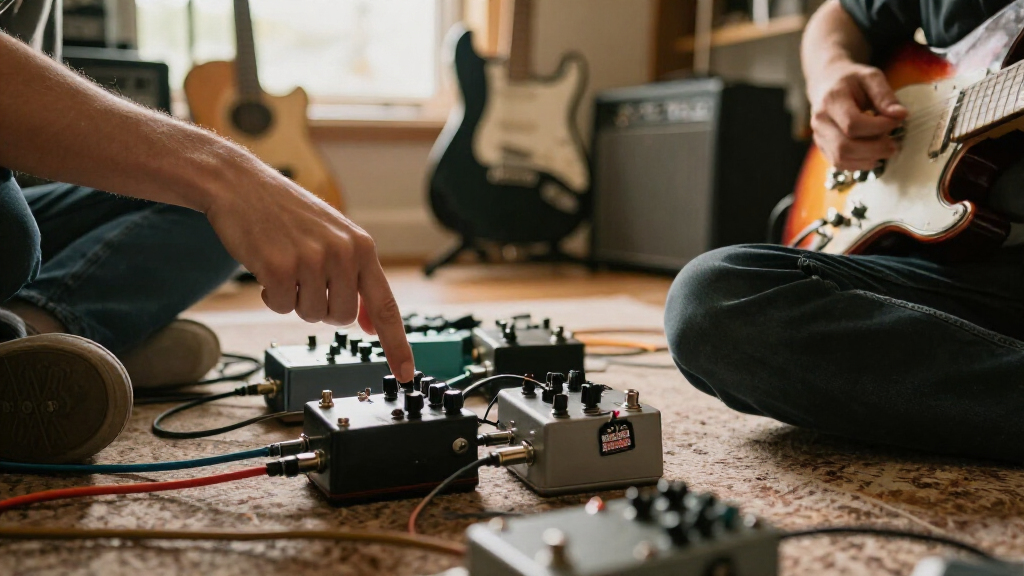
I ranked these 15 guitar pedals by the job they do for a buyer, not by how many features appear on a box. I weighed sound-shaping range, ease of setup, useful controls, format, and practical fit for a pedalboard or portable rig. I also looked at whether each product’s defining feature—such as IR loading, a noise gate, rechargeable operation, or true bypass—solves a real playing need rather than adding complexity for its own sake.
The order favors useful versatility and a clear reason to buy, while still recognizing simpler pedals when they make a more focused choice. That puts the Valeton GP-5 first for compact flexibility, followed by established single-effect options and feature-rich alternatives; focused pedals rank well for their specific jobs, but not as substitutes for broader rigs. Since Black Friday listings and bundles can change, I’d compare the included accessories and power requirements as well as the pedal itself, and I would not treat a temporary deal as a reason to buy a feature set I won’t use.
Factors to Consider When Choosing Black Friday Guitar Pedals
Black Friday can make it tempting to add pedals because a listing looks like a bargain, but a useful purchase starts with your signal chain and playing habits. I’d decide what problem the pedal needs to solve, then check compatibility and day-to-day usability before comparing features.
Choose One Missing Job Before Chasing More Effects
Start by identifying what your rig cannot currently do: shape distortion, add modulation, control volume, tune silently, or cover several sounds in one unit. A dedicated pedal often gets you to the desired sound faster, while a multi-effects processor can replace several boxes when board space or travel matters. The common mistake is choosing the unit with the longest effects list even when most of those sounds duplicate gear you already own. Write down two or three sounds you actually need and use those as a filter. If one pedal solves a regular problem, it may be more useful than a larger unit with many options you rarely reach for.
Check Power, Connections, and Board Fit
Before buying, verify how a pedal is powered and whether its input, output, and switching layout fit your existing board. Rechargeable models can help when wall power is inconvenient, but battery habits and charging needs become part of the setup. A compact enclosure saves space, yet small controls can be harder to adjust during a set. Check whether you need a separate power supply, patch cables, or an adapter, since a pedal is only a good fit if the full setup works. Measure available board space rather than relying on product photos, which can make size differences difficult to judge.
Match Complexity to How You Play
Multi-effects pedals can offer presets, multiple effect types, and deeper editing, but those benefits matter only if you can reach the sounds you need without slowing down practice or performance. Players who make frequent changes may welcome saved settings; players who keep one core tone may prefer a few direct controls. Check whether editing happens on the pedal itself or depends on a phone, computer, or companion app. Consider how clearly you can see and change settings under stage lighting. A feature-rich unit is not automatically a better purchase if its workflow makes quick adjustments awkward.
Treat Distortion as a Gain-Structure Decision
Distortion, overdrive, and fuzz are not simply stronger versions of the same sound; they respond differently to your guitar, amp, pickup output, and other pedals. Before choosing, decide whether you want a mild push, a tighter high-gain sound, or a more unruly fuzz texture. Extra controls such as EQ, boost, or a noise gate can help shape a sound and manage unwanted noise, but they also add settings to balance. If possible, compare demos using a similar amp and pickup type, since a clip recorded through a different setup can mislead. Think about where the pedal will sit in your chain, especially if you already use an amp with substantial gain.
Look Beyond the Deal to the Complete Setup
A Black Friday listing may bundle accessories or change its included items, so confirm exactly what arrives rather than assuming a power supply, cable, or case is included. Check the seller’s return terms and the manufacturer’s support information before buying unfamiliar digital gear. For pedals that load IRs or offer advanced editing, consider whether the file formats and connection methods fit your current devices. A low-cost pedal can still become an inconvenient purchase if it requires extra equipment you do not have. Compare the total setup you need with the simpler alternative, not just the headline listing.
Frequently Asked Questions
Should I choose a multi-effects pedal or several individual pedals for a first board?
I’d choose based on how many distinct sounds you need and how you prefer to change them. A multi-effects unit can cover several jobs in less space and may reduce the number of separate purchases, but navigating settings can take more effort. Individual pedals are easier to understand one at a time and let you replace or rearrange a single sound. If you are still learning what effects you like, a flexible unit can help you experiment; if you already know your core sounds, focused pedals may feel more direct. Check the power and connection needs of either setup before deciding.
Is a compact pedal a good choice if I plan to use it on stage?
Compact size helps with limited board space, but it can make controls and footswitches harder to reach. I’d check the spacing between switches, how easy it is to read settings, and whether you need to change parameters during a song. If a pedal will stay on one setting, a small enclosure is often easier to accommodate. For frequent changes, a larger layout or preset-based workflow may be more practical. Also confirm that the pedal’s power source suits a full rehearsal or performance rather than just short practice sessions.
Do I need IR loading if my amplifier already sounds good?
Not necessarily. IR loading is most useful when you want to shape a direct recording or headphone signal with speaker-cabinet character, or when you need a consistent sound without relying on a physical amp and cabinet. If you mainly play through an amp you like, a conventional effects pedal may address your needs without adding file management or setup steps. Consider where you play and record before paying attention to the feature. The value comes from solving a real direct-signal need, not from having the capability unused.
Can I put a tuner or volume pedal anywhere in my signal chain?
Placement changes how the pedal interacts with the rest of the rig. A tuner near the start of the chain generally receives a cleaner signal, which can make tuning more dependable. A volume pedal before distortion changes how strongly you drive later effects, while one later in the chain mainly reduces overall level. Expression pedals depend on compatible equipment and the intended control input, so check the connection type before buying. If you are unsure, sketch your current chain and decide whether you want to change gain, output level, or a parameter.
What should I verify before buying a guitar pedal during Black Friday?
Confirm the exact model, included accessories, power requirements, connection type, and seller return terms before placing an order. Check whether the pedal needs a separate supply or extra software, and whether your current cables and board can accommodate it. For digital units, verify that the editing and file-loading options work with devices you already use. Compare the pedal’s role with gear you own so a deal does not lead to redundant effects. I’d make the purchase only when the pedal fits a specific need and the complete setup is clear.
Conclusion
For the best overall balance of compact size and sound-shaping range, I’d choose the Valeton GP-5. The best value for a focused distortion sound is the BOSS DS-1, while the Pro Co RAT 2 is a stronger match for players seeking a wider distortion-to-fuzz character. For beginners, the Flatsons KMF-1 offers a multi-effects starting point; those who want more advanced compact processing can compare it with the GP-5. I’d treat the MOOER GE100 and LEKATO CUBE BABY as alternatives when their particular format and portability suit your setup. For specific needs, pick the LEKATO tuner for tuning, SONICAKE Vexpress for expression control, Donner Vowel for wah and volume, or the SONICAKE Thump QDS-09 for high gain with boost and a noise gate. Buy the pedal that fills a clear gap in your rig, not simply the one that appears most tempting during Black Friday.