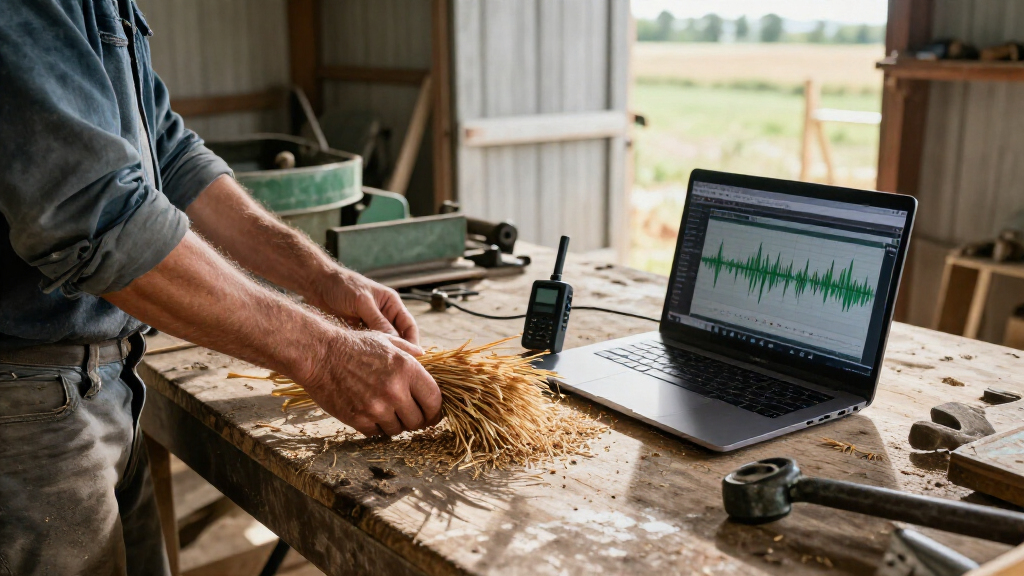
🔍 Read the full analysis: When Farm Work Dominated—and AI Entered The Picture on ThorstenMeyerAI.com

Get audio and creator gear delivered free with Prime
- Fast, free delivery on millions of items
- Prime Video, Amazon Music and more included
- Member-only deals all year
TL;DR
An essay published by ThorstenMeyerAI.com on November 3, 2026, traces how agriculture’s share of work fell over roughly two centuries as tools, fertilizer and improved crops raised output. It presents farming as a historical comparison for AI-driven automation, while acknowledging that the author’s prediction of automation potentially reaching 90% of a sector is a thesis, not an established forecast.
In an essay published November 3, 2026, Thorsten Meyer argues that the history of farming offers a useful comparison for understanding AI and automation: the share of American workers in agriculture fell from an estimated 73.7% in 1800 to about 1.5% today, while food production increased. The account describes a gradual change driven by tools, fertilizer and crop breeding, not a single technological leap.
Meyer’s figures draw on historical estimates cited in his essay. The U.S. 1800 estimate, attributed to economic historian Stanley Lebergott and published by the Census Bureau, counts about 1.4 million agricultural workers out of a labor force of 1.9 million people aged 10 and older. The series includes about 530,000 enslaved people; the figures before 1840 are estimates rather than census counts. Meyer therefore describes the share as roughly three in four, rather than treating the number as exact.
The essay traces changes across several stages. It cites a 1837 steel plough associated with John Deere, later farm machinery, the industrial production of ammonia fertilizer following Fritz Haber’s 1908 patent, and short-straw wheat varieties developed in the 1960s. According to Indian government statistics cited by Meyer, the wheat harvest rose from 12.3 million tonnes in 1964–65 to 26.4 million tonnes in 1971–72, and a 2024–25 advance estimate put it at 117.5 million tonnes.
Employment shares and worker totals did not move in lockstep. Meyer says the number of U.S. farm workers continued to rise until about 1910, reaching an estimated 11.8 million, even as agriculture’s share of the workforce declined. He also cites a German reconstruction in which agriculture’s share fell from 43% in 1882 to 25% in 1939 while the number of farm workers remained between eight and 10 million.
Farm Output Rose as Labor Fell
The history challenges the simple assumption that fewer workers in a sector must mean less of its product. Meyer cites estimates that global cereal harvests grew 4.2-fold from 1961, while the world population grew 2.7-fold over the same period. He also reports that U.S. farm output in 2023 was nearly three times its 1948 level, with only a small rise in total inputs. These measures suggest that productivity gains can allow fewer people to produce more, though they do not by themselves show how the gains or costs were distributed.
The comparison matters for readers weighing claims about AI and jobs. Agriculture shows that technology can transform the labor needs of an entire sector over time, but it does not establish how quickly AI will change office or factory work, which occupations will be affected, or whether new jobs will offset losses. Meyer’s suggestion that automation could reach as much as 90% of a sector within a decade or a few decades is explicitly his thesis, not a measured outcome or consensus forecast.
The change also remains uneven worldwide. Meyer cites a 2025 International Labour Organization estimate of 928 million people working in agriculture, about one in four workers globally. His essay gives agriculture’s employment share as 43% in India, about 1.5% in the United States and about 1% in Germany. The figures underline that a long-run transformation in one country does not mean the same change has already happened everywhere.
Products Worth Considering

DJI Osmo Mobile 8 Gimbal with Mic Mini Transmitter, Infinity Black

Logitech MX Mechanical Wireless Illuminated Keyboard, Tactile Quiet, Graphite

Samsung 27-Inch Odyssey OLED G5 QHD Gaming Monitor
As an affiliate, we earn on qualifying purchases.
A Long, Uneven Mechanization
Meyer’s account begins with the limits of farming based largely on human and animal muscle: hand tools, draft animals and weather constrained how much one household could grow. Under those conditions, a large share of the population had to produce food. Historical estimates cited in the essay put the primary-sector share at about 85% in Japan in 1872, 83.5% in China in 1952 and 69.7% of workers in India in 1951. Those numbers come from different reconstructions and statistical categories; they are not directly identical measures.
In the United States, the change unfolded over generations. The steel plough is one early example in Meyer’s account: a polished steel surface could shed sticky Midwestern soil more readily than earlier designs, reducing the need to stop and scrape. Reapers, threshers and tractors later mechanized further tasks. Fertilizer and improved crop varieties raised the amount that could be harvested from land, with short-straw wheat able to carry more grain without falling over when supplied with fertilizer and irrigation.
The essay is the second installment of Meyer’s “Work After Work” series, which divides the economy into field, factory and office. Its focus is not a new AI product or policy announcement; it uses agriculture’s earlier transformation to frame questions about the future of work.
“The share fell long before the headcount.”
— Thorsten Meyer, in the essay
Limits of the AI Comparison
The essay documents historical agricultural change but does not provide a forecast for specific AI-related job losses, industries or countries. Its potential 90% automation figure is not accompanied in the supplied material by a model, definition of “automation,” or evidence that the same timeline applies across sectors. It should be read as Meyer’s argument, not a confirmed projection.
Some of the historical figures also carry qualifications. The U.S. estimate for 1800 is a reconstruction, not a census result, and the source notes that it includes enslaved workers. Cross-country estimates refer to different years and may use different definitions, including the broader primary sector in some cases. The essay does not establish how agricultural gains were distributed among workers, farm owners and consumers, or how displaced workers found other work.
The Series Turns to Factories
Meyer identifies the next installment as a look at the factory sector, including the role of mechanical reapers, threshers and tractors in agriculture’s labor shift. The essay does not give a publication date for that episode. Readers can expect the series to continue its field, factory and office framework, but any conclusions about AI’s likely effects will depend on evidence beyond the historical farming comparison.
Key Questions
What is the essay’s main point?
Meyer argues that farming shows how a sector can produce more while relying on a much smaller share of the workforce. He presents that history as a comparison for thinking about AI and automation, not as proof that other sectors will follow the same path.
How many Americans worked in agriculture around 1800?
The Census Bureau-published estimate by Stanley Lebergott puts the figure at 73.7% of the U.S. labor force in 1800. It is a historical estimate, not a census count, and includes enslaved people.
Did fewer farm workers mean less food?
Not in the long-run figures cited by Meyer. He reports that global cereal production increased faster than population from 1961, and that U.S. farm output in 2023 was nearly three times its 1948 level. Those figures describe production and inputs, not how benefits were shared.
Is the 90% automation figure a forecast?
No. Meyer labels it his thesis. The supplied material does not provide a model or independent evidence supporting that figure as a forecast.
How many people still work in agriculture worldwide?
The essay cites a 2025 ILO estimate of 928 million people, or about one in four workers worldwide. The share varies substantially by country, according to the figures Meyer cites.
Source: ThorstenMeyerAI.com