📊 Full opportunity report: Best Quiet CPU Coolers for Sustained AI/Compute Loads on ThorstenMeyerAI.com — validation score, market gap, and execution plan.

Get audio and creator gear delivered free with Prime
- Fast, free delivery on millions of items
- Prime Video, Amazon Music and more included
- Member-only deals all year
TL;DR
This article reviews the best quiet CPU coolers for sustained AI and compute tasks in 2026. It compares air and liquid cooling solutions, emphasizing reliability, noise levels, and performance under continuous load.
In 2026, the focus on quiet, reliable CPU cooling solutions for sustained AI and compute workloads has intensified, with new benchmarks set for air and liquid coolers designed to handle continuous high loads without noise or failure.
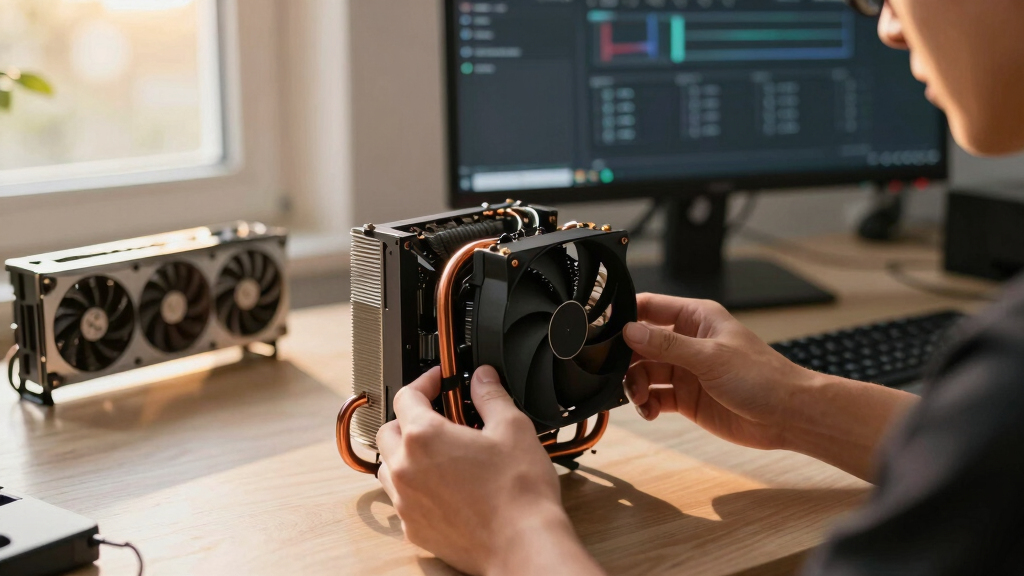
This guide evaluates the top CPU coolers suitable for long-duration AI and data processing tasks, emphasizing noise levels, thermal capacity, and reliability. The Noctua NH-D15 G2 remains the top air cooler for its combination of low noise and high performance, while the Arctic Liquid Freezer III Pro 360 leads among liquid cooling options for high-TDP workloads. These choices are based on testing and expert analysis, considering factors like fan size, surface area, and long-term durability. The importance of matching cooler capacity to workload duration and heat output is stressed, especially for high-end CPUs like Ryzen 9 and Core i9, which generate sustained heat during extended inference or training sessions. The article notes that air coolers with large heatsinks and slow-spinning fans excel in quiet operation over long periods, while AIOs provide more stable temperatures under extreme loads but introduce potential failure points such as pumps.Best quiet CPU coolers
for sustained AI loads.
A cooler that’s fine for gaming bursts can run out of headroom on hour three of an inference job. What matters here isn’t peak capacity — it’s holding a steady temperature at a quiet fan speed, all day. Tap your priority in Part 3 to find your pick.
- Mainstream to high-end CPU, power-capped.
- You run it 24/7 — no pump to fail, ever.
- You want zero maintenance for years.
- Quiet matters more than the last few degrees.
- Top-tier CPU under sustained all-core load.
- A big air tower won’t physically fit (multi-GPU case).
- You want maximum sustained thermal headroom.
- You’ll accept a pump as one more moving part.
Why Quiet Cooling Is Critical for AI Workstations
Choosing the right CPU cooler for sustained AI workloads impacts system stability, noise levels, and long-term reliability. Quiet, high-capacity coolers prevent thermal throttling and hardware stress during continuous operation, essential for professional AI research and data processing. As AI workloads grow more demanding, the ability to maintain steady temperatures without disruptive noise becomes increasingly important for productivity and environment comfort.
As an affiliate, we earn on qualifying purchases.
Evolution of CPU Cooling for Long-Run AI Tasks
Traditional gaming-focused coolers prioritize peak performance for short bursts, but AI and compute workloads require consistent thermal management over hours or days. In 2026, the market has shifted towards larger, more efficient coolers—both air and liquid—that can handle these sustained loads. The Noctua NH-D15 G2 has been a long-standing leader, but newer liquid solutions like Arctic's 360mm AIOs have gained popularity for their superior thermal stability at high TDP levels. Reliability concerns, especially with pumps in AIOs, continue to influence user choice, favoring proven air coolers for 24/7 operation.
"For long AI inference and training, cooling capacity at low noise levels is non-negotiable. Larger heatsinks and slow-spinning fans outperform smaller, noisier solutions over time."
— Thorsten Meyer, AI hardware expert
Remaining Questions About Cooler Performance and Longevity
While current testing favors large air coolers like the Noctua NH-D15 G2 for reliability and noise, long-term data on the durability of high-performance AIOs under continuous load is still emerging. It is not yet clear how pump lifespan and potential maintenance needs will impact total cost of ownership over several years.
Upcoming Developments in CPU Cooling for AI Workloads
Manufacturers are expected to release next-generation coolers with improved thermal interfaces and quieter pumps. Further long-term testing will clarify the durability of liquid coolers, and new designs may better balance performance, noise, and reliability for AI and compute environments. Monitoring these updates will be critical for builders aiming for long-term stability.
Key Questions
Why are large air coolers preferred for sustained AI workloads?
Large air coolers with big heatsinks and slow fans provide high thermal capacity with low noise, making them ideal for continuous operation without failure risk associated with pumps in liquid coolers.
Are liquid coolers better than air for long AI training sessions?
Liquid coolers generally offer more stable temperatures under extreme loads, but they introduce potential pump failure points, making high-quality air coolers more reliable for 24/7 use.
How important is noise level in choosing a CPU cooler for AI workstations?
Very important. Sustained workloads require coolers that operate quietly over long periods, reducing noise pollution and maintaining a comfortable working environment.
What should I consider when selecting a cooler for a high-end CPU under continuous load?
Focus on thermal capacity, fan size, noise levels, and long-term reliability. Larger, slower-spinning fans and bigger heatsinks typically perform better over extended periods.
Will newer cooling technologies emerge in 2026?
Yes, manufacturers are developing next-generation coolers with improved thermal interfaces, quieter pumps, and more efficient designs, which will likely enhance performance and reliability for AI workloads.
Source: ThorstenMeyerAI.com
Halloween Picks
halloween
As an affiliate, we earn on qualifying purchases.