The Bottleneck Moved: Inside Anthropic’s Expansion of Project Glasswing

Anthropic extends Project Glasswing, shifting focus from vulnerability detection to rapid verification, disclosure, and patching in cybersecurity efforts.

The bridge. Why the AI buildout runs on a nuclear story and a gas reality.

Analysis of how AI data centers rely on gas for immediate power despite nuclear deals for the future, highlighting a timeline mismatch and emissions impact.

The rails. Why European agentic commerce is co-defined by two converging regimes.

European agentic commerce is being shaped by two regulatory regimes—PSD3/PSR and the AI Act—creating a complex, statutory infrastructure that differs from the US model.

The policy menu. There’s no single answer. There’s a menu — and choosing is a values choice in disguise.

A comprehensive analysis of the policy options for managing AI-driven economic shifts, emphasizing values and uncertainty over single solutions.

The prospectus. Where the AI labs’ singular governance history meets the auditor.

OpenAI prepares to file its IPO prospectus, exposing its complex governance structure, mission-focused mechanisms, and legal risks, impacting investor perception.

The stake. Why the answer to automation is broad-based ownership, not a bigger transfer.

Thorsten Meyer argues that expanding ownership of capital, not increasing taxes, is the market-friendly response to AI’s impact on labor and income distribution.

Understanding Anthropic’s $965B Series H: The Compute Revolution

Anthropic’s latest funding round highlights a strategic focus on hardware capacity, chips, and power to scale AI models like Claude, marking a major infrastructure investment in AI.

Different Game, or Already Lost? Reading Mistral’s Sovereignty Bet

Mistral emphasizes European control over AI infrastructure and open weights, aiming to reshape AI sovereignty. Is this a strategic advantage or a sign of falling behind?

A War Room for Your Next Idea: Inside IdeaClyst

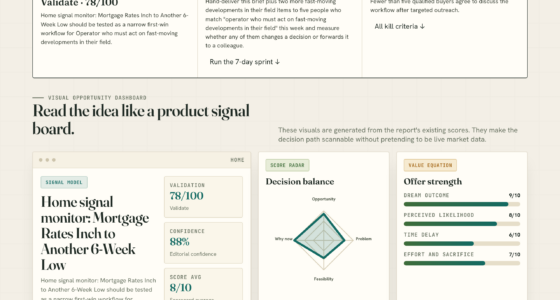
IdeaClyst launches as a local-first AI-driven tool that helps founders validate ideas, pressure-test strategies, and make confident decisions without cloud dependence.

IdeaClyst: The Engine That Decides What’s Worth Building

IdeaClyst, an AI-powered idea engine, transforms rough concepts into validated, targeted product initiatives by analyzing roadmaps and market opportunities.

Disk Is the Contract: Inside Threlmark’s Local-First Architecture

Exploring how Threlmark’s local-first design uses disk-based JSON files for project management, enabling portability, safety, and interoperability.

The Free-Download Question: When Running Your Own Model Actually Beats Paying

Analysis of the rising viability of self-hosted AI models versus API costs, highlighting recent technical and economic shifts as of mid-2026.

Quiet GPUs for Local AI: Acoustic and Thermal Roundup

A comprehensive roundup of the quietest GPUs for local AI in 2026, focusing on thermal performance, acoustics, and optimal configurations for different VRAM tiers.

The deployment. How the AI labs verticallyintegrated into the serviceslayer — the Palantir modelat scale.

Major AI labs adopt Palantir-inspired forward-deployed engineer model to embed models into enterprise workflows, transforming AI deployment and revenue streams.

$965B and Climbing: Anthropic’s Series H Is Really a Compute Bet

Anthropic closes a $65B Series H at a $965B valuation, emphasizing compute infrastructure investments over valuation; a major shift in AI funding focus.

When a Content Network Starts Publishing to Itself

A large automated content network began publishing heavily to a few sites, leaving many inactive. The issue stems from internal system dynamics, not external errors.

The 4.8 Staircase: What the Market Actually Believes About Claude’s Next Release

Market signals suggest a likely release of Claude 4.8 by late June or July, but no official announcement has been made. Here’s what’s confirmed and what remains uncertain.

Opus 4.8 Lands, and the Quiet Headline Is Honesty

Anthropic releases Claude Opus 4.8 with improved benchmarks and a focus on honesty, claiming it is less likely to pass flaws unremarked. Details on safety and impact remain under review.

DeepSWE – The benchmark that made the models spread out again

DeepSWE, released May 2026, exposes significant gaps among AI coding models, challenging previous benchmarks that showed models as nearly identical.

The referral. How AI search severs the content-for-traffic contract that funded the open web.

AI search engines now answer queries directly, ending the traditional referral-based traffic model that funded independent publishers, causing significant revenue shifts.

The Defender’s Window Is Closing Faster Than Anyone Is Counting

April 2026 saw rapid advances in AI offensive skills, with models outperforming humans in cyberattack simulations, raising urgent security concerns.

The clause. How a contractual definition of AGI met the capital built on top of it.

The original AGI clause in the 2019 Microsoft–OpenAI contract was a doomsday provision, but it was gradually defused through amendments in 2025 and 2026, reshaping AI governance.

The queue. Why the grid, not the chip, is the binding constraint on AI.

The US interconnection queue now blocks AI infrastructure growth, shifting build strategies toward private grids and raising political costs for ratepayers.
The pyramid cracks. What agentic AI does to the consulting leverage model.

Generative AI is disrupting the traditional consulting pyramid, leading to sector splits and talent pipeline shifts. Here’s what is confirmed and what remains uncertain.

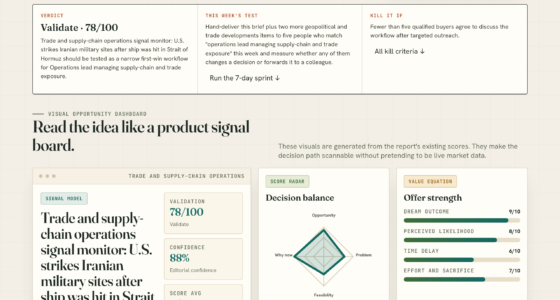
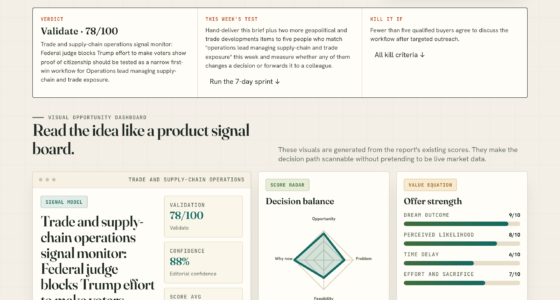
Trade and supply-chain operations signal monitor: Chicago, Illinois weather forecast: Tornado Watch issued for parts of area | Radar

A Tornado Watch issued for parts of Chicago has activated a trade and supply-chain operations signal monitor, highlighting real-time weather impacts on logistics.

The CFO’s new operating system. Anthropic, OpenAI, and the consulting margin that just got compressed.

Anthropic’s $1.5B JV and OpenAI’s parallel funding shift the AI enterprise model, integrating AI into CFO workflows and disrupting traditional consulting margins.

The gigawatt gap. Why China is structurally positioned for AI power and the US is engineering around its grid.

Analysis of how China’s centralized power infrastructure and renewable buildout give it an edge in AI deployment, contrasting with US fragmentation.

Phase 1 synthesis. What the four sectors crystallize.

Empirical analysis confirms four distinct labor displacement patterns across sectors, revealing sector-specific structural signatures in AI-driven labor shifts.

The Bubble Question, Disentangled: 1999 vs 2026 Category by Category

A detailed comparison of the AI investment cycle in 2026 versus the dotcom bubble of 1999, highlighting confirmed facts, claims, and uncertainties.

Q3 2026 SaaS Earnings Pre-Brief: The Litmus Test for the Agentic-Disruption Thesis

Ahead of Q3 2026 earnings, SaaS giants like ServiceNow and Salesforce face critical tests on agentic-disruption trends, impacting valuations and strategic direction.
Forward-Deployed Engineer Economics 2.0: The Unit Economics Math, Six Months Later

Six months after initial analysis, FDE economics reveal profitability at enterprise scale but challenges at lower levels, impacting AI lab scaling strategies.

China Sphere Capability Gap, Q2 2026 Update: Five Labs, Five Strategies, One Narrowing Frontier

Five Chinese labs launched frontier-tier models in April 2026, narrowing the gap with US leaders in capability and cost efficiency, reshaping the AI landscape.

The Machine Economy — Capital-Heavy, Human-Light, Trading With Itself

Analysis of the rise of AI-driven, capital-intensive firms trading mainly with each other, transforming economic structures and raising governance questions.

The Roblox Cheat That Broke Vercel.

A Roblox auto-farm script downloaded by an employee exploited OAuth trust, causing a major breach at Vercel. The incident highlights security risks from seemingly harmless decisions.
The Compounding Error Problem — Why 99.9% Alignment Decays to 60% in 500 Generations

Analysis of how 99.9% alignment accuracy per generation can decline sharply over hundreds of AI generations, raising concerns for recursive self-improvement.

732 Bytes to Root. One Hour of Scan Time.

A new Linux kernel privilege escalation bug was identified in just one hour of scanning, collapsing security cost assumptions and raising urgent questions for enterprise defense.

The Co-Founder’s Black Hole — A Structural Read on Jack Clark’s Automated AI R&D Essay

Anthropic co-founder Jack Clark predicts over 60% chance of fully automated AI research by 2028, raising concerns about institutional readiness and future risks.

The Compute Concentration Audit: When Sovereign Wealth Funds Notice Three Companies Own the Frontier

Global regulators are investigating the dominance of AWS, Microsoft Azure, and Google Cloud in AI compute infrastructure, impacting strategic investments.

The Power Bottleneck: AI Data Centers and the Grid Cliff Approaching 2027-2028

Power availability limits AI data center expansion, with grid expansion lagging behind hyperscaler capex. Key developments point to a looming energy bottleneck by 2027.

The Skills Marketplace Nobody Is Building Yet

A new open standard for AI skills exists, but a dedicated marketplace with monetization, vetting, and security remains undeveloped, risking ecosystem fragmentation.

The Labor Displacement Data: What Q1-Q2 2026 Actually Shows

New data from Q1-Q2 2026 shows AI-driven layoffs are concentrated in specific cohorts, with overall employment metrics remaining stable, highlighting structural shifts.

Two Channels: How the Pentagon Just Split Frontier-AI Procurement in Half

The Pentagon announced a split in AI procurement, placing Anthropic exclusively in a cybersecurity channel, not the classified multi-vendor network, reflecting strategic segmentation.