
TL;DR

Get audio and creator gear delivered free with Prime
- Fast, free delivery on millions of items
- Prime Video, Amazon Music and more included
- Member-only deals all year
Siemens is shifting focus from language-based AI to physical AI for manufacturing, leveraging its industrial data and expertise. The company announced a partnership with NVIDIA to build an Industrial AI Operating System aimed at transforming factory automation.
Siemens has announced a strategic push into physical AI for manufacturing, emphasizing its focus on factory automation and industrial data rather than chatbots or language models. The company revealed plans to develop an Industrial Foundation Model and an Industrial AI Operating System in partnership with NVIDIA, aiming to embed AI across the entire industrial lifecycle.
The core of Siemens’ strategy is the Industrial Foundation Model (IFM), designed to process and contextualize 3D models, 2D drawings, sensor telemetry, and automation logic. First announced at Hannover Messe 2025, the model aims to optimize engineering and manufacturing processes by leveraging proprietary industrial data.
At CES 2026, Siemens detailed its collaboration with NVIDIA to build the Industrial AI Operating System, a platform intended to accelerate simulation, enable generative digital twins, and support AI-driven manufacturing. Siemens plans to launch its first fully AI-driven factory in Erlangen, Germany, in 2026, with further digital twin tools like Digital Twin Composer and industrial copilots planned for deployment.
Siemens claims that its extensive industrial data, domain expertise, and existing customer relationships position it uniquely to lead in physical AI, contrasting with the more generalist AI approaches focused on language and text.
Transforming Manufacturing with Physical AI
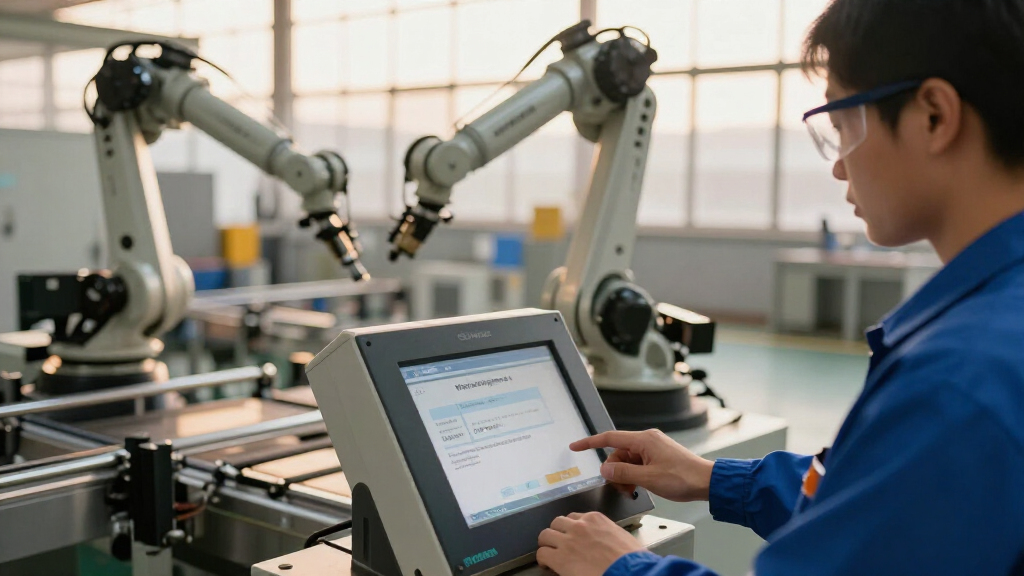
This development signifies a potential paradigm shift in industrial automation, where AI is no longer confined to software or chatbots but is embedded directly into physical processes. Siemens’ focus on proprietary industrial data and domain expertise could give it a competitive edge in creating more efficient, adaptive factories. The partnership with NVIDIA accelerates this shift by providing the necessary simulation and AI infrastructure. If successful, this approach could redefine manufacturing, supply chain management, and infrastructure maintenance, making AI a fundamental component of physical operations rather than a supplementary feature.industrial AI software for manufacturing
As an affiliate, we earn on qualifying purchases.
As an affiliate, we earn on qualifying purchases.
Siemens’ Industrial Data and Domain Expertise
Siemens has over 175 years of experience in industrial automation, accumulating vast proprietary data from manufacturing, engineering, and operational telemetry. Its existing relationships with major manufacturers like PepsiCo and Audi provide a strong foundation for deploying AI solutions tailored to specific industry needs. Prior efforts have focused on automation and software tools, but the current strategy emphasizes leveraging this domain knowledge for AI-driven optimization.
The broader industrial AI landscape has been increasingly competitive, with companies like Palantir, Qualcomm, and Hugging Face entering adjacent markets. Siemens’ emphasis on physical AI distinguishes it from general-purpose AI providers, aiming to embed intelligence directly into factory systems and infrastructure.
“Industrial AI is no longer a feature; it’s a force that will reshape the next century.”
— Roland Busch, Siemens CEO
Unconfirmed Performance Metrics and Deployment Timelines
While Siemens announced ambitious plans for 2026, specific hardware configurations, performance benchmarks, and deployment timelines remain undisclosed. The effectiveness of the Industrial AI Operating System and the actual impact of the Digital Twin Composer are still unproven at scale, with no independent validation available yet.
Furthermore, the dependency on NVIDIA’s infrastructure raises questions about vendor lock-in, hardware sovereignty, and performance in diverse industrial environments.
Next Steps in Industrial AI Deployment and Validation
Siemens plans to launch its first fully AI-driven factory in Erlangen in 2026, serving as a proof of concept. The company will also roll out Digital Twin Composer and expand its industrial copilots across different sectors. Monitoring these deployments and their performance metrics will be critical to assessing the success of Siemens’ physical AI strategy.
Independent evaluations and customer case studies are expected to follow, providing validation or critique of the platform’s capabilities and real-world impact.
Key Questions
How is Siemens’ approach different from other AI solutions in manufacturing?
Siemens emphasizes physical AI tailored to industrial data, models, and physics, leveraging its proprietary data and domain expertise, unlike general-purpose AI focused on language or text.
What are the main benefits Siemens claims for its physical AI platform?
Siemens asserts that its platform will enable more accurate simulations, real-time process optimization, and autonomous factory operation, reducing costs and increasing flexibility.
Will Siemens’ AI solutions be compatible with existing factory systems?
Yes, Siemens aims to integrate its AI tools with current automation infrastructure, leveraging its established customer relationships and industrial data ecosystem.
Are there any risks or limitations to Siemens’ approach?
Dependence on NVIDIA’s hardware and software infrastructure, unverified performance claims, and long deployment cycles pose potential risks to rapid adoption and scalability.
What is the timeline for seeing tangible results from Siemens’ AI initiatives?
The first fully AI-driven factory is expected to launch in 2026, but broader impacts and validation may take several years to materialize fully.
Source: ThorstenMeyerAI.com
Halloween Picks
halloween
As an affiliate, we earn on qualifying purchases.