
by Thorsten Meyer — Munich-based Futurist, Author, and Post-Labor Economist
Published on StrongMocha.com | October 30, 2025

Get audio and creator gear delivered free with Prime
- Fast, free delivery on millions of items
- Prime Video, Amazon Music and more included
- Member-only deals all year
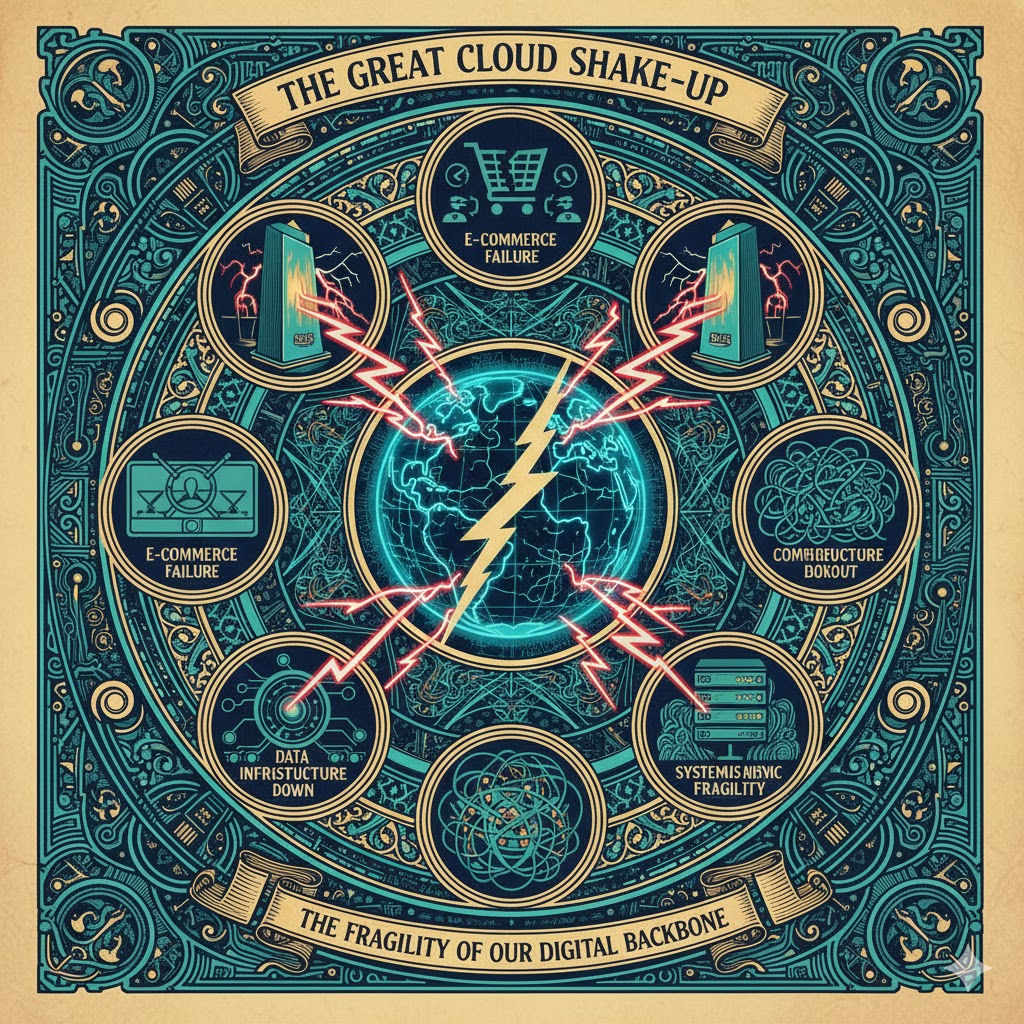
The Great Cloud Shake-Up
Two massive cloud disruptions within ten days have sent a shockwave through the global digital ecosystem — revealing how precariously our connected world still rests on the shoulders of a few centralized providers.
On October 20, 2025, Amazon Web Services (AWS) suffered a crippling outage in its US-East-1 region (Northern Virginia). Just nine days later, Microsoft Azure followed with its own global disruption on October 29, affecting Azure Front Door, Microsoft 365, and even Xbox Live.
As an affiliate, we earn on qualifying purchases.
AWS Outage (Oct 20): When a DNS Glitch Toppled the Cloud Giant
The AWS incident started with a DNS resolution failure inside the DynamoDB API endpoints. What began as a routine routing issue snowballed into a full-scale disruption, affecting Snapchat, WhatsApp, Fortnite, Duolingo, and even Alexa and Ring devices.
Although Amazon restored functionality within hours, secondary effects persisted for over a day — queues stalled, authentication systems broke, and workloads in “redundant” regions experienced degraded performance.
🟢 Key insight: Multi-region redundancy inside one cloud isn’t real resilience if DNS, IAM, or routing layers remain centralized.
Microsoft Azure Outage (Oct 29): When the Edge Fails
A similar fate struck Microsoft’s network just nine days later. The Azure Front Door edge and CDN layer suffered a cascading DNS configuration failure, taking down Microsoft 365, Teams, Outlook, Xbox Live, and countless enterprise workloads.
Companies like Alaska Airlines and Starbucks confirmed widespread service disruption. The root cause? An inconsistent DNS propagation sequence that essentially locked the digital front door to Microsoft’s cloud — while the back-end services remained healthy.
🟢 Lesson: Edge reliability is now as critical as compute performance. When your DNS goes dark, everything else is invisible.
The Shared Weakness: DNS — The Internet’s Achilles’ Heel
Both events share a fragile common thread — DNS infrastructure. Despite decades of engineering progress, DNS remains one of the most failure-prone yet mission-critical components of the modern web stack.
In both outages, misconfigured or partially propagated DNS records cascaded across global networks, disrupting services at scale. Redundancy at the compute or database layer offers no defense if the lookup system that finds them fails.
Market Impact and Ripple Effects
Preliminary estimates suggest:
- AWS Outage: impacted ~6% of global web traffic for several hours.
- Azure Outage: affected millions of enterprise users worldwide.
- Combined financial impact: potentially exceeding $1.2 billion USD in lost productivity and SLA penalties.
Meanwhile, Google Cloud and Oracle Cloud Infrastructure reported measurable traffic spikes as enterprises rerouted workloads — reinforcing the strategic case for multi-cloud deployment.
Building Resilience: Key Takeaways for Organizations
1. Design for Graceful Degradation
Ensure your applications can operate in a limited mode when external dependencies fail. Avoid “all-or-nothing” service patterns.
2. Go Provider-Agnostic
True resilience requires abstraction. Use tools like Terraform, Kubernetes, or Cloudflare Workers to deploy workloads across multiple providers.
3. Test Your Failover — Don’t Just Document It
Conduct chaos-engineering drills and DNS failover simulations regularly. Real-world testing surfaces architectural blind spots before they cost you uptime and reputation.
The Bigger Picture: Cloud Resilience as a Public Good
The October 2025 outages reignited debate around the centralization of critical digital infrastructure. With AWS, Microsoft, and Google collectively powering more than 65% of global web traffic, a single provider’s error can ripple across the economy.
Regulators and policymakers are already exploring standards for transparency, redundancy, and interoperability. Expect future frameworks treating cloud resilience as part of essential digital infrastructure — similar to how power grids or financial networks are governed today.
Final Thoughts
The back-to-back AWS and Azure outages of October 2025 will be remembered not merely as technical failures but as strategic inflection points. They expose a hard truth: the cloud isn’t a destination — it’s an ecosystem that demands continuous resilience planning.
For digital leaders and infrastructure architects, the new mantra is clear:
“Build for resilience, expect the unexpected, and never assume the cloud is invincible.”
Fall Picks
fall essentials
As an affiliate, we earn on qualifying purchases.