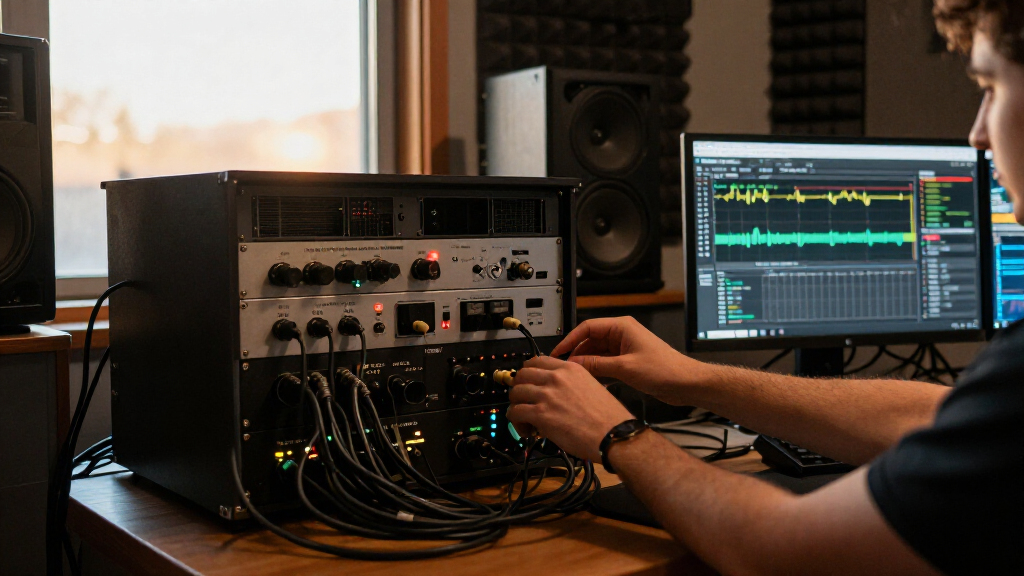
🔍 Read the full analysis: How AI Chip Rental Demand Powers Neocloud Revenue on ThorstenMeyerAI.com

Get audio and creator gear delivered free with Prime
- Fast, free delivery on millions of items
- Prime Video, Amazon Music and more included
- Member-only deals all year
TL;DR
Neoclouds earn revenue by renting GPU capacity, but their economics depend on keeping expensive chips in use and covering financing and depreciation costs. CoreWeave reported $3.661 billion in revenue for the quarter ended Sept. 30, 2026; calculations from its filings put depreciation and amortization at about $52 per $100 of revenue and net interest at about $23. Those figures describe costs, not profit, and do not establish whether the business is profitable overall.
Neocloud revenue depends on renting GPU hours from costly AI servers, while keeping those machines busy enough to cover depreciation and financing. A November 29 explainer from ThorstenMeyerAI.com uses CoreWeave’s quarter ended September 30, 2026 to show the pressures behind the model: its calculations put depreciation and amortization at about $52 and net interest at about $23 for every $100 of reported revenue.
CoreWeave reported $3.661 billion in revenue for the three months ended Sept. 30, according to its results release dated Nov. 10. The explainer divides selected cost figures by revenue: depreciation and amortization of $1.889 billion equaled about 51.6%, while net interest of $846 million equaled about 23.1%. Rounded, that is roughly $52 for equipment depreciation and $23 for net interest per $100 of revenue. These are ratios of stated expenses to revenue, not a full account of costs or a measure of profit.
The business sells access to GPU computing, generally measured in chip-hours. The source compares it with a hotel: a GPU hour that goes unused cannot be saved and sold later. This makes utilization—the share of capacity that is rented and working a key influence on revenue. The company still has costs when equipment is idle, while the amount it can charge depends on demand and market prices.
Neoclouds also rely on contracts and financing. The explainer says customers sign long-term, take-or-pay agreements, under which they pay for booked capacity even if they do not use it; lenders can lend against customer contracts and equipment. It reports that CoreWeave’s contracts average about five years, while the company depreciates technology equipment over six years. That difference means equipment accounting and customer commitments run on separate schedules, though the source does not provide enough detail to establish how each contract aligns with particular assets or loans.
Why Utilization Shapes Rental Economics
The figures show why fast revenue growth alone does not settle whether a neocloud’s business model is financially sound. Providers must earn enough from rented capacity to cover the cost of equipment over time and the interest on money borrowed to buy it. Idle GPUs can reduce revenue without removing those obligations, while falling rental prices can make it harder to recover capital costs.
The same model matters to customers deciding whether to rent AI computing. The source cites an April 2026 index that placed an Nvidia H100 rental at neoclouds at about one-third of the price at large cloud providers. That is an on-demand index comparison for a particular time, not a guaranteed price for a buyer’s contract; rates move, and negotiated terms can differ. Lower headline prices may also come with take-or-pay commitments, which leave the customer responsible for capacity it does not use.
For users of AI products, chip rental economics can affect the cost of providing services. Lower costs per unit of computing may make some AI features cheaper to operate; tighter financing or higher capacity costs could put pressure in the other direction. The source presents this as an implication of the business model, not a forecast of consumer prices.
Products Worth Considering

LG UltraGear 27-inch 4K UHD IPS Gaming Monitor, Dual Mode 180Hz/360Hz, 1ms, G-SYNC Compatible

Apple MacBook Air 13-inch Laptop with M5 Chip, 32GB Memory, 1TB SSD, Silver

DJI Osmo Mobile 8 Phone Gimbal with Mic Mini Transmitter, Infinity Black
As an affiliate, we earn on qualifying purchases.
CoreWeave and the Cloud Market
Hyperscalers such as Amazon, Microsoft, Google and Oracle offer a broad range of cloud services. Neoclouds specialize more narrowly in GPU computing for AI. The distinction is not absolute: CoreWeave’s 2025 annual report, filed on March 2, 2026, names those large cloud companies among its competitors and says that a number are also its current customers. Neoclouds can therefore supply companies that compete with them, as well as other customers.
Depreciation records the cost of equipment over the years a company expects to use it. CoreWeave says it moved its estimated useful life for technology equipment from five to six years in 2023. The explainer also says Amazon shortened the estimated life for a subset of its servers and networking equipment from six years to five beginning in January 2025, citing the pace of technology development. These are different companies’ accounting estimates and do not, by themselves, show how long any particular machine remains useful or productive.
That distinction matters because AI hardware can lose commercial appeal as newer equipment arrives, even while the older machines remain operational. A provider’s economics thus involve both physical use and the market value of its capacity. Accounting useful life is an estimate, not a direct measure of utilization, resale value or the price customers will pay.
“A GPU-hour that is unused today cannot be stored and delivered next month.”
— ThorstenMeyerAI.com, describing the GPU-hour economics and citing Bandi and Su’s 2026 research paper
Costs Do Not Settle Profitability
The reported expense ratios do not show CoreWeave’s complete financial position. The source excerpt does not provide all operating expenses, cash flows, capital spending, debt terms or profit measures needed to assess the quarter’s overall returns. Nor does it establish what share of available GPU capacity was rented, the rates achieved under individual contracts, or how much equipment was financed on particular terms.
The cited H100 price comparison is an April 2026 on-demand index figure, not a current quote or an apples-to-apples comparison of every service and contract. Actual customer pricing and obligations can differ by provider, workload, duration and agreement. The source also does not quantify how quickly CoreWeave’s equipment may lose value or how much capacity customers could shift if a provider encountered financial or operational trouble.
What Buyers and Investors Can Track
For buyers, the immediate next step is to compare current offers rather than rely on an older index. They can examine the take-or-pay terms, the capacity they are committing to, service and support obligations, and what would happen to workloads if the provider could not deliver. Contract details determine the buyer’s actual cost and exposure, not the headline hourly rate alone.
For readers following the business, subsequent company filings and quarterly results can show how revenue, depreciation, interest, capital spending and debt change over time. Utilization and contract duration would also help explain whether new capacity is generating enough rental income to support its cost, but the figures supplied here do not answer those questions. The explainer is an account of how the model works, and expressly says it is not an investment view.
Key Questions
How does a neocloud make money?
It rents GPU computing capacity, often charging for access by time or under a longer-term agreement. Revenue depends in part on how much capacity customers rent and the prices and terms in their contracts.
What do CoreWeave’s $52 and $23 figures mean?
They are rounded estimates per $100 of revenue for depreciation and amortization, and net interest, respectively, in the quarter ended Sept. 30, 2026. They are calculated from stated line items and are not profit figures or a complete breakdown of expenses.
What is a take-or-pay contract?
It requires a customer to pay for capacity it has booked even if it does not use all of it. The exact obligation depends on the contract.
Are neocloud GPU rentals always cheaper than large-cloud rentals?
No. The source cites an April 2026 index that put an H100 neocloud on-demand rate at about one-third of the big-cloud price, but rates change and a particular customer’s negotiated price and service terms may differ.
Does this data show that CoreWeave was profitable?
No. The cited depreciation and interest figures show significant costs relative to revenue, but the information provided does not include the complete results needed to determine overall profitability.
Source: ThorstenMeyerAI.com