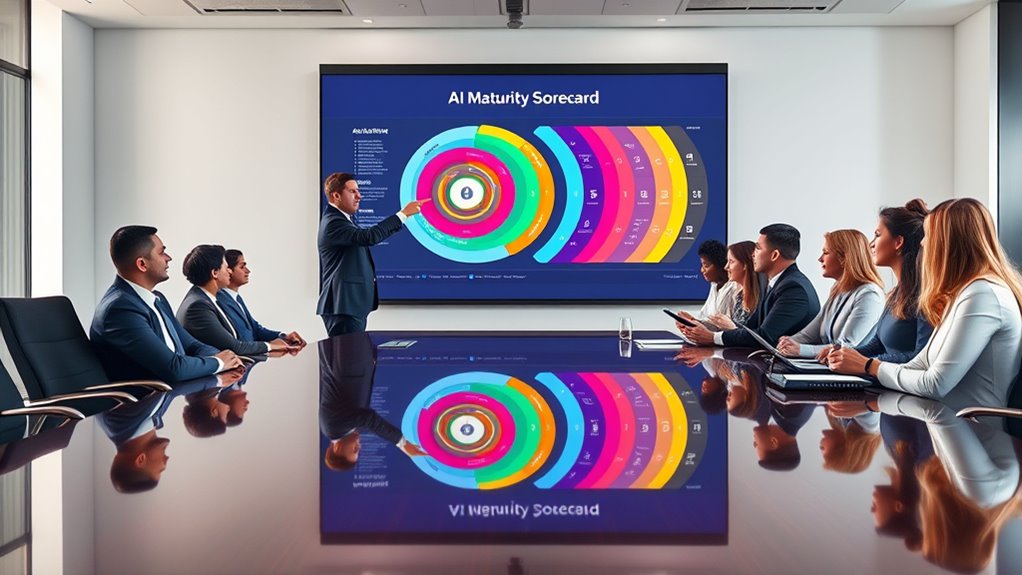

To measure AI program maturity using a scorecard approach, focus on key areas like data governance, ethics, technical capabilities, organizational culture, and operational integration. Assess how well data quality, security, and privacy are maintained, and whether ethical considerations such as fairness and transparency are prioritized. Evaluate technical robustness, staff training, and the alignment of AI with business goals. Exploring these aspects will help you develop a thorough view of your AI program’s strengths and areas for growth.
Key Takeaways
- Develop comprehensive metrics across data governance, ethics, technical capabilities, organizational culture, and operational integration.
- Use a scoring system to evaluate maturity levels within each key domain regularly.
- Incorporate qualitative assessments alongside quantitative data to capture nuanced progress.
- Benchmark against industry standards and best practices to identify gaps and prioritize improvements.
- Leverage dashboards and reports to visualize maturity scores and guide strategic decision-making.

How do you determine if your AI initiatives are truly mature? It’s a question that requires a close look at several key factors, especially around how well your organization manages data and upholds ethical standards. A mature AI program isn’t just about deploying models; it’s about establishing robust data governance that ensures data quality, security, and privacy. You want to verify that your data sources are reliable, well-documented, and compliant with regulations. When data governance is solid, you minimize risks like bias, inaccuracies, or breaches that could compromise your AI’s performance or reputation. Additionally, implementing digital literacy programs can empower teams to better understand and manage AI systems responsibly.
Equally critical are the ethical considerations embedded in your AI processes. A mature AI initiative considers the societal impact of its decisions, maintains transparency, and upholds fairness. It’s about asking tough questions: Are we avoiding bias? Are we respecting user privacy? Do our models operate under clear ethical guidelines? If you’re able to answer “yes” to these questions, it’s a sign that your AI efforts are progressing toward maturity. Otherwise, it’s time to revisit your policies and ensure ethical standards are integrated into every stage of your AI lifecycle.
A good way to assess your AI program’s maturity is through a structured scorecard. This scorecard evaluates multiple dimensions, including data governance, ethical considerations, technical capabilities, organizational culture, and operational integration. For data governance, you check whether data is properly classified, secured, and regularly audited. For ethical considerations, you review how your team handles bias detection, transparency, and accountability. Technical capabilities look at model robustness, scalability, and ongoing monitoring. Organizational culture examines whether leadership champions AI ethics and whether employees are trained to understand both technical and ethical responsibilities. Operational integration assesses how seamlessly AI is embedded into daily workflows, decision-making, and business strategies.

Data for AI: Data Infrastructure for Machine Intelligence
As an affiliate, we earn on qualifying purchases.
As an affiliate, we earn on qualifying purchases.
Frequently Asked Questions
How Often Should the AI Maturity Scorecard Be Updated?
You should update your AI maturity scorecard regularly, ideally every quarter or biannually, to support continuous improvement. Frequent updates ensure data accuracy, reflecting recent changes in your AI capabilities and processes. This consistency helps you identify gaps early, adjust strategies, and track progress effectively. By maintaining up-to-date assessments, you foster ongoing growth and guarantee your AI initiatives remain aligned with your organizational goals.
Can the Scorecard Be Customized for Specific Industries?
Yes, you can customize the scorecard for specific industries by incorporating industry-specific metrics and customization strategies. This allows you to focus on key areas relevant to your field, such as regulatory compliance or customer engagement. By tailoring the scorecard, you guarantee it accurately reflects your unique AI maturity levels, helping you identify gaps and prioritize improvements aligned with your industry’s needs and best practices.
What Are Common Challenges in Implementing the Scorecard?
Ever wonder why implementing the scorecard faces hurdles? You’ll often struggle with data accuracy, which skews results and hampers decision-making. Stakeholder engagement can also be difficult, especially if teams don’t see the scorecard’s value. These challenges require consistent data validation and proactive communication. Without reliable data and strong buy-in, your efforts to measure AI maturity may fall flat, making it tough to track progress effectively.
How Does Company Size Impact AI Maturity Assessment?
Your company’s size substantially impacts AI maturity assessment because larger organizations face greater organizational complexity and diverse departmental needs. With increased company scale, you must navigate more complex workflows, data silos, and stakeholder priorities, making it harder to get an accurate picture of your AI capabilities. Smaller firms may find assessments easier, but they might lack the resources to fully leverage AI. Understanding this helps tailor your maturity evaluation effectively.
Are There Benchmarks for Different AI Maturity Levels?
Think of AI maturity levels as stars guiding your journey; yes, there are benchmark standards that help you gauge your progress. Maturity metrics serve as your compass, revealing where you stand and what to improve. These benchmarks, often industry-specific, provide clear targets, enabling you to compare your AI capabilities against best practices. Use them to navigate your path toward advanced AI integration and guarantee continuous growth.

AI: Unexplainable, Unpredictable, Uncontrollable (Chapman & Hall/CRC Artificial Intelligence and Robotics Series)
As an affiliate, we earn on qualifying purchases.
As an affiliate, we earn on qualifying purchases.
Conclusion
By using a scorecard approach, you can effectively gauge your AI program’s maturity and identify areas for growth. Think of it as your compass, guiding you through the complex landscape of AI development. With clear metrics and continuous assessment, you’ll steer your organization toward innovation and success. Remember, measuring progress isn’t a one-time act—it’s an ongoing journey, a steady drumbeat that keeps your AI efforts on the path to excellence.
AI program maturity assessment tools
As an affiliate, we earn on qualifying purchases.
As an affiliate, we earn on qualifying purchases.

CarMD Connect – Real-Time Vehicle Location Sharing + Vehicle Health Monitoring | No Subscription | AI Auto Expert | Safety Alerts | Geofencing | Works on 1996+ OBDII Cars and Light Trucks
Real-Time Vehicle Health Monitoring and Alerts: Get instant notifications for check engine lights and more to prevent costly…
As an affiliate, we earn on qualifying purchases.
As an affiliate, we earn on qualifying purchases.