
Short rooms feel more real because your brain relies on natural acoustic cues like early reflections and shorter reverberation times, which mimic how we perceive spaces in real life. These cues help you recognize environments as familiar and authentic, making sounds clearer and more focused. Longer reverberations and artificial reflections, on the other hand, create an unnatural or echoey atmosphere. Keep exploring, and you’ll discover how understanding these principles can transform your sound experiences.
Key Takeaways
- Short rooms produce quick, early reflections that closely match natural hearing cues, enhancing perceived realism.
- Reduced reverberation times in small spaces create intimate environments that feel authentic and familiar.
- Precise auditory cues like interaural timing and reflection patterns are preserved in short rooms, maintaining natural sound perception.
- Managing acoustic reflections prevents muddiness, ensuring clarity and a believable sense of space.
- Our brain associates rapid, clear reflections with real environments, making short rooms feel more genuine and “true” to natural acoustics.

Focusound 52 Pack Acoustic Foam Panels 1" x 12" x 12" Sound Proof Foam Panles Soundproofing Noise Cancelling Wedge Panels for Home Office Recoding Studio with 300PCS Double-Side Adhesive
Soundproofing – Acoustic foam panels triangular grooves structure for better noise absorption, helps to reduce and absorb unwanted…
As an affiliate, we earn on qualifying purchases.
As an affiliate, we earn on qualifying purchases.
How Reverb Psychology Shapes Our Perception of Room Space

Reverb psychology considerably influences how you perceive the size and character of a room. Perceptual cues, such as echoes and reverberation, help your brain gauge space by providing auditory signals about boundaries and volume. When a room has longer reverberation times, your spatial awareness shifts, making the space feel larger or more open. Conversely, shorter reverb times can make a room seem more intimate and focused. Your brain interprets these cues rapidly, shaping your overall impression of the environment. The way sound reflects and decays offers essential clues about the room’s dimensions and acoustics. Reverberation time plays a crucial role in how these perceptions are formed, influencing whether a space feels natural or artificial. By understanding how reverberation affects your perception, you can better grasp why certain spaces feel more natural or artificial based on their acoustic qualities. Additionally, auditory cues are processed quickly by the brain, allowing for immediate spatial judgments that influence comfort and familiarity in a given environment. Furthermore, sound reflection patterns can significantly alter the perceived size and ambiance of the space, making it feel more expansive or confined depending on the reflective surfaces present.

Ortizan C7 Dual-Mode 2.0 Studio Monitors, Active Monitor Speakers for Near Field Music Production, Bluetooth 5.3 Wireless Computer PC Monitor Gaming Bookshelf Speakers(Pair, Black)
【Multiple INPUTS】The stereo speakers home audio is built with RCA which ensure a lossless connection surround sound system…
As an affiliate, we earn on qualifying purchases.
As an affiliate, we earn on qualifying purchases.
Why Short Rooms Sound More Natural and Focused

Short rooms tend to sound more natural and focused because their limited space restricts sound reflections, resulting in faster decay times. This creates a sense of perceived intimacy, making you feel closer to the sound source. The quick reduction of echoes minimizes muddiness, enhancing acoustic clarity. As a result, sounds stay clear and well-defined, helping your brain interpret the audio as more realistic. The reduced reverberation also prevents overwhelming echoes, allowing subtle details to come through more easily. This focused environment makes it easier to concentrate on vocals or instruments without distraction. In short, the intimate, clean sound of short rooms aligns with your natural hearing expectations, making them feel more authentic and easier to listen to for extended periods. Additionally, understanding room acoustics can help you optimize your listening environment for a more immersive experience. Recognizing how sound reflections influence perception can guide you in designing spaces that enhance audio quality and comfort. Properly managing acoustic treatment in small spaces can further improve sound quality by controlling unwanted echoes and reverberations, which is especially important for creating listening environments that feel natural and engaging. Moreover, implementing strategic soundproofing can also help maintain clarity by reducing external noise interference.
Focusound 52 Pack Acoustic Foam Panels 1" x 12" x 12" Sound Proof Foam Panles Soundproofing Noise Cancelling Wedge Panels for Home Office Recoding Studio with 300PCS Double-Side Adhesive
Soundproofing – Acoustic foam panels triangular grooves structure for better noise absorption, helps to reduce and absorb unwanted…
As an affiliate, we earn on qualifying purchases.
As an affiliate, we earn on qualifying purchases.
The Role of Room Size and Reflections in Creating Realistic Reverberations

Room size and reflections play a crucial role in shaping how you perceive reverberations as realistic. A smaller room tends to enhance perceived spaciousness without overwhelming, creating a balanced sense of space. In contrast, larger rooms produce more diffuse reflections, which can feel less intimate but more expansive. The way sound reflects off surfaces influences acoustic intimacy, making you feel closer or farther from the source. Short reverberation times in small rooms reinforce this feeling, helping sounds seem more immediate and natural. Additionally, the reflections and surface materials in a space significantly affect how authentic the reverberations feel. Surface textures and reflective properties can either amplify or dampen certain frequencies, further shaping the perception of realism. Understanding how room dimensions and reflective surfaces** impact perceived spaciousness can help you craft environments that feel genuinely real and engaging. Properly managing acoustic reflections ensures that sound remains clear and true to life, avoiding muddiness or unnatural echoes. Being aware of how sound absorption and diffusion** work can further optimize the acoustic environment for a more convincing and immersive experience.

SONICAKE Acoustic Guitar Effects Pedal with Analog Preamp and Digital Reverb Acoustic Instruments with XLR Output – A Factory
Analog Preamp and Digital Reverb
As an affiliate, we earn on qualifying purchases.
As an affiliate, we earn on qualifying purchases.
Understanding Reverberation Time and Its Effect on Perceived Realism

Understanding reverberation time is essential because it directly influences how realistic a sound environment feels. Longer reverberation times create a sense of perceived spaciousness, making the space seem larger and more open. Conversely, shorter times foster acoustic intimacy, making sounds feel closer and more personal. When reverberation time aligns with the room’s purpose, your brain perceives the environment as authentic. Additionally, sound absorption materials can be strategically used to modify reverberation, improving overall acoustic comfort. Properly tuning reverberation time helps optimize acoustic environment for the specific activities taking place, and understanding the science behind sound healing can inform how spaces are designed for both relaxation and productivity. Adjusting reverberation time through room acoustics principles ensures spaces feel natural and comfortable.
How Reflections and Early Echoes Make Spaces Feel Authentic
When you experience early reflections and echoes, they add a sense of depth and realism to a space. Shorter rooms can create a feeling of intimacy, making you feel closer to the environment. These echoes and reflections work together to make spaces feel more authentic and inviting. Additionally, the presence of support breakfast options in accommodations can enhance your overall sense of comfort and familiarity. Incorporating acoustic properties into the design of a space can further amplify these effects, making environments feel more genuine and soundproofing can help control unwanted noise, ensuring that the quality of reflections remains positive. Understanding how reflection and echo influence perception can lead to more effective space design, creating environments that feel both natural and engaging. Embracing curiosity about how sound interacts within spaces can lead to more innovative and personalized design solutions.
Early Reflections Enhance Depth
Early reflections and echoes play an essential role in making a space feel authentic and immersive. They create perceptual cues that our brains interpret as depth, making environments seem more three-dimensional. These early echoes contribute to auditory illusions, helping you distinguish between close and distant surfaces. When reflections arrive within a specific time window, your brain perceives a richer sense of space, enhancing realism. The timing and intensity of these cues shape how you interpret room size and acoustics. Additionally, understanding the influence of perceived authenticity can deepen our appreciation for how acoustics shape our experience of space. Recognizing the importance of acoustic properties in design can help us better appreciate the subtle ways sound influences our perception of environments. Incorporating sound reflection techniques can further enhance the immersive quality of small spaces, making them feel more genuine and lived-in.
Shorter Rooms Amplify Intimacy
Shorter rooms tend to feel more intimate because the reflections and early echoes bounce back quickly, creating a cozy and personal atmosphere. This influences your perception of room acoustics, making the space seem closer and more engaging. When reflections arrive sooner, your brain perceives the environment as smaller and more familiar, enhancing feelings of authenticity. The rapid repetition of sounds heightens your spatial perception, giving you a sense of closeness and immediacy. Consequently, the sound waves don’t travel far before bouncing back, the space feels less distant and more connected to you. This effect amplifies intimacy, making you feel as though you’re part of a personal conversation rather than an impersonal environment. Shorter rooms, therefore, foster genuine interactions through their acoustic design. Room dimensions significantly influence how sound reflections are perceived, shaping the overall sense of space and authenticity.
Echoes Foster Authenticity
Reflections and early echoes play a crucial role in making a space feel authentic because they mirror how we naturally perceive sound in real environments. These sound cues contribute markedly to perceived spaciousness and auditory authenticity, making you feel immersed in the space. When you hear distinct reflections shortly after a sound, it mimics natural acoustics, grounding your perception in reality. This creates a sense of presence and connection to the environment. Spaces with well-balanced early echoes provide subtle cues without overwhelming, enhancing the feeling of being in an authentic setting.
- Reinforce spatial cues through controlled reflections
- Enhance perceived spaciousness without cluttering sound
- Foster a natural listening experience that feels genuine
What Makes Longer Rooms Sound Less Natural to Our Ears
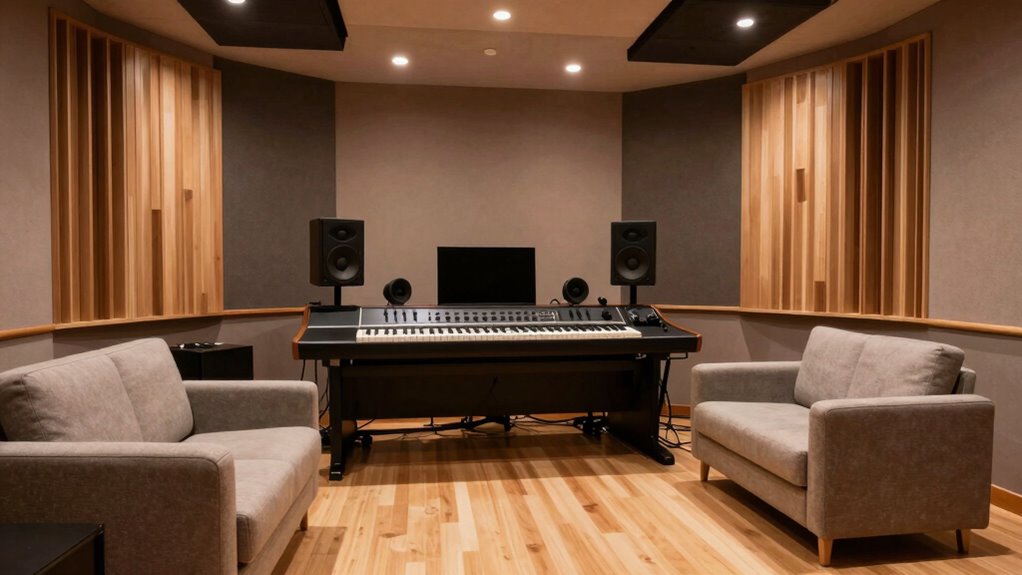
In longer rooms, the density of echoes can become overwhelming, making sounds seem less clear and more artificial. This creates temporal smearing, where echoes overlap and blur together, confusing your perception of space. Additionally, altered spatial cues can trick your brain, causing these environments to feel unnatural or unsettling. Incorporating adaptive lighting or soundproofing can help mitigate these effects and improve acoustic clarity. Properly managing sound reflections also plays a crucial role in maintaining natural sound perception, as understanding acoustic treatment techniques can further enhance auditory experience. Recognizing how room acoustics influence our perception can aid in designing spaces that feel more authentic and comfortable.
Echo Density Differences
When a room’s size increases, the density of echoes—known as echo density—also changes, which can make the sound feel less natural to your ears. In larger spaces, echoes are more spread out, reducing the overlap that helps your brain interpret reverberation. This impacts perception calibration, as your brain relies on consistent echo patterns to judge space accurately. The lower echo density creates auditory illusions where sounds seem disconnected or distant, making the environment feel less authentic. To understand this, consider how your brain expects a certain echo pattern based on familiar spaces. Deviations from this pattern can confuse your perception, leading to a sense that the room isn’t real or natural.
- Echo overlap’s role in natural sound perception
- Impact on spatial awareness and realism
- How echo density influences auditory illusions
Temporal Smearing Effects
Have you ever noticed how sounds in a large, elongated room tend to become blurry or smeared? That’s due to temporal smearing effects, which distort perceived space by altering auditory cues over time. In longer rooms, sound reflections arrive at your ears over an extended period, blending together and creating a sense of lingering reverberation. This smearing reduces clarity, making it harder to distinguish individual sounds or pinpoint their origin. When your brain receives these altered auditory cues, it perceives the space as less natural and more artificial. The extended reverberation muddles the temporal details, diminishing your ability to accurately interpret the environment’s size and shape. This is why longer rooms often feel less realistic and more disconnected from the natural acoustic experience.
Spatial Cues Altered
Longer rooms alter the way your brain interprets spatial cues, making the environment sound less natural. This perception distortion occurs because sound reflections in extended spaces create unusual auditory illusions, confusing your brain’s expectations. As a result, your perception of distance and direction becomes distorted, leading to an unnatural listening experience. The brain relies on consistent cues to construct a realistic acoustic image, but in elongated rooms, these cues are skewed, disrupting perception. You might notice sounds seem disconnected or oddly positioned, which diminishes the sense of immersion. To deepen your understanding, consider these factors:
- Changes in early reflection timing and intensity
- Altered interaural time and level differences
- Disrupted head-related transfer functions (HRTFs)
Practical Tips for Using Short-Reverb Settings in Music and Audio Production

Using short-reverb settings can effectively add clarity and punch to your mixes by creating a sense of space without overwhelming the original sound. To enhance perceived intimacy and acoustic intimacy, keep reverb time minimal—around 0.2 to 0.5 seconds—and focus on tight reflections. Use it selectively on vocals, snare drums, or acoustic guitar to maintain clarity. Adjust pre-delay to separate the dry signal from the reverb, ensuring your mix stays focused. Here’s a quick visual:
| Tip | Effect |
|---|---|
| Short reverb time | Increases clarity, prevents muddiness |
| Pre-delay adjustment | Creates separation, enhances perceived intimacy |
| Focused application | Maintains punch, avoids washout |
| EQ to dampen high frequencies | Keeps reverb from sounding too bright |
| Use on selective elements | Preserves clarity, emphasizes acoustic intimacy |
How to Recreate Short-Room Reverb Effects in Virtual and Mixing Environments

Recreating short-room reverb effects in virtual and mixing environments involves selecting the right tools and settings to simulate the natural acoustic characteristics of a small space. To enhance perceived intimacy and influence room perception, focus on parameters like decay time, early reflections, and diffusion. Use high-quality reverb plugins with precise control over these elements to craft an authentic short-room ambiance. Adjust the decay to be brief, around 0.3 to 1 second, and emphasize early reflections to mimic close, intimate spaces. Consider these techniques:
Use short decay, prominent early reflections, and EQ to craft realistic small-room reverb effects.
- Fine-tune pre-delay to maintain clarity and prevent muddiness
- Use equalization to reduce high frequencies, enhancing warmth and closeness
- Incorporate early reflection adjustments for precise room perception
These steps help recreate the natural feel of a short room, making your mix sound more realistic and engaging.
Common Reverb Mistakes That Make Spaces Sound Artificial

When reverb sounds unnatural, it’s often due to excessive reverberation time that smears the original sound. Poor sound diffusion can make the space feel flat and artificial, while unrealistic room dimensions create a sense of disconnect. Recognizing these common mistakes helps you craft more authentic and pleasing acoustic environments.
Excessive Reverberation Time
Excessive reverberation time can make a space sound unnatural and uncomfortable, often giving an impression of echo that distracts listeners. This perception distortion hampers your ability to focus and creates an acoustic illusion of emptiness or hollowness. When reverberation lingers too long, it muddles speech clarity and diminishes intimacy, making the environment feel less authentic. To avoid this, consider these factors:
- Overusing sound-absorbing materials, which can overly dampen sound and distort natural perception
- Ignoring room size and shape, leading to unnatural echo patterns
- Relying on excessive reflective surfaces that prolong reverberation time unnecessarily
Poor Sound Diffusion
Poor sound diffusion occurs when reflections are uneven or poorly managed, causing the space to sound artificial and disjointed. Diffusion issues lead to inconsistent sound scatter, which prevents reflections from blending smoothly. When reflections are not evenly dispersed, certain areas may sound overly bright or echoey, while others feel dull or dead. This uneven distribution creates a sense of artificiality, making the room seem unnatural. Proper diffusion helps scatter sound waves evenly across the space, resulting in a more cohesive and realistic acoustic environment. Without it, the reverb feels choppy and disconnected, undermining the sense of “realness.” To avoid this mistake, incorporate diffusers or textured surfaces that break up sound reflections, promoting better sound scatter and a more natural acoustic experience.
Unrealistic Room Dimensions
Unrealistic room dimensions can make your space sound unnatural by distorting how sound waves behave. When room proportions are off, the room’s acoustic response becomes skewed, affecting auditory perception. This results in unnatural echoes or dead spots that undermine the sense of realism. To avoid this, consider these factors:
- Proportional geometry: Rooms with balanced height, width, and length create more authentic soundscapes.
- Avoiding extreme ratios: Very elongated or squat spaces can cause confusing reflections and muddled reverberation.
- Proper scaling: Ensuring the room size aligns with the intended purpose helps maintain natural sound diffusion.
Tips for Designing Short Rooms That Sound Truly Real

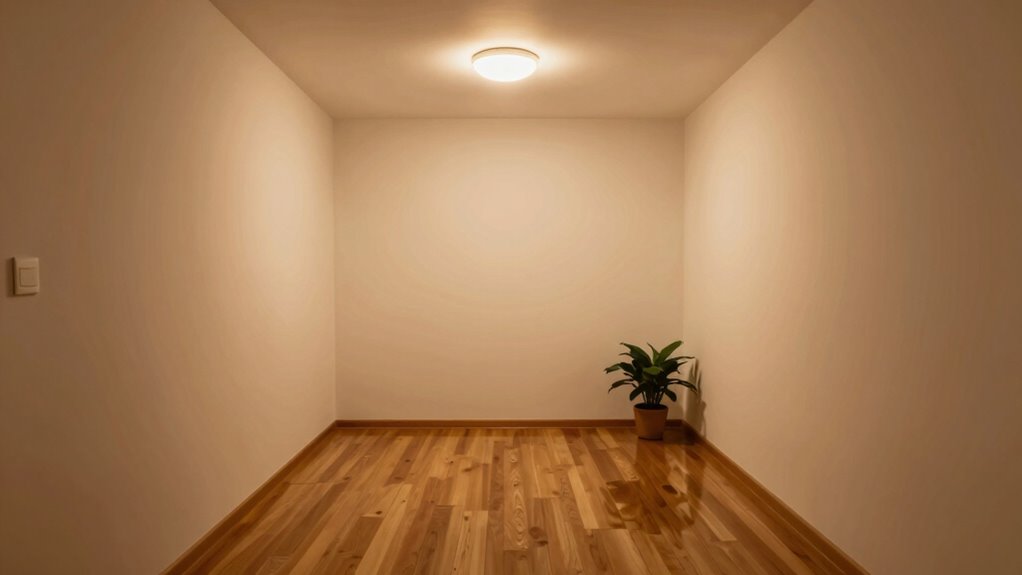
Designing short rooms to sound truly real can be challenging, but with the right approach, you can create a space that feels natural and immersive. To enhance perceived spaciousness, avoid excessive early reflections that make the room sound artificially large. Instead, focus on controlling the amount and timing of reflections to balance clarity and natural reverberation. Incorporate acoustic intimacy by using materials that absorb and diffuse sound thoughtfully, preventing echoes that break immersion. Properly positioning sound sources and listeners helps maintain natural spatial cues, making the room feel more genuine. Keep the reverberation time short but lively enough to suggest a real environment. By managing these elements, you craft a short room that feels both intimate and convincingly spatial, heightening the perception of realism.
How Reverb Psychology Can Improve Your Listening and Mixing Experience

Understanding how reverb psychology influences your perception can considerably enhance your listening and mixing skills. By recognizing auditory illusions and perceptual biases, you can better interpret how sound interacts with space. This awareness helps you craft mixes that sound natural and immersive, even in virtual environments. For example, subtle reverb adjustments can exploit perceptual biases, making a track feel more spacious or intimate. You can also manipulate auditory illusions to emphasize certain elements or create a sense of depth. Mastering these psychological effects enables you to fine-tune your mixes for clarity and realism, ensuring your audience perceives your sound as authentic.
- Utilize perceptual biases to enhance spatial depth
- Leverage auditory illusions to guide listener focus
- Adjust reverb parameters to influence perceived room size
Frequently Asked Questions
How Does Our Brain Interpret Different Reverberation Durations?
Your brain interprets different reverberation durations through neural processing and adaptation. Short reverberations signal a nearby, intimate space, making sounds feel more immediate and real. Longer reverb suggests a larger, distant environment, which your brain perceives differently. It quickly adapts to these cues, helping you judge room size and acoustics. This neural processing enables you to intuitively distinguish between environments, making short rooms seem more lifelike and real.
Can Room Shape Influence Perceived Reverberation Realism?
Yes, room shape can influence perceived reverberation realism by creating acoustic illusions that affect your spatial awareness. When the shape directs sound waves in specific ways, it enhances or diminishes reverberation, making a space feel more natural or artificial. You’ll notice this especially in rooms with irregular shapes, as they produce more convincing acoustics that trick your brain into perceiving a more authentic environment.
What Role Does Material Reflectivity Play in Short-Room Perception?
Material reflectivity markedly shapes your perception in short rooms. If surfaces have high reflectivity, they bounce sound waves efficiently, creating clearer, more vibrant reverberations that feel realistic. Conversely, materials with high absorption dampen sound, making reverberation seem dull or unnatural. Surface texture also matters; smoother textures reflect sound uniformly, enhancing realism, while rough textures scatter sound waves, reducing clarity and making the space feel less authentic.
Are There Cultural Differences in Reverb Perception?
Like a modern Orpheus exploring cultural acoustics, you notice that reverb perception varies across cultures. Environmental expectations shape how you interpret reverberation, with some cultures perceiving longer echoes as more natural, while others favor shorter, intimate soundscapes. These differences influence your emotional response and spatial awareness, showing that your perception of reverberation isn’t universal but deeply rooted in your cultural background and acoustic environment.
How Do Individual Hearing Differences Affect Reverb Realism?
Your individual hearing differences markedly impact how you perceive reverb realism. Auditory calibration shapes how you interpret reflections and decay, making some spaces feel more authentic to you. Personal acoustics, including your ear structure and hearing sensitivity, influence how you experience room size and reverberation. By understanding your unique hearing profile, you can better adapt and appreciate how different reverb environments feel “real” to you.
Conclusion
By understanding reverb psychology, you hold the brush to paint authentic spaces that breathe with life. Short rooms, with their intimate reflections, invite listeners into a cozy, real-world embrace—like stepping into a familiar room filled with whispers of authenticity. When you master these principles, your soundscapes become vivid stories, not just echoes. Embrace the art of short-room reverb, and watch your music or mixes come alive with genuine warmth and soul.