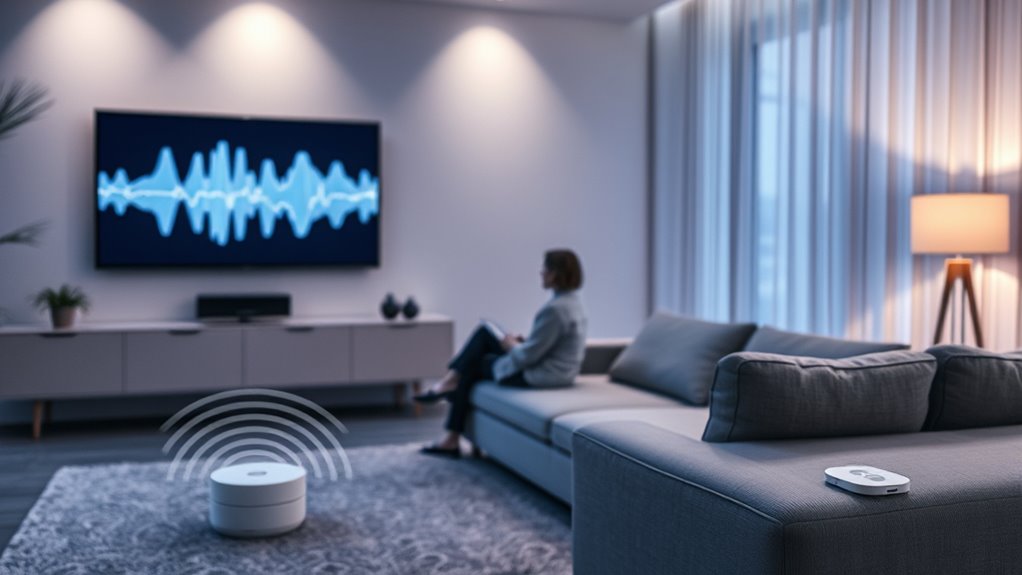

Wi-Fi sensing and presence detection use existing wireless signals to monitor movement, identify devices, and map environments without extra hardware or cameras. When humans or devices move, they cause reflections and signal distortions that your Wi-Fi network can detect and analyze. This technology allows you to track activity, recognize specific devices, and understand movement patterns silently and privately. If you want to discover how this smart sensing works and its benefits, there’s much more to explore.
Key Takeaways
- Wi-Fi sensing uses existing wireless signals to detect human presence and movement without additional hardware.
- It analyzes signal variations like strength and phase to identify activity and track device locations.
- Devices create unique Wi-Fi signal fingerprints, enabling recognition and movement mapping over time.
- This method penetrates walls better than cameras, offering privacy-friendly, non-intrusive environment monitoring.
- It supports smart automation in homes and offices by detecting occupancy and activity patterns contactlessly.
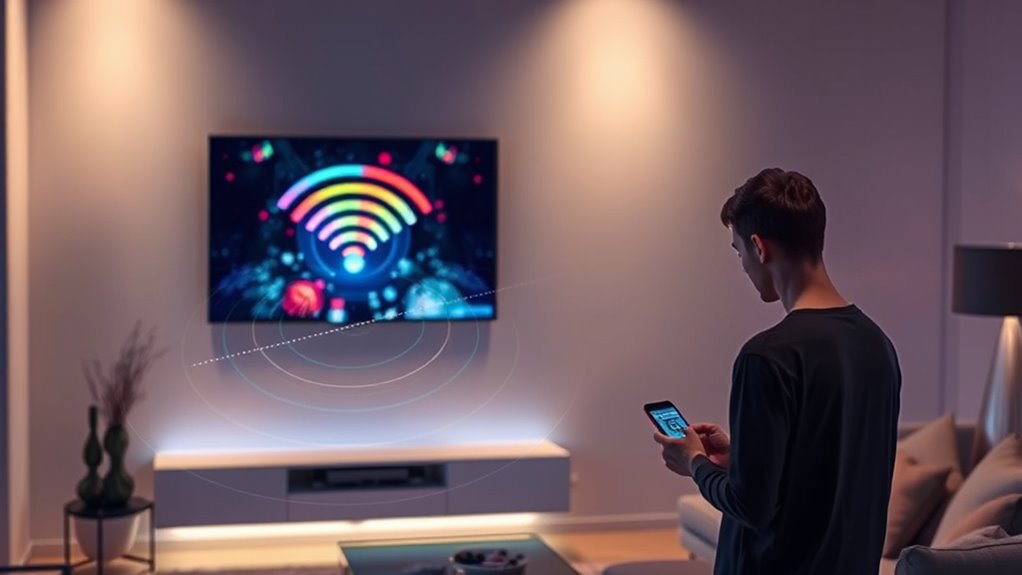
Wi-Fi sensing and presence detection are transforming how we monitor and interact with our environment, leveraging existing wireless networks to identify and track human activity. Instead of relying solely on cameras or intrusive sensors, this technology uses the signals already bouncing around your space, turning them into valuable data about movement and presence. When you’re in a room, your devices and your body influence Wi-Fi signals, causing reflections and distortions that can be detected and analyzed. This process enables precise device tracking and motion analysis without requiring additional hardware.
As you move through a space, your device’s Wi-Fi signals create unique fingerprints that can be identified and followed over time. This allows systems to recognize individual devices and distinguish between different people based on their device signatures. Device tracking becomes even more effective when combined with motion analysis, which examines how signals change as you move. For example, if you walk from one corner to another, the way signals fluctuate reveals your path, speed, and activity level. This means that your presence can be detected instantly, and your movements can be mapped with impressive accuracy, all through the existing Wi-Fi infrastructure.
You don’t need to carry any special sensors or wearables; your smartphone or laptop acts as a beacon, contributing to the network’s understanding of your location and activity. The technology continuously monitors the environment, analyzing variations in signal strength, phase, and time delays. These subtle changes help create a dynamic picture of motion within the space, making it possible to detect when someone enters or leaves a room, or even to track specific movements within an area. This kind of device tracking and motion analysis is particularly useful in smart homes, offices, or security environments, where understanding human presence can automate lighting, adjust climate controls, or trigger alarms.
Moreover, because Wi-Fi signals penetrate walls and obstacles more effectively than cameras, this method offers a non-intrusive way to monitor activity across larger or more complex spaces. It respects privacy better than traditional surveillance, since it doesn’t capture images or video, focusing solely on signal patterns. As you move around, the system’s ability to analyze motion and track devices becomes more refined, providing detailed insights into activity levels and patterns. This technology is opening new avenues for contactless monitoring, making environments smarter and more responsive without the need for extensive additional hardware. Additionally, privacy considerations are central to this technology, ensuring user data is protected while enabling effective monitoring. In summary, Wi-Fi sensing and presence detection turn everyday wireless signals into a powerful tool for understanding human behavior in real time.

Presence Sensor, WenzhiIoT Smart Motion Sensor WiFi 5.8 GHz Radar MmWave Presence Sensor Movement Body Motion Detection with Luminance/Distance Tuya Smart Life Home
【Functional Wi-Fi Smart Human Presence Sensor】Featured as human presence,human static,human micro motion and human movement motion detection to…
As an affiliate, we earn on qualifying purchases.
As an affiliate, we earn on qualifying purchases.
Frequently Asked Questions
Can Wi-Fi Sensing Detect Specific Individual Identities?
No, Wi-Fi sensing can’t detect specific individual identities directly. It uses techniques like device fingerprinting to identify devices based on unique signals, but it doesn’t recognize people personally. You might be able to infer who someone is if their device’s fingerprint is already known, but it doesn’t provide detailed identity recognition. Instead, it tracks device presence, not individual identities, making it more about detection than identification.
How Accurate Is Wi-Fi Presence Detection in Crowded Environments?
Sure, Wi-Fi presence detection gets pretty good at crowded places, but don’t expect perfection. Signal interference from all those devices and walls can make it tricky to pinpoint who’s there, and device compatibility issues might leave some folks undetected. So, in a busy room, it’s more like a helpful guess than a precise science—think of it as trying to find your friends in a packed concert.
Does Wi-Fi Sensing Require Additional Hardware Installations?
No, Wi-Fi sensing generally doesn’t require additional hardware installations since it uses existing Wi-Fi infrastructure. However, for maximum accuracy, you might need to focus on hardware integration and signal calibration. Calibration helps guarantee the sensors interpret signals correctly, especially in complex environments. While some setups may benefit from specialized hardware, most systems work effectively with your current Wi-Fi routers and devices, making deployment straightforward and cost-effective.
What Privacy Concerns Are Associated With Wi-Fi Presence Detection?
Some believe Wi-Fi presence detection compromises privacy, but this isn’t necessarily true. You might worry about data encryption and user anonymity, yet many systems encrypt data to protect identities and prevent tracking. While there’s potential for misuse, proper safeguards help guarantee your presence data remains confidential. It’s crucial to stay informed about how your data is handled and push for transparency to minimize privacy concerns.
How Does Wi-Fi Sensing Perform in Different Building Materials?
You’ll notice that building material impact considerably affects Wi-Fi sensing performance. Different materials cause signal attenuation, weakening the Wi-Fi signals, which can reduce detection accuracy. For example, concrete and metal walls block signals more than drywall or glass, making it harder to detect presence reliably. To improve performance, you may need to adjust sensor placement or use additional access points to compensate for these signal disruptions caused by various building materials.

WiFi Motion Sensor, Smart Motion Detector for Home Security, Wireless Motion Sensor App Remote Monitor, Voice Command Compatible with Alexa. 1 Pack
【App Real-Time Remote Monitor】The smart motion sensor is compatible with Smart Life App and Tuya Smart App. No…
As an affiliate, we earn on qualifying purchases.
As an affiliate, we earn on qualifying purchases.
Conclusion
So, here you are, relying on Wi-Fi to tell if someone’s home or not—because who needs cameras or alarms anyway? It’s almost poetic how your Wi-Fi, originally meant for internet, now has the power to detect your presence. Who knew that your router’s sneaky little sensors could be the new home security? Next time you disconnect, remember: your Wi-Fi’s watching, waiting, and just might know more than you think.

Tracki Pro GPS Tracker for Vehicles – Magnetic Waterproof 4G LTE Car Tracker, Long-Life Battery Up to 7 Months, Unlimited Distance, Smart Alerts, Hidden Tracking Device (Subscription Required)
Compact, Undetectable Vehicle Tracker – Tracki Pro is a small GPS tracker with a strong magnet, hiding easily…
As an affiliate, we earn on qualifying purchases.
As an affiliate, we earn on qualifying purchases.
![[2 Pack] 24 Inch Computer Privacy Screen for 16:9 Aspect Ratio Widescreen Monitor, Eye Protection Anti Glare Blue Light Computer Monitor Privacy Filter, Removable Anti-Scratch 24in Protector Film](https://m.media-amazon.com/images/I/41SBKw3J4ML._SL500_.jpg "Wi‑Fi Sensing and Presence Detection Explained 7")
[2 Pack] 24 Inch Computer Privacy Screen for 16:9 Aspect Ratio Widescreen Monitor, Eye Protection Anti Glare Blue Light Computer Monitor Privacy Filter, Removable Anti-Scratch 24in Protector Film
【24 PRIVACY FILTER DIMENSIONS】 Width: 20 15/16" (20.9 inches/532 mm), Height: 11 13/16" (11.8 inches/299 mm) – 16:9…
As an affiliate, we earn on qualifying purchases.
As an affiliate, we earn on qualifying purchases.