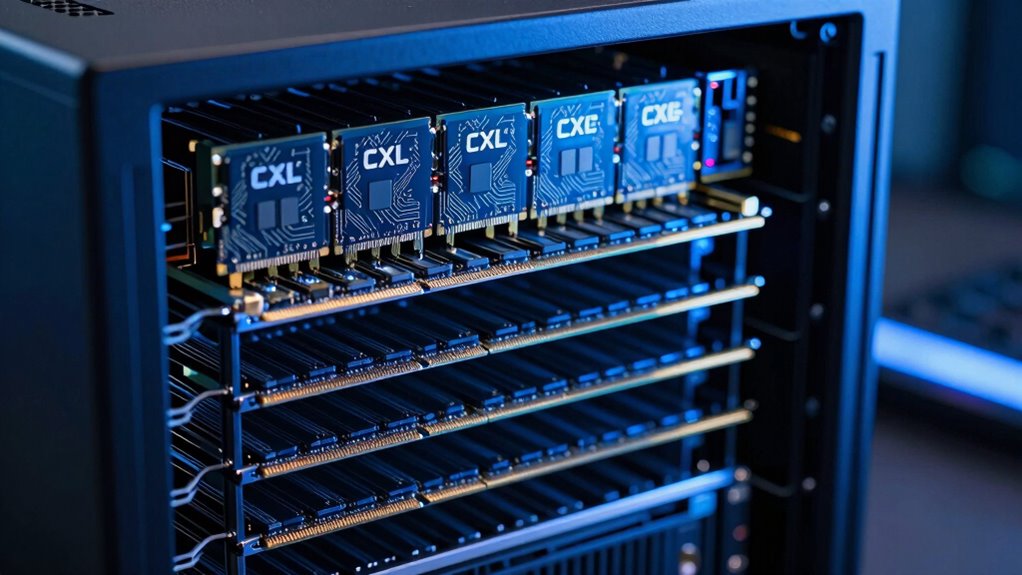

CXL transforms your servers and workstations by making them more scalable, flexible, and power-efficient. You can connect more devices and expand memory pools easily, without needing costly hardware upgrades. It allows on-the-fly memory allocation, reducing latency and optimizing resource use. Plus, CXL promotes broader hardware compatibility, keeping your systems adaptable for future technology advances. If you want to understand how these changes impact your infrastructure, there’s plenty more to explore.
Key Takeaways
- Enables dynamic and scalable memory expansion, reducing hardware overhauls and supporting larger workloads.
- Improves power efficiency by enabling direct communication between processors and memory, lowering energy consumption.
- Allows flexible, on-the-fly memory resource allocation and reallocation for optimized performance.
- Promotes cross-vendor hardware compatibility, fostering innovation and future-proof infrastructure designs.
- Enhances system adaptability, supporting complex applications and evolving technological demands.
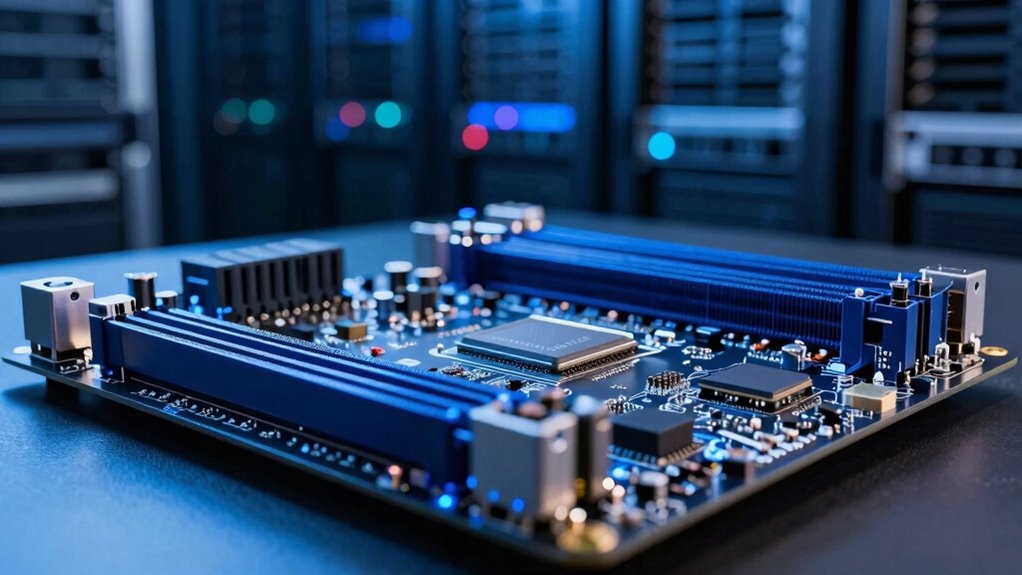
As data centers and high-performance workstations evolve, the recent changes to Compute Express Link (CXL) are transforming how servers and memory systems are designed and managed. These updates bring notable improvements in data center scalability, allowing you to connect more devices and expand memory pools without sacrificing performance or efficiency. Instead of traditional rigid architectures, CXL now facilitates a more flexible approach, where you can add or upgrade components dynamically, making your infrastructure more adaptable to growing demands. This flexibility means you can scale your data center more efficiently, handling larger workloads and complex applications with less effort and cost.
CXL’s flexibility enhances scalability, enabling dynamic upgrades and efficient handling of larger, complex workloads.
Power efficiency is also a major focus of these CXL enhancements. By enabling direct, high-speed communication between processors and memory, CXL reduces the need for intermediate components that typically consume extra power. This streamlined pathway lowers overall power consumption, which is essential for maintaining cost-effective and sustainable operations. With these improvements, your servers and workstations can deliver high performance while using less energy, aligning with green data center initiatives and reducing operational expenses over time. Furthermore, the enhanced power management capabilities enable more precise control over energy use, further supporting sustainable practices.
These changes impact memory planning considerably. Instead of being limited by fixed memory configurations, you’re now empowered to allocate and reallocate memory resources on-the-fly, optimizing utilization and performance. CXL’s support for persistent memory and memory pooling means you can create larger, shared memory pools accessible across multiple devices. This setup simplifies memory management, reduces latency, and improves overall system responsiveness. As a result, you gain greater control over your memory architecture, enabling you to tailor configurations to specific workloads without costly hardware overhauls. Moreover, understanding the importance of high-performance memory can help you maximize the benefits of these flexible configurations.
Furthermore, CXL’s improved interoperability encourages a broader ecosystem of hardware options. You’re no longer restricted to a single vendor or specific hardware configurations, giving you more freedom in building versatile, future-proof systems. This openness promotes innovation and allows your infrastructure to evolve alongside technological advances. As a result, you can better future-proof your investments, ensuring your servers and workstations remain relevant and capable of handling emerging demands.
In addition, understanding the importance of color accuracy and high contrast ratios in projectors can be crucial for creating effective and immersive environments, whether for home cinema or gaming. In essence, the recent CXL updates redefine how you approach server and workstation design. They emphasize scalability, power efficiency, and flexible memory management, making your infrastructure more adaptable, cost-effective, and sustainable. These changes empower you to meet the increasing performance requirements of modern applications while keeping operational costs in check. As you incorporate these advancements, you’ll find your systems are better prepared for future growth, with optimized resource utilization and streamlined management that drive your data center’s success.
CXL compatible server memory modules
As an affiliate, we earn on qualifying purchases.
As an affiliate, we earn on qualifying purchases.
Frequently Asked Questions
How Does CXL Impact Overall System Latency?
CXL reduces overall system latency by enabling faster communication between components, which helps optimize system bandwidth. You’ll notice quicker data transfers and improved responsiveness because CXL’s high-speed protocol minimizes delays. By streamlining memory access and interconnects, it enhances latency optimization, allowing your server or workstation to operate more efficiently. This means faster processing, better performance, and a smoother experience in handling demanding workloads.
Are There Compatibility Issues With Existing Hardware?
You might encounter some compatibility issues with existing hardware when integrating CXL, especially concerning hardware integration and legacy support. Not all older servers or workstations will seamlessly support CXL modules without upgrades or adapters. It’s crucial to verify whether your current hardware can handle CXL technology or if you’ll need newer components designed for CXL compatibility. This ensures smooth operation and avoids potential system stability problems.
What Security Concerns Arise With CXL Adoption?
With CXL adoption, security concerns focus on data encryption and access control. You need to guarantee data transmitted between devices is encrypted to prevent eavesdropping or tampering. Additionally, strict access controls are essential to restrict unauthorized device or user interactions, safeguarding sensitive data and system integrity. Implementing robust encryption protocols and access management measures becomes critical to mitigate potential vulnerabilities introduced by the high-speed, flexible CXL interconnects.
How Will CXL Influence Future Hardware Upgrade Cycles?
CXL will profoundly influence your future hardware upgrade cycles by enhancing scalability and modularity. You’ll be able to upgrade individual components like memory or accelerators independently, avoiding complete system replacements. This shift promotes future scalability, allowing your systems to adapt quickly to evolving workloads. Modular hardware design means upgrades become more flexible, cost-effective, and less disruptive, ensuring your infrastructure stays current without lengthy downtime or major overhauls.
What Are the Cost Implications for Cxl-Enabled Systems?
Imagine upgrading your server with CXL, which enhances hardware scalability and cost efficiency. While initial costs might be higher due to new components, you save long-term by easily adding memory or accelerators without full replacements. CXL-enabled systems reduce upgrade frequency, lowering total ownership costs. Overall, you’ll find that investing in CXL technology balances upfront expenses with future-proofing, making your infrastructure more adaptable and economical over time.
high-performance memory pooling for data centers
As an affiliate, we earn on qualifying purchases.
As an affiliate, we earn on qualifying purchases.
Conclusion
In conclusion, CXL revolutionizes how you approach servers, workstations, and memory planning, making data transfer faster and more flexible—think of it like upgrading from dial-up to fiber optics in your network. This tech promises smoother performance and smarter resource allocation, much like how the invention of the printing press transformed information sharing. Embrace CXL now, and you’ll be pioneering a future where your systems operate at lightning speed, leaving the old ways in the dust.
power-efficient server processors with CXL support
As an affiliate, we earn on qualifying purchases.
As an affiliate, we earn on qualifying purchases.

Fikwot FN955 1TB NVMe SSD M.2 2280 PCIe Gen4x4, Up to 7300MB/s, 3D NAND TLC Flash Internal Solid State Drive, Configure SLC Cache, Storage and Memory Expansion for PS5 Laptop Desktop
⚡【Up to 7300MB/s】The M.2 SSD 1TB utilizes M.2 PCIe Gen4.0x4 technology and is fully compatible with the NVMe…
As an affiliate, we earn on qualifying purchases.
As an affiliate, we earn on qualifying purchases.