Wireless in-ear monitors for musicians range from compact, easy-to-pair 2.4 GHz kits to more configurable UHF systems for busy stages. I rank the Sennheiser XSW IEM as the best overall choice for musicians seeking a more established, adaptable monitoring setup; the Xvive U45 stands out for its 5.8 GHz design, while the Phenyx Pro PTM-11-2B offers two bodypacks for sharing a mix. The main tradeoffs are wireless-band congestion, stereo flexibility, receiver count, and how much setup control your performances require. A simple kit can suit rehearsals and small gigs, while touring or crowded RF environments call for more attention to frequency coordination and system expandability. Read on for the full comparison, buying advice, and recommendations by musician type.

Get audio and creator gear delivered free with Prime
- Fast, free delivery on millions of items
- Prime Video, Amazon Music and more included
- Member-only deals all year
Complete the kit


Key Takeaways
- The lineup splits between convenience and control: 2.4 GHz systems such as the LEKATO MS-1 and JOYO JW-07 emphasize straightforward pairing, while UHF options offer a different approach for musicians who need frequency choices.
- Receiver count changes the value of a system: the Phenyx Pro PTM-11-2B includes two bodypacks, which can serve two performers from one transmitter when they need the same monitor mix.
- Stereo support matters when the mix itself is part of the performance: musicians who rely on stereo panning should check the exact system configuration rather than assume every wireless IEM kit delivers stereo.
- Frequency band is a practical venue decision, not a simple quality ranking: 2.4 GHz convenience may suit home and rehearsal use, while UHF frequency options can be more useful when local wireless traffic shapes the setup.
- Battery and charging features are uneven across the choices: the LEKATO MS-20 highlights a charging case and extended stated runtime, but those conveniences should be weighed against the band, routing, and receiver needs of the gig.
| Xvive U45 Wireless in-Ear Monitor System, 5.8 GHz True Diversity IEM |  | Best for Fast, Low-Latency Monitoring | Wireless frequency: 5.8 GHz | Audio resolution: 24-bit/48 kHz | Latency: Under 5 ms | VIEW LATEST PRICE | See Our Full Breakdown |
| LEKATO MS-02 Wireless In-Ear Monitor System |  | Best for Shared Band Monitoring | Wireless frequency: 2.4 GHz | Latency: Less than 4.5 ms in mono mode | Audio resolution: 24-bit/48 kHz | VIEW LATEST PRICE | See Our Full Breakdown |
| LEKATO Wireless In-Ear Monitor MS-20 with Charging Case |  | Best for Long Rehearsal Days | Wireless frequency: 2.4 GHz | Audio resolution: 24-bit/48 kHz | Frequency response: 20 Hz–20 kHz | VIEW LATEST PRICE | See Our Full Breakdown |
| POGOLAB Wireless In-Ear Monitor System with 7-Channel UHF |  | Best for Low-Latency Stage Use | Wireless band: UHF | Selectable channels: 7 | Audio resolution: 48 kHz/24-bit | VIEW LATEST PRICE | See Our Full Breakdown |
| Sennheiser XSW IEM Wireless In-ear Monitoring System – B Band |  | Best Complete Starter Kit | Band: B Band | Included transmitter: 1 XSW IEM transmitter | Included receiver: 1 XSW IEM bodypack receiver | VIEW LATEST PRICE | See Our Full Breakdown |
| Sennheiser XSW-IEM Wireless In-ear monitor System A Band, Black |  | Best Complete Starter Kit | System: XSW IEM stereo wireless monitoring system | Frequency band: A band, 476–500 MHz | Included transmitter: 1 XSW IEM SR | VIEW LATEST PRICE | See Our Full Breakdown |
| Phenyx Pro Wireless in Ear Monitor System, Dual In-Ear Monitors for Musicians, PTM-11-2B |  | Best for Two Musicians Sharing a Mono Mix | Monitoring format: Mono | Wireless band: UHF, 900 MHz | Selectable frequencies: 50 | VIEW LATEST PRICE | See Our Full Breakdown |
| LEKATO Wireless in Ear Monitor System 2.4GHz, MS-1 |  | Best for Quick Stereo Rehearsal Setups | Wireless frequency: 2.4 GHz | Audio transmission: Stereo or mono | Pairing: Automatic pairing | VIEW LATEST PRICE | See Our Full Breakdown |
| Shure P3TRA215CL Wireless In-Ear Monitor System, J13 Band |  | Best for Professional Stereo Stage Monitoring | System: Shure PSM 300 | Frequency band: J13 | Audio: 24-bit digital audio | VIEW LATEST PRICE | See Our Full Breakdown |
| Xvive U4 Wireless in-Ear Monitor System Set |  | Best Compact Setup | Wireless frequency: 2.4 GHz | Stated range: 27 meters | Headphone connection: 3.5 mm jack | VIEW LATEST PRICE | See Our Full Breakdown |
| JOYO Wireless in Ear Monitor System 2.4G Wireless IEM System with Transmitter Clip on Receiver Automatic Pairing in-Ear Monitoring for Studio,Guitar,DJ,Live Performance (JW-07) |  | Best for Personal Practice | Wireless band: 2.4 GHz | Audio resolution: 48 kHz/16-bit | Latency: Under 5 ms | VIEW LATEST PRICE | See Our Full Breakdown |
| Phenyx Pro PTM-10 UHF Stereo Wireless In-Ear Monitor System |  | Best for Adjustable Stage Monitoring | Frequency band: 900 MHz UHF | Tunable frequencies: 89 | Operating range: Up to 160 ft / 50 m | VIEW LATEST PRICE | See Our Full Breakdown |
| Coda AirSync IEM Wireless In-Ear Monitor System |  | Best for Low-Latency UHF Monitoring | Frequency: 657–663 MHz UHF | Channels: 13 | Operating range: 150 ft | VIEW LATEST PRICE | See Our Full Breakdown |
More Details on Our Top Picks
Xvive U45 Wireless in-Ear Monitor System, 5.8 GHz True Diversity IEM
The Xvive U45 suits musicians who want a compact, quick-to-deploy system and value its stated under-5-ms latency. Its 5.8 GHz wireless link and channel scan give performers a way to check for a usable channel before playing, while 24-bit/48 kHz audio supports detailed monitoring. Compared with the POGOLAB MWB-1, the U45 avoids a UHF transmitter setup and offers more than five hours of stated battery life, but POGOLAB specifies a lower 1 ms latency and XLR input options. The U45’s listed 3.5 mm output and wireless connection make it a fit for straightforward mixer or interface rigs. Its key limitation is that the supplied details do not specify range or receiver capacity, so it is harder to plan for larger stages or multiple performers.
Pros:- Channel scan helps find a usable 5.8 GHz channel before a set.
- Under-5-ms stated latency supports close timing with live playing.
- 24-bit/48 kHz audio and a balanced-armature driver are specified.
- More than five hours of stated battery life suits shorter rehearsals and performances.
Cons:- No wireless range or multi-receiver capacity is given in the supplied product details.
- The listed 3.5 mm connection may require adapters or a separate routing plan for some mixer setups.
- Battery runtime is shorter than the LEKATO MS-02’s stated 6–8 hours.
Best for: Solo performers and small-stage musicians who want a portable, channel-scanning IEM system with low stated latency.
Not ideal for: Bands planning to feed several bodypacks from one transmitter or buyers who need a clearly specified operating range and input layout.
- Wireless frequency:5.8 GHz
- Audio resolution:24-bit/48 kHz
- Latency:Under 5 ms
- Battery life:More than 5 hours
- Driver type:Balanced armature
- Frequency response:20 kHz (listed)
- Audio impedance:220 ohm
- Connections:3.5 mm audio; USB-C
Our verdict“Choose the U45 for a compact, channel-scanning setup with low stated latency, but look elsewhere if you need documented multi-bodypack support or longer runtime.”
LEKATO MS-02 Wireless In-Ear Monitor System
The LEKATO MS-02 is the clearest fit here for a band that wants one transmitter to serve several performers: it supports up to four receivers, with mono and stereo modes for different monitoring setups. Its stated latency is under 4.5 ms in mono mode, and the advertised 6–8-hour battery life gives it more runtime headroom than the Xvive U45. That flexibility comes with a catch: earbuds are not included, so each musician needs compatible listening gear before the system is ready to use. The stated 100-foot range also applies to open areas, not a crowded venue with bodies and equipment between transmitter and receivers. Compared with the LEKATO MS-20, this model lists fewer receivers but provides a clearer receiver limit and mode details in the supplied specifications.
Pros:- One transmitter can support up to four receivers.
- Offers both mono and stereo modes.
- Stated battery life of 6–8 hours exceeds the U45’s stated runtime.
- Includes two 3.5 mm audio cables, a 3.5 mm-to-6.35 mm adapter, and USB-C charging cables.
Cons:- Earbuds must be purchased separately.
- The stated 100-foot range is for open areas and may not reflect a busy stage.
- The under-4.5-ms latency figure applies specifically to mono mode.
Best for: Small bands or rehearsal groups who want one transmitter to feed up to four musicians and already own compatible earbuds.
Not ideal for: Musicians seeking a ready-to-play package with included earphones, or performers who need proven range through crowded, obstructed venues.
- Wireless frequency:2.4 GHz
- Latency:Less than 4.5 ms in mono mode
- Audio resolution:24-bit/48 kHz
- Receiver capacity:Up to 4 receivers per transmitter
- Battery life:Up to 6–8 hours
- Range:Up to 100 ft in open areas
- Modes:Mono and stereo
- Earbuds included:No
Our verdict“Pick the MS-02 when several bandmates need a shared transmitter and can bring their own earbuds.”
LEKATO Wireless In-Ear Monitor MS-20 with Charging Case
The LEKATO MS-20 makes the most sense for musicians who prioritize fewer charging stops and a multi-person setup. Its charging case is advertised to support up to 30 hours of use, and the system includes one transmitter and two receivers with auto-pairing. A single transmitter can reportedly connect to as many as ten pairs, a larger stated capacity than the LEKATO MS-02’s four receivers. The MS-20 also accepts OTG audio from compatible phones and USB-C devices, which can be handy for practice tracks without a mixer. Its 150-foot range is specified for open areas, and the description does not provide a precise latency figure, so I would not rank it ahead of the POGOLAB MWB-1 for latency-sensitive stage work. Earphones are not included, adding another item to source.
Pros:- Charging case is advertised to provide up to 30 hours of use.
- Package includes one transmitter and two receivers with auto-pairing.
- One transmitter can reportedly support up to ten pairs of devices.
- OTG input supports audio from compatible phones and USB-C devices.
Cons:- Earphones are not included.
- The 150-foot range is specified for open areas.
- The supplied description gives no numerical latency figure.
Best for: Bands and rehearsal groups that need long case-assisted runtime, auto-pairing, and the option to send one signal to multiple performers.
Not ideal for: Performers who need a precise latency specification, included earphones, or reliable range expectations in obstructed venues.
- Wireless frequency:2.4 GHz
- Audio resolution:24-bit/48 kHz
- Frequency response:20 Hz–20 kHz
- Signal-to-noise ratio:100 dB
- Battery life:Up to 30 hours with charging case
- Range:Up to 150 ft in open areas
- Transmitter and receiver setup:1 transmitter and 2 receivers
- Modes:Mono and stereo
- Earphones included:No
Our verdict“Choose the MS-20 for extended rehearsals and larger shared-monitoring groups, not when a verified low-latency figure is your main requirement.”
POGOLAB Wireless In-Ear Monitor System with 7-Channel UHF
For musicians who put timing ahead of compact convenience, the POGOLAB MWB-1 stands out with its stated 1 ms latency and seven selectable UHF channels. That makes it a stronger paper fit for tight rhythmic parts than the Xvive U45, whose listed latency is under 5 ms. Its transmitter accepts balanced XLR and AUX/LINE inputs, so it can connect to a broader range of live sound setups without relying on a single input type. The stated 164-foot range is line of sight, and battery life tops out at five hours—shorter than the LEKATO MS-02’s stated 6–8 hours. The system also lists a 35 Hz–16.5 kHz frequency response, narrower than the LEKATO MS-20’s stated 20 Hz–20 kHz. It suits focused stage monitoring, but its runtime needs planning.
Pros:- Stated 1 ms latency supports close synchronization with live playing.
- Seven selectable UHF channels give options for channel coordination.
- Balanced XLR and AUX/LINE inputs fit varied mixer and audio-source setups.
- Includes a belt-clip receiver with a 3.5 mm headphone output.
Cons:- Battery life is limited to up to five hours per charge.
- The stated 164-foot range depends on line of sight.
- Listed frequency response is 35 Hz–16.5 kHz, narrower than the MS-20’s specified range.
Best for: Drummers, bassists, and other timing-sensitive performers who need very low stated latency and XLR/AUX input flexibility.
Not ideal for: Musicians playing long sets without charging breaks or buyers who need range beyond the specified line-of-sight conditions.
- Wireless band:UHF
- Selectable channels:7
- Audio resolution:48 kHz/24-bit
- Latency:1 ms
- Range:164 ft (50 m), line of sight
- Frequency response:35 Hz–16.5 kHz
- Battery life:Up to 5 hours
- Inputs:Balanced XLR and AUX/LINE
- Receiver output:3.5 mm headphone jack
Our verdict“The MWB-1 is the pick for timing-sensitive stage players who can work within its five-hour battery window and line-of-sight range.”
Sennheiser XSW IEM Wireless In-ear Monitoring System – B Band
The Sennheiser XSW IEM B Band is the most complete out-of-box option in this group: the package includes a transmitter, one bodypack receiver, IE 4 in-ear headphones, a rackmounting kit, and a power supply with adapters. That makes it less piecemeal than the LEKATO MS-02, which requires buyers to supply their own earbuds. It also suits a musician who wants a rack-based transmitter rather than the POGOLAB MWB-1’s compact rechargeable unit. The tradeoff is that the supplied product information does not specify latency, range, battery life, audio resolution, or the B Band’s frequency details, so I cannot compare its performance on those measures. Its listing also identifies Bluetooth connectivity, which does not by itself clarify the IEM transmission specifications. This is a convenient package, but buyers should confirm band compatibility for their location.
Pros:- Includes transmitter and one bodypack receiver.
- IE 4 in-ear headphones are included, unlike the LEKATO MS-02 package.
- Rackmounting kit and power supply with adapters are supplied.
- A complete package reduces the need to source basic components separately.
Cons:- The supplied details do not state latency, range, or battery life.
- The listing does not give audio resolution or a clear frequency-band specification beyond B Band.
- Only one bodypack receiver is listed in the package.
Best for: A musician or small act starting an IEM setup who wants the transmitter, bodypack, headphones, rackmount kit, and power supply together.
Not ideal for: Experienced bands that need documented range, latency, battery runtime, multi-receiver capacity, or detailed frequency coordination before buying.
- Band:B Band
- Included transmitter:1 XSW IEM transmitter
- Included receiver:1 XSW IEM bodypack receiver
- Included headphones:1 set of IE 4 in-ear headphones
- Rack accessories:Rackmounting kit
- Power supply:NT 12-5CW power supply with power adapters
- Listed headphone impedance:6 ohm
- Listed wireless technology:Bluetooth 5
Our verdict“Choose the XSW IEM B Band when a bundled transmitter, receiver, headphones, and rack accessories matter more than published performance figures.”
Sennheiser XSW-IEM Wireless In-ear monitor System A Band, Black
The Sennheiser XSW-IEM A Band is a practical entry point for a musician who wants a conventional rack-based UHF system with the main pieces already in the box. Its transmitter, bodypack receiver, IE 4 earphones, rack kit, power supply, and batteries mean less kit-matching than the Xvive U4, which is a more compact, receiver-focused setup. Focus mode helps balance a personal mix, while EQ and a limiter give players useful control over comfort and level. Infrared syncing is handy when pairing receivers to the transmitter. The tradeoff is that this set supplies only one receiver, and its 476–500 MHz A-band range is fixed; check local frequency availability before buying. It is a straightforward starter, but not the most scalable pick for a growing band.
Pros:- Complete set includes transmitter, receiver, IE 4 earphones, rack kit, power supply, and batteries
- UHF operation with selectable presets and manual frequency control
- Focus mode, EQ, and limiter offer practical personal-mix adjustments
- Infrared sync makes pairing compatible receivers more convenient
Cons:- Includes only one bodypack receiver
- A-band operation is limited to 476–500 MHz, so local frequency compatibility needs checking
- The included earphones and starter-oriented feature set may not satisfy players seeking a more advanced personal monitoring setup
Best for: Solo performers and musicians moving from floor wedges to their first rack-based wireless IEM rig who want transmitter, receiver, and earphones in one package.
Not ideal for: Bands needing several receivers from the outset, or players who need stereo monitoring or a different frequency band.
- System:XSW IEM stereo wireless monitoring system
- Frequency band:A band, 476–500 MHz
- Included transmitter:1 XSW IEM SR
- Included receiver:1 XSW IEM EK
- Included earphones:1 pair of IE 4 in-ear headphones
- Mix features:Focus mode, EQ, and limiter
- Frequency control:Presets and manual control
- Power:Power supply and 2 AA batteries included
Our verdict“Choose this Sennheiser set for a ready-to-rack first IEM system with useful mix controls, but look elsewhere if you need multiple receivers or a different band.”
Phenyx Pro Wireless in Ear Monitor System, Dual In-Ear Monitors for Musicians, PTM-11-2B
The Phenyx Pro PTM-11-2B makes a clear case for bands or small productions that need two listeners on one transmitter without building out separate rigs. It includes two bodypack receivers and earphones, unlike the single-receiver Sennheiser XSW-IEM set, and its 50 selectable UHF frequencies provide channel choices for a shared setup. This is a mono system, which keeps monitoring simple but rules out the left-right separation available from stereo options such as the LEKATO MS-1. The transmitter also passes the original left/right signal to the soundboard or speakers, and its PAD switch can help prevent an overly hot input from distorting. The stated 164-foot range suits many stage and rehearsal layouts, though obstacles can reduce it. Choose this for practical shared monitoring, not individualized stereo mixes.
Pros:- Two bodypack receivers and two earphones are included
- 50 selectable UHF frequencies offer channel options for multi-system environments
- Left/right inputs feed a mono monitor mix while line outputs pass signal onward
- PAD switch helps manage strong input signals
Cons:- Mono monitoring does not provide stereo separation or spatial placement
- Both receivers share the transmitter’s mix rather than providing individual mixes
- The stated 164-foot range may be reduced by walls and other obstructions
Best for: Small bands, churches, or presenters who want two performers to hear the same mono monitor feed from one transmitter.
Not ideal for: Musicians who need stereo placement, independent mixes for each player, or a system with a stated frequency band that can be checked against venue requirements.
- Monitoring format:Mono
- Wireless band:UHF, 900 MHz
- Selectable frequencies:50
- Included receivers:2 bodypack receivers
- Stated operating range:Up to 164 ft
- Frequency response:16 kHz
- Signal connections:Left/right inputs and left/right line outputs
- Included accessories:2 earphones, rack-mount kit, carry case, power adapter, and 4 AA batteries
Our verdict“Pick the PTM-11-2B when two performers can share a mono feed; choose the LEKATO MS-1 or another stereo system if mix separation matters.”
LEKATO Wireless in Ear Monitor System 2.4GHz, MS-1
The LEKATO MS-1 is the most convenient fit here for bands that want to get a stereo monitor feed running without UHF frequency selection. Its automatic pairing and one-transmitter-to-multiple-receiver design (up to six sets, according to the listing) make it simpler to share a rehearsal mix than the more conventional Sennheiser XSW-IEM, which uses a transmitter and bodypack arrangement with frequency controls. Stereo/mono input switching adds flexibility when the source changes, and the stated latency is under 12 ms. The compromise is the 2.4 GHz band, which can be more exposed to congestion from other devices than a coordinated UHF setup. Battery life is listed at over five hours, so it suits rehearsals and shorter gigs better than long events without a charging plan.
Pros:- Automatic pairing reduces setup steps
- Supports stereo transmission with a stereo/mono input switch
- One transmitter can pair with up to six receiver sets
- Stated latency is under 12 ms
Cons:- 2.4 GHz operation may face congestion from other wireless devices
- Listed battery life is just over five hours, requiring charging between longer sessions
- The stated 100-foot range is intended for open areas and can be affected by surroundings
Best for: Rehearsal bands and small-gig performers who want a quick-to-pair stereo feed shared across several compatible receivers.
Not ideal for: Touring musicians who need long operating sessions without charging, or venues where 2.4 GHz congestion makes a dedicated UHF system preferable.
- Wireless frequency:2.4 GHz
- Audio transmission:Stereo or mono
- Pairing:Automatic pairing
- Receiver capacity:Up to 6 receiver sets per transmitter
- Stated latency:Under 12 ms
- Audio format:24-bit/48 kHz, as listed
- Stated battery life:More than 5 hours
- Stated range:Up to 100 ft in an open area
Our verdict“Choose the MS-1 for fast, shared stereo rehearsal monitoring, but favor a UHF system such as the Sennheiser XSW-IEM for a more traditional stage setup.”
Shure P3TRA215CL Wireless In-Ear Monitor System, J13 Band
The Shure P3TRA215CL is the strongest fit in this group for performers who want a more developed stereo monitoring workflow. Its PSM 300 system offers 24-bit digital audio, one-touch frequency scan and sync, and a stated range of up to 300 feet; compared with the Phenyx Pro PTM-11-2B, it adds stereo or MixMode listening rather than limiting the monitor feed to mono. The package also includes SE215 sound-isolating earphones, rated for up to 37 dB of isolation, which can help musicians hear their mix amid stage noise. The tradeoff is a more involved, dedicated transmitter-and-bodypack setup, and the J13 band must suit the local RF environment. The included P3RA receiver uses durable aluminum and supports optional rechargeability, but the rechargeable battery is not listed as included.
Pros:- Stereo and MixMode options support more flexible personal monitoring
- One-touch frequency scan and sync simplify channel setup
- Includes SE215 earphones with up to 37 dB of stated sound isolation
- P3RA bodypack has aluminum construction and optional rechargeable-battery support
Cons:- J13 band requires checking against local frequency availability
- Rechargeable battery is optional rather than listed as included
- More setup and rack equipment are involved than with compact systems such as the Xvive U4
Best for: Gigging musicians who need stereo or MixMode monitoring, stage isolation, and a rack-based system with frequency scan and sync.
Not ideal for: Players seeking a simple plug-and-play rehearsal unit, a multi-receiver starter bundle, or a system that avoids checking band compatibility.
- System:Shure PSM 300
- Frequency band:J13
- Audio:24-bit digital audio
- Operating range:Up to 300 ft (90 m), as stated
- Monitoring modes:Stereo and MixMode
- Included receiver:P3RA bodypack receiver
- Included earphones:SE215CL Sound Isolating Earphones
- Earphone isolation:Up to 37 dB, as stated
Our verdict“Choose the Shure PSM 300 bundle for a feature-rich stereo stage rig with included isolating earphones, provided the J13 band fits your venues.”
Xvive U4 Wireless in-Ear Monitor System Set
The Xvive U4 is the compact alternative for musicians who want to add wireless monitoring without the rack hardware and frequency-management routine of the Sennheiser XSW-IEM. Its listed 2.4 GHz wireless connection and compact metal construction suit a portable rig, and the 3.5 mm headphone connection makes it usable with compatible earphones. That simplicity has limits: the product information supplied here does not specify stereo capability, battery life, or transmitter/receiver counts, so buyers should confirm the set contents and session runtime before relying on it for a full show. The stated range is 27 meters, shorter than the Shure PSM 300’s listed reach. Like other 2.4 GHz systems, it may be a less suitable choice in crowded wireless environments. It is best viewed as a portability-first option, not a feature-complete stage system.
Pros:- Compact design is easier to carry than a rack-based transmitter system
- Metal enclosure is listed for the system
- 3.5 mm headphone connection supports compatible in-ear headphones
- Wireless operation is listed for studio and live performance use
Cons:- Supplied product data does not state battery life or stereo capability
- Listed range is 27 meters, below the Shure PSM 300’s stated reach
- 2.4 GHz operation can be less suitable in congested wireless settings
Best for: Musicians assembling a compact, portable monitoring rig for studio or live use who value minimal hardware over detailed system specifications.
Not ideal for: Touring players who require clearly documented stereo operation, extended range, long battery life, or UHF channel coordination.
- Wireless frequency:2.4 GHz
- Stated range:27 meters
- Headphone connection:3.5 mm jack
- Enclosure material:Metal
- System type:Wireless in-ear monitor system
- Listed use:Studio and live performance
- Water resistance:Not water resistant
Our verdict“Choose the U4 when compactness is the priority, but pick the Shure PSM 300 or Sennheiser XSW-IEM when documented stage features and range matter more.”
JOYO Wireless in Ear Monitor System 2.4G Wireless IEM System with Transmitter Clip on Receiver Automatic Pairing in-Ear Monitoring for Studio,Guitar,DJ,Live Performance (JW-07)
The JOYO JW-07 is the most practice-focused option here: its claimed latency under 5 ms is suited to monitoring guitar in real time, while 48 kHz/16-bit audio supports clear rehearsal and recording playback. Its compact, 62 g build and stated battery life of more than eight hours make it easier to wear through a long practice session than a rack-centered setup such as the Phenyx Pro PTM-10. The 12 channel banks offer flexibility when selecting a channel, but they do not make this a shared band system: one transmitter cannot connect to multiple receivers. That limitation matters onstage, where musicians may need the same mix. Its 40–60 ft open-space range is also shorter than the PTM-10’s stated range, so I’d favor the JOYO for individual practice and nearby performance rather than a spread-out stage.
Pros:- Stated latency under 5 ms supports responsive practice monitoring.
- More than eight hours of stated battery life suits extended sessions.
- 12 channel banks provide options for choosing a frequency.
- Lightweight 62 g design is practical for clip-on use.
Cons:- One transmitter cannot connect to multiple receivers, limiting shared band monitoring.
- Stated 40–60 ft range is shorter than the Phenyx Pro PTM-10’s stated maximum.
- The supplied information does not specify stereo/mono modes or detailed mix controls.
Best for: Guitarists and other solo musicians who want a lightweight wireless monitor for practice, recording, or a compact setup with one receiver.
Not ideal for: Bands that need one transmitter to feed several performers, or musicians who need reliable coverage across a large stage.
- Wireless band:2.4 GHz
- Audio resolution:48 kHz/16-bit
- Latency:Under 5 ms
- Operating range:40–60 ft in open space
- Battery life:More than 8 hours
- Channel banks:12, divided into 4 groups
- Weight:62 g
- Receiver compatibility:One transmitter does not support multiple receivers
Our verdict“Choose the JW-07 for low-latency individual practice and skip it if your band needs multiple receivers on one transmitter.”
Phenyx Pro PTM-10 UHF Stereo Wireless In-Ear Monitor System
The Phenyx Pro PTM-10 earns its place for musicians who want more control over a stage mix than a basic wireless link provides. Its stereo and mono modes, EQ, balance, and limiter let a performer shape monitoring for the venue and source; the lock function can help prevent accidental changes during a set. Compared with the compact JOYO JW-07, this is a more install-ready package, with a metal transmitter, rack-mount kit, and carrying case. Its 900 MHz UHF band and 89 tunable frequencies suit setups that need channel selection, and the system is specified to support up to five simultaneous systems. The tradeoff is a less grab-and-go receiver experience: the bodypack uses AA batteries, and the stated maximum range is 160 ft. I’d choose it for a stage rig where mix controls and rack mounting matter more than USB charging.
Pros:- Stereo and mono modes accommodate different monitoring setups.
- EQ, balance, limiter, and lock add useful control at the receiver.
- Supports up to five simultaneous systems.
- Rack-mount kit and carrying case suit a more permanent or transportable stage rig.
Cons:- Bodypack receiver requires AA batteries rather than a stated rechargeable battery.
- Its stated maximum range is 160 ft, shorter than some larger-stage requirements.
- More components and setup options make it less streamlined than the JOYO JW-07.
Best for: Gigging musicians and small ensembles who want stereo/mono flexibility, bodypack mix controls, and a transmitter that can be rack-mounted.
Not ideal for: Players seeking a rechargeable, minimal practice system or a setup that needs coverage beyond the stated 160 ft maximum.
- Frequency band:900 MHz UHF
- Tunable frequencies:89
- Operating range:Up to 160 ft / 50 m
- Simultaneous systems:Up to 5
- Monitoring modes:Stereo and mono
- Inputs:XLR and 6.3 mm
- Receiver power:2 AA batteries included
- Included accessories:Transmitter, bodypack receiver, earbuds, power adapter, antenna, rack-mount kit, and carrying case
Our verdict“Pick the PTM-10 when stage mix controls and rack integration matter more than a rechargeable, lightweight practice setup.”
Coda AirSync IEM Wireless In-Ear Monitor System
The Coda AirSync IEM is the low-latency pick for musicians who want a UHF system that pairs a compact setup with quick response: its stated latency is under 3 ms, lower than the JW-07’s stated under-5 ms figure. The 657–663 MHz band is described as avoiding competition with Wi-Fi and Bluetooth, while 13 channels give groups options for assigning separate links. Compared with the Phenyx Pro PTM-10, AirSync trades stereo/mono and receiver EQ controls for USB-C charging and a simpler included kit. It also supplies an XLR-to-1/4-inch adapter and hardshell case. The main compromise is runtime: its stated five to six hours falls short of the JOYO’s more-than-eight-hour claim. Earphones are not listed as included, so musicians need compatible 3.5 mm buds already on hand.
Pros:- Stated latency under 3 ms suits responsive live monitoring.
- UHF frequency band is intended to avoid Wi-Fi and Bluetooth competition.
- USB-C charging and included hardshell case support portable use.
- 13 channels offer options for coordinating multiple systems.
Cons:- Stated five to six hours of battery life is shorter than the JOYO JW-07’s more-than-eight-hour claim.
- Earphones are not listed among the included accessories.
- The supplied details do not list the PTM-10’s EQ, balance, or limiter controls.
Best for: Performers who prioritize very low stated latency and UHF operation, and already own 3.5 mm earphones.
Not ideal for: Musicians who need a full-shift battery without recharging, or buyers expecting earphones and extensive receiver-side EQ controls in the box.
- Frequency:657–663 MHz UHF
- Channels:13
- Operating range:150 ft
- Latency:Under 3 ms
- Battery life:5–6 hours
- Frequency response:20 Hz–20 kHz
- Signal-to-noise ratio:>95 dB
- Charging and earphone connection:USB-C; 3.5 mm
- Included accessories:Transmitter, belt-pack receiver, USB-C cable, XLR-to-1/4-inch adapter, and hardshell case
Our verdict“Choose AirSync for low-latency UHF monitoring in a portable kit, provided its shorter runtime and separate earphone requirement suit your setup.”
How We Picked
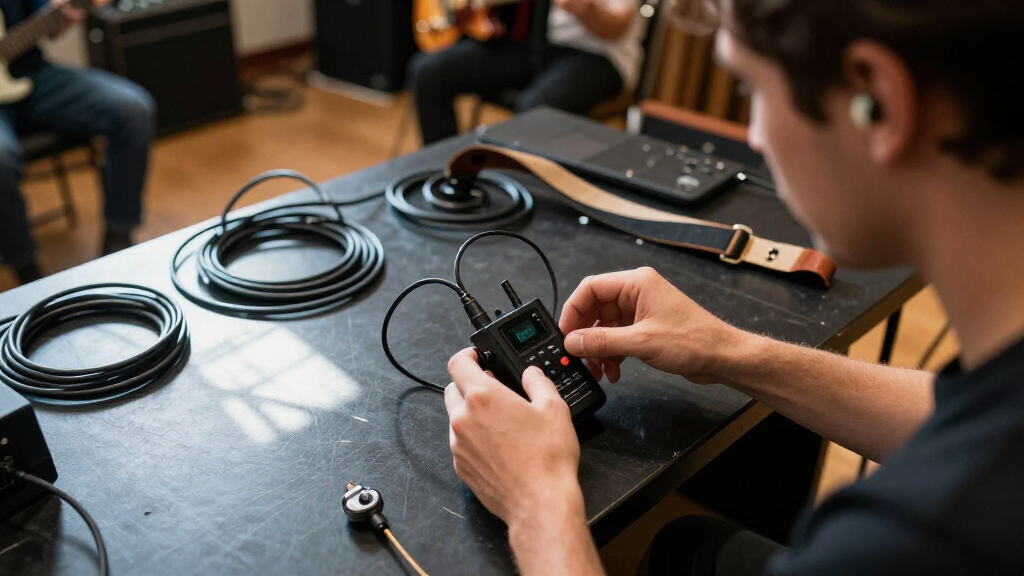
I compared these 13 systems on the needs that shape a musician’s monitoring experience: wireless band and frequency flexibility, mono or stereo operation, receiver configuration, setup and pairing demands, battery approach, and suitability for rehearsals, studios, churches, or live stages. I also considered how a system’s included hardware affects who can use it: a single receiver serves one performer, while a multi-bodypack package may suit performers sharing a mix. Product names and listed features informed the comparison; I did not treat a feature claim as proof of performance in every venue.
The ranking favors systems with a useful balance of monitoring capability, practical setup, and fit across more than one musician scenario. The Sennheiser XSW IEM leads as the more established all-round stage-oriented option, while specialized kits rank for their particular strengths rather than being treated as direct replacements. Compact 2.4 GHz models earn a place for ease of use, but their convenience does not automatically make them the right choice in a crowded RF environment. I separate similarly named products and versions where their listed band or configuration differs, since those details can change compatibility and day-to-day use.
Factors to Consider When Choosing Wireless In-ear Monitors For Musicians
Before choosing a system, I would match it to the actual signal path and wireless conditions of your performances—not just the number of features on the box. These broader checks can prevent common mismatches, such as buying a stereo-capable setup for a mono mix, or picking a convenient frequency band without checking what else is transmitting at the venue.
Match the Wireless Band to Your Venues
Wireless systems share radio space with other equipment, so performance depends partly on what is active around the stage. A 2.4 GHz kit can be appealing for home practice and simpler setups, but that band may also carry Wi-Fi and other devices. UHF systems offer frequency choices, yet those frequencies still need to be legal and usable where you perform. Check local spectrum rules and ask whether your venue or production team coordinates wireless channels. A common mistake is assuming one band is always more reliable everywhere. For a fixed rehearsal room, convenience may matter most; for changing venues, frequency planning should carry more weight.
Decide Whether Your Mix Needs Stereo
Stereo is useful when your monitor mix uses left-right placement to separate instruments or create space, but it is not automatically better for every performer. A mono mix can keep vocals and key cues centered and may be simpler to manage when several musicians share the same feed. Confirm both the transmitter input path and receiver output support the format you intend to use. Also check whether the system sends a distinct mix to each ear or merely accepts a stereo source under a particular operating mode. If your mixer only sends mono monitor mixes, paying extra for stereo capability may not improve what you hear. Build the decision around your console routing and the mix you actually need onstage.
Count Performers, Mixes, and Receivers Separately
One transmitter feeding several receivers can help a band share a monitor mix, but it does not necessarily give each musician an independent mix. If a singer needs more vocal and a drummer needs more click, they may require separate monitor sends and a system that can carry them. Count the number of bodypacks you need, then map each one to a mix before buying. Consider whether performers will use identical or different earphones, since the wireless pack and the earphones are separate parts of the listening setup. Avoid treating “one to many” as shorthand for personalized monitoring. A shared mix is practical for rehearsals, while performers with different needs may benefit more from separate transmitters or console mixes.
Plan for Battery Management and Failure Points
Battery life claims help compare designs, but they do not replace a gig-day power plan. Check whether the transmitter and each bodypack use rechargeable or replaceable power, how charging works, and whether the kit can be topped up between sets. A charging case can simplify storage and routine charging, while a system using separate packs may call for spare batteries or a dedicated charging routine. Think through what happens if a receiver runs low during a long rehearsal or if a cable is damaged. Carrying a wired backup or spare earphones can keep a minor failure from interrupting a performance. Prioritize a charging setup your band will actually maintain, not just the longest stated runtime.
Check Connections and Stage Workflow Before Buying
Make sure the transmitter can accept the outputs your mixer provides, including the connector type and whether you need a balanced or stereo feed. Decide where the transmitter will sit, how it will receive power, and whether it needs rack mounting or quick placement near a small mixer. Clip-on systems can reduce setup friction for mobile performers, while rack-oriented designs may fit a more permanent stage rig. Confirm that the bodypack’s controls are usable during a performance and that the output works with your preferred earphones. A system can be wireless and still create a cable-management problem at the mixer or on the musician. Sketching the signal path before purchase often reveals adapters or accessories you would otherwise overlook.
Spend More for the Limitation You Need to Solve
Paying more makes sense when it buys a capability that changes your work: dependable frequency coordination, more flexible routing, or a receiver configuration suited to multiple performers. A premium system is less useful if your gigs are informal and the extra controls add setup steps you will not use. Conversely, the simplest kit may become frustrating if your stages are crowded with wireless equipment or your band needs distinct mixes. Compare the cost of a complete setup, including the required number of bodypacks, earphones, batteries, and any adapters. Do not choose on transmitter specifications alone; the whole monitoring chain determines the result. The best fit is the least complicated system that meets your venue, mix, and performer needs.
Frequently Asked Questions
Should I choose UHF or 2.4 GHz for a band that plays different venues?
I would choose based on how much control you need over frequencies and how much setup time your band can devote to wireless checks. UHF systems with selectable frequencies can offer more options for adapting to a venue, but you still need to check local rules and coordinate against other transmitters. 2.4 GHz models often make pairing simpler, which can suit rehearsals and small gigs, though crowded Wi-Fi environments may complicate use. Ask venues or the sound engineer what wireless systems are already in use before committing. If your schedule includes varied stages, prioritize frequency planning and a backup plan over convenience alone.
Can two musicians use one transmitter and hear different monitor mixes?
Usually, multiple receivers listening to one transmitter hear the same transmitted mix unless the system and mixer routing provide separate channels or independent transmitters. A package with two bodypacks can be helpful when two performers want the same feed, but the receiver count alone does not create separate mixes. Check how many monitor outputs your mixer has and what each wireless system can transmit at once. If one performer needs more vocal and another needs more percussion, plan for separate sends and compatible wireless paths. Confirm this before buying a multi-receiver kit to avoid mistaking shared listening for independent monitoring.
Is a stereo IEM system worth choosing if our mixer sends mono?
If your mixer sends only a mono monitor feed, a stereo wireless system may not provide a wider or more separated mix without changes to the signal path. Mono can be perfectly workable for vocals, timing cues, and a straightforward stage mix. Stereo becomes more useful when the console can send a stereo monitor mix and you have a reason to place instruments across the image. Check the mixer’s aux or bus capabilities as well as the IEM system’s input and output format. Spend on stereo capability when your routing and listening preferences can make use of it, not simply because the feature is available.
What should I check before buying a wireless IEM kit for a church or rehearsal room?
Start by identifying the mixer’s available outputs, how many performers need monitoring, and whether everyone can share a mix. Then check the room’s existing wireless microphones, Wi-Fi use, and any frequency coordination process. For a permanent room, ease of setup and a repeatable channel plan can matter more than a large feature set. For rehearsals, simple pairing and manageable charging may save more time than extra stage controls. Confirm the kit includes the number of bodypacks needed, and budget for earphones and any connection adapters that are not part of the wireless system.
Are the two Sennheiser XSW IEM band versions interchangeable?
No—do not assume the A Band and B Band versions can communicate with each other or operate on the same frequencies. Wireless transmitters and receivers need compatible frequency-band versions, and local regulations can affect which band is usable. Match the transmitter and bodypack specifications before adding receivers or replacing a component. If you already own wireless microphones or IEMs, check their frequency ranges to avoid conflicts. When choosing between the listed versions, verify availability and permitted frequencies for your location rather than selecting by model name alone.
Conclusion
For the strongest all-round starting point, I recommend the Sennheiser XSW IEM to musicians who want a stage-oriented system with a more established feature set. The LEKATO MS-02 or LEKATO MS-1 makes more sense for value-focused rehearsals and straightforward setups; compare their exact package details before choosing. Beginners who want a simple wireless workflow can start with the JOYO JW-07 or a compact Xvive option, provided its band and configuration suit the room. For two performers sharing one feed, the Phenyx Pro PTM-11-2B is the specific pick to examine. Musicians prioritizing battery convenience can look at the LEKATO MS-20, while players who need UHF frequency options should compare the Phenyx Pro PTM-10 and POGOLAB system against their venue’s wireless plan. Pick the kit that matches your mix, receiver count, and radio environment—not the one with the longest feature list.
Halloween Picks

Spirit Halloween Scary Sitting Scarecrow Animatronic, 4 ft 6 in

Fun Costumes Creepy Twin Boys Halloween Animatronic

JOYIN 5-Foot Halloween Animatronic Drinking Skeleton
As an affiliate, we earn on qualifying purchases.