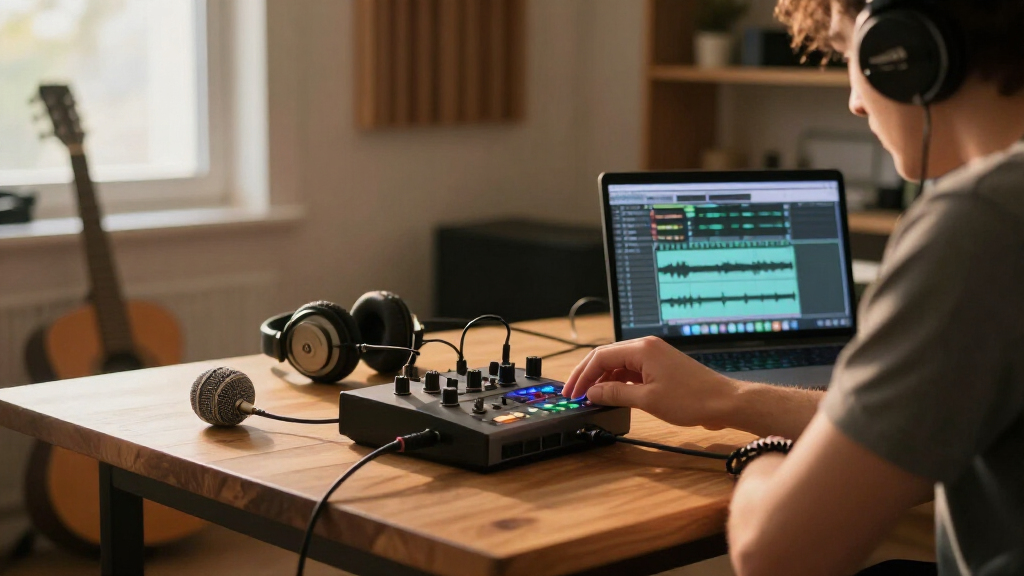

The best desktop audio interface for most home recording setups is the Focusrite Scarlett 2i2 4th Gen, with two versatile inputs that suit vocals, instruments, and small recording sessions. For a ready-to-record starter kit, the PreSonus AudioBox USB 96 Studio Bundle adds a microphone and headphones; the Shure MVX2U Gen 2 is a more focused pick for recording one XLR microphone over USB-C. The main tradeoffs are how many sources you need to record at once, whether you want a complete bundle, and how much you value podcast-specific controls over a straightforward interface. I compare all 14 options by their recording fit, usability, and flexibility. Continue reading for the full breakdown and help matching a model to your setup.

Get audio and creator gear delivered free with Prime
- Fast, free delivery on millions of items
- Prime Video, Amazon Music and more included
- Member-only deals all year
Complete the kit


Key Takeaways
- The Scarlett 2i2 4th Gen is the strongest all-rounder because its two inputs cover common vocal-and-instrument workflows without the added controls of a podcast mixer.
- Bundles solve different setup problems: PreSonus includes core recording accessories, while the Scarlett Studio bundles pair a Focusrite interface with recording gear.
- Solo interfaces are best for one source at a time; the Scarlett Solo models and Shure MVX2U are less suitable if you need to record two independent inputs simultaneously.
- Podcast-focused models trade music-studio simplicity for workflow features, with the MAONO E2 Gen 2, P2, and four-person bundle aimed at spoken-word setups.
- Connectivity and intended use matter more than headline resolution: phone-friendly models and USB-C designs can fit particular workflows, but they do not automatically make a better match for every recording desk.
| PreSonus AudioBox USB 96 Studio Recording Bundle |  | Best Complete Starter Bundle | Connectivity: USB; bus-powered | Channels: 2 | Maximum sample rate: 96 kHz | VIEW LATEST PRICE | See Our Full Breakdown |
| Fender AudioBox Go 2×2 USB-C Audio Interface |  | Best Compact Travel Interface | Connectivity: USB-C; bus-powered | Channels: 2×2 | Converters: 24-bit/96 kHz | VIEW LATEST PRICE | See Our Full Breakdown |
| Shure MVX2U Gen 2 XLR-to-USB-C Audio Interface |  | Best for Single-Microphone Recording | Model: MVX2UG2 | Connectivity: USB-C | Audio input: XLR | VIEW LATEST PRICE | See Our Full Breakdown |
| Focusrite Scarlett 2i2 4th Gen USB-C Audio Interface |  | Best Overall for Two-Input Recording | Connectivity: USB-C | Channels: 2 | Microphone preamps: 2 | VIEW LATEST PRICE | See Our Full Breakdown |
| Focusrite Scarlett Solo 3rd Gen USB-C Audio Interface |  | Best for One-Person Vocal and Guitar Sessions | Connectivity: USB | Channels: 2 | Maximum sample rate: 192 kHz | VIEW LATEST PRICE | See Our Full Breakdown |
| Focusrite Scarlett Solo Studio 4th Gen USB-C Audio Interface Bundle |  | Best Complete Recording Starter Kit | Channels: 2 | Inputs: 1 XLR microphone preamp; 1 Hi-Z instrument input | Maximum sample rate: 192 kHz | VIEW LATEST PRICE | See Our Full Breakdown |
| 4-Person Podcast Equipment Bundle with M100 Audio Interface and Four Dynamic Microphones |  | Best for Four-Person Podcast Recording | Channels: 4 | Connectivity: USB | USB interfaces: 2 | VIEW LATEST PRICE | See Our Full Breakdown |
| MAONO P2 Hybrid USB Audio Interface with Dual XLR Inputs |  | Best for Computer-and-Phone Recording | Channels: 2 | Connectivity: USB-C | XLR gain: 56 dB | VIEW LATEST PRICE | See Our Full Breakdown |
| Focusrite Scarlett Solo 4th Gen USB-C Audio Interface |  | Best for Solo Vocal-and-Instrument Recording | Channels: 2 | Inputs: 1 XLR microphone preamp; 1 Hi-Z instrument input | Maximum sample rate: 192 kHz | VIEW LATEST PRICE | See Our Full Breakdown |
| MAONO PS22 Lite USB Audio Interface for Guitar, Vocals, and Streaming |  | Best Compact Routing Pick | Channels: 2 | Maximum sample rate: 192 kHz | Recording resolution: 24-bit | VIEW LATEST PRICE | See Our Full Breakdown |
| MAONO P1 USB Audio Interface for PC, Phone, iPad, and Guitar |  | Best for Mobile-Creator Flexibility | Channels: 2 | Maximum resolution: 24-bit/192 kHz | Maximum gain: 70 dB | VIEW LATEST PRICE | See Our Full Breakdown |
| Focusrite Scarlett 2i2 Studio 4th Gen USB-C Audio Interface Bundle |  | Best Complete Recording Starter Kit | Channels and inputs: 2 channels; 2 audio inputs | Connectivity: USB-C | Mic preamps: 2 | VIEW LATEST PRICE | See Our Full Breakdown |
| PIYONE Q2 2×2 USB-C Audio Interface, 24-bit/192 kHz, Alloy Red |  | Best Compact USB-C Pick | Inputs/channels: 2×2; two XLR/TRS combo inputs | Connection: USB-C | Maximum recording resolution: 24-bit/192 kHz | VIEW LATEST PRICE | See Our Full Breakdown |
| MAONO E2 Gen 2 Podcast Audio Interface and Mixer |  | Best for Podcast and Stream Production | Channels: 10 | XLR inputs: 2 | Preamp gain: Up to 60 dB | VIEW LATEST PRICE | See Our Full Breakdown |
| desktop audio interfaces for recording | Connectivity | Channels | Maximum sample rate | Weight |
|---|---|---|---|---|
| PreSonus AudioBox USB 96 Studi | USB; bus-powered | 2 | 96 kHz | — |
| Fender AudioBox Go 2×2 USB-C A | USB-C; bus-powered | 2×2 | — | 8.16 ounces |
| Shure MVX2U Gen 2 XLR-to-USB-C | USB-C | 1 | 192 kHz | 100 g |
| Focusrite Scarlett 2i2 4th Gen | USB-C | 2 | 192 kHz | — |
| Focusrite Scarlett Solo 3rd Ge | USB | 2 | 192 kHz | 12.32 ounces |
| Focusrite Scarlett Solo Studio | USB | 2 | 192 kHz | — |
| 4-Person Podcast Equipment Bun | USB | 4 | — | — |
| MAONO P2 Hybrid USB Audio Inte | USB-C | 2 | 192 kHz | 0.5 kg |
| Focusrite Scarlett Solo 4th Ge | USB | 2 | 192 kHz | 14.4 oz |
| MAONO PS22 Lite USB Audio Inte | USB | 2 | 192 kHz | 0.43 kg |
| MAONO P1 USB Audio Interface f | — | 2 | — | — |
| Focusrite Scarlett 2i2 Studio | USB-C | — | 192 kHz | — |
| PIYONE Q2 2×2 USB-C Audio Inte | — | — | — | 0.74 kg |
| MAONO E2 Gen 2 Podcast Audio I | AUX, Bluetooth, and USB | 10 | 48 kHz | — |
More Details on Our Top Picks
PreSonus AudioBox USB 96 Studio Recording Bundle
The AudioBox USB 96 Studio Recording Bundle is the most ready-to-record pick here: it pairs a two-preamp interface with an M7 condenser mic, HD7 headphones, stand, cables, and software. That makes it a more complete first setup than the Focusrite Scarlett 2i2 4th Gen, which supplies recording tools but not this full set of recording hardware. Two combo inputs let you capture a vocalist and an instrument at once, while zero-latency monitoring helps performers hear themselves without distracting delay. MIDI I/O also suits musicians with compatible keyboards or gear. The tradeoff is a basic two-channel ceiling and fewer level-assistance features than the Scarlett 2i2. Choose this bundle when having the core recording kit together matters more than a more guided gain-setting workflow.
Pros:- Includes an M7 condenser microphone, HD7 headphones, stand, cables, and recording software.
- Two Class A preamps and combo inputs allow a mic and line-level source to be recorded together.
- Zero-latency hardware monitoring supports comfortable live performance.
- MIDI I/O and balanced monitor outputs suit a small, expanding music setup.
Cons:- Two channels limit simultaneous recording of larger ensembles or multi-mic setups.
- Its listed features lack the Auto Gain and Clip Safe assistance found on the Scarlett 2i2 4th Gen.
- Recording and production still require a compatible computer and software.
Best for: First-time home recordists who need an interface, condenser microphone, headphones, stand, cables, and software in one setup.
Not ideal for: Musicians recording more than two sources at once or buyers who already own a microphone and headphones and would rather choose a more feature-rich standalone interface.
- Connectivity:USB; bus-powered
- Channels:2
- Maximum sample rate:96 kHz
- Mic preamps:2 Class A preamps with +48 V phantom power
- Inputs:Combo inputs for microphones and line-level sources
- Monitoring:Zero-latency hardware monitoring
- MIDI:MIDI In/Out
- Main outputs:Balanced 1/4-inch
- Included accessories:M7 condenser microphone, HD7 headphones, stand, and cables
Our verdict“Choose the AudioBox USB 96 bundle if you need a practical starter recording rig in one box and can work within two input channels.”
Fender AudioBox Go 2×2 USB-C Audio Interface
For recording away from a fixed desk, the Fender AudioBox Go puts a mic/line combo input and a separate instrument input in a body weighing just 8.16 ounces. That dedicated guitar or bass input makes it more direct for a mobile singer-songwriter than the Shure MVX2U Gen 2, which connects one XLR microphone and does not provide a second instrument channel. USB-C bus power and zero-latency headphone monitoring with mix control help keep a compact laptop setup simple. It also includes Fender Studio tools and an amp-and-effects pack. The tradeoff is that it remains a two-channel interface, and the effects pack requires registration and an app download. I’d pick it for portability, not for recording a multi-mic band.
Pros:- Lightweight, compact design and USB-C bus power suit mobile recording.
- Separate mic/line and instrument inputs allow a vocal and guitar or bass to be captured together.
- Zero-latency headphone monitoring includes a mix control.
- Fender Studio app and Amp & FX Pack provide included recording and tone-shaping tools.
Cons:- Two-channel capacity is not suited to larger ensembles or multi-microphone sessions.
- The Amp & FX Pack requires interface registration and an app download.
- Its feature set is aimed at a simple portable rig rather than an expanded desktop studio.
Best for: Laptop-based singer-songwriters and traveling creators who want to record one microphone and one guitar or bass without carrying a larger interface.
Not ideal for: Recordists who need more than two simultaneous channels, or who want to avoid registering hardware and downloading companion software to access bundled effects.
- Connectivity:USB-C; bus-powered
- Channels:2×2
- Converters:24-bit/96 kHz
- Inputs:XLR/mic-line combo input and dedicated 1/4-inch TS instrument input
- Phantom power:Switchable +48 V
- Outputs:Two balanced 1/4-inch TRS main outputs and headphone output
- Monitoring:Zero-latency headphone monitoring with mix control
- Dimensions:3.3 × 4.25 × 1.73 inches
- Weight:8.16 ounces
Our verdict“Pick the AudioBox Go for a small, bus-powered setup built around one mic and one instrument, rather than a larger recording session.”
Shure MVX2U Gen 2 XLR-to-USB-C Audio Interface
The Shure MVX2U Gen 2 takes a deliberately narrow approach: it connects one XLR microphone directly to a desktop or mobile device over USB-C. Its up to 60 dB of gain, 48 V phantom power, and onboard processing make it a focused choice for a solo voice recording chain, with compatible MOTIV apps providing access to settings. Compared with the Fender AudioBox Go, it gives up an instrument input and a second recording channel; in return, it is a particularly compact way to bring an existing XLR mic to a computer or phone. This is not a conventional two-input desktop interface, so it is a poor fit for recording vocals and guitar simultaneously. Buyers also need to supply the microphone and use a USB-C connection.
Pros:- Connects an XLR microphone to desktop and mobile devices through USB-C.
- Up to 60 dB of gain supports a range of dynamic and condenser microphones.
- 48 V phantom power accommodates condenser microphones.
- Onboard Auto Level Mode, denoising, and Digital Popper Stopper processing are available through compatible MOTIV apps.
Cons:- Single-channel design cannot record a separate instrument or second microphone at the same time.
- Requires a separate XLR microphone and USB-C connection.
- Settings depend on compatible MOTIV apps rather than a broader two-input interface control layout.
Best for: Solo podcasters, voice-over artists, and mobile creators who already own an XLR microphone and want a compact USB-C connection with onboard processing.
Not ideal for: Musicians who need to record a microphone and instrument together, users without an XLR mic, or anyone who needs multiple simultaneous inputs.
- Model:MVX2UG2
- Connectivity:USB-C
- Audio input:XLR
- Channels:1
- Maximum sample rate:192 kHz
- Gain:Up to 60 dB
- Phantom power:48 V
- Weight:100 g
- Compatible operating systems:Android, Windows, iOS, and macOS
Our verdict“Choose the MVX2U Gen 2 when your recording revolves around one XLR microphone and portability matters more than multi-input flexibility.”
Focusrite Scarlett 2i2 4th Gen USB-C Audio Interface
The Scarlett 2i2 4th Gen is my strongest all-around fit for desktop recording when two inputs are enough. It combines two mic preamps, two instrument inputs, and up to 192 kHz recording with Auto Gain and Clip Safe, features that help users set workable levels and reduce the risk of a ruined take. Its independently controlled headphone output also makes monitoring easier to adjust without changing the speaker level. Compared with the PreSonus AudioBox USB 96 bundle, it offers more recording guidance but does not include a microphone, headphones, or stand. The Scarlett Solo 3rd Gen is a simpler option for one mic at a time; the 2i2 earns its place for paired sources. Its main limit is still two-channel capacity.
Pros:- Two low-noise microphone preamps support simultaneous two-mic recording.
- Auto Gain and Clip Safe help manage recording levels and reduce clipping risk.
- Air mode can add presence to vocals and guitars.
- Independent headphone volume control makes monitoring adjustments separate from other outputs.
Cons:- Two input channels limit recording of larger ensembles and multi-mic setups.
- Unlike the PreSonus AudioBox USB 96 bundle, it does not include a microphone, headphones, or stand.
- Its added level-control features may be unnecessary for users recording only one source at a time.
Best for: Home recordists who regularly capture two sources at once, such as vocals and guitar, and want level-setting assistance without moving to a larger interface.
Not ideal for: Buyers who need more than two simultaneous inputs or want a ready-to-record hardware bundle with microphone and headphones included.
- Connectivity:USB-C
- Channels:2
- Microphone preamps:2
- Maximum sample rate:192 kHz
- Dynamic range:120 dB
- Analogue gain:69 dB
- Audio inputs:2
- Dimensions:4.61 × 7.09 × 1.87 inches (D × W × H)
- Included software:Pro Tools Intro+, Ableton Live Lite, Cubase LE, and Hitmaker Expansion
Our verdict“Choose the Scarlett 2i2 4th Gen if you want a capable two-input desktop interface with useful recording safeguards and already have your microphones and headphones.”
Focusrite Scarlett Solo 3rd Gen USB-C Audio Interface
The Scarlett Solo 3rd Gen suits a simple desktop workflow: one microphone input plus an instrument input lets a solo musician record vocals alongside guitar or bass without needing a larger interface. Its Air mode offers a tonal option for vocals and acoustic instruments, while gain Halo metering gives a quick visual cue as levels are set. Compared with the Scarlett 2i2 4th Gen, this Solo is the more focused choice for a one-mic setup, but it lacks the 2i2’s pair of mic preamps and recording aids such as Auto Gain and Clip Safe. The AudioBox Go also adds a separate instrument input in a highly portable form. Expect limited flexibility: just one mic at a time, and the supplied data lists USB connectivity without specifying a connector type.
Pros:- Mic and instrument inputs support a vocal-and-guitar or vocal-and-bass workflow.
- Switchable Air mode offers an added presence option for vocals and acoustic instruments.
- Gain Halo metering helps users watch input levels while recording.
- Records up to 24-bit/192 kHz and provides balanced outputs.
Cons:- A single mic preamp prevents simultaneous two-microphone recording.
- Compared with the Scarlett 2i2 4th Gen, it lacks Auto Gain and Clip Safe.
- No external power supply is included, and the listed connectivity is USB.
Best for: Solo singer-songwriters and home recordists who need to capture one microphone and one guitar or bass with balanced monitor outputs.
Not ideal for: Two-microphone interviews, duos, or users who want newer level-assistance features or more mic inputs than the Solo provides.
- Connectivity:USB
- Channels:2
- Maximum sample rate:192 kHz
- Bit depth:24-bit
- Inputs:XLR microphone and instrument
- Outputs:2 balanced outputs
- Dimensions:1.71 × 5.65 × 3.77 inches
- Weight:12.32 ounces
- Warranty:3 years
Our verdict“Pick the Scarlett Solo 3rd Gen for a straightforward one-person mic-and-instrument setup, but choose the 2i2 if two microphones or extra level safeguards matter.”
Focusrite Scarlett Solo Studio 4th Gen USB-C Audio Interface Bundle
The Scarlett Solo Studio bundle is the clearest choice here for someone building a first desktop vocal-and-instrument recording setup. It pairs the Solo interface with a CM25 MkIII condenser microphone, SH-450 headphones, and recording software, so you can start tracking without assembling those pieces separately. Its 24-bit/192 kHz recording and 120 dB dynamic range match the standalone Scarlett Solo 4th Gen, while Air mode offers a tonal option for vocals and guitar. The tradeoff is the Solo’s layout: there is just one XLR preamp alongside one Hi-Z instrument input, so two microphones cannot be recorded through it at once. Choose this bundle over the standalone Solo if you need the mic and headphones; skip it if you already own suitable gear or expect to record multiple vocalists.
Pros:- Includes an interface, condenser microphone, headphones, and recording software.
- Air mode provides an alternate tonal character for vocal and guitar tracks.
- Records at up to 24-bit/192 kHz with a listed 120 dB dynamic range.
- Small desktop footprint suits a compact home recording station.
Cons:- One XLR preamp prevents recording two microphones directly at the same time.
- The included microphone and headphones may not suit buyers who already have preferred studio gear.
- USB connectivity requires a compatible computer or mobile device.
Best for: New home recordists who need an interface, condenser microphone, headphones, and starter software for solo vocals or guitar.
Not ideal for: People who already own recording headphones and a microphone, or musicians who need two microphone inputs for simultaneous recording.
- Channels:2
- Inputs:1 XLR microphone preamp; 1 Hi-Z instrument input
- Maximum sample rate:192 kHz
- Bit depth:24-bit
- Dynamic range:120 dB
- Included microphone:CM25 MkIII condenser microphone
- Included headphones:SH-450
- Connectivity:USB
Our verdict“Choose this bundle if you want the Solo’s straightforward recording setup with a microphone and headphones included; choose the standalone Scarlett Solo if you already have those accessories.”
4-Person Podcast Equipment Bundle with M100 Audio Interface and Four Dynamic Microphones
When the recording plan involves several people around one table, this four-microphone bundle solves a different problem from the two-channel Focusrite and MAONO interfaces in this roundup. It supplies four dynamic microphones, stands, shock mounts, and accessories, while the M100 adds four-channel recording, dual USB connections, noise reduction, and quick preset recall. That package is aimed more at conversational podcasts and group streaming than detailed solo music production: the listed feature set emphasizes effects and voice controls rather than high-resolution sample-rate specifications. Its battery power and broad device compatibility can help with flexible setups, but buyers should verify the connection and routing needs of their recording software. The custom sound-effect recordings are limited to 20 seconds, and the update-support date is unknown. For one vocalist and a guitar, the Scarlett Solo Studio bundle is a more focused recording choice.
Pros:- Includes four dynamic microphones and the stands, shock mounts, and cables for a group setup.
- Four-channel design supports recording multiple speakers together.
- Dual USB connections can connect two computers or mobile devices simultaneously.
- Noise reduction and preset recall offer quick controls for podcast and streaming sessions.
Cons:- The supplied specifications do not state a maximum sample rate or bit depth.
- Custom sound-effect recordings are limited to 20 seconds.
- Software update support information is unknown.
Best for: Podcast hosts recording up to four people at once who want microphones, desktop stands, and basic live-production controls in one package.
Not ideal for: Solo musicians seeking clearly specified high-resolution recording, or producers who need a conventional interface workflow with detailed software support information.
- Channels:4
- Connectivity:USB
- USB interfaces:2
- Microphones:4 dynamic microphones
- Power source:Battery powered
- Compatibility:Windows, Mac, iOS, Android
- Outputs:Auxiliary, USB, XLR
- Included accessories:4 desktop stands, 4 shock mounts, 4 earphones, cables, foam covers, splitters, and accessories
Our verdict“Pick this bundle for a multi-person podcast table; for solo vocal-and-guitar recording with explicit high-resolution specs, the Focusrite Scarlett Solo Studio bundle is a better fit.”
MAONO P2 Hybrid USB Audio Interface with Dual XLR Inputs
The MAONO P2 Hybrid suits creators who want a desktop interface to serve both a computer recording setup and a phone- or tablet-based workflow. Its compact two-channel layout supports 24-bit/192 kHz audio, direct monitoring, and loopback, while separate mute and monitoring controls make quick changes easier during recording or a stream. Compared with the Focusrite Scarlett Solo, the P2 is more oriented toward flexible device connections and routing than a simple one-mic-and-one-instrument setup; its listed inputs include microphone, guitar, PC, smartphone, and iPad. The aluminum-alloy housing and tilted shape also suit a desk where controls need to stay visible. The main limit is capacity: two channels will not cover larger sessions, and some routing and VST functions depend on companion software. Buyers after a simpler guitar-and-vocal interface may prefer the MAONO PS22 Lite.
Pros:- Supports 24-bit/192 kHz recording with direct monitoring and loopback.
- Can connect a computer and a phone or iPad in the same setup.
- Independent mute and monitoring controls simplify live adjustments.
- Tilted aluminum-alloy housing keeps the desktop controls accessible.
Cons:- Two channels limit simultaneous recording capacity.
- Some routing and VST features depend on companion software.
- Its broad device-routing focus may be unnecessary for a basic single-computer recording rig.
Best for: Creators who record or stream through a computer while also connecting a phone or tablet, and want loopback and hands-on mute controls.
Not ideal for: Bands or interview setups needing more than two channels, or users who want routing features without relying on companion software.
- Channels:2
- Connectivity:USB-C
- XLR gain:56 dB
- Maximum sample rate:192 kHz
- Audio resolution:24-bit
- Housing:Aluminum alloy
- Dimensions:6.42 × 8.27 × 3.23 in
- Weight:0.5 kg
Our verdict“Choose the P2 if computer-and-mobile connectivity and loopback matter more than extra input capacity; for a simpler guitar-and-vocal setup, consider the MAONO PS22 Lite.”
Focusrite Scarlett Solo 4th Gen USB-C Audio Interface
For a desktop setup built around one microphone and one instrument, the Scarlett Solo 4th Gen keeps the signal path clear without bundling gear you may not need. Its XLR preamp and Hi-Z input let a solo performer record a vocal and guitar or bass, while 24-bit/192 kHz recording and a listed 120 dB dynamic range give it the same headline capture specifications as the Scarlett Solo Studio bundle. Air mode adds another tonal option, and the amplified headphone output has independent volume control for monitoring. The distinction between the two Scarlett Solo options is what comes in the box: this model is the more direct pick if you already own a microphone and headphones. Its chief constraint is also clear—there is only one microphone input—so the two-XLR MAONO P2 is a better match for setups that need more microphone connectivity.
Pros:- Combines one XLR microphone preamp with one Hi-Z instrument input.
- Supports 24-bit/192 kHz recording and a listed 120 dB dynamic range.
- Air mode offers an alternate sound character for vocals and guitars.
- Independent headphone volume control supports direct desktop monitoring.
Cons:- Only one microphone input is listed.
- Buyers must supply their own microphone and headphones.
- USB operation requires a compatible computer or iOS device.
Best for: Solo singers, guitarists, and home recordists who already own a microphone and headphones and need one mic input plus an instrument input.
Not ideal for: Duos or podcasters who need to record two microphones simultaneously, or beginners seeking a bundled microphone and headphones.
- Channels:2
- Inputs:1 XLR microphone preamp; 1 Hi-Z instrument input
- Maximum sample rate:192 kHz
- Bit depth:24-bit
- Dynamic range:120 dB
- Connectivity:USB
- Dimensions:3.78 × 5.63 × 1.83 in
- Weight:14.4 oz
Our verdict“Choose this standalone Solo for straightforward vocal-and-instrument recording if you already own the accessories; select the Studio bundle if you need a microphone and headphones too.”
MAONO PS22 Lite USB Audio Interface for Guitar, Vocals, and Streaming
The MAONO PS22 Lite is a compact two-channel option for home recordists who want direct monitoring and software routing without stepping up to a larger interface. It records at 24-bit/192 kHz, supplies up to 56 dB of microphone preamp gain, and includes 48V phantom power for compatible microphones. The ProStudio software adds virtual channels and loopback, making this more flexible for a recording-and-streaming desk than the straightforward Scarlett Solo, though that Focusrite lists a higher 120 dB dynamic range compared with the PS22 Lite’s 106 dB. The tradeoff is a software-dependent workflow: users need to select the MAONO ASIO driver for proper operation with compatible recording programs. Its two-channel format also makes it a solo or small setup choice, not a route to recording several microphones at once. For computer-and-phone connection flexibility, the MAONO P2 is the closer alternative.
Pros:- Records at up to 24-bit/192 kHz.
- Offers up to 56 dB of microphone preamp gain and 48V phantom power.
- Direct monitoring and ProStudio virtual channels with loopback support recording and streaming workflows.
- Compact design and included USB-A/USB-C to USB-C cable suit a small desktop setup.
Cons:- Two channels limit larger recording sessions.
- Compatible recording programs require selecting the MAONO ASIO driver for proper use.
- Its listed 106 dB dynamic range is lower than the Scarlett Solo 4th Gen’s 120 dB.
Best for: Solo home musicians and streamers who want phantom power, direct monitoring, and loopback routing in a compact two-channel interface.
Not ideal for: Multi-microphone recording groups or users who prefer a setup that does not depend on selecting a specific ASIO driver.
- Channels:2
- Maximum sample rate:192 kHz
- Recording resolution:24-bit
- Dynamic range:106 dB
- Microphone preamp gain:Up to 56 dB
- Phantom power:48 V
- Connectivity:USB
- Weight:0.43 kg
Our verdict“Pick the PS22 Lite for compact recording with phantom power and software loopback; choose the Scarlett Solo for its higher listed dynamic range and simpler solo setup.”
MAONO P1 USB Audio Interface for PC, Phone, iPad, and Guitar
The MAONO P1 suits a solo recording desk that may also involve a phone or tablet. Its support for computer and mobile workflows, combined with up to 70 dB of gain, gives dynamic-mic users more flexibility than a basic interface aimed only at desktop recording. Direct monitoring and loopback also make it useful for tracking while streaming or capturing computer audio. Compared with the PIYONE Q2, the P1 offers more explicitly described device compatibility and separate headphone and monitor controls; the Q2 is a simpler USB-C, bus-powered choice. The P1 still has just two channels, so it is a better fit for solo vocals or an instrument-and-vocal setup than ensemble recording. Its many supported devices also mean buyers may need to check cable and settings compatibility for their particular setup.
Pros:- Up to 70 dB of gain can accommodate many dynamic microphones without a separate booster.
- Computer and mobile compatibility supports flexible recording and streaming setups.
- Direct monitoring, loopback, and independent headphone and monitor controls aid tracking and capture.
- Compact metal housing is suited to a crowded desktop.
Cons:- Two channels limit recording to small, solo-focused setups.
- Microphones, cables, and device settings may need checking for a compatible connection.
- The included package lists a USB cable and manual, not a microphone or headphones.
Best for: Solo creators who record vocals or instruments at a desk and want to switch between a computer, phone, or tablet.
Not ideal for: Bands or multi-person podcast teams that need more than two recording channels, and buyers seeking a setup with a microphone and headphones included.
- Channels:2
- Maximum resolution:24-bit/192 kHz
- Maximum gain:70 dB
- Equivalent input noise:-130 dB EIN
- Inputs:XLR microphone and guitar/instrument
- Phantom power:48 V
- Monitoring:Direct monitoring, loopback, independent headphone and monitor controls
- Connectivity and compatibility:USB; Android, ChromeOS, Windows, and iOS
Our verdict“Choose the P1 if you need a compact two-channel interface that can move between desktop and mobile recording.”
Focusrite Scarlett 2i2 Studio 4th Gen USB-C Audio Interface Bundle
The Scarlett 2i2 Studio 4th Gen bundle stands out for buyers who want the core pieces of a desktop vocal setup in one package: a two-input interface, condenser microphone, headphones, pop filter, and XLR cable. That makes it a more ready-to-record choice than the MAONO P1, which supplies the interface but leaves the microphone and headphones to the buyer. On the interface side, Auto Gain and Clip Safe help manage levels, while Air mode offers a selectable change to vocal or guitar character. Its two inputs can handle a small recording setup, but not a larger ensemble or multi-person session that needs more simultaneous sources. The supplied mic and headphones also define the starter setup rather than letting buyers choose every component themselves. I’d favor this bundle for a first desktop recording station, not for someone who already owns a complete kit.
Pros:- Includes the interface, CM25 MkIII condenser microphone, SH-450 headphones, pop filter, and XLR cable.
- Auto Gain and Clip Safe assist with setting and controlling recording levels.
- Air mode offers an additional tonal option for vocals and guitars.
- Recording software and plugins provide tools for tracking, mixing, and mastering.
Cons:- Two inputs limit simultaneous recording sources.
- The included microphone and headphones are wired, so the bundle is not a wireless setup.
- Buyers with existing studio gear may have little need for several bundled components.
Best for: New home-recording users who need an interface, condenser microphone, headphones, and basic vocal accessories together.
Not ideal for: Musicians who need more than two inputs or experienced recordists who already own preferred microphones and headphones.
- Channels and inputs:2 channels; 2 audio inputs
- Connectivity:USB-C
- Mic preamps:2
- Maximum sample rate:192 kHz
- Dynamic range:120 dB
- Analogue gain:69 dB
- Included recording gear:CM25 MkIII condenser microphone, SH-450 headphones, pop filter, and XLR cable
- Dimensions and weight:4.6 × 7.1 × 1.87 in; 3.5 lb
Our verdict“Pick this bundle if you want a matched starter setup for desktop recording rather than an interface alone.”
PIYONE Q2 2×2 USB-C Audio Interface, 24-bit/192 kHz, Alloy Red
The PIYONE Q2 keeps its desktop recording setup straightforward: two combo inputs, USB-C bus power, and direct monitoring, without requiring an external power supply. Its XLR/TRS inputs accommodate microphones and instruments, while Hi-Z support helps connect an instrument directly for tracking. Compared with the MAONO P1, the Q2 is a more pared-back choice; the P1 describes broader mobile compatibility, loopback, and independent headphone and monitor controls, while the Q2 emphasizes a compact 2×2 USB-C workflow. That simplicity comes with a compatibility caveat: the supplied information specifies Windows, but does not detail support for other operating systems. The Q2 also depends on a connected host for power, so it is not a standalone recording solution. For a Windows user who wants a small, bus-powered interface for one or two sources, those limits may be acceptable.
Pros:- Two XLR/TRS combo inputs accept microphones and instruments.
- Hi-Z input supports direct guitar or instrument connection.
- USB-C bus power avoids a separate power supply.
- Direct monitoring and a 3.5 mm headphone jack support tracking.
Cons:- USB bus power requires a connected host device.
- Listed operating-system compatibility specifies Windows without details for other systems.
- The supplied information does not describe loopback or expanded streaming controls.
Best for: Windows-based home recordists who want a compact USB-C interface for one microphone, an instrument, or a two-source session.
Not ideal for: Buyers who need a battery-powered interface or clearly documented compatibility with Mac, phones, or tablets.
- Inputs/channels:2×2; two XLR/TRS combo inputs
- Connection:USB-C
- Maximum recording resolution:24-bit/192 kHz
- Phantom power:48 V
- Instrument support:Hi-Z input
- Monitoring:Direct monitoring; 3.5 mm headphone jack
- Power:USB bus-powered
- Listed operating system:Windows
- Weight:0.74 kg
Our verdict“Choose the Q2 for a simple, compact Windows recording setup when USB-C bus power and two inputs meet your needs.”
MAONO E2 Gen 2 Podcast Audio Interface and Mixer
The MAONO E2 Gen 2 is the most production-focused pick here: it combines two XLR inputs with loopback, voice effects, and eight customizable sound-effect buttons. Those controls suit a desktop podcast or stream where playback and live interaction matter alongside microphone recording. Its built-in battery, rated for up to eight hours, also makes it less tied to a powered desk than the Focusrite Scarlett 2i2 Studio bundle, which is oriented toward conventional recording and includes a mic and headphones. The tradeoff is recording resolution: the E2 tops out at 48 kHz, while the Scarlett bundle supports up to 192 kHz. Its larger mixer-style layout and sound tools are useful for spoken-word production, but less compelling for someone who simply wants a compact interface for clean instrument tracking. It also cannot charge a connected phone.
Pros:- Two XLR inputs and preamps provide up to 60 dB of gain.
- Eight customizable sound-effect buttons store clips up to 20 seconds each.
- Loopback, mute, voice effects, and monitoring features support live production.
- Built-in battery is rated for up to eight hours of use.
Cons:- Maximum sample rate of 48 kHz is lower than the 192 kHz support of the Scarlett 2i2 Studio bundle.
- Does not provide phone charging or power delivery.
- Battery runtime is limited to up to eight hours per charge.
Best for: Podcasters and streamers who record with up to two XLR microphones and want sound effects, loopback, and battery-powered operation.
Not ideal for: Musicians prioritizing higher sample rates for instrument recording, or mobile creators who need the interface to charge a phone.
- Channels:10
- XLR inputs:2
- Preamp gain:Up to 60 dB
- Maximum sample rate:48 kHz
- Connectivity:AUX, Bluetooth, and USB
- Sound-effect buttons:8; up to 20 seconds per button
- Battery life:Up to 8 hours
- Compatibility:Windows and macOS; computers, smartphones, and tablets
- Dimensions and weight:9.64 × 6.18 × 2.16 in; 0.89 kg
Our verdict“Choose the E2 Gen 2 for desktop podcasting and streaming controls, not for high-resolution music recording.”
How We Picked
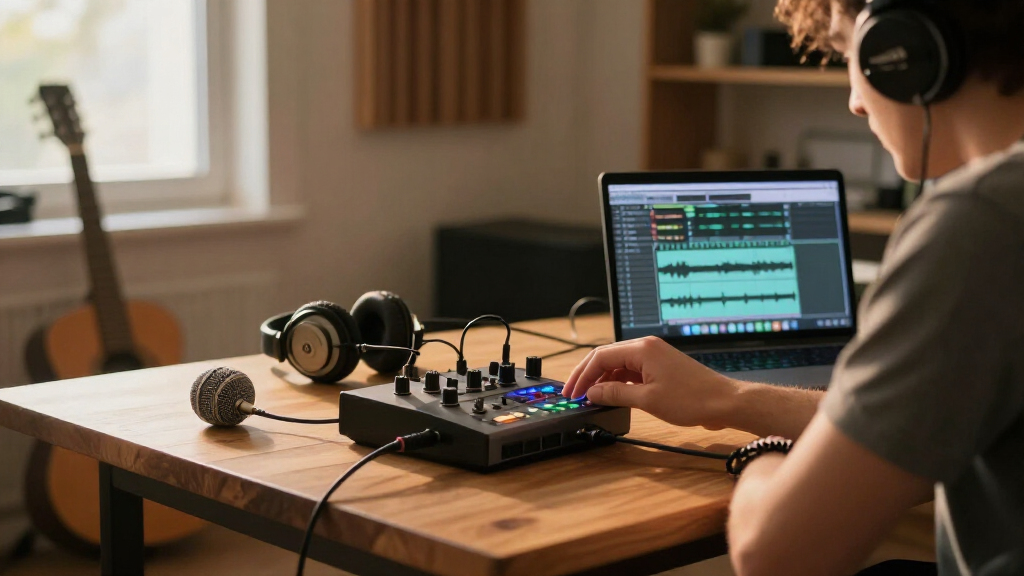
I ranked these interfaces around the needs of people recording at a desk: how many sources each can handle, whether its connections suit common microphones and instruments, and how easily a buyer can build a usable recording setup. I also weighed workflow fit—especially the difference between music-focused interfaces, microphone adapters, complete starter bundles, and podcast mixers—along with practical factors such as monitoring, portability, and the amount of gear included.
The Scarlett 2i2 4th Gen leads because its two-input format gives the broadest fit across the lineup without committing buyers to a specialized podcast workflow. Other rankings reflect narrower strengths: the PreSonus bundle and Scarlett Studio kits suit people who need accessories, while single-input models make more sense for solo recording. Podcast bundles and compact alternatives rank lower for general recording because their advantages are more specific, or because buyers should check their connection and workflow needs closely before choosing. No single model is right for every desk, so the ordering favors versatility first and specialized use cases after it.
| desktop audio interfaces for recording | Connectivity |
|---|---|
| PreSonus AudioBox USB 96 Studi | USB; bus-powered |
| Fender AudioBox Go 2×2 USB-C A | USB-C; bus-powered |
| Shure MVX2U Gen 2 XLR-to-USB-C | USB-C |
| Focusrite Scarlett 2i2 4th Gen | USB-C |
| Focusrite Scarlett Solo 3rd Ge | USB |
| Focusrite Scarlett Solo Studio | USB |
| 4-Person Podcast Equipment Bun | USB |
| MAONO P2 Hybrid USB Audio Inte | USB-C |
| Focusrite Scarlett Solo 4th Ge | USB |
| MAONO PS22 Lite USB Audio Inte | USB |
| MAONO P1 USB Audio Interface f | — |
| Focusrite Scarlett 2i2 Studio | USB-C |
| PIYONE Q2 2×2 USB-C Audio Inte | — |
| MAONO E2 Gen 2 Podcast Audio I | AUX, Bluetooth, and USB |
Factors to Consider When Choosing Desktop Audio Interfaces For Recording
Choosing an interface starts with the recording session you expect to have, not the largest spec sheet. These broader checks can help you avoid paying for inputs you will not use or buying a device that cannot support your actual workflow.
Count simultaneous sources, not just microphones
Write down how many independent sources you need to capture at the same time. A singer who records one vocal track at a time may be well served by a single-input interface, while a guitarist who wants to record a microphone and a direct instrument signal needs two usable inputs. A bundle with several microphones does not automatically mean the interface records each person to a separate track. Check the input count and routing details before buying a multi-person podcast kit. Recording sources separately gives more control during editing, while a mixed output can be quicker for live conversations. Choose for your busiest likely session rather than the simplest one.
Match the interface to your recording style
Music recording, podcasting, streaming, and mobile recording can call for different controls even when each device connects to a computer. Music makers often benefit most from straightforward mic and instrument inputs with direct monitoring. Podcast hosts may value multiple mic connections, headphone monitoring, or controls for managing a conversation without relying on software. A microphone adapter such as the Shure MVX2U serves a different role from a two-input studio interface; it is not a substitute for a multi-source recording hub. If you record in several formats, favor general-purpose inputs over features tied to one show setup. Specialized controls are useful only when they simplify a task you actually do.
Check compatibility across the whole signal chain
An interface is only one link between the source and the finished recording. Confirm that your microphone type, instrument connection, computer or mobile device, and recording software can work together. USB-C describes a connector, but buyers should still check the device’s stated compatibility and power requirements for their intended computer, phone, or tablet. A bundled microphone may reduce setup work, though it can limit later choices if it does not fit your preferred recording style. Also check whether included software or controls support your operating system. A little compatibility checking can prevent a capable interface from becoming an awkward fit at your desk.
Decide whether a bundle saves effort or adds clutter
Starter bundles can help newcomers begin recording without sourcing a microphone and headphones separately. Their value depends on whether the included accessories suit your voice, instruments, and monitoring needs. If you already own reliable gear, a bundle may leave you paying—in equipment and desk space—for items you will not use. Conversely, piecing together a setup can involve extra compatibility decisions and cables. Make a short list of what you own before comparing complete kits with interface-only options. A bundle is most useful when its contents fill real gaps rather than simply making the box feel more complete.
Treat resolution as one factor, not a quality shortcut
Sample-rate and bit-depth figures describe recording formats, but they do not tell the whole story about a usable setup. The quality of the source, microphone placement, room noise, and gain adjustment all affect the result. For many home recording tasks, ease of monitoring and reliable connections matter more day to day than pursuing the largest advertised number. A high-resolution specification cannot compensate for a room that adds distracting echo or a microphone that is poorly placed. Compare formats when they affect a specific project or software workflow. Otherwise, prioritize the inputs and controls you will use every session.
Plan for your next recording step
Think about whether your needs are likely to stay fixed or grow. A solo voice setup may only need one input now, but adding a second performer or recording a stereo instrument can change that quickly. Extra inputs are useful only if the interface can route them the way your software and sessions require. On the other hand, a large podcast mixer may add controls that a simple home music setup never uses. Consider likely upgrades such as another microphone, a second performer, or mobile recording before settling on a format. Spending more makes sense when it removes a real limitation, not just because a device has a longer feature list.
Frequently Asked Questions
Should I choose the Scarlett Solo or Scarlett 2i2 for home recording?
Choose the Scarlett Solo if you normally record one source at a time and want a simpler desk setup. The Scarlett 2i2 is the more flexible choice when you may record a microphone and instrument together, or capture two sources in one session. The distinction is about simultaneous input needs, not whether one is automatically better for every user. If your recording plans include interviews, duets, or a mic plus guitar, the extra input can save a later replacement. If your sessions stay strictly solo, the Solo models may be a better fit.
Is a recording bundle a good choice if I already own a microphone?
It can be, but first check exactly what the bundle adds and whether those accessories fill a gap. The PreSonus AudioBox USB 96 Studio and Scarlett Studio bundles are aimed at buyers building more of a complete setup. If you already have a microphone and headphones you like, an interface-only model may avoid duplicate gear. Bundled accessories can still be useful as a second setup or a convenient backup. Compare the included items against your actual recording needs rather than treating a larger package as automatically better.
Can I record a multi-person podcast with a regular two-input interface?
A two-input interface is generally suited to two simultaneous input sources, not a group of four people each on a separate microphone. A multi-person bundle or podcast-focused mixer may fit better, but check whether it records each microphone independently or combines signals. Separate tracks offer more freedom to adjust voices after recording; a combined mix can simplify a live workflow but leave fewer editing options. Also confirm how many headphones can be monitored comfortably. The right setup depends on both the number of speakers and how much control you want during editing.
When does a dedicated XLR-to-USB adapter make more sense than a desktop interface?
A device such as the Shure MVX2U Gen 2 is a focused option when your main task is connecting one XLR microphone to a computer over USB-C. It may suit a solo voice recording or streaming setup that does not need instrument inputs or multiple simultaneous sources. A conventional interface is a better fit if you want to record a microphone and guitar together, expand to another source, or use a broader set of studio connections. Compare the workflow you need rather than assuming a smaller device is a full replacement. The adapter’s narrow focus can be an advantage when you want a simple one-mic chain.
Will a USB-C interface work with my phone or tablet?
USB-C on the interface alone does not confirm compatibility with every phone or tablet. Check the product’s supported devices, operating-system requirements, power needs, and whether your recording app accepts the interface as an input. Mobile devices may also need an adapter or a suitable power arrangement, depending on the model and setup. The MAONO P1 is positioned for PC, phone, and iPad workflows, while other interfaces may be more computer-oriented. Confirm the full connection path before buying if mobile recording is a central part of your plan.
Conclusion
For a broad range of home recording, I recommend the Focusrite Scarlett 2i2 4th Gen as the best overall because its two-input layout suits more sessions than the single-input picks. The PreSonus AudioBox USB 96 Studio Bundle is my best value-style starter choice for buyers who need interface and recording accessories together, while the Scarlett 2i2 Studio 4th Gen bundle is the premium complete-kit option for someone who wants a coordinated setup around the versatile interface. Beginners recording one source at a time can start with the Scarlett Solo 4th Gen or the Solo Studio bundle if they also need accessories. For specific needs, choose the Shure MVX2U Gen 2 for a one-mic XLR-to-USB-C workflow, or a MAONO podcast model or four-person bundle when spoken-word production and multiple participants are the priority. Match the input count and workflow to your real sessions, and the shortlist becomes much easier to decide.