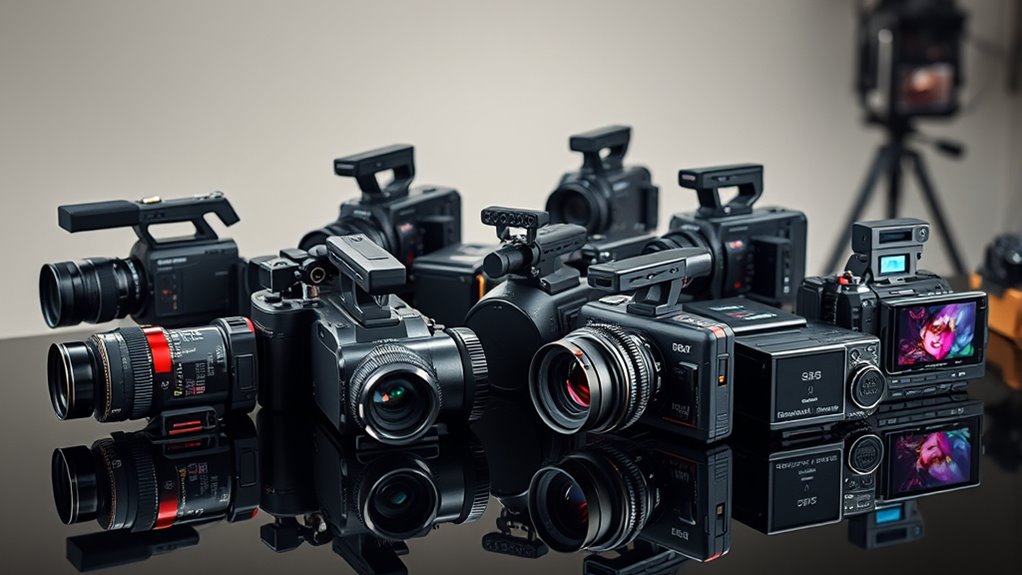
Among these cinema cameras, I rank the Sony FX3 best overall for its full-frame image, compact body, and practical run-and-gun design. The Canon EOS C50 stands out for filmmakers seeking a more production-focused camera, while the DJI Ronin 4D-8K brings integrated stabilization and focus tools into one system. The central tradeoffs are sensor format, recording workflow, camera size, and how much rigging or stabilization you want built in. A highly capable body can still add costs through lenses, media, batteries, and support gear. Read on for how the ten options compare and which one fits your kind of work.

Get audio and creator gear delivered free with Prime
- Fast, free delivery on millions of items
- Prime Video, Amazon Music and more included
- Member-only deals all year
Complete the kit


Key Takeaways
- The FX3 leads as the most adaptable pick: it pairs full-frame capture with a compact body, making it a strong fit for small crews that need mobility without giving up a cinema-oriented workflow.
- Built-in systems can change the value equation: the DJI Ronin 4D-8K combines stabilization, LiDAR focusing, and wireless transmission, while conventional bodies give buyers more freedom to choose separate accessories.
- Sensor size is not the only route to a practical image: the Sony FX30 models use Super 35, a format that can suit productions with existing Super 35 lenses and a preference for a smaller sensor package.
- Resolution and workflow need to be weighed together: the Nikon ZR and Blackmagic Pyxis 6K offer high-resolution capture, but buyers should also plan for media capacity, post-production demands, and the rig that their shooting style requires.
- Product condition and configuration affect the comparison: the FX30 Renewed listing is not the same buying proposition as the standard FX30, and the FX6 listing includes a lens, unlike several body-only options.
| Sony Alpha FX3 ILME-FX3A Full-Frame Cinema Line Camera, Black |  | Best for Solo Full-Frame Shooters | Sensor: Full-frame CMOS | Resolution: 12.1 MP | Video: 4K UHD and 1080p | VIEW ON AMAZON | See Our Full Breakdown |
| Sony Cinema Line FX30 Super 35 Camera, Grey (Renewed) |  | Best Renewed Super 35 Pick | Sensor: 20.1 MP APS-C CMOS | Mount: Sony E | Video resolution: 1080p and 2160p | VIEW ON AMAZON | See Our Full Breakdown |
| Blackmagic Design Pocket Cinema Camera 4K Power Bundle |  | Best for RAW and ProRes Workflows | Sensor: 4/3-inch CMOS | Video resolution: 4K | Dynamic range: 13 stops stated | VIEW ON AMAZON | See Our Full Breakdown |
| Sony FX30 Cinema Line Super 35 Camera |  | Best Value Cinema-Line Body | Sensor: 20.1 MP APS-C CMOS | Maximum resolution: 6K (6144 × 3160) | Video resolution: 1080p and 2160p | VIEW ON AMAZON | See Our Full Breakdown |
| DJI Ronin 4D-8K Full-Frame Cinema Camera with 4-Axis Stabilization, LiDAR Focusing, and Wireless Transmission |  | Best Integrated Stabilization System | Sensor: Full-frame CMOS | Video: 8K at up to 75fps | Stabilization: Digital, four-axis | VIEW ON AMAZON | See Our Full Breakdown |
| Sony ILME-FX6 Cinema Line Full-Frame Camera with SEL24105G, 10.2 MP, 2K, 4K |  | Best for Run-and-Gun Production | Sensor: 10.2 MP full-frame CMOS | Video resolution: 2K and 4K | Maximum frame rate: 4K up to 60p (as listed in product details) | VIEW ON AMAZON | See Our Full Breakdown |
| Canon EOS R5 C Mirrorless Camera (Body Only) |  | Best for 8K Hybrid Shoots | Sensor: 45 MP full-frame CMOS | Video modes: 8K/60P RAW, 4K/120P, and FHD | ISO range: 100–51,200, expandable to 102,400 | VIEW ON AMAZON | See Our Full Breakdown |
| Canon EOS C50 Body |  | Best for Compact 7K Capture | Sensor description: Described as 7K full-frame CMOS; supplied sensor-size field also lists 1/4-inch | Sensor resolution: 32 MP | Listed video resolution: 4320p | VIEW ON AMAZON | See Our Full Breakdown |
| Nikon RED Z Cinema | ZR Cinema Camera | 6K Full-Frame Camera with 4-Inch DCI-P3 Monitor |  | Best for Solo RAW Monitoring | Sensor: 24.5 MP full-frame CMOS | Video resolution: 6K | RAW format: REDCODE RAW (R3D NE), as listed | VIEW ON AMAZON | See Our Full Breakdown |
| Blackmagic Design Pyxis 6K Cinema Camera L-Mount |  | Best for Codec and Post-Production Flexibility | Sensor: Full-frame CMOS, 36 × 24 mm | Effective video resolution: 6048 × 4032 (6K) | Frame rates: Up to 36 fps at full resolution; 120 fps in windowed mode | VIEW ON AMAZON | See Our Full Breakdown |
| cinema camera | Sensor | Display | Weight | Connectivity |
|---|---|---|---|---|
| Sony Alpha FX3 ILME-FX3A Full- | Full-frame CMOS | 3-inch LCD, 1920 × 1080 | 1.5 kg | — |
| Sony Cinema Line FX30 Super 35 | 20.1 MP APS-C CMOS | 3 inches | 2.7 pounds | — |
| Blackmagic Design Pocket Cinem | 4/3-inch CMOS | 5-inch LCD | — | HDMI, mini XLR, 3.5 mm microphone, USB-C, and Bluetooth |
| Sony FX30 Cinema Line Super 35 | 20.1 MP APS-C CMOS | 3-inch LCD, 2,360,000 dots | 1.2 pounds | — |
| DJI Ronin 4D-8K Full-Frame Cin | Full-frame CMOS | — | 4.67 kg | HDMI and USB |
| Sony ILME-FX6 Cinema Line Full | 10.2 MP full-frame CMOS | 3.5-inch, 1280 × 720 pixels | — | HDMI, NFC, USB, Wi-Fi |
| Canon EOS R5 C Mirrorless Came | 45 MP full-frame CMOS | — | — | — |
| Canon EOS C50 Body | — | — | 1.8 pounds | Wi-Fi and USB-C |
| Nikon RED Z Cinema | ZR Cinema | 24.5 MP full-frame CMOS | 4-inch DCI-P3 touchscreen, 4096 × 2160 pixels | 1.2 pounds | Bluetooth, Wi-Fi, USB-C, HDMI Type A |
| Blackmagic Design Pyxis 6K Cin | Full-frame CMOS, 36 × 24 mm | 4-inch HDR LCD, 1500 nits | — | HDMI, Bluetooth, Wi-Fi with RTMP/RTS streaming |
More Details on Our Top Picks
Sony Alpha FX3 ILME-FX3A Full-Frame Cinema Line Camera, Black
The Sony FX3 is the strongest fit here for a filmmaker who wants full-frame image character without building a large rig. Its 4K recording up to 120p in 10-bit 4:2:2 supports slow motion while retaining color latitude for grading, and the included XLR top handle gives solo operators a direct route to professional audio. Compared with the Sony FX30, the FX3 pairs that production-ready handling with a full-frame sensor and a higher listed ISO ceiling, which can help in dim locations. Its compact cage-free design and sensor-shift stabilization also suit handheld work. The tradeoffs are a missing viewfinder and a menu system that may take time to learn; the larger DJI Ronin 4D-8K offers integrated gimbal movement, but is a much heavier, more specialized system.
Pros:- Full-frame sensor with 4K recording up to 120p in 10-bit 4:2:2
- XLR inputs via the top handle support professional audio capture
- Sensor-shift stabilization helps with handheld shooting
- Listed ISO range reaches 409,600 for low-light flexibility
Cons:- No viewfinder is included
- Menu complexity may slow down new users
- Battery life is not specified in the supplied product data
Best for: Solo filmmakers who need full-frame 4K slow motion, in-body stabilization, and XLR audio inputs in a compact camera.
Not ideal for: Operators who rely on an eye-level viewfinder, or crews seeking a built-in gimbal system for stabilized moving shots.
- Sensor:Full-frame CMOS
- Resolution:12.1 MP
- Video:4K UHD and 1080p
- Maximum frame rate:Up to 120p in 4K, 10-bit 4:2:2
- ISO range:80–409,600
- Stabilization:Sensor-shift
- Autofocus:Contrast detection and phase detection; 627 focus points
- Display:3-inch LCD, 1920 × 1080
- Weight:1.5 kg
Our verdict“Choose the FX3 if you want a compact full-frame cinema camera with slow motion, stabilization, and XLR audio, and can work without a viewfinder.”
Sony Cinema Line FX30 Super 35 Camera, Grey (Renewed)
The renewed Sony FX30 makes sense for filmmakers who want Sony’s cinema-oriented tools in a Super 35 body and are comfortable buying a professionally inspected renewed unit. Its Cine EI, S-Log3, and S-Cinetone options support different workflows, from deliberate grading to a polished starting look, while the stated 14-plus stops of dynamic range give editors room to manage contrast. Compared with the full-frame Sony FX3, this model gives up sensor size and the FX3’s stated 4K 120p capability, but its 20.1MP sensor and dual base ISO make it a capable production camera rather than a basic video body. Two memory slots add recording flexibility. The main compromises are its renewed condition, lack of a viewfinder, and APS-C sensor; buyers who specifically need full-frame capture should choose the FX3 instead.
Pros:- Cine EI, S-Log3, and S-Cinetone provide flexible production and grading options
- Dual base ISO and stated 14-plus-stop dynamic range support demanding lighting
- Two memory slots provide recording flexibility
- Compact Super 35 format suits cinema-style production setups
Cons:- This listing is for a renewed unit, not a new camera
- APS-C sensor does not provide the full-frame coverage of the FX3
- No built-in viewfinder
Best for: Independent filmmakers who want Sony cinema color tools, Super 35 coverage, dual base ISO, and two memory slots, and accept renewed condition.
Not ideal for: Buyers who require a new camera, a built-in viewfinder, or full-frame sensor coverage.
- Sensor:20.1 MP APS-C CMOS
- Mount:Sony E
- Video resolution:1080p and 2160p
- ISO:Expanded minimum ISO 50; dual base ISO stated
- Dynamic range:14+ stops stated
- Recording features:Cine EI, S-Log3, and S-Cinetone
- Memory slots:2
- Display:3 inches
- Weight:2.7 pounds
Our verdict“Pick this renewed FX30 if Sony’s cinema profiles and Super 35 workflow matter more to you than full-frame coverage or new-unit condition.”
Blackmagic Design Pocket Cinema Camera 4K Power Bundle
The Blackmagic Pocket Cinema Camera 4K Power Bundle is the clearest choice here for filmmakers who want control over acquisition and post-production formats. Recording in Blackmagic RAW or Apple ProRes gives editors options for balancing image flexibility against file handling, while the stated 13 stops of dynamic range and dual native ISO up to 25,600 support carefully graded footage. The included batteries, dual charger, and DaVinci Resolve Studio make this a more complete post-focused package than the Sony FX30, whose listing emphasizes Sony’s in-camera profiles and dual-slot recording instead. Its 4/3-inch sensor and MFT mount also create a different lens and depth-of-field proposition from the full-frame Sony FX3. The cost of that workflow flexibility is practical: at 5 pounds, it is less appealing for extended handheld shooting, and its feature set may be demanding for first-time filmmakers.
Pros:- Records Blackmagic RAW and Apple ProRes
- Stated 13 stops of dynamic range and dual native ISO up to 25,600
- Includes two LP-E6 batteries and a dual charger
- Bundle includes DaVinci Resolve Studio for editing and grading
Cons:- Listed 5-pound weight makes extended handheld use less comfortable
- MFT mount may require adapters for lenses from other systems
- The extensive format and camera options can be complex for beginners
Best for: Independent filmmakers and editors who want RAW or ProRes capture, grading latitude, and a bundle that includes batteries, a charger, and DaVinci Resolve Studio.
Not ideal for: Run-and-gun shooters prioritizing a light handheld setup, or beginners who want a simpler, more guided camera workflow.
- Sensor:4/3-inch CMOS
- Video resolution:4K
- Dynamic range:13 stops stated
- Native ISO:Dual native ISO up to 25,600
- Recording formats:Blackmagic RAW and Apple ProRes
- Lens mount:Micro Four Thirds
- Display:5-inch LCD
- Connectivity:HDMI, mini XLR, 3.5 mm microphone, USB-C, and Bluetooth
- Bundle power:Two LP-E6 batteries and dual charger
Our verdict“Choose this bundle if you value RAW and ProRes post-production control more than a lightweight camera body or a beginner-friendly workflow.”
Sony FX30 Cinema Line Super 35 Camera
The Sony FX30 is the most approachable route in this group to a dedicated cinema-style camera with current Sony color profiles. Its 20.1MP APS-C sensor and 6K oversampling are intended to produce detailed 4K footage, while S-Cinetone offers a ready-to-use look and S-Log3 leaves more room for grading. Compared with the renewed FX30 listing, this version is presented as a standard camera rather than a renewed unit; the supplied details also specify active stabilization and two memory slots. It is a more compact, less full-frame-oriented choice than the Sony FX3, so buyers give up the FX3’s stated 4K 120p recording and very high listed ISO ceiling. The specs do not state maximum ISO or battery life, and the camera has no listed viewfinder, which may matter for field work.
Pros:- 6K oversampling supports detailed 4K image capture
- S-Cinetone and S-Log3 offer both ready-made and grading-focused color options
- Active stabilization supports handheld and mobile shooting
- Two memory slots support flexible media planning
Cons:- APS-C sensor is smaller than the FX3’s full-frame sensor
- Maximum ISO and battery life are not specified in the supplied data
- No viewfinder is listed
Best for: Emerging filmmakers and content creators who want a compact Sony cinema-line camera for 4K production, with S-Cinetone and S-Log3 available.
Not ideal for: Shooters who need documented 4K 120p capture, a full-frame sensor, or a built-in viewfinder for outdoor monitoring.
- Sensor:20.1 MP APS-C CMOS
- Maximum resolution:6K (6144 × 3160)
- Video resolution:1080p and 2160p
- ISO:Minimum ISO 80; maximum not specified
- Stabilization:Active
- Color profiles:S-Cinetone and S-Log3
- Display:3-inch LCD, 2,360,000 dots
- Memory slots:2; CFexpress Type A and SDXC/SDHC listed
- Weight:1.2 pounds
Our verdict“Choose the standard FX30 if you want a compact Sony cinema-line camera and 6K oversampling without needing the FX3’s full-frame format.”
DJI Ronin 4D-8K Full-Frame Cinema Camera with 4-Axis Stabilization, LiDAR Focusing, and Wireless Transmission
The DJI Ronin 4D-8K is less a conventional camera body than an integrated movement system: it combines 8K/75fps recording, four-axis stabilization, LiDAR focusing, and wireless video transmission. That combination targets crews who need smooth moving shots and focus support in one setup, rather than a small camera they will build around separate accessories. Compared with the Sony FX3, the Ronin adds a built-in gimbal-style stabilization approach and higher stated resolution, while the FX3 is lighter and offers a more compact solo-shooting form. The tradeoff is substantial: this system weighs 4.67 kg, is not water resistant, and the listing says additional accessories may be needed for full functionality. Its specialized design also makes it a less flexible grab-and-go choice than either Sony FX30.
Pros:- 8K recording at up to 75fps is suited to high-resolution production and slow motion
- Four-axis stabilization integrates camera movement support into the system
- LiDAR focusing adds a dedicated focus-assistance option
- Wireless video transmission is built into the listed feature set
Cons:- At 4.67 kg, it is substantially heavier than the Sony FX3 and FX30
- Not water resistant
- Additional accessories may be needed for full functionality
Best for: Professional crews shooting stabilized moving scenes who can work with a heavier integrated system and want LiDAR focus support and wireless transmission.
Not ideal for: Solo operators who need a lightweight camera for long handheld days, or filmmakers working in wet environments without added protection.
- Sensor:Full-frame CMOS
- Video:8K at up to 75fps
- Stabilization:Digital, four-axis
- Focus:LiDAR focusing; manual and autofocus
- Wireless feature:Wireless video transmission
- Connectivity:HDMI and USB
- Memory:CFexpress Type B; 1 TB flash memory listed
- Water resistance:Not water resistant
- Weight:4.67 kg
Our verdict“Choose the Ronin 4D-8K for integrated stabilization, LiDAR, and wireless monitoring on demanding moving-camera shoots, not for a lightweight everyday cinema body.”
Sony ILME-FX6 Cinema Line Full-Frame Camera with SEL24105G, 10.2 MP, 2K, 4K
The Sony FX6 is the strongest fit here for crews that need a dedicated cinema body with fast, dependable focus and a full-frame look. Its 10.2 MP sensor is geared toward video rather than high-resolution stills, while 4K recording up to 60p and an electronically controlled optical ND filter help adapt exposure without interrupting a moving shoot. Compared with the Canon EOS R5 C, the FX6 gives up 8K capture and hybrid photo resolution but puts more emphasis on a production-ready cinema workflow. The included SEL24105G lens adds useful focal-length flexibility, though the listed aperture range and lens details should be checked against the seller’s bundle. The body is not weather resistant, and its professional controls can take time to learn. I’d choose it for working video crews, not buyers seeking a simple hybrid camera.
Pros:- Full-frame sensor designed around professional video capture
- 4K recording up to 60p supports smooth motion and flexible editing
- Electronically controlled optical ND filter helps manage exposure on location
- Hybrid AF with Eye-AF tracking can reduce manual focus demands
Cons:- Not water resistant, so adverse-weather shoots call for added protection
- At 2 pounds before accessories, it is less suited to extended handheld operation
- Cinema-focused controls may be a steep start for beginners
Best for: Documentary and event crews who need full-frame 4K, responsive autofocus, and built-in ND control for changing light.
Not ideal for: Photographers or first-time filmmakers who want a high-resolution stills camera, weather protection, or a simpler interface.
- Sensor:10.2 MP full-frame CMOS
- Video resolution:2K and 4K
- Maximum frame rate:4K up to 60p (as listed in product details)
- Focus:Autofocus and manual focus; Hybrid AF with Eye-AF tracking
- ND filter:Electronically controlled optical ND
- Display:3.5-inch, 1280 × 720 pixels
- Media:CFexpress Type A and SDXC
- Connectivity:HDMI, NFC, USB, Wi-Fi
Our verdict“Choose the FX6 if run-and-gun video control and full-frame 4K matter more than 8K capture or still-photo versatility.”
Canon EOS R5 C Mirrorless Camera (Body Only)
The Canon EOS R5 C suits filmmakers who also need a capable stills camera, with a 45 MP full-frame sensor alongside 8K/60P RAW and 4K/120P recording. That resolution and frame-rate range give editors room to crop, reframe, or create slow motion; the Sony FX6, by comparison, is more purpose-built for production video and includes optical ND control. The R5 C’s autofocus can track people, animals, and vehicles, which helps on unpredictable shoots, while its internal cooling fan supports extended recording workflows. This is a body-only listing, so the lens and supporting accessories are separate needs. The high-resolution files also demand capable storage and a thoughtful post-production setup, and battery endurance can be limiting on long days. I’d favor it for hybrid operators who will make use of both its stills and video strengths.
Pros:- 45 MP full-frame sensor supports detailed still photography
- 8K/60P RAW and 4K/120P provide substantial capture flexibility
- Subject detection covers people, animals, and vehicles
- Internal cooling fan supports demanding video recording
Cons:- Battery life may constrain long recording days
- High-resolution recording can require substantial storage and post-production resources
- Complex menus may slow down newcomers
Best for: Hybrid filmmakers, journalists, and small production teams who need detailed stills plus high-resolution and high-frame-rate video.
Not ideal for: Video-only crews who prioritize built-in ND, long battery endurance, or a cinema-first operating layout over photo resolution.
- Sensor:45 MP full-frame CMOS
- Video modes:8K/60P RAW, 4K/120P, and FHD
- ISO range:100–51,200, expandable to 102,400
- Autofocus:Dual Pixel CMOS AF II with eye, face, head, animal, and vehicle detection
- Continuous shooting:Up to 20 fps
- Recording formats:MXF-based XF-AVC and MP4
- Cooling:Internal cooling fan
- Included accessories:LP-E6NH battery pack, LC-E6 charger, shoulder strap
Our verdict“Pick the R5 C if one camera must handle serious still photography and advanced video, and you can support its power and media needs.”
Canon EOS C50 Body
The Canon EOS C50 is the compact high-resolution choice in this group, offering a stated 7K full-frame sensor and Cinema RAW Light recording in a 1.8-pound body. That combination can suit small crews who want detailed footage and room to crop while keeping the camera easier to carry than the Blackmagic Design Pyxis 6K, which weighs 2.1 kg and is built around a larger production rig. The C50’s claimed 4K 120P capability and advanced autofocus also make it appealing for action and solo operation. However, the supplied specifications conflict: they list a 1/4-inch sensor size despite describing the camera as full-frame, and give 4320p as its video resolution. Buyers should verify the exact configuration and recording modes before choosing it. It is a promising compact cinema option, but less straightforward to evaluate from this listing than the better-documented alternatives.
Pros:- Compact 1.8-pound body is easier to carry than the heavier Pyxis 6K
- Cinema RAW Light recording is suited to flexible grading workflows
- High-frame-rate capture is listed, including 4K 120P in the product details
- Wi-Fi/IP remote-control capability can help with solo setups
Cons:- Provided sensor-size information conflicts with the full-frame description
- Listed video resolution and capture-mode details are inconsistent and need verification
- Professional feature set may take time to configure and learn
Best for: Small-crew filmmakers seeking a lightweight Canon RF cinema body for high-resolution capture, RAW workflows, and autofocus-led shooting.
Not ideal for: Buyers who need clearly verified sensor and recording specifications or a camera with a well-established, straightforward workflow.
- Sensor description:Described as 7K full-frame CMOS; supplied sensor-size field also lists 1/4-inch
- Sensor resolution:32 MP
- Listed video resolution:4320p
- Video format:Cinema RAW Light
- High-frame-rate mode:4K 120P stated in product description
- Lens mount:Canon RF
- Weight:1.8 pounds
- Connectivity:Wi-Fi and USB-C
Our verdict“Consider the C50 for compact, high-resolution Canon cinema work, but confirm its exact sensor and recording specifications before buying.”
Nikon RED Z Cinema | ZR Cinema Camera | 6K Full-Frame Camera with 4-Inch DCI-P3 Monitor
The Nikon RED Z Cinema pairs a compact full-frame body with 6K REDCODE RAW and a 4-inch DCI-P3 touchscreen, making it a distinctive option for solo operators who need a large on-camera view. Its 1.2-pound listed weight is notably lower than the Blackmagic Design Pyxis 6K, which offers a bright built-in HDR screen but weighs 2.1 kg. REDCODE RAW gives post-production teams room to shape footage, while the stated 32-bit float audio support is aimed at recording flexibility. The tradeoff is a less complete self-contained setup: there is no built-in viewfinder, and buyers may need to build out monitoring and rigging for particular jobs. The listing’s fields also name JPEG as the file format while separately specifying R3D NE, so recording details merit confirmation. I’d shortlist it for mobile RAW work, not for buyers seeking a simple, fully specified camera kit.
Pros:- 6K full-frame capture with REDCODE RAW support
- Four-inch DCI-P3 touchscreen offers a generous monitoring surface
- Listed 1.2-pound weight favors mobile and solo setups
- Hybrid autofocus includes 273 focus points
Cons:- No built-in viewfinder, which can complicate bright-light monitoring
- File-format details in the listing are inconsistent and should be verified
- A compact body may still need added rigging and monitoring accessories for some productions
Best for: Solo filmmakers and B-roll operators who value a lightweight full-frame body, large touchscreen, and RAW post-production options.
Not ideal for: Crew members who rely on a built-in viewfinder or buyers who need unambiguous recording-format details before purchase.
- Sensor:24.5 MP full-frame CMOS
- Video resolution:6K
- RAW format:REDCODE RAW (R3D NE), as listed
- Display:4-inch DCI-P3 touchscreen, 4096 × 2160 pixels
- Weight:1.2 pounds
- Autofocus:Hybrid focus with 273 focus points
- Connectivity:Bluetooth, Wi-Fi, USB-C, HDMI Type A
- ISO range:Expanded ISO 50–204,800
Our verdict“Choose the Nikon RED Z if lightweight 6K RAW capture and a large touchscreen matter more than a built-in viewfinder.”
Blackmagic Design Pyxis 6K Cinema Camera L-Mount
The Blackmagic Design Pyxis 6K is the pick for productions that want a broad set of professional recording formats in a full-frame body. Its 6K sensor records at up to 36 fps at full resolution, with 120 fps in windowed mode; that distinction matters if a project needs slow motion, since it comes with a crop rather than full-sensor framing. Blackmagic RAW, ProRes, DNxHR, CinemaDNG, and H.264 proxies give editors options across capture and delivery, unlike the Nikon RED Z Cinema, which centers its pitch on REDCODE RAW. The built-in 4-inch, 1500-nit HDR LCD is useful for on-camera monitoring, and L-mount support provides lens choices. At 2.1 kg, though, it is not the lightest handheld choice, and the lack of in-body stabilization or weather sealing calls for a more supported, protected setup.
Pros:- Full-frame 6K sensor records 6048 × 4032 footage
- Multiple codecs support varied editing and delivery workflows
- Four-inch, 1500-nit HDR LCD aids on-camera monitoring
- L-mount compatibility broadens lens options
Cons:- At 2.1 kg, it is comparatively heavy for extended handheld use
- No in-body image stabilization
- No weather sealing for challenging outdoor shoots
- 120 fps is available in windowed mode rather than full-resolution capture
Best for: Post-production-focused filmmakers who want multiple professional codecs, L-mount flexibility, and a bright built-in screen for rigged shoots.
Not ideal for: Solo handheld shooters who need a lightweight, stabilized camera or crews regularly filming in wet or dusty conditions.
- Sensor:Full-frame CMOS, 36 × 24 mm
- Effective video resolution:6048 × 4032 (6K)
- Frame rates:Up to 36 fps at full resolution; 120 fps in windowed mode
- Lens mount:L-Mount
- Display:4-inch HDR LCD, 1500 nits
- Storage:CFexpress PCIe
- Video codecs:Blackmagic RAW, ProRes, DNxHR, CinemaDNG, H.264 proxies
- Connectivity:HDMI, Bluetooth, Wi-Fi with RTMP/RTS streaming
Our verdict“Pick the Pyxis 6K for codec flexibility and a bright built-in screen on supported shoots, not for lightweight stabilized handheld work.”

How We Picked
I compared these cameras around the decisions that shape real cinema work: sensor format, recording capability, handling, stabilization, focus support, expandability, and the demands each system places on a crew. I also considered the supplied configuration, since a camera bundled with a lens or integrated tools can serve a different buyer than a body that needs a separate rig. The aim is not to treat the highest resolution or newest feature as an automatic win, but to judge how well each camera fits a practical production style.
The FX3 ranks first because its compact full-frame design balances image-making flexibility and manageable operation for a broad range of productions. The next positions favor cameras with a clear advantage for a particular working style: the FX6 for production-oriented operation, the EOS C50 for Canon-focused workflows, and the DJI Ronin 4D-8K for integrated movement tools. The FX30 options, Blackmagic models, Canon R5 C, and Nikon ZR remain compelling when their formats or workflows match the buyer, but they rank lower for general-purpose fit, specialized rigging, configuration, or the additional planning their strengths may require.
| cinema camera | Connectivity |
|---|---|
| Sony Alpha FX3 ILME-FX3A Full- | — |
| Sony Cinema Line FX30 Super 35 | — |
| Blackmagic Design Pocket Cinem | HDMI, mini XLR, 3.5 mm microphone, USB-C, and Bluetooth |
| Sony FX30 Cinema Line Super 35 | — |
| DJI Ronin 4D-8K Full-Frame Cin | HDMI and USB |
| Sony ILME-FX6 Cinema Line Full | HDMI, NFC, USB, Wi-Fi |
| Canon EOS R5 C Mirrorless Came | — |
| Canon EOS C50 Body | Wi-Fi and USB-C |
| Nikon RED Z Cinema | ZR Cinema | Bluetooth, Wi-Fi, USB-C, HDMI Type A |
| Blackmagic Design Pyxis 6K Cin | HDMI, Bluetooth, Wi-Fi with RTMP/RTS streaming |
Factors to Consider When Choosing Cinema Cameras
Before choosing a body, I would map the camera to the full job: what you shoot, who operates it, what footage must fit into, and which gear you already own. The following factors can prevent a spec-sheet choice from becoming an expensive mismatch.
Match Sensor Format to Your Lens Collection
Full-frame and Super 35 cameras shape lens choice, field of view, depth of field, and the size of the lens kit you may need. If you already own lenses for one format, keeping that system can matter more than chasing a larger sensor. Adapting lenses may work, but autofocus behavior, coverage, and support can vary by lens and adapter. A common mistake is budgeting for the camera body while overlooking the cost of replacing or expanding glass. I would check the lenses used most often on actual shoots before comparing sensor labels. The right format is the one that supports your framing and existing workflow without forcing unnecessary purchases.
Plan the Recording and Post-Production Workflow
Resolution is only one part of recording choice; codec, bit depth, frame rates, and media requirements determine how footage moves through a production. Higher-resolution or data-heavy formats can give editors more room to crop and reframe, but they also increase storage needs and may slow down editing on less capable systems. Before buying, confirm that your media cards, drives, editing computer, and backup routine fit the intended recording modes. Do not assume that a camera’s headline resolution is the mode you will use most often. For frequent client delivery, a predictable workflow can be more useful than an unused maximum setting. Match recording options to the finish you actually deliver.
Decide How Much Rigging You Want Built In
A compact camera can be easier to carry, but a bare body may need a cage, monitor, handles, audio gear, and power accessories before it is ready for a crew. Integrated systems can reduce setup steps and cable clutter, though they may be heavier, more specialized, or less flexible to reconfigure. Buyers often compare body weight without accounting for the working package they will carry on set. Write down the minimum rig for a typical shoot, then compare total size, power, and setup complexity. Solo operators may value fewer separate components, while larger crews may prefer modular gear that can be assigned and replaced independently. The best balance depends on whether speed or customization matters more to your production.
Treat Stabilization and Focus as Production Choices
Built-in stabilization can help with handheld movement, but it is not a substitute for every gimbal, tripod, or dolly shot. Likewise, advanced focus aids can reduce operator workload, yet focus still depends on the lens, subject, lighting, and movement involved. A common buying error is paying for an integrated feature without checking whether it suits the shots you regularly make. For controlled interviews, support and manual focus may matter more than mobility tools. For moving single-operator work, a unified stabilization and focus system can save setup time. Choose around your shot list, not around the longest feature list.
Budget for the Complete Camera System
The body is only the starting point for most cinema-camera builds. Lenses, media, batteries, audio connections, monitoring, rigging, and storage can all affect whether a setup is ready for paid work. Bundles may reduce the number of separate decisions, but check exactly what is included and whether those components fit your needs. A renewed listing also calls for careful review of condition, warranty, return terms, and included accessories before purchase. I would compare the cost and compatibility of the full kit rather than treating body-only and lens-included listings as equivalent. Spending more on a body makes sense only when its capabilities improve the work or reduce other system costs.
Choose for Crew Size and Shooting Conditions
A camera that suits a controlled set may be cumbersome for travel, documentary work, or a one-person crew. Consider how often you shoot alone, how long the camera stays handheld, whether you need fast setup, and who handles focus and sound. A compact body can ease transport but may still need extra support for long days. Larger production-oriented systems can offer a more direct set workflow, provided your crew and accessories can support them. Make a list of your three most common shooting situations and rank portability, connectivity, and operator control for each. That exercise often reveals more than comparing feature tables in isolation.
Frequently Asked Questions
Is the Sony FX3 a better first cinema camera than the Sony FX30?
I would choose between them based on sensor format, lens plans, and the work you expect to shoot rather than treating one as a universal upgrade. The FX3’s full-frame approach can appeal when you want that field of view and depth-of-field flexibility in a compact body. The FX30’s Super 35 format may be a more natural fit for a Super 35 lens collection or productions built around that look. Also compare the exact listing: the renewed FX30 has a different condition and purchase-risk profile from the standard FX30. A first-time buyer should reserve part of the budget for lenses, media, audio, and support gear.
Should I choose the DJI Ronin 4D-8K or a conventional cinema camera with a separate gimbal?
The 4D-8K makes the most sense when its integrated stabilization, LiDAR focus assistance, and transmission features fit the way you shoot and the crew you have. A conventional body with a separate gimbal offers more freedom to mix camera, lens, and support choices, and may suit productions that already own those tools. The integrated route can simplify setup, but it also commits you to a more specific system and handling approach. Compare the complete rig, including power, monitoring, transport, and operator needs. If you rarely shoot moving shots, built-in motion tools may not justify becoming a central part of your camera decision.
Does a 6K cinema camera make sense if I mostly deliver in 4K?
It can, when reframing, cropping, stabilization, or creating multiple deliverables from one shot is part of your workflow. Extra resolution also raises storage and processing demands, so the benefit is less clear if you record straightforward 4K projects and have limited post-production capacity. Cameras such as the Nikon ZR and Blackmagic Pyxis 6K should be judged by their recording workflow and system fit, not resolution alone. Check which recording modes you plan to use and whether your media and editing setup can handle them comfortably. If higher-resolution capture does not improve your final work, a camera that fits your crew and lenses may be the wiser choice.
Is the renewed Sony FX30 a safe choice compared with the standard FX30?
The renewed listing may suit buyers who are comfortable verifying the seller’s condition standards, warranty, return policy, and included accessories. Those details can affect your ability to rely on the camera for scheduled production, so they deserve attention before purchase. The standard FX30 offers a more direct comparison when condition history is a priority, though the right choice still depends on the listing terms and your needs. Check that batteries, ports, mount, screen, and media compatibility meet your requirements. For mission-critical work, predictable support may matter more than saving on a particular listing.
When is it worth choosing the Sony FX6 over a smaller camera such as the FX3?
The FX6 is worth prioritizing when its production-oriented handling and the supplied SEL24105G lens fit the way your crew works. A larger, more purpose-built setup can be a better match for repeatable production operation, while the FX3’s compact body is easier to place in travel, handheld, and small-crew setups. Compare the working package rather than the camera bodies alone: lens coverage, rigging, power, monitoring, and the people operating it all count. If portability is your strongest need, the smaller option may be the more practical tool. If your work benefits from the FX6’s operational setup and included lens, it may justify taking on a larger camera package.
Conclusion
For the broadest balance of full-frame capture and compact handling, I recommend the Sony FX3 as best overall. The best value depends on your lens kit and listing comfort: the standard Sony FX30 is a strong Super 35 route, while the renewed version calls for closer checks on condition and support. For production-focused operation, my best premium pick is the Sony FX6; the best beginner choice is the FX3 for buyers seeking a flexible, manageable body, or the standard FX30 for a Super 35 setup. Choose the DJI Ronin 4D-8K for integrated stabilization and focus tools, the Nikon ZR or Blackmagic Pyxis 6K when high-resolution recording fits your workflow, and the Blackmagic Pocket Cinema Camera 4K Power Bundle when its 4K format and bundled approach suit your production. The right cinema camera is the one whose recording, lenses, and complete rig match the work you actually plan to make.