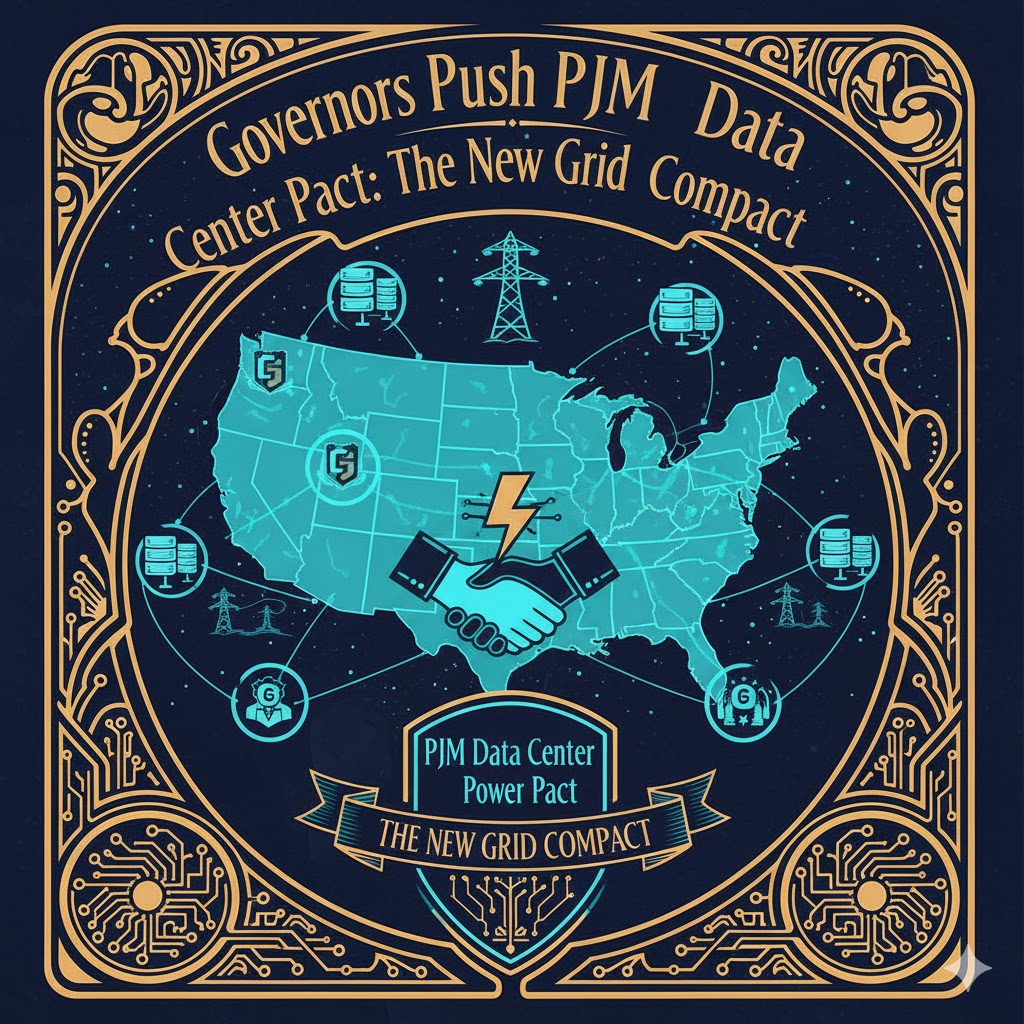

By StrongMocha News Desk | November 2025

Get audio and creator gear delivered free — and shop member deals
- Fast, free delivery on millions of items
- Access to Prime Big Deal Days deals on October 6–7
- Prime Video, Amazon Music and more included
Data Centers Told: “Bring Your Own Megawatts”
Four governors inside the PJM Interconnection footprint—Pennsylvania’s Josh Shapiro, Maryland’s Wes Moore, New Jersey’s Phil Murphy, and Virginia’s Glenn Youngkin—are rewriting the playbook for digital infrastructure growth.
Their joint proposal demands that new data centers guarantee dependable power back to the grid before qualifying for fast-track permits.
This “BYO Megawatts” model reframes the tech-energy bargain: hyperscalers get speed, states get stability.
PJM’s Pressure Cooker
PJM—the largest U.S. grid operator, spanning 13 states plus D.C.—is straining under unprecedented load growth.
- +32 GW peak demand projected by 2030, with roughly 30 GW tied to data-center expansion.
- Capacity-market prices have rocketed from $28.92/MW-day (2024/25) to $329.17 (2026/27), mirroring the collision of AI-era demand with slow-moving interconnection queues.
- Recent winters exposed razor-thin reserve margins, forcing PJM to fast-track new generation—even as FERC critics warn the reforms tilt toward natural-gas projects.
Governors Form a New Bloc
The freshly launched “PJM Governors Collaborative” coordinates policy across borders to:
- Cut interconnection bottlenecks,
- Cap consumer exposure to capacity-price spikes,
- And tie economic development incentives to firm-power commitments.
Their stance signals a broader shift—states are reclaiming control from PJM’s market bureaucracy to ensure reliability and affordability in the face of hyperscale growth.
The Mechanics of “Fast-Track If You Firm”
Under the draft framework:
- Data centers secure rapid siting only if they supply or contract firm power (on- or off-site) equivalent to their draw.
- PJM classifies such customers as Non-Capacity-Backed Load (NCBL)—meaning they self-procure reliability, not depend on pooled ratepayers.
- Verification would use capacity-accreditation standards and winter-performance metrics aligned with PJM’s resource-adequacy rules.
This effectively turns major data-center developers into mini-utilities, responsible for their own reliability portfolios.
Winners, Losers, and Risks
Winners
- Hyperscalers and colocation firms that aggregate hybrid portfolios—renewables + storage + gas peakers—gain regulatory certainty and ESG credibility.
- Independent Power Producers (IPPs) offering turnkey “MW-as-a-Service” near load pockets.
- Grid-digitalization vendors, buoyed by PJM’s new AI-driven interconnection partnership with Google.
Losers / Risks
- Pure-play renewables could be sidelined if gas remains the fastest compliance path.
- Ratepayers may still absorb network-upgrade costs unless “beneficiary-pays” rules are enforced.
- Decarbonization goals risk slippage without a carbon-intensity glidepath baked into approvals.
Policy Guardrails StrongMocha Analysts Flag
- Technology-neutral firmness metrics — avoid gas bias; base on Effective Load Carrying Capability (ELCC).
- Transparent upgrade cost allocation — publish who pays, who benefits.
- Carbon-intensity trajectory — declining tCO₂/MWh through 2030.
- Portfolio compliance — allow mixed resource portfolios that evolve from thermal to renewable firming.
- Public dashboards & SLAs — track interconnection timelines and fairness metrics.
Scenario Outlook (2026-2030)
| Scenario | Reliability | Cost Trend | Emissions Path | Policy Risk |
|---|---|---|---|---|
| Gas-Heavy Firming | High now | Stable then volatile | ↑ short-term | Lock-in risk |
| Balanced Portfolio | Moderate-High | Down after capex | ↓ steady | Manageable |
| Clean-Dominant (Storage + LDS) | High steady-state | ↓ lifecycle | ↓ strong | Early tech risk |
Why It Matters
PJM’s data-center pivot is the first large-scale attempt to internalize grid externalities created by AI and cloud computing.
If the model works, it could become the template for ERCOT, MISO, and SPP, reshaping how digital infrastructure expansion interacts with public grids.
As StrongMocha’s energy desk has tracked all year, AI workloads are colliding with aging grid design. The governors’ move recognizes a truth the market has avoided: in the age of limitless compute, power itself becomes the permit.
The Bottom Line
The policy gamble aims to turn megawatts into moral currency—rewarding firms that contribute resilience, not just consumption.
If executed with fairness and carbon discipline, the “Fast-Track If You Firm” approach could mark the most important governance innovation in U.S. grid policy since the creation of regional markets two decades ago.
Otherwise, it risks becoming what one PJM insider called “a reliability fig leaf over another gas boom.”
Reporting by StrongMocha Energy & Tech Policy Desk
Part of the StrongMocha News Group — Munich
uninterruptible power supply for data centers
As an affiliate, we earn on qualifying purchases.
As an affiliate, we earn on qualifying purchases.
Fall Picks
fall essentials
As an affiliate, we earn on qualifying purchases.