
Category: AI Infrastructure & Strategy
Author: Thorsten Meyer | StrongMocha News Group
Estimated Reading Time: 6 minutes

Get audio and creator gear delivered free with Prime
- Fast, free delivery on millions of items
- Prime Video, Amazon Music and more included
- Member-only deals all year
Meta Description
OpenAI’s $38 billion AWS deal, $300 billion Oracle contract, Walmart’s ChatGPT shopping integration, and Europe’s sovereign AI projects are redrawing global AI infrastructure. Here’s how it reshapes competition, cloud pricing, and customer experience across industries.
Products Worth Considering

Apple MacBook Air 15-inch with M5 chip, 24GB RAM, 512GB SSD, Midnight

Samsung Galaxy Tab A11 (2026) – 8.7 90Hz Android Tablet, 64GB/4GB Wi‑Fi, Octa-core MediaTek Helio G99, Dual Dolby Speakers, 20W Fast Charger

Samsung Galaxy Tab A11 Wi‑Fi (International Version), 8.7, 64GB + 4GB, Gray
As an affiliate, we earn on qualifying purchases.
The Compute Chessboard Is Being Redrawn
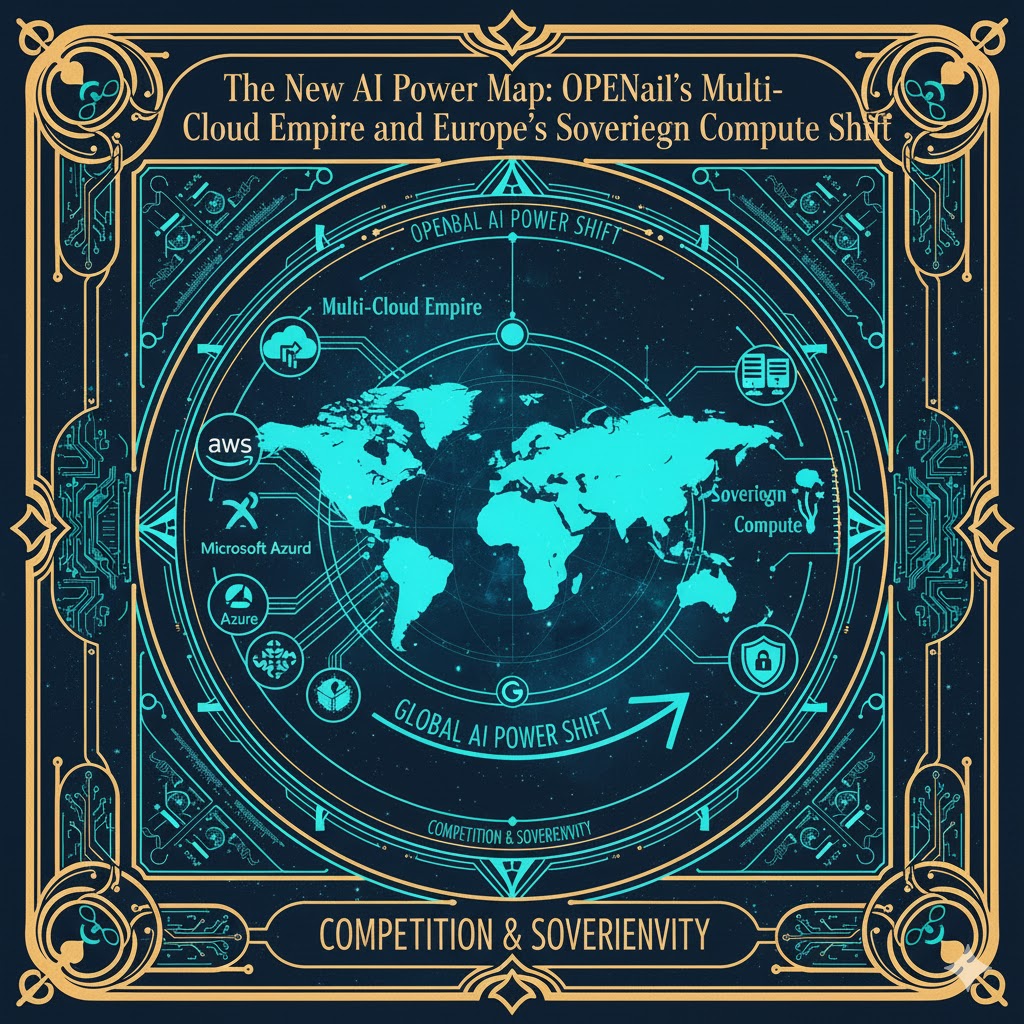
In late 2025, OpenAI rewired the power dynamics of the global AI infrastructure market. A seven-year, $38 billion pact with Amazon Web Services, a $300 billion compute contract with Oracle, and retail integration with Walmart’s ChatGPT Instant Checkout have transformed OpenAI from a Microsoft-anchored tenant into a multi-cloud empire.
Simultaneously, Germany and the European Commission are building sovereign AI compute backbones—NVIDIA-powered data factories and the new RAISE (Resource for AI Science in Europe) initiative—to end hyperscaler dependence.
Together, these moves redefine how AI will be trained, priced, and delivered in 2026 and beyond.
1. OpenAI + AWS: From Dependency to Dominance
The $38 billion AWS partnership secures OpenAI access to hundreds of thousands of NVIDIA GB200/GB300 GPUs on EC2 UltraServers. It’s a diversification play that ends Microsoft’s exclusive grip on OpenAI’s infrastructure.
Competitive Impact
- AWS regains relevance in frontier compute after trailing Azure and Google.
- Microsoft loses exclusivity but remains embedded via Copilot integrations.
- Google Cloud now faces a unified NVIDIA-based multi-cloud standard instead of its proprietary TPU moat.
Customer Impact
- Improved uptime and regional redundancy for API users.
- Greater pricing leverage through cross-cloud competition.
- A model for future “compute arbitrage” in enterprise AI.
2. Walmart + ChatGPT: Agentic Commerce Arrives
Walmart’s October 2025 launch of Instant Checkout lets users browse, compare, and complete purchases directly inside ChatGPT.
Competitive Impact
- Walmart becomes the first major retailer to turn a conversational interface into a full sales channel.
- Google Shopping and Amazon Marketplace face erosion of search-based product discovery.
- OpenAI gains a new revenue stream—transaction fees from “agentic commerce.”
Customer Impact
- Instant, context-aware shopping guided by personal preferences.
- Reduced friction—no logins, carts, or redirects.
- New privacy expectations as AI mediates purchase data.
3. Germany × NVIDIA × Deutsche Telekom: Europe’s Sovereign AI Factory
A €1 billion “Industrial AI Cloud” in Munich will host 10 000 NVIDIA Blackwell GPUs, doubling Germany’s AI compute capacity by 2026.
Competitive Impact
- Challenges hyperscaler dominance with a jurisdiction-compliant local alternative.
- Strengthens Europe’s industrial AI base in automotive, robotics, and smart manufacturing.
Customer Impact
- EU-sovereign data handling under GDPR.
- Reduced latency for European AI applications.
- Higher initial costs offset by compliance and proximity.
4. RAISE: The EU’s Public-Compute Leap
The European Commission’s RAISE pilot allocates €107 million to create a federated compute and research hub for AI-driven science.
Competitive Impact
- Gives researchers and startups a public alternative to hyperscaler dependence.
- Signals Europe’s shift from regulating AI to building AI capacity.
Customer Impact
- Democratised access to GPU clusters for climate, health, and materials science.
- Lower entry costs for early-stage AI startups.
5. Oracle’s $300 Billion Bet
Oracle’s record-breaking contract with OpenAI elevates it from second-tier cloud to first-tier AI compute provider—but at massive exposure risk.
Competitive Impact
- Consolidates OpenAI’s compute supply chain across three giants—AWS, Oracle, Microsoft.
- Forces rivals into aggressive pricing to stay relevant.
Customer Impact
- Potentially cheaper API and hosting costs downstream.
- Global performance improvements as OpenAI deploys across multiple regions.
Key Verticals: Winners, Risks, and Customer Payoffs
| Vertical | Winners | Emerging Risks | Customer Value |
|---|---|---|---|
| Cloud & Compute | AWS, Oracle, NVIDIA | Energy scarcity, overcapacity | Lower latency, flexible deployment |
| Retail & Commerce | Walmart, OpenAI | Data-privacy regulation | Personalized, frictionless buying |
| Enterprise AI Tools | Microsoft Copilot, AWS Bedrock | Margin compression | Multi-cloud resilience |
| Public Research | EU RAISE Labs | Bureaucratic friction | Accessible compute for science |
| Chipmakers | NVIDIA, AMD (secondary) | Supply chain strain | Accelerated model innovation |
Strategic Outlook
The age of compute pluralism has begun.
No single cloud, company, or nation will own the AI stack. Instead, power will flow to those who control distribution, pricing, and locality of intelligence.
For competitors, this means competing not on model size but on infrastructure sovereignty, energy efficiency, and end-to-end latency.
For customers, it promises faster access, lower cost per token, and a clearer path to enterprise-grade reliability.
About StrongMocha
StrongMocha.com, part of the StrongMocha News Group, delivers deep analysis of AI infrastructure, automation, and post-labor economics.
Press & Partner Inquiries: press@strongmocha.com | Info: info@strongmocha.com