🔍 Read the full analysis: 3 AI Workflow Automation Software Guides For Planning Your 2027 Toolkit on ThorstenMeyerAI.com

Get audio and creator gear delivered free with Prime
- Fast, free delivery on millions of items
- Prime Video, Amazon Music and more included
- Member-only deals all year
TL;DR
A guide published by ThorstenMeyerAI.com recommends three learning resources for people planning an AI workflow toolkit: n8n AI Automation, Workflow Automation with Microsoft Power Automate, and The AI Workflow and Automation System. These are books or learning resources, not automation software; the available descriptions do not confirm their formats, detailed contents, or access to tools.
ThorstenMeyerAI.com has outlined three learning resources for people planning an AI workflow automation toolkit for 2027: n8n AI Automation, Workflow Automation with Microsoft Power Automate, and The AI Workflow and Automation System. The guide ranks them by how directly their stated focus may help readers learn to build or govern automated workflows, as described in the original analysis, while stressing that they are books or learning materials, not automation platforms.
The guide places n8n AI Automation first for readers seeking project-based coverage of AI workflows and agents in the n8n ecosystem. Its description identifies real-world projects, but the supplied details do not say what those projects build, how advanced they are, or whether they include code, exercises, or downloadable resources. For a broader comparison, see 14 AI workflow automation choices.
Workflow Automation with Microsoft Power Automate is presented as the most direct fit for people working with Microsoft’s low-code platform. Its stated scope covers cloud and desktop workflows, alongside low-code and AI-powered workflow design. The available product information does not provide further specifications or examples. Readers comparing platforms can also consult a comparison of AI workflow automation tools.
The third option, The AI Workflow and Automation System, is positioned around controlled processes and dependable automation rather than instruction for a named platform. The guide says the title signals a reliability focus, but the supplied description does not explain its methods, tools, format, or specific contents. The ranking is based on the clarity of each resource’s stated learning focus, not on a comparison of software features.
The 3 picks
- 1
 Workflow Automation with Microsoft Power AutomateView on Amazon →
- 2
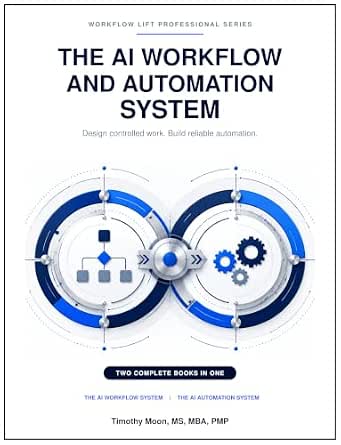 The AI Workflow and Automation System: Design Controlled Work, Build Reliable…View on Amazon →
- 3
 n8n AI Automation: Build Smarter Workflows, Agents, and Intelligent Systems w…View on Amazon →
Choosing a Guide Before a Platform
The recommendations address a common planning distinction: learning how to automate work is not the same as choosing software that runs an automation. A book may help a team understand workflows, agents, or process controls, but its title alone cannot establish whether a platform supports the required integrations, security controls, monitoring, or deployment needs.
For 2027 planning, the guide’s practical takeaway is to match the learning resource to the work already underway. A team committed to Microsoft tools may find the Power Automate guide’s stated cloud-and-desktop scope most relevant; someone learning n8n may prefer the resource that names that platform and project work. Readers focused on reliability may investigate the Workflow Lift title further, while recognizing that its specific approach is not detailed in the supplied information.
Products Worth Considering

Samsung Galaxy Tab A11+ 11-Inch Wi-Fi Tablet, 128GB, 6GB RAM, Silver

Apple Watch SE 3 GPS 40mm Smartwatch

Bose QuietComfort Ultra Earbuds (2nd Gen), Wireless Noise-Cancelling Earbuds, Black
As an affiliate, we earn on qualifying purchases.
How the Three Resources Differ
The source ranks the resources by specificity and practical orientation. The n8n title explicitly names workflows, agents, and real-world projects. The Microsoft guide names a platform and describes a cloud-and-desktop remit. The Workflow Lift resource, by contrast, emphasizes controlled work and reliability in its title, but the source provides less information about what readers would actually study.
The guide also distinguishes its selection from a software review. It does not establish that any of the three resources provides access to an automation service, integrations, or licensing. It says the n8n listing lacks details such as length and format; the Power Automate entry has limited product specifications; and the Workflow Lift entry has no further contents or format information. Readers are advised to check full listings and evaluate software separately.
Details Buyers Still Need
The supplied material does not identify the publication dates, authors, editions, prices, or formats of the three resources. It also does not give enough detail to verify their teaching methods, examples, technical depth, or suitability for particular experience levels. The guide does not report independent testing or reader outcomes, so its ranking should be read as an assessment of the stated descriptions rather than proof of learning results.
It is also unclear whether the resources have been updated for tools and features available in 2027. The source does not establish that any includes software access, current integrations, security guidance, or licensing. Those points need confirmation from the publishers or sellers before purchase.
Checks Before Buying a Guide
Readers can first identify whether their immediate need is building a workflow in a particular platform or improving the design and oversight of automated processes. They can then compare each resource’s full listing for format, contents, examples, technical requirements, and date of publication, especially if current product features matter to their plans.
Organizations that have not chosen an automation platform should assess the software separately, including its integrations, access controls, monitoring, deployment options, and operating costs. The source provides no announced follow-up or product testing schedule; the next step is for buyers to verify these details with the resource providers and software vendors.
Key Questions
Are these three AI workflow automation software platforms?
No. The source describes them as books and learning resources, not executable automation software. It does not establish that they provide platform access, integrations, or licensing.
Which guide is aimed at n8n learners?
n8n AI Automation is the platform-specific choice in the guide. Its stated focus includes AI workflows, agents, and real-world projects, but the available description does not detail those projects.
What does the Microsoft Power Automate guide cover?
Its stated scope includes low-code cloud and desktop workflows, as well as AI-powered workflow design. The source does not provide specific examples or fuller product specifications.
What is known about The AI Workflow and Automation System?
The guide describes it as a resource centered on controlled processes and reliable automation. The supplied details do not identify its methods, platform coverage, format, or specific contents.
Does the guide establish which automation software to buy?
No. It ranks learning resources by the clarity of their stated focus. Readers still need to assess software capabilities, integrations, security, monitoring, deployment, and costs against their own requirements.
Source: ThorstenMeyerAI.com