
📊 Full opportunity report: The Artistic Science Of Particle Geometry Mapping In AI: 'SINGULARITY' on ThorstenMeyerAI.com — validation score, market gap, and execution plan.
TL;DR
The ‘SINGULARITY’ project demonstrates how particle geometry mapping enhances AI environments, transforming abstract data into immersive visual spaces. This innovation pushes boundaries in AI design and artistic expression.
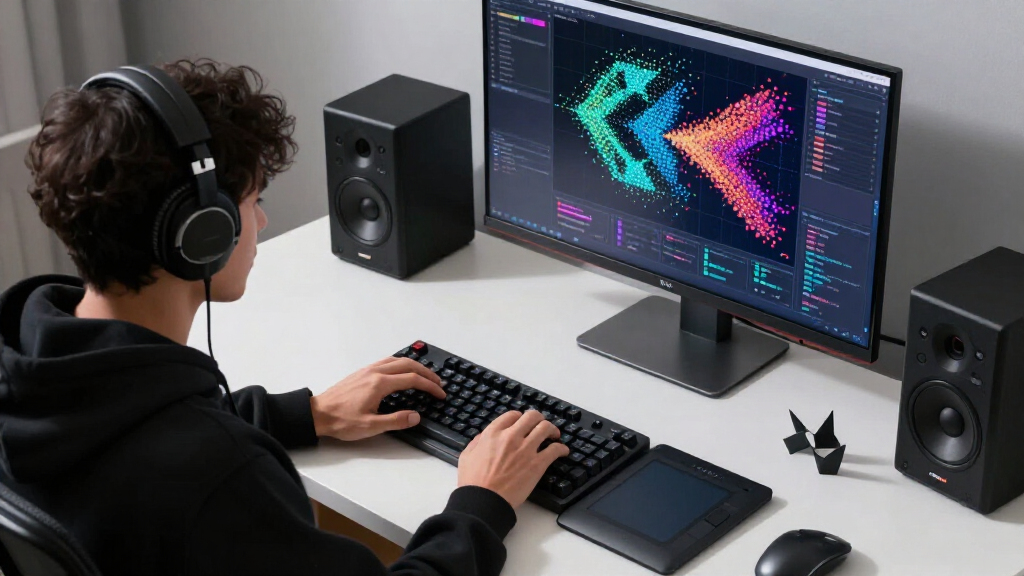
The ‘SINGULARITY’ project, a groundbreaking AI-driven environment, was unveiled through a live demonstration, showcasing how particle geometry mapping transforms abstract data into immersive visual spaces. This development highlights a novel intersection of art, technology, and design, emphasizing its potential impact on AI environments and creative visualization.
The ‘SINGULARITY’ space is a digital environment that employs particle geometry mapping—an innovative technique that translates complex data sets into dynamic, three-dimensional structures. According to Thorsten Meyer, the project explores how this method can generate visually engaging, data-driven environments that challenge conventional notions of form and function. The design process involved navigating technical challenges to maintain aesthetic coherence while accurately representing data patterns, culminating in a stark black room transformed into a visual symphony of data and geometry.
Developed as a case study, the project demonstrates how advanced algorithms can be harnessed to create immersive spaces that serve both artistic and functional purposes. The demonstration was live, allowing viewers to see real-time data visualization through particle formations that respond to underlying algorithms. The project aims to serve as a blueprint for future AI-enabled environments in fields like architecture, virtual reality, and data science, where form is dictated by complex data inputs rather than traditional design constraints.
Implications of Particle Geometry Mapping in AI Environments
This development signifies a shift toward more dynamic, data-driven spatial design in AI environments, blending artistry with technical precision. It demonstrates how advanced algorithms can generate immersive visual experiences that are both aesthetically compelling and informationally rich. For AI and automation industries, this approach offers new avenues for creating interactive, adaptable spaces that respond to real-time data, potentially transforming sectors like digital art, architecture, and human-computer interaction.
Furthermore, the project underscores the importance of visualization techniques in making complex data accessible and engaging. As AI tools become more sophisticated, such methods could influence how data is presented in educational, commercial, and entertainment contexts, making information more intuitive and impactful for diverse audiences.

Interactive GPU-based Visualization of Large Dynamic Particle Data (Synthesis Lectures on Visualization)
As an affiliate, we earn on qualifying purchases.
As an affiliate, we earn on qualifying purchases.
Evolution of Data Visualization in AI-Driven Design
The use of particle-based visualization techniques in AI environments has been emerging over recent years, driven by advances in computational power and algorithmic design. Prior projects have explored simple data mapping, but the ‘SINGULARITY’ initiative pushes this further by integrating complex geometric transformations that respond dynamically to data inputs. Thorsten Meyer’s team has been experimenting with how abstract data can be converted into visually expressive structures, aiming to bridge the gap between technical data and artistic representation.
This project builds on earlier research in generative design and data visualization, but its focus on particle geometry mapping marks a significant step forward. It exemplifies how AI can be used not just for analysis but for creating immersive artistic spaces that serve as both functional interfaces and artistic expressions. The live demonstration underscores the technology’s potential to influence future design paradigms in various creative and industrial sectors.
“Particle geometry mapping offers a new language for translating data into visual form, enabling environments that are both data-rich and artistically compelling.”
— an anonymous researcher
Unresolved Questions About Practical Applications
While the ‘SINGULARITY’ project demonstrates promising techniques, it is not yet clear how these methods will be scaled for widespread industrial or commercial use. The long-term stability, interactivity, and user experience of such environments remain under evaluation, and further testing is needed to confirm their practicality outside controlled demonstrations.
Additionally, it is unclear how adaptable the particle geometry mapping approach is to different data types or environments, and what technical limitations might emerge as the technology evolves.
Next Steps for Development and Integration
Future developments are expected to focus on refining the algorithms to improve real-time responsiveness and scalability. Thorsten Meyer’s team plans to explore integration with existing AI platforms and virtual reality systems, aiming to create more interactive and user-friendly environments.
Further testing in real-world applications, such as architectural design, digital art installations, and data analysis tools, is anticipated to validate the technology’s versatility and commercial viability. The project team also intends to publish detailed technical findings and collaborate with industry partners to accelerate adoption.
Key Questions
What is particle geometry mapping?
Particle geometry mapping is an innovative technique that translates complex data sets into dynamic, three-dimensional structures composed of particles, creating immersive visual environments.
How does ‘SINGULARITY’ differ from traditional data visualization?
‘SINGULARITY’ uses advanced algorithms to generate real-time, data-responsive geometric formations that are both artistic and functional, moving beyond static charts or graphs.
Can this technology be applied outside artistic environments?
Yes, potential applications include architecture, virtual reality, data analysis, and interactive installations, though practical deployment is still under development.
What are the main technical challenges?
Challenges include ensuring real-time responsiveness, scalability to large data sets, and maintaining aesthetic coherence while accurately representing complex data patterns.
When will this technology become commercially available?
It is not yet clear when or if the technology will be commercially available. Ongoing research and testing are required to assess its practical viability.
Source: ThorstenMeyerAI.com