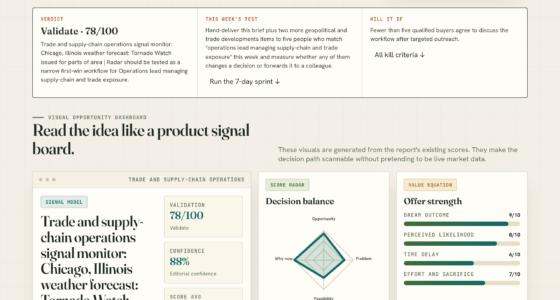

📊 Full opportunity report: AI's Next Roadblock: Plumbing And Data Infrastructure Challenges on ThorstenMeyerAI.com — validation score, market gap, and execution plan.

Get audio and creator gear delivered free with Prime
- Fast, free delivery on millions of items
- Prime Video, Amazon Music and more included
- Member-only deals all year
TL;DR
While AI models have become highly capable and cost-effective, the main hurdle for widespread enterprise adoption is integrating these models with existing systems. Smaller operators owning their entire stack may have a competitive edge due to fewer integration challenges.
New research confirms that the primary challenge in scaling enterprise AI deployments is integration with existing systems, not model capability or cost. This shift in bottleneck focus has significant implications for AI vendors and organizations aiming for large-scale adoption.
Multiple independent surveys and industry reports from 2026 reveal that 46% of teams building AI agents cite integration issues as their main obstacle. These challenges include connecting AI models securely and reliably to legacy systems, APIs, databases, and internal workflows.
While AI models have advanced rapidly—becoming more capable and cheaper—the infrastructure to orchestrate, govern, and evaluate these models remains underdeveloped. This mismatch is delaying broad enterprise deployment, despite the models’ technical readiness.
Small operators owning entire stacks—such as local inference, dedicated queues, and internal APIs—are better positioned to bypass these bottlenecks. This gives them a potential competitive advantage over larger firms constrained by legacy systems and complex security protocols.
The Agent Bottleneck Moved —
It’s Not the Models, It’s the Plumbing
Same-day-verified meta-trend · the one finding the conflicting surveys agree on
The survey chaos, plotted honestly
The inversion
2024–25: WHICH MODEL?
Capability was scarce, so the model was the moat. That race now resets weekly — frontier-class open weights every few weeks, from multiple labs.
2026: WHOSE PLUMBING?
Orchestration, tool access, evaluation harnesses, queues, audit trails, inference economics. Capability commoditized; infrastructure didn’t.
STEELMAN: WHY ENTERPRISES ARE SLOW
Not stupidity — their agents touch payroll, patients, and production, where cascading failures have consequences a solo builder’s stack never faces. Bounded autonomy and governance gaps are rational responses to real risk. Small operators defer that reckoning; they don’t escape it.
The signal: stop watching model benchmarks to predict who wins the agent era. Watch who owns the plumbing. The bottleneck moved there, the money is following — and the structural advantage runs, for once, toward operators small enough to own their whole stack.
Impact of Infrastructure Bottlenecks on Enterprise AI Adoption
The focus on infrastructure challenges signifies a shift in the AI deployment landscape. As the cost of models drops and capabilities improve, the real barrier becomes orchestration, governance, and integration. This favors smaller, vertically integrated operators who can own their entire stack, potentially reshaping market dynamics and competitive advantages.
For enterprises, this means that successful large-scale AI adoption will depend heavily on building or acquiring robust infrastructure, not just acquiring advanced models. The emphasis on secure, reliable, and governed integration is critical for managing risks associated with AI failures in sensitive applications.
As an affiliate, we earn on qualifying purchases.
2026 Trends in AI Infrastructure and Adoption Challenges
Industry surveys from 2026 show a wide range of reported AI adoption levels, but a consistent theme is that integration remains the main hurdle. Gartner projects that by the end of 2026, 40% of enterprise applications will feature task-specific AI agents, yet actual deployment lags behind due to infrastructure issues.
The reports highlight that while AI models are becoming commoditized and capable, the underlying orchestration frameworks, governance protocols, and secure API connections are not keeping pace. This discrepancy is causing delays and risk concerns in enterprise environments.
Small operators who own their entire infrastructure—such as local inference engines and internal APIs—are demonstrating that bypassing complex integration layers can enable faster deployment and more reliable operation.
“Most teams report that integrating AI with legacy systems and ensuring governance is the biggest challenge, not the AI models themselves.”
— an anonymous researcher
Unresolved Questions About Infrastructure and Adoption Speed
It remains unclear how quickly enterprises will overcome these infrastructure challenges or whether new standards and tools will emerge to streamline integration. Additionally, the exact market share gains for small, full-stack operators versus large vendors are still developing.
Further, the precise impact of governance and security regulations on deployment timelines varies across industries and regions, adding complexity to forecasts.
Next Steps in Building Scalable AI Infrastructure
Expect ongoing investments in orchestration frameworks, governance protocols, and secure API standards to address integration bottlenecks. Smaller operators owning entire stacks may accelerate deployment, potentially capturing significant market share.
Industry players will likely focus on developing standardized tools and evaluation pipelines to reduce integration costs and risks, enabling broader enterprise adoption in the coming years.
Key Questions
Why is infrastructure now the main bottleneck for AI deployment?
Because AI models have become highly capable and cost-effective, the limiting factor is now the ability to securely, reliably, and efficiently connect these models to existing enterprise systems, which is complex and underdeveloped.
How do small operators have an advantage in this environment?
Small operators owning their entire stack can bypass complex integration layers, reducing friction and deployment time, giving them a competitive edge over larger firms constrained by legacy systems and security protocols.
What are the risks associated with infrastructure bottlenecks?
Delays in deployment, increased costs, and potential security vulnerabilities are key risks. Poor integration can also lead to failures in critical applications like finance, healthcare, and manufacturing.
Will new standards or tools solve these infrastructure issues?
It is expected that ongoing development of orchestration frameworks, governance tools, and API standards will help mitigate these challenges, but the timeline and effectiveness remain uncertain.
What does this mean for the future of enterprise AI?
Successful large-scale AI deployment will depend increasingly on infrastructure ownership and integration capabilities, potentially shifting market power toward smaller, full-stack operators.
Source: ThorstenMeyerAI.com
Fall Picks
fall essentials
As an affiliate, we earn on qualifying purchases.