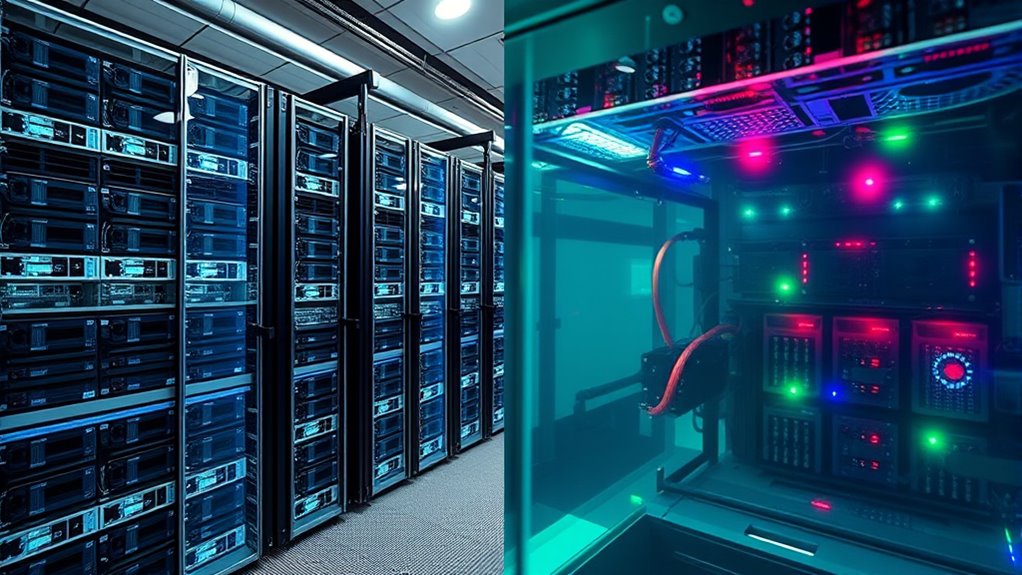

When choosing cooling options for dense racks, liquid cooling and immersion cooling stand out. Liquid cooling directs coolant directly to components like CPUs and GPUs, offering efficient heat removal with precise temperature control. Immersion cooling submerges servers in a thermally conductive fluid, maximizing space and energy efficiency. Both methods support higher rack densities, but immersion cooling requires specialized hardware and maintenance. To find the best solution for your needs, explore how each approach can optimize your data center’s performance and efficiency.
Key Takeaways
- Liquid cooling (DLC) enables higher rack densities with efficient heat removal via direct coolant contact.
- Immersion cooling offers maximum space and energy efficiency by submerging components in thermally conductive liquids.
- DLC systems are modular and scalable, suitable for diverse data center configurations; immersion requires specialized hardware.
- Both methods reduce reliance on traditional air conditioning, lowering operational energy costs.
- Choice depends on space constraints, cooling needs, and infrastructure investment priorities.
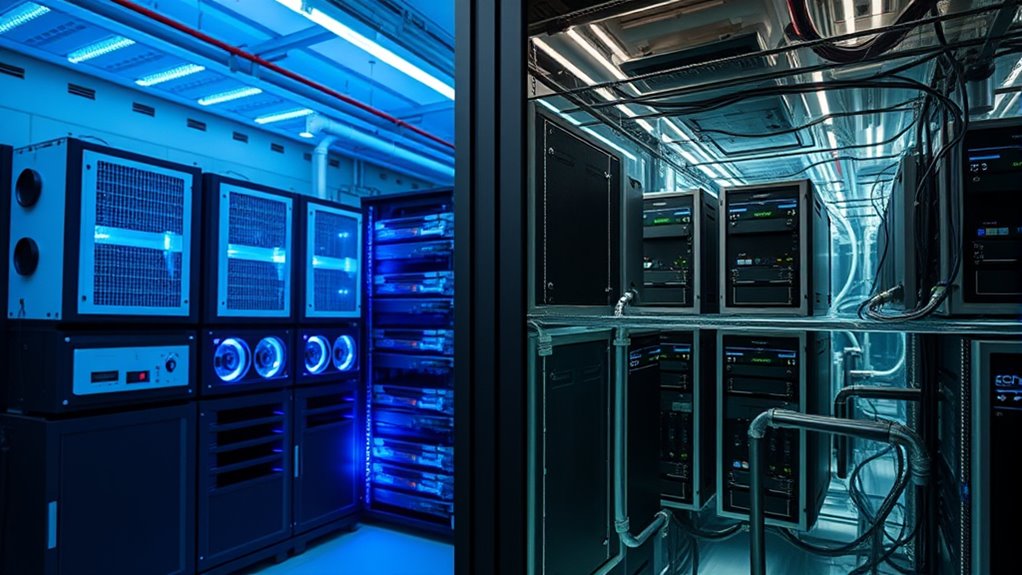
As data centers become more densely packed with equipment, effective cooling options are crucial to maintain peak performance and prevent overheating. When dealing with such high-density racks, traditional air cooling often struggles to keep up, making advanced solutions like liquid cooling and immersion cooling increasingly attractive. Both methods aim to remove heat efficiently, but they do so through different approaches. Your goal is to guarantee that equipment stays within safe operating temperatures without wasting energy or space.
Liquid cooling works by circulating a liquid, typically water or a specialized coolant, directly to heat-generating components like CPUs and GPUs. This method offers much higher heat transfer efficiency compared to airflow management alone, allowing for closer rack spacing and higher densities. As liquid cools the hardware directly, it reduces hot spots and minimizes the reliance on large air conditioning units. It also enables more precise temperature control, which can extend equipment lifespan and improve reliability. To implement this effectively, you need to contemplate the design of the cooling infrastructure—such as cold plates, heat exchangers, and piping—and integrate it seamlessly with your data center’s existing systems. Properly managing airflow becomes critical here; you want to ensure cool liquid is directed precisely where it’s needed, avoiding stagnation and ensuring uniform heat removal. Additionally, choosing the right coolant type can significantly impact system performance and safety.
Circulate coolant directly to components for higher efficiency, closer rack spacing, and better temperature control.
On the other hand, immersion cooling involves submerging entire servers or components in a thermally conductive, non-electrically conductive liquid. This approach completely eliminates the need for traditional airflow management around hot components because heat is transferred directly into the immersion fluid. It’s especially effective in densely packed racks where space is at a premium and airflow pathways can be complicated to optimize. Immersion cooling reduces energy consumption by substantially cutting down on fan and air conditioning use, and it offers excellent thermal stability. However, it requires specialized hardware and careful planning to prevent issues like corrosion and maintenance challenges. Since the entire system is immersed, you don’t need to worry much about airflow management in the traditional sense, but you do need to ensure the coolant remains pure and stable over time.
Choosing between liquid cooling and immersion depends on your specific needs, budget, and infrastructure constraints. Liquid cooling offers a more modular, scalable solution suitable for high-density racks, while immersion can provide maximum efficiency in environments where space and energy savings are priorities. Both options push past conventional airflow management, delivering superior heat removal and ensuring your data center stays cool under pressure. Ultimately, integrating these advanced cooling methods will help you maintain peak performance, reduce operational costs, and support the continued growth of your dense rack environments.
liquid cooling system for data centers
As an affiliate, we earn on qualifying purchases.
As an affiliate, we earn on qualifying purchases.
Frequently Asked Questions
Which Cooling Method Is More Energy-Efficient Long-Term?
Immersion cooling typically offers better energy savings and reduces environmental impact over the long term. It directly cools components with less energy-consuming airflow, resulting in lower power consumption. DLC can be effective, but it often requires more energy for fans and airflow management. By choosing immersion, you’ll minimize your environmental footprint and benefit from more sustainable, cost-efficient cooling, making it the smarter long-term option for dense racks.
How Do Installation Costs Compare Between DLC and Immersion?
You’ll find that installation costs are generally higher for immersion cooling due to its setup complexity, requiring specialized tanks, pumps, and insulation. DLC systems tend to be simpler and quicker to install, leading to lower initial expenses. However, consider that the long-term savings and maintenance differences might offset the higher upfront costs of immersion. Weigh these factors carefully based on your infrastructure and scalability needs.
What Maintenance Challenges Are Associated With Each Cooling Option?
You’ll face maintenance challenges with both systems. With DLC, you need to monitor airflow management closely to prevent hotspots, and guarantee filters stay clean. For immersion cooling, fluid handling becomes critical; you must regularly check for leaks, monitor coolant levels, and keep the fluid free of contaminants. Both systems demand diligent upkeep to maintain peak performance, but immersion requires more specialized skills for handling and fluid management.
Can These Cooling Methods Be Combined for Enhanced Performance?
Yes, you can combine cooling methods for enhanced performance through hybrid cooling. By integrating DLC with immersion cooling, you create a performance synergy that maximizes heat removal efficiency and minimizes energy use. This hybrid approach allows you to tailor cooling strategies based on your data center’s specific needs, reducing hotspots and improving overall system reliability. It’s a smart way to optimize your dense rack cooling while balancing operational costs.
How Do Cooling Options Impact Hardware Lifespan and Reliability?
Picture your hardware as a delicate engine, where proper cooling keeps it running smoothly. Effective cooling options, like DLC or immersion, directly boost hardware durability and reliability. By maintaining ideal temperatures, they prevent overheating, reduce wear and tear, and extend lifespan. Choosing the right cooling method ensures your equipment stays dependable longer, providing a reliability enhancement that keeps your systems resilient against thermal stress and operational failures.
immersion cooling server hardware
As an affiliate, we earn on qualifying purchases.
As an affiliate, we earn on qualifying purchases.
Conclusion
Choosing between DLC and immersion cooling is like deciding whether to breathe fresh mountain air or plunge into a clear, cool lake. Both methods keep your racks from overheating, but your choice shapes the landscape of your data center. As you weigh the options, picture your equipment basking in the ideal climate—efficient, cool, and ready to perform. Make the right move, and watch your dense racks thrive like a lush forest in perfect harmony.
data center cooling solutions
As an affiliate, we earn on qualifying purchases.
As an affiliate, we earn on qualifying purchases.
high density server cooling
As an affiliate, we earn on qualifying purchases.
As an affiliate, we earn on qualifying purchases.