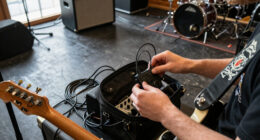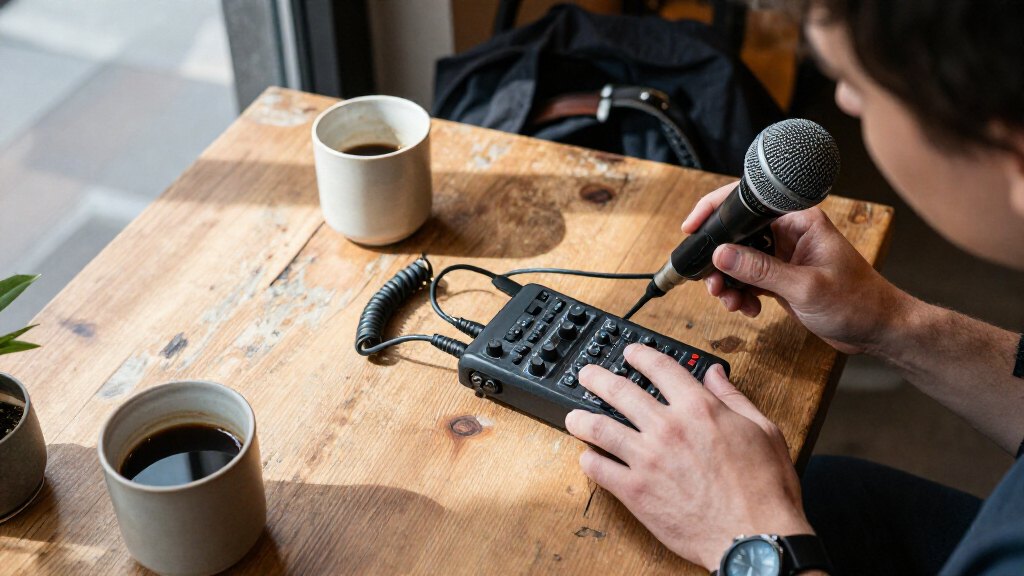
Portable podcast recorders range from compact USB-mic hubs to handheld recorders built for interviews and field audio. My best overall pick is the Zoom PodTrak P4, which balances four XLR mic inputs, four headphone outputs, and remote-call options for group shows. The Zoom PodTrak P4next adds AI noise reduction, while the TASCAM DR-40XP suits people who need a more general-purpose field recorder. The main tradeoff is between podcast-specific controls and a small, versatile recorder that can handle other audio work. Read on for the full comparison and guidance on matching a recorder to your setup.

Get audio and creator gear delivered free with Prime
- Fast, free delivery on millions of items
- Prime Video, Amazon Music and more included
- Member-only deals all year
Complete the kit


Key Takeaways
- The standard PodTrak P4 stands out as the best all-around group-show choice because its four XLR inputs and four headphone outputs support a full in-person panel without extra headphone gear.
- The P4next and original P4 serve different priorities: the P4next adds AI noise reduction, while the original P4 offers a proven podcast-focused layout and remote-call connections.
- The PodTrak P2 is the clearest fit for a compact two-person USB-mic setup; it trades XLR microphone connections and four-person capacity for a simpler, smaller recording workflow.
- The H-series and TASCAM DR-40XP favor flexible field recording over podcast-specific operation, making them better suited to solo voices, interviews, and location audio than a multi-mic studio-style show.
- Several listings are bundles or near-duplicates, not different recorder platforms: compare included mics, storage, batteries, and accessories rather than treating each package as a recorder upgrade.


| portable podcast recorder | Recording format | Power | Headphone outputs | Microphone inputs |
|---|---|---|---|---|
| Zoom H4 Essential Handheld Rec | WAV | 2 AA batteries | — | — |
| Zoom PodTrak P4 Portable Multi | WAV, 16-bit/44.1 kHz | 4 AA rechargeable batteries included; USB power supported | 4, each with individual volume control | 4 XLR |
| Zoom PodTrak P2 Podcast Record | WAV | 4 AA batteries, USB bus power, or AC adapter | 2 | 2 USB |
| Zoom H2 Essential Handheld Rec | WAV | 2 AA batteries | — | — |
| Zoom PodTrak P4 Podcast Record | WAV, 16-bit/44.1 kHz | — | 4 with individual volume controls | 4 XLR with phantom power |
| Zoom H1 XLR 2-Channel Recorder | — | 2 AA batteries | — | — |
| Zoom PodTrak P4next Podcast Re | WAV | 2 AA batteries | 4, with separate volume controls | 4 XLR inputs |
| Zoom PodTrak P4 Portable Multi | — | — | 4 independent outputs | — |
| TASCAM DR-40XP 4-Channel 32-Bi | 32-bit float | — | — | — |
| Zoom H1 Essential Recorder for | WAV | 2 AAA batteries | — | — |
| Zoom PodTrak P4 Portable Multi | — | 2 AA batteries required | 4 independent outputs | 4 XLR inputs with +48V phantom power |
| Zoom PodTrak P2 Podcast Record | 48 kHz/24-bit WAV | — | 2 | 2 USB microphone inputs |
| Zoom PodTrak P4next Podcast Re | WAV | — | 4 with separate volume controls | 4 XLR inputs |
More Details on Our Top Picks
Zoom H4 Essential Handheld Recorder for Musicians, Podcasters & Filmmakers
The Zoom H4 Essential suits podcasters who need a handheld recorder that can also take a full external-mic setup. Its two XLR/TRS inputs accommodate microphones or instruments, while the built-in stereo mics make it possible to capture a quick interview without extra gear. Four-track recording and 32-bit float give it more room for changing sources than the two-person-focused PodTrak P2, and its USB-C connection can feed a computer or mobile device while an SD card keeps a backup. Spoken menu guidance adds practical accessibility. The tradeoff is that this is less podcast-specific than the PodTrak P4: it lacks four dedicated headphone outputs and the P4’s call-in workflow and sound pads. Choose it for mixed-location recording, not a group podcast desk.
Pros:- Two XLR/TRS inputs connect microphones, instruments, or mixer outputs.
- Built-in stereo microphones support quick recordings without a separate mic kit.
- Four-track, 32-bit float recording offers flexibility for changing sound levels.
- USB-C device connection can record or stream while audio is backed up to SD.
Cons:- Does not provide the PodTrak P4’s four individually controlled headphone outputs.
- Lacks the P4’s dedicated call-in and sound-pad podcast features.
- Its broader recording controls may be more than a simple two-person show needs.
Best for: Solo podcasters and field producers who alternate between built-in-mic interviews, external microphones, and instrument or mixer feeds.
Not ideal for: Four-person podcast teams that need separate headphone monitoring and streamlined phone call-ins; the PodTrak P4 is better equipped for that setup.
- Recording tracks:4
- Built-in microphones:Stereo
- External inputs:2 XLR/TRS
- Recording format:WAV
- Maximum recording quality:32-bit float, up to 96 kHz
- Device connection:USB-C
- Storage:SD card; listed capacity up to 1 TB
- Power:2 AA batteries
Our verdict“Choose the H4 Essential if your portable podcast work mixes built-in stereo capture with external mics, instruments, or mixer feeds.”
Zoom PodTrak P4 Portable Multitrack Podcast Recorder, Audio Interface w/ 4 Mic Inputs, 4 Headphone Outputs with 64GB SD, 4X Zoom Podcast Mic Pack, 4X Pop Filter Set, 4AA Rechargeable Batteries & More
This PodTrak P4 bundle is aimed at a podcast team that wants a recorder and a starter kit of participant gear together. The core P4 provides four XLR mic inputs, four separately controlled headphone outputs, and mix-minus for remote calls; the included mic packs, stands, windscreens, and pop filters help outfit four positions. That makes it a more ready-to-assemble group setup than the standalone PodTrak P4, while the H4 Essential is more adaptable for field recording and instruments. The bundle’s advantage is convenience, not a different recorder: its recording format remains 16-bit/44.1 kHz, and the included accessories add pieces to manage and transport. It also relies on AA or USB power, so plan around the stated short battery runtime for location sessions.
Pros:- Four XLR inputs and four independent headphone outputs suit a full panel.
- Mix-minus supports phone or remote call-ins without call audio echoing back.
- Bundle includes four mic packs and related accessories for a multi-person setup.
- Records separate input sources to SD and can also function as a USB interface.
Cons:- 16-bit/44.1 kHz recording offers less level-recovery flexibility than the H4 Essential’s 32-bit float recording.
- The bundle’s multiple mics and accessories are less convenient to carry than a handheld recorder alone.
- Listed battery runtime is up to 3 hours, which may call for spare power on longer sessions.
Best for: New or expanding four-person podcast teams who need a recorder, participant monitoring, and a basic microphone accessory kit in one package.
Not ideal for: Solo field recordists or creators who need 32-bit float capture, built-in stereo mics, or a lighter setup; the H4 Essential is more versatile for those jobs.
- Microphone inputs:4 XLR
- Headphone outputs:4, each with individual volume control
- Recording format:WAV, 16-bit/44.1 kHz
- Recording tracks:Separate tracks for input sources
- Remote call feature:Mix-minus; TRRS connection
- Storage:SD, SDHC, or SDXC up to 1 TB; bundle includes 64 GB card
- USB interface:2-in/2-out
- Power:4 AA rechargeable batteries included; USB power supported
Our verdict“Pick this bundle for a four-person show that needs a recorder and starter mic accessories, rather than a compact field-first setup.”
Zoom PodTrak P2 Podcast Recorder with 2 USB Mic Inputs & AI Noise Reduction
The PodTrak P2 keeps a two-person podcast setup unusually direct: connect two USB microphones, plug in headphones, and record without adding an XLR interface or separate mixer. Its AI noise reduction, tone shaping, compression, and de-essing can help voice tracks sound more controlled before editing, while mix-minus supports a remote caller. It is more purpose-built for a compact conversational show than the H4 Essential, whose XLR/TRS inputs and four-track design suit a wider range of sources. Compared with the four-input PodTrak P4, the P2 is smaller and easier to configure, but it stops at two USB mics and two headphone outputs. That ceiling matters if the show adds guests in the room; it also means existing XLR microphones need another solution.
Pros:- Two USB microphone inputs simplify setup for a host and co-host.
- Two headphone outputs provide monitoring for both speakers.
- AI noise reduction and voice-processing effects can reduce routine cleanup work.
- Records to SD while supporting USB recording or streaming and remote call-ins.
Cons:- Only supports two USB microphones, limiting growth to larger in-room panels.
- USB mic inputs do not replace the PodTrak P4’s four XLR inputs for conventional podcast microphones.
- Listed battery life is up to 4 hours on four AA batteries, so longer mobile sessions need power planning.
Best for: Two-person podcast hosts who already own USB microphones and want portable recording, headphone monitoring, and call-in support with minimal setup.
Not ideal for: Hosts using XLR microphones or regularly recording three or more in-person speakers; the PodTrak P4 offers four XLR inputs and four headphone outputs.
- Microphone inputs:2 USB
- Headphone outputs:2
- Recording format:WAV
- Storage:SD cards up to 1 TB
- Audio processing:AI noise reduction, tone shaping, compressor, and de-esser
- Remote guest feature:Mix-minus
- Power:4 AA batteries, USB bus power, or AC adapter
- Listed battery life:Up to 4 hours
Our verdict“Choose the P2 for a portable two-person show built around USB microphones, but opt for the P4 if you need XLR inputs or more seats.”
Zoom H2 Essential Handheld Recorder for Musicians, Podcasters & Filmmakers
For podcasters who want to travel light and record the room rather than wire several guests, the Zoom H2 Essential offers three built-in microphones and nine recording patterns. Those selectable patterns make it more adaptable to different room layouts than a simple stereo handheld recorder, while 32-bit float recording helps preserve usable takes when voices or surrounding sound vary in level. It can also act as a USB microphone and record to SD at the same time, giving a computer-based session a local backup. Compared with the H4 Essential, the H2 is smaller and its built-in mic array offers more capture patterns, but it does not provide the H4’s two XLR/TRS inputs for adding conventional external mics. It is best for portable ambient and interview capture, not a multi-mic podcast console.
Pros:- Three built-in microphones and nine patterns accommodate varied recording positions.
- 32-bit float recording reduces the need to set gain precisely before a changing-level recording.
- Can serve as a USB microphone while recording a backup to SD.
- Spoken menu navigation supports accessible operation.
Cons:- No XLR/TRS inputs for connecting the external microphones supported by the H4 Essential.
- Built-in-mic capture is less suited to isolating several podcast speakers than a multi-input recorder.
- Does not offer the PodTrak P4’s dedicated multi-headphone and call-in controls.
Best for: Mobile journalists and solo podcasters who want a lightweight recorder for interviews, room sound, and flexible built-in-mic capture.
Not ideal for: Podcast teams that need multiple XLR microphones, individual headphone feeds, or a dedicated call-in workflow; the PodTrak P4 is built for those needs.
- Built-in microphones:3
- Recording patterns:9
- Recording quality:32-bit float, up to 96 kHz
- Recording format:WAV
- USB function:USB microphone; simultaneous SD recording
- Storage:SD card capacity listed up to 2 TB
- Power:2 AA batteries
- Listed battery life:Up to 20 hours
Our verdict“Choose the H2 Essential when portability and adaptable built-in-mic recording matter more than external mic inputs or group-podcast controls.”
Zoom PodTrak P4 Podcast Recorder with 4 XLR Mic Inputs, 4 Headphone Outputs, Phone & USB Input for Remote Interviews, Sound Pads, 2-In/2-Out USB Audio Interface, Battery Powered
The Zoom PodTrak P4 is the strongest fit here for a show built around several spoken-word guests. Four XLR inputs with phantom power cover common podcast microphones, and four headphone outputs with individual volume let each participant monitor at a comfortable level. Mix-minus handles phone call-ins, while programmable sound pads add cues or short effects without a computer. Against the bundled P4 listing, this standalone version provides the same core recorder workflow without the extra mic packs and accessories; against the H4 Essential, it trades broader instrument and field-recording flexibility for podcast-specific controls. Its limitations are real: recording is 16-bit/44.1 kHz, and the listed 3.5-hour battery life makes spare AAs or USB power sensible for longer remote sessions.
Pros:- Four XLR inputs with phantom power support a conventional multi-mic podcast setup.
- Four headphone outputs have individual volume control for participants.
- Mix-minus supports call-in interviews through a phone connection or USB workflow.
- Sound pads and multitrack recording add production control without requiring a computer.
Cons:- 16-bit/44.1 kHz recording has less level-recovery flexibility than the H4 Essential’s 32-bit float capture.
- Listed battery life is up to 3.5 hours on two AA batteries.
- Its podcast-focused controls are less suited to ambient field recording than the H2 Essential’s built-in microphone patterns.
Best for: Podcast hosts recording up to four XLR-mic participants who need separate headphone levels, remote call-ins, and sound-pad controls.
Not ideal for: Creators prioritizing 32-bit float capture, built-in stereo microphones, or longer battery sessions; the H4 Essential or H2 Essential better matches those recording needs.
- Microphone inputs:4 XLR with phantom power
- Headphone outputs:4 with individual volume controls
- Recording format:WAV, 16-bit/44.1 kHz
- Recording tracks:Multitrack recording for inputs and sound pads
- Remote interview feature:Automatic mix-minus; TRRS phone input and USB
- Sound pads:4 programmable pads
- USB interface:2-in/2-out
- Power and listed battery life:2 AA batteries; up to 3.5 hours
Our verdict“Pick the PodTrak P4 for a portable, multi-person XLR podcast rig with individual monitoring and remote-call features.”
Zoom H1 XLR 2-Channel Recorder for Filmmakers, Musicians & Podcasters
The Zoom H1 XLR fits podcasters who want to bring their own microphones on location without carrying a larger multitrack console. Its two locking XLR/TRS inputs accommodate two speakers with separate mics, while 32-bit float recording helps preserve takes when speaking levels vary. Compared with the built-in-mic Zoom H1 Essential, this recorder trades grab-and-go simplicity for connections to external microphones; unlike the four-input Zoom PodTrak P4next, it keeps the setup smaller but cannot host a larger panel. The waveform display gives a quick visual check, and the 3.5mm input and headphone output add useful monitoring flexibility. The tradeoff is a two-input ceiling and a workflow better suited to recording than managing a full podcast show. Choose it for compact interviews, not multi-guest sessions.
Pros:- Two locking XLR/TRS inputs support two external microphones or instruments.
- 32-bit float recording helps handle unpredictable changes in speaking or performance levels.
- OLED waveform display offers a fast visual recording check.
- 3.5mm stereo input and headphone output support extra sources and monitoring.
Cons:- Only two XLR/TRS inputs, so it cannot record a larger group directly.
- Lacks the four separate headphone outputs and podcast-focused show controls of the PodTrak P4next.
- Requires two AA batteries, adding a separate power item to a portable kit.
Best for: Mobile interviewers and two-person podcast teams who already own XLR microphones and want separate mic inputs in a compact recorder.
Not ideal for: Panel hosts who need three or four mic channels, individual headphone feeds, or onboard tools for running a live podcast.
- Recording resolution:32-bit float, up to 96 kHz
- XLR/TRS inputs:2 locking combo inputs
- Additional audio connections:3.5mm stereo input and 3.5mm headphone output
- Display:0.96-inch OLED waveform display
- Storage support:SDXC cards up to 1 TB
- Power:2 AA batteries
- Listed battery life:Up to 10 hours
- Dimensions and weight:4.21 × 2.44 × 1.55 inches; 6.4 ounces
Our verdict“Pick the H1 XLR for portable two-mic interviews with external microphones; choose a PodTrak if your show needs more people or headphone mixes.”
Zoom PodTrak P4next Podcast Recorder with 4 Inputs + AI Noise Reduction
For a traveling show with several voices around the table, the Zoom PodTrak P4next is the strongest fit in this group. Four XLR inputs and four independently controlled headphone outputs let each participant use a mic and monitor comfortably, while up to +70 dB of gain supports demanding microphones. Its AI noise reduction, Tone Enhancement, and COMP tools aim to reduce cleanup and mixing work—useful when a mobile recording has less-than-studio conditions. Compared with the two-input Zoom H1 XLR, it can handle a full panel; compared with the bundled Zoom PodTrak P4, it adds AI-assisted processing. That convenience comes with a larger, more feature-heavy workflow than a simple handheld recorder, and it runs on two AA batteries. Choose it for organized group recording, not minimal solo capture.
Pros:- Four XLR inputs support a multi-mic panel recording.
- Four headphone outputs have separate volume controls for individual monitoring.
- AI noise reduction, Tone Enhancement, and COMP provide onboard processing options.
- Phone connection supports recording audio directly with phone video.
Cons:- More inputs and controls make it less suited to simple, lightweight stereo recording than the H1 Essential.
- Requires two AA batteries, so extended mobile sessions call for power planning.
- Its four-mic capacity is unnecessary overhead for a one-person podcast.
Best for: Podcast hosts who record up to four in-person guests, need a headphone feed for each person, and want onboard tools to shape voices.
Not ideal for: Solo creators and minimalist field recordists who do not need multiple XLR inputs, separate headphone controls, or podcast-specific processing.
- Microphone inputs:4 XLR inputs
- Maximum input gain:Up to +70 dB
- Headphone outputs:4, with separate volume controls
- Processing:AI noise reduction, Tone Enhancement, and COMP
- Phone video connection:Connects to a phone for direct audio capture with video
- Recording format:WAV
- Storage support:Up to 2 TB
- Power:2 AA batteries
Our verdict“Choose the P4next when a mobile podcast needs four mic channels, four headphone feeds, and onboard voice-processing tools.”
Zoom PodTrak P4 Portable Multitrack Podcast Recorder Bundle with 2X Zoom ZDM-1 Podcast Pack
This PodTrak P4 bundle is the practical pick for two people starting a portable show: it pairs a four-mic recorder with two Zoom ZDM-1 podcast packs, including microphones, headphones, stands, and cables. The recorder itself can grow beyond a two-host setup, with four high-gain XLR inputs, four headphone outputs, sound pads, and options for remote call-ins. That makes the bundle more expandable than the Zoom H1 XLR, which only has two external mic inputs, while the included gear means fewer separate pieces to assemble than buying a recorder alone. The tradeoff is that only two mic kits are included, so using all four XLR channels requires additional equipment. It also lacks the P4next’s listed AI noise reduction and voice-enhancement tools. It makes sense for a small team that wants a ready-to-record foundation, not buyers seeking a fully outfitted four-person kit.
Pros:- Includes two ZDM-1 packs with microphones, headphones, stands, and cables.
- Four XLR inputs leave capacity to add two more microphones.
- Four independent headphone outputs support monitoring for multiple participants.
- Sound pads and remote call-in support suit podcast production beyond basic recording.
Cons:- The bundle includes only two mic packs despite the recorder having four XLR inputs.
- Does not list the P4next’s AI noise reduction or Tone Enhancement features.
- More accessories make the kit less compact than a handheld recorder such as the H1 Essential.
Best for: Two-host beginners who want a portable recorder plus two matching microphone-and-headphone kits, with room to add more guests later.
Not ideal for: Four-person podcast teams expecting a complete mic kit for every participant, or creators who want the P4next’s AI processing tools.
- Recorder inputs:4 high-gain XLR microphone inputs
- Phantom power:+48V
- Headphone outputs:4 independent outputs
- Sound pads:4
- Remote call-ins:Simultaneous TRRS and USB call-ins
- Included microphone packs:2 Zoom ZDM-1 Podcast Packs
- Included pack equipment:Dynamic microphone, headphones, tabletop stand, mic cable, windscreen, and mounting accessories per pack
- Recording media:USB memory stick listed in product information
Our verdict“Choose this bundle if two hosts need a portable recorder and matching mic kits now, with the option to add more channels later.”
TASCAM DR-40XP 4-Channel 32-Bit Float Portable Handheld Field Recorder and USB-C Audio Interface — With 2 XLR/TRS Inputs and Adjustable Mics for Music, Audio for Video and Interviews
The TASCAM DR-40XP is the most flexible choice here for podcasters who also record ambient sound, music, or location audio. Its adjustable built-in stereo microphones capture a room or scene, while two XLR/TRS inputs let you add external mics; four-channel recording and 32-bit float broaden its use beyond a basic interview recorder. Compared with the Zoom H1 XLR, it combines built-in adjustable mics with external inputs, rather than focusing on two external connections alone. It also offers a more field-recording-oriented alternative to the group-focused PodTrak P4next, which has four XLR channels and individual headphone feeds. The tradeoff is that the DR-40XP has only two external inputs, and the provided details do not specify battery life, storage capacity, or headphone-output arrangements. It suits hybrid recording, not a four-mic panel workflow.
Pros:- 32-bit float recording helps accommodate unpredictable changes in sound level.
- Adjustable built-in stereo microphones capture location sound without extra gear.
- Two XLR/TRS inputs allow external microphones or other compatible sources.
- USB-C audio interface mode supports computer-based recording workflows.
Cons:- Two external inputs cannot support the four-mic panel capacity of the PodTrak P4next.
- Product details provided do not state battery life or supported storage capacity.
- Built-in mics and field-recording features may add complexity for a podcaster who only needs a simple voice recorder.
Best for: Location podcasters and creators who want one handheld device for two external microphones, stereo ambience, interviews, and music capture.
Not ideal for: Panel podcasters who need four XLR mic inputs and separate headphone outputs for each participant.
- Recording channels:4-channel
- Recording format:32-bit float
- External inputs:2 XLR/TRS inputs
- Built-in microphones:Adjustable stereo microphones
- Preamps:HDDA preamps
- Computer connection:USB-C audio interface
Our verdict“Pick the DR-40XP if your portable podcast work also calls for ambient, music, or location recording; choose a PodTrak for multi-person mic management.”
Zoom H1 Essential Recorder for Musicians, Podcasters & Content Creators
The Zoom H1 Essential is the easiest fit for a solo podcaster or interviewer who values low setup effort over a bank of mic inputs. Its built-in X/Y stereo microphones make it ready to capture a voice, conversation, or surrounding sound, and 32-bit float recording can help preserve audio when levels change unexpectedly. Spoken menu guidance and USB-C microphone mode add accessibility and let it serve as a mic for calls or streaming as well as an SD-card recorder. Compared with the H1 XLR, it skips external XLR inputs in favor of built-in microphones and a simpler capture workflow; compared with the PodTrak P4next, it is far less suited to a multi-guest table. The tradeoff is limited external-mic flexibility and no separate headphone feeds. Pick it for compact solo work, not a growing panel show.
Pros:- Built-in X/Y stereo microphones allow recording without an external mic.
- 32-bit float recording helps manage sudden changes in input level.
- USB-C microphone mode works with computers and compatible mobile setups.
- Spoken menu guidance supports accessible operation.
Cons:- No XLR inputs for connecting professional external podcast microphones.
- Built-in stereo capture is less suited to isolating multiple speakers than the PodTrak P4next.
- Uses two AAA batteries, a different power format from the AA-powered H1 XLR.
Best for: Solo podcasters, students, and mobile interviewers who want an accessible handheld recorder with built-in stereo mics and USB-C microphone mode.
Not ideal for: Hosts recording several guests on separate XLR microphones or teams that need individual headphone mixes.
- Built-in microphones:X/Y stereo microphones
- Recording:32-bit float
- Recording format:WAV
- USB connection:USB-C; supports USB microphone mode
- Storage support:Up to 1 TB
- Power:2 AAA batteries
- Listed battery life:Up to 10 hours
- Dimensions and weight:5.38 × 2.12 × 1.14 inches; 92 g
Our verdict“Choose the H1 Essential for simple solo or interview recording with built-in mics; move to an XLR recorder for separate mic tracks.”
Zoom PodTrak P4 Portable Multitrack Podcast Recorder Bundle with 4X Zoom ZDM-1 Podcast Pack
I’d choose this bundle for a group that needs a portable recording setup, not just a recorder. The four XLR inputs and four independent headphone outputs let each host or guest use a dedicated mic and monitor level, while the included four ZDM-1 mic packs supply microphones, headphones, stands, and cables for a ready-to-go panel setup. Sound pads and phone or USB call-ins also suit shows that mix in clips or remote voices. Compared with the P4next, this original P4 bundle includes the full set of microphones but does not list the newer model’s AI processing or higher-gain XLR inputs. The tradeoff is a less advanced recorder paired with much more included gear; buyers who already own microphones may get more value from a recorder-only option.
Pros:- Four XLR inputs and four separate headphone outputs support a full in-person panel.
- Four included ZDM-1 mic packs provide core recording gear for each participant.
- Mix-minus supports remote call-ins without sending the guest’s voice back to them.
- Sound pads, limiters, and low-cut filters add practical production tools.
Cons:- The complete four-person bundle is bulkier to transport than a recorder-only setup.
- Unlike the P4next, it does not list AI noise reduction or up to 70 dB of gain.
- Runs on two AA batteries, so extended mobile sessions may call for spare batteries or another power source.
Best for: Podcast teams of up to four people who need a portable recorder and a matching set of microphones, headphones, stands, and cables.
Not ideal for: Solo hosts or buyers who already own XLR microphones and monitoring gear; much of this bundle’s appeal is the four included mic packs.
- Microphone inputs:4 XLR inputs with +48V phantom power
- Headphone outputs:4 independent outputs
- Sound pads:4
- Remote connections:Simultaneous TRRS and USB call-ins; mix-minus
- Included microphones:4 Zoom ZDM-1 dynamic microphones
- Included monitoring:4 Zoom ZHP-1 headphones
- Power:2 AA batteries required
- Included accessories:Mic stands, XLR cables, windscreens, and headphone cables
Our verdict“Choose this bundle for a ready-to-record mobile panel; skip it if you only need a recorder or already have a full mic kit.”
Zoom PodTrak P2 Podcast Recorder Bundle with 64GB MicroSD Card and Adapter
The P2 makes the most sense when a show has two people and both prefer USB microphones. Its two USB mic inputs and two headphone outputs keep the setup compact, while mix-minus helps prevent a remote caller from hearing their own voice returned. It can record 48 kHz/24-bit WAV to microSD while also streaming to a connected phone or computer, and the included 64GB card means storage is part of the bundle. Compared with the PodTrak P4, this is a simpler fit for a two-person USB workflow, but it gives up the P4’s four XLR inputs and support for a larger in-room panel. The key limitation is mic compatibility: microphones are not included, and this recorder’s USB-input design won’t suit buyers building around XLR mics.
Pros:- Two USB microphone inputs suit a simple two-host recording setup.
- Two headphone outputs let both speakers monitor during a session.
- Records 48 kHz/24-bit WAV to microSD while streaming to a connected device.
- AI noise reduction, tone processing, and compression offer built-in voice shaping.
Cons:- USB microphone inputs limit mic choice compared with the P4 and P4next XLR models.
- Microphones and headphones are not included.
- Two input channels are not enough for a multi-person in-room panel.
Best for: Two-person podcast hosts who already own compatible USB microphones and want portable recording, monitoring, and remote-call support.
Not ideal for: Panel-show producers or anyone using XLR microphones; the P2 has only two USB mic inputs and no listed XLR inputs.
- Microphone inputs:2 USB microphone inputs
- Headphone outputs:2
- Recording format:48 kHz/24-bit WAV
- Storage included:64GB microSD card with SD adapter
- Remote guest support:Phone or computer connection with mix-minus
- Voice processing:AI noise reduction, tone processing, and compression
- Power options:4 AA batteries, USB bus power, or compatible external USB power supply
- Computer or mobile use:Can stream to a connected computer or mobile device while recording
Our verdict“Pick the P2 bundle for a portable two-host show built around compatible USB mics, not for XLR-based panels.”
Zoom PodTrak P4next Podcast Recorder Bundle with 64GB microSDXC Card and Adapter
For buyers who need four mic channels but want a newer feature set than the original P4 bundle, the P4next is the stronger recorder-first choice. Its four XLR inputs offer up to +70 dB of gain, giving more room to work with demanding podcast microphones, and four independently controlled headphone outputs help each participant set a comfortable monitor level. AI noise reduction, tone enhancement, and compression can reduce setup work before editing; the unit also supports a call-in guest and phone-connected video capture. Compared with the P2, it fits larger groups and XLR-based studios, while the P2 is simpler for two USB mics. Unlike the four-pack P4 bundle, this package includes no microphones or headphones, so a complete portable rig requires separate gear.
Pros:- Four XLR inputs with up to +70 dB of gain accommodate a broad range of podcast microphones.
- Four headphone outputs have separate volume controls for individual monitoring.
- AI noise reduction, tone enhancement, and compression provide onboard voice processing.
- Includes a 64GB microSDXC card and supports phone-connected audio capture for video.
Cons:- Microphones and headphones are not included, unlike the four-mic P4 bundle.
- Four XLR channels and related accessories make it more equipment-intensive than the two-input P2.
- Buyers who prefer a simpler setup may not need its four-person capacity and processing features.
Best for: Four-person podcast teams that own or plan to choose their own XLR microphones and want onboard voice processing for mobile sessions.
Not ideal for: First-time hosts seeking an all-in-one mic kit or two-person USB-mic users who do not need four XLR channels.
- Microphone inputs:4 XLR inputs
- Maximum input gain:Up to +70 dB
- Headphone outputs:4 with separate volume controls
- Voice processing:AI noise reduction, Tone Enhancement, and compression
- Remote guest support:Supports a call-in guest
- Included storage:64GB microSDXC card with SD adapter
- Connectivity:USB audio-interface functionality and smartphone connection
- Recording format:WAV
Our verdict“Choose the P4next bundle for a flexible four-person XLR setup with newer processing tools, provided you already have microphones and headphones.”
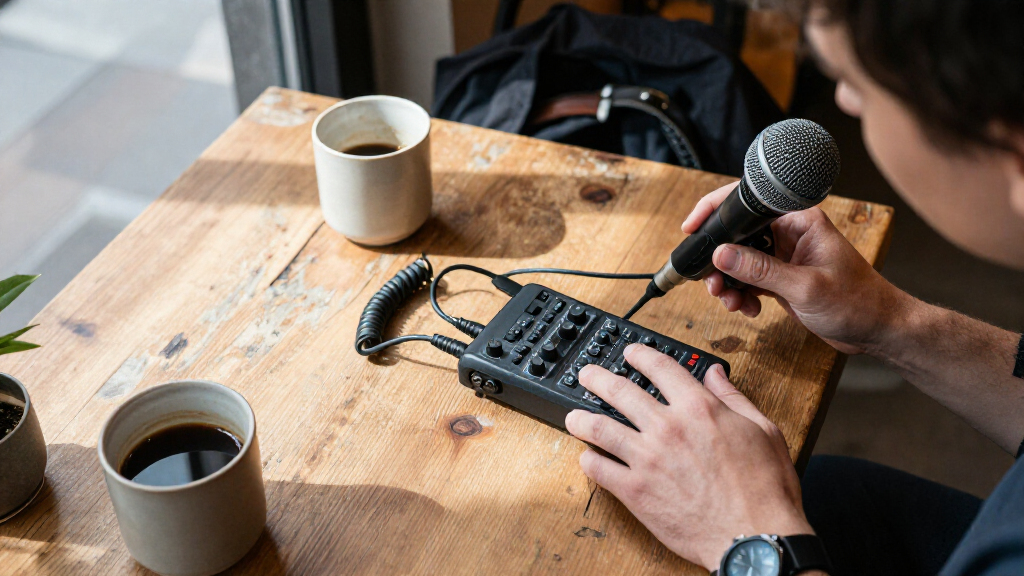
How We Picked
I ranked these recorders by how well they serve portable podcast work: recording capacity, microphone connections, headphone monitoring, remote-guest options, portability, and ease of running a session away from a full studio. I also considered whether a recorder offers useful flexibility beyond podcasting, such as handheld microphones or field-recording features, and whether its controls match the needs of a beginner or a more involved production.
Podcast workflow and useful connections carry the most weight, which puts the standard PodTrak P4 near the top for multi-person shows. The P4next earns a distinct place for its noise-reduction feature, while the P2 ranks well for a compact two-USB-mic setup. Handheld models rank lower for group podcasting because their small size and broader recording role do not replace a multi-mic podcast mixer. Bundle listings are judged by their included equipment, not as a higher-performing recorder than the underlying model.
Factors to Consider When Choosing Portable Podcast Recorders
Before choosing a model, map the recorder to the way you actually record: who speaks in the room, what microphones they use, and whether guests join by phone or computer. A compact device can be the better portable choice, but only if its inputs and monitoring match your show. These decisions can prevent a setup that is easy to carry yet awkward to record with.
Count speakers and headphone users separately
Start by counting the people who need their own microphone, then count everyone who needs to hear the recording live. Those numbers are not always the same: a producer or host may need a separate headphone feed even when not speaking. A recorder with enough mic inputs but too few headphone outputs can force guests to share a connection or require an added headphone amplifier. For a solo show, extra channels add size and control complexity without much benefit. For a rotating panel, leave room for an occasional guest instead of buying only for the usual headcount. Match both counts to your likely maximum, not just your typical session.
Choose connections around the microphones you own
Check the recorder’s input type against your microphones before buying; USB microphones, XLR microphones, and built-in mics do not connect interchangeably. A USB-mic recorder can make a small two-person setup straightforward, while XLR inputs suit common studio microphones and allow more flexible mic choices. Handheld recorders with built-in microphones can capture a conversation quickly, but they are less suited to giving each speaker an isolated mic track. Also check whether the recorder supplies the power a microphone needs and whether the connector count describes simultaneous recording inputs. Buying adapters to bridge an incompatible setup can add clutter and may not preserve the workflow you wanted.
Decide how remote guests will join
A remote interview can involve a phone, a computer, or a separate call-recording service, and each route changes the connection needs. A recorder with a dedicated phone input can simplify a phone-based guest session, while a USB audio interface can connect the unit to a computer-based call. Before relying on either approach, check how the guest audio and local microphones are captured and whether you can monitor both without echo. Do not assume that a USB port automatically provides the remote-call features you need. If remote interviews are rare, a simpler recorder plus your existing computer workflow may be easier to manage than buying around an occasional use case.
Balance backup recording against setup simplicity
Separate tracks give you more control when one speaker is too quiet or a conversation needs editing, but they also create more files to organize and monitor. A finished stereo mix is easier to move and share, though it leaves fewer options if levels are uneven. Think about how much post-production you actually do and who will handle it. A portable session also benefits from clear file naming, spare storage, and a repeatable routine for checking that recording has started. More recording modes are only useful when you have the time and process to manage them. Pick a workflow that suits your editing habits rather than treating every available format as a must-have.
Treat noise reduction as help, not room treatment
Noise-reduction processing can help limit steady background sound, but it cannot make a poor recording space sound like a treated studio. Air conditioning, street noise, reverberant walls, and microphone handling each affect audio differently. A quieter room, close microphone placement, and consistent speaking distance often improve clarity more than extra processing. If you record in changing locations, a noise-reduction feature may be useful, but listen for artifacts and keep the original recording when possible. Do not choose a recorder on the assumption that software will remove every distraction. The better purchase is the one that fits the environments you can realistically control.
Compare bundle contents without confusing them for upgrades
Bundle listings can include microphones, pop filters, memory cards, batteries, or accessories, but the recorder itself may be unchanged. Make a short checklist of what you already own and what the package actually supplies. A microphone bundle can save setup decisions if its included mics suit your voices and recording space; otherwise, you may prefer to select microphones separately. Check card type and capacity, battery compatibility, and whether needed cables are included rather than inferring them from a product title. Avoid paying attention to the number of accessories alone: an extra item is useful only if it solves a real setup gap. Compare the complete recording kit you need, not package names.
Frequently Asked Questions
Is the PodTrak P4 a better choice than the P4next for every podcast?
No; the better fit depends on whether you value a familiar multi-mic podcast workflow or the P4next’s AI noise-reduction feature. Both are aimed at podcast production, but a feature difference does not automatically make one the right choice for every room. If your recording space is already quiet and your show needs four XLR mics and headphone feeds, the standard P4 may cover the practical requirements. If you regularly record where background noise is harder to control, the P4next may be worth comparing more closely. Room sound and microphone technique still matter with either model.
Can I record a four-person podcast with a PodTrak P2?
The P2 is positioned as a two-USB-mic recorder, so it is not the natural pick for a four-person show with separate microphones. Adding a second pair of speakers to a shared mic can make voices harder to balance and edit. If all four people need individual microphones, look for a recorder with enough simultaneous inputs for that arrangement. The P2 makes more sense for a compact two-person setup where USB microphones are already part of the plan. Count both speakers and required headphone feeds before choosing it as a group recorder.
Should I buy a handheld recorder or a podcast-focused recorder?
Choose based on the recording job, not just which device is smaller. A handheld recorder is a stronger match for solo narration, quick interviews, ambient sound, or mixed field-recording use. A podcast-focused unit is generally easier to operate when several people need separate microphones and headphone monitoring. If you record a panel at home and also gather location audio, consider which task happens most often and whether carrying two tools is acceptable. Buying one device to cover both jobs can work, but it may require accepting compromises in channel count or session controls.
Do I need 32-bit float recording for a podcast?
Not every podcaster needs it. Recording formats that offer more flexibility with level recovery can be useful when sound levels vary or a session is difficult to monitor, especially for field interviews. They do not fix clipping that occurs elsewhere in the signal chain, eliminate room noise, or remove the need to check recordings. For a controlled studio-style conversation with consistent mic distance, straightforward level management may be enough. Choose a format that fits your recording conditions and editing workflow rather than treating a technical specification as a substitute for good setup.
Are the P4 and P2 bundle versions different recorders from the standalone models?
Bundle versions are listings that add items such as microphones, storage, or batteries; the included accessories do not by themselves indicate a different recorder. Compare the exact recorder model first, then check the package list against your existing kit. A mic bundle may be useful if you need a ready-made set for multiple speakers, while a card bundle helps only if its storage suits your session length and file workflow. Check for microphones, stands or clips, cables, filters, and power items rather than assuming all pieces are included. This approach helps distinguish a practical starter kit from an accessory mix you will not use.
Conclusion
For the best overall group-podcast setup, I recommend the standard Zoom PodTrak P4 for its four XLR inputs, four headphone outputs, and remote-call options. The best value in a compact two-person workflow is the PodTrak P2 when USB microphones suit your setup; beginners who want a simple handheld recorder should look at the H1 Essential instead. For a premium feature-led pick, consider the P4next if AI noise reduction fits your recording conditions. The TASCAM DR-40XP is my pick for people who want podcast recording alongside broader field use, while the H2 Essential, H4 Essential, and H1 XLR suit different handheld and input needs. Choose the recorder that matches your speaker count, microphones, and recording setting first, then select a bundle only if its extras fill real gaps in your kit.