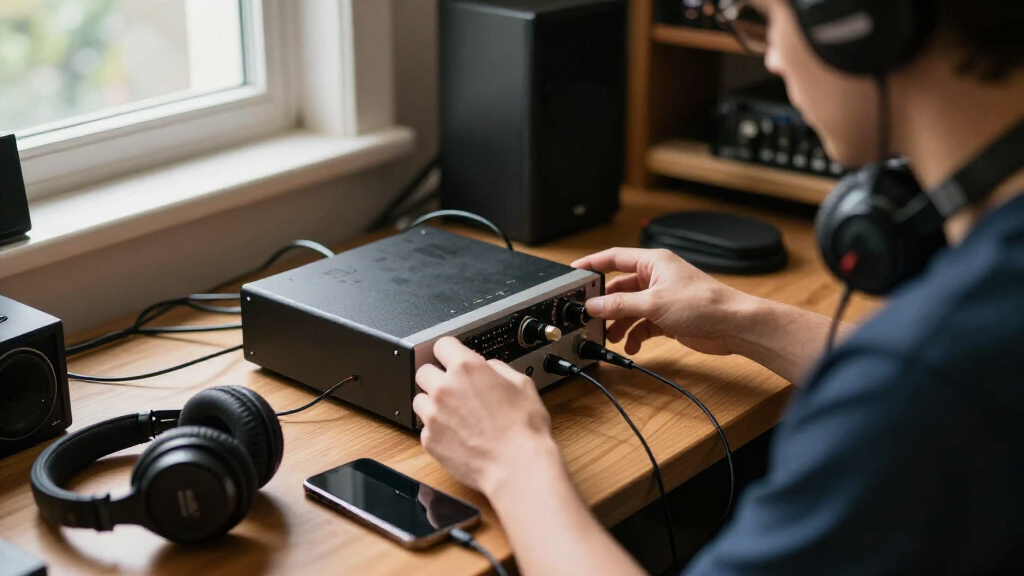

Portable headphone amplifiers solve a simple problem: phones, laptops, and consoles rarely deliver enough clean power to drive demanding headphones. After comparing 14 of the most popular options, the Qudelix-5K stands out as the best overall pick because it combines a Bluetooth USB DAC, LDAC and aptX Adaptive support, and a parametric EQ in a pocketable clip-on design. If you want a pure analog upgrade on a tight budget, the Donner EM1 offers the best sound-per-dollar, while the Questyle M18i Max is the premium choice for listeners who want desktop-class power in a portable shell. The main tradeoffs in this category come down to Bluetooth versus wired-only, whether you need a built-in DAC at all, and how much output power your headphones genuinely require. Continue reading for the full breakdown, including who each amplifier is for and which ones you should skip.

Get audio and creator gear delivered free with Prime
- Fast, free delivery on millions of items
- Prime Video, Amazon Music and more included
- Member-only deals all year
Complete the kit


Key Takeaways
- The Qudelix-5K won best overall because it is the only budget-friendly option here that handles both Bluetooth (LDAC, aptX Adaptive) and USB DAC duties with a genuinely useful parametric EQ app — no other pick under $200 matches its versatility.
- The lineup splits into two clear camps: DAC-equipped amplifiers like the iFi Hip-dac 3 and Questyle M18i Max that replace your source’s entire audio chain, and analog-only amps like the Donner EM1, Neoteck, and eSynic units that only make sense if your source already has a decent DAC.
- Impedance ratings (16-300Ω versus 16-600Ω) were the most misleading spec in the category — a high impedance ceiling does not equal high power, and only the eSynic 16-600Ω and Questyle units can realistically drive HD 650-class headphones at satisfying volumes.
- The sub-$40 tier (Neoteck and eSynic models) is crowded with near-identical amplifiers; they all add volume, but several introduce audible hiss with sensitive in-ear monitors, which is why the Donner EM1 ranked above them despite fewer features.
- Every wired-only pick here requires you to check your phone’s port situation first — iPhones and most modern Android phones need a dongle or USB-C input, which can erase the portability advantage that made you choose a small amp in the first place.


| portable headphone amplifier | Battery Life |
|---|---|
| Qudelix-5K Bluetooth USB DAC A | — |
| Neoteck 3.5mm Headphone Amp wi | Over 8 hours |
| iFi Hip-dac 3 Portable USB DAC | — |
| PROZOR 16-300Ω Portable Headph | 8-10 hours |
| Neoteck Headphone Amplifier Bl | — |
| Neoteck 16-300 Ohm Portable He | 12 hours |
| eSynic Rechargeable 16-150Ω Po | — |
| eSynic Rechargeable Portable H | 12+ hours |
| 16-300Ω Portable Headphone Amp | — |
| LVY Portable Headphone Amplifi | — |
| Donner EM1 Portable Analog Hea | Up to 12 hours |
| Questyle M18i Max Bluetooth 5. | — |
| eSynic Rechargeable 16-600Ω He | 12+ hours rechargeable |
| Portable Headphone Amplifier w | Up to 15 hours |
More Details on Our Top Picks
Qudelix-5K Bluetooth USB DAC AMP with LDAC, aptX Adaptive, aptX HD, AAC
The Qudelix-5K earns the top spot because it solves the problem most portable headphone amplifiers ignore: how your phone actually connects. With LDAC and aptX Adaptive over Bluetooth plus a dual ES9219 DAC setup, it delivers near-wired quality without a cable dangling between pocket and amp. The 2.5mm balanced output is something none of the analog-only picks here — like the Neoteck 3.5mm bass-boost model — can offer, and its 25g weight makes even the compact PROZOR feel chunky. The tradeoff is simplicity: it’s a receiver, not a transmitter, and Bluetooth headphones are completely off the table. The companion app’s EQ options add depth that budget rivals lack, though the plastic body feels less premium than the iFi Hip-dac 3’s aluminum shell.
Pros:- High-quality LDAC and aptX Adaptive Bluetooth codecs
- Dual ES9219 DACs with balanced 2.5mm output
- Featherweight 25g clip-on design
- Deep EQ customization via companion app
Cons:- Receive-only Bluetooth, no transmitter function
- Plastic body feels less rugged than aluminum rivals
Best for: Listeners who stream from a phone and want wireless convenience with balanced-output flexibility
Not ideal for: Anyone hoping to drive Bluetooth headphones or send audio to a wireless speaker — it only receives
- DAC:Dual ES9219
- Bluetooth Chipset:Qualcomm QCC5124
- Bluetooth Codecs:LDAC, aptX Adaptive, aptX HD, AAC
- Outputs:2.5mm Balanced, 3.5mm Unbalanced
- Battery:500mA Li-Po, 6-20 hours
- Dimensions:52.8 x 26.7 x 15.6 mm
- Weight:25g
Our verdict“If you want one compact device that handles both wireless streaming and serious wired listening, this is the most complete package in the lineup.”
Neoteck 3.5mm Headphone Amp with Bass Boost, HiFi Headphone Amplifier
At its price point, this Neoteck covers the fundamentals better than anything else here. The bass boost function is its defining feature — none of the other analog amps in this roundup offer a tone shaping option, so bass-forward listeners get something the PROZOR can’t match despite that amp’s cleaner spec sheet. With support up to 600Ω headphones, it actually handles more demanding loads than the 300Ω-capped models, and the sub-0.001% THD figure is genuinely impressive for the money. Compared with the Bluetooth-equipped Neoteck, you give up wireless streaming entirely, and the no-charging-while-listening limitation means planning around battery life. It’s also strictly 3.5mm, so iPhone users need adapters before anything else.
Pros:- Bass boost adds tonal flexibility most budget amps lack
- Handles headphones up to 600Ω
- Very low distortion at under 0.0005% THD+N
- Solid aluminum build at a low price
Cons:- Cannot be used while charging
- No digital or wireless inputs of any kind
Best for: Budget-minded listeners who want warmer, bass-enhanced sound from high-impedance wired headphones
Not ideal for: Anyone wanting Bluetooth or USB connectivity — this is purely an analog 3.5mm pass-through
- Input/Output:3.5mm AUX
- Impedance Range:16-600Ω
- SNR:>100dB
- THD+N:0.0005%
- Battery Life:Over 8 hours
- Material:Aluminum
- Compatibility:MP3 players, phones, laptops, portable CD players
Our verdict“The cheapest way to add warmth and volume headroom to wired headphones, as long as you never need wireless or USB.”
iFi Hip-dac 3 Portable USB DAC Headphone Amplifier (Black Stealth)
The Hip-dac 3 sits at the top of the price range because it’s the only option here built around a true USB DAC architecture. Supporting PCM 32-bit/384kHz, DSD256, and MQA, it bypasses your phone’s mediocre internal DAC entirely — something no analog-only amp like the bass-boost Neoteck can do, since those simply amplify whatever signal your device already produced. The 4.4mm balanced output paired with PowerMatch gain control and iEMatch makes it equally at home with sensitive IEMs or demanding over-ears, a versatility the Qudelix-5K approaches but doesn’t match for raw wired resolution. The catch is complexity: beginners may find the multiple switches and format support overwhelming, and at this size it’s pocketable but not clip-friendly.
Pros:- Native hi-res decoding up to PCM 384kHz and DSD256
- Fully balanced 4.4mm output plus S-Balanced 3.5mm
- PowerMatch and iEMatch suit both IEMs and power-hungry headphones
- XBass adds tunable low-end without software EQ
Cons:- Steeper learning curve than plug-and-play analog amps
- Premium price with no Bluetooth option
Best for: Audiophiles who want hi-res USB decoding and balanced drive for both IEMs and full-size headphones
Not ideal for: First-time buyers who just want louder sound — the feature set and price are overkill for casual use
- Supported Formats:PCM 32-bit/384kHz, DSD256, MQA
- Inputs:USB-C (data and charging)
- Outputs:Balanced 4.4mm, S-Balanced 3.5mm
- Features:PowerMatch, iEMatch, XBass
- Enclosure:Aluminum
- Finish:Matte black stealth
Our verdict“The pick for listeners who care about source quality as much as amplification and are willing to pay for it.”
PROZOR 16-300Ω Portable Headphone Amp with Two-Stage Gain Switch
This PROZOR model wins on straightforwardness. The two-stage gain switch is the single most useful feature for newcomers — flip between low gain for earbuds and high gain for demanding headphones without wading through menus like the app-driven Qudelix-5K demands. Its ≥120dB signal-to-noise ratio actually beats the bass-boost Neoteck’s rating, and the 1500mAh battery with Type-C charging is more modern than the micro-USB era amps still floating around. The limitations are predictable for the price: it tops out at 300Ω, so very demanding headphones like 600Ω Beyerdynamics are out, and it’s a pure 3.5mm analog design with no DAC inside — your phone’s own sound quality is the ceiling. Compared with the iFi Hip-dac 3, it’s simpler but sonically far more limited.
Pros:- Two-stage gain switch makes matching headphones easy
- Excellent ≥120dB SNR for the price
- 8-10 hour battery with convenient Type-C charging
- Durable aluminum housing
Cons:- Analog-only design, no DAC or wireless input
- 300Ω impedance ceiling excludes demanding headphones
Best for: First-time buyers who want a simple gain-switched boost for moderate-impedance headphones
Not ideal for: Owners of very high-impedance headphones above 300Ω or anyone wanting a built-in DAC
- Supported Impedance:16-300Ω
- SNR:≥120dB
- THD+N:0.005%
- Battery Capacity:1500mAh
- Battery Life:8-10 hours
- Charging:Type-C
- Input/Output:3.5mm
Our verdict“The easiest entry point into portable amplification — just know you’re buying volume, not better source quality.”
Neoteck Headphone Amplifier Bluetooth 5.0 Headphone Amp 16-300Ω
This Neoteck occupies a middle ground no other budget option covers: it pairs Bluetooth 5.0 streaming with a 3.5mm input in one device. Unlike the Qudelix-5K, which is a DAC-first device with premium codecs, this one trades codec sophistication for a color display and a friendlier price — you can see battery status and connection state at a glance instead of guessing. The 1500mAh battery matching the PROZOR means all-day use, and the dual input paths mean it works even when Bluetooth isn’t an option. The wireless sound won’t satisfy critical listeners the way LDAC on the Qudelix does, and the 300Ω cap rules out the most demanding headphones. It’s a convenience-first purchase rather than a fidelity-first one, and it’s priced accordingly.
Pros:- Bluetooth 5.0 plus 3.5mm AUX for dual connectivity
- Color display for battery and pairing status
- Drives headphones up to 300Ω
- Over 8 hours of playback per charge
Cons:- Basic Bluetooth codecs, no LDAC or aptX HD
- 300Ω impedance limit excludes high-end headphones
Best for: Commuters who want wireless streaming to wired headphones with a screen showing status at a glance
Not ideal for: Sound-quality purists — basic Bluetooth audio trails far behind the Qudelix-5K’s LDAC performance
- Impedance Range:16-300Ω
- Bluetooth Version:5.0
- Battery Capacity:1500mAh
- Playback Time:Over 8 hours
- Connectivity:3.5mm AUX, Bluetooth
- Display:Color screen for status
Our verdict“The affordable way to cut the cable between phone and headphones while keeping wired cans — just don’t expect reference-grade wireless sound.”
Neoteck 16-300 Ohm Portable Headphone Amplifier with 3.5mm Jack
Among the analog amps in this lineup, the Neoteck stands out for its 12-hour battery, which edges out the eSynic 16-300Ω model’s runtime while matching its full 16-300Ω impedance support. That matters for commuters and long-haul travelers who don’t want to top up mid-day. Its signal-to-noise ratio above 120dB is also stronger than the sub-100Ω eSynic’s >100dB rating, meaning a quieter background with sensitive in-ear monitors.
The tradeoff is that this is a strictly analog device — the same limitation as the LVY and the PROZOR — so anyone wanting Bluetooth or USB DAC functionality will need the Qudelix-5K or iFi Hip-dac 3 instead. Gain switching is manual and wired-only connectivity feels dated in a wireless era.
Pros:- 12-hour battery outlasts most analog competitors in this price range
- >120dB SNR delivers a genuinely quiet noise floor for sensitive IEMs
- Full 16-300Ω impedance support covers everything from earbuds to studio headphones
- Lightweight 102g body slips into a pocket easily
Cons:- 3.5mm-only connectivity requires adapters for modern phones
- Manual gain switching can confuse audio beginners
- Type-C port is for charging only, not audio
Best for: Commuters and travelers with mixed headphone collections who need all-day battery between charges
Not ideal for: Wireless-first listeners — there’s no Bluetooth, so phone users without a 3.5mm jack need a dongle
- Impedance Compatibility:16-300 Ohms
- Signal-to-Noise Ratio:>120dB
- Total Harmonic Distortion:0.0003%
- Battery Capacity:1500mAh
- Battery Life:12 hours
- Weight:102g
- Connectivity:3.5mm audio jack, Type-C power cable
Our verdict“Buy this if runtime is your top priority and you’re happy staying wired; skip it if your phone lacks a headphone jack.”
eSynic Rechargeable 16-150Ω Portable Headphone Amplifier with 3.5mm Audio In & Out
At the affordable end of this roundup, the eSynic 16-150Ω makes sense for buyers pairing it with low-impedance headphones and earbuds rather than demanding studio cans. Its 6061 aluminum shell gives it a more premium feel than the price suggests, and its slim 13mm profile is easier to pocket than chunkier options like the iFi Hip-dac 3.
The catch is the impedance ceiling: where the Neoteck 16-300Ω and the PROZOR handle power-hungry 250-300Ω headphones, this model tops out at 150Ω. Its >100dB SNR is also the weakest noise-floor spec in this batch, which may be audible with very sensitive IEMs. Compared with the LVY, however, it offers longer playback and sturdier build for similar money — a better value if your headphones fit within its range.
Pros:- Affordable entry point into amplified portable audio
- Aerospace-grade 6061 aluminum build feels durable
- 8+ hours of playback from a 1000mAh cell
- Gain switch tuned for the impedance range it supports
Cons:- 150Ω ceiling excludes many popular over-ear headphones
- >100dB SNR is the noisiest floor in this batch
- No digital inputs limits use with modern sources
Best for: Budget-conscious listeners using earbuds or low-impedance headphones who want cleaner sound for minimal spend
Not ideal for: Owners of high-impedance headphones like HD 650-class models — the 150Ω ceiling simply won’t drive them properly
- Impedance Range:16-150Ω
- THD+N:0.0003%
- SNR:>100dB
- Battery Capacity:1000mAh
- Playback Time:8+ hours
- Material:6061 aluminum
- Dimensions:95×52×13mm
- Connectivity:3.5mm audio jack
Our verdict“A sensible budget buy for earbud and easy-to-drive headphone owners; anyone with 250Ω+ cans should pay slightly more for the 300Ω-rated alternatives.”
eSynic Rechargeable Portable Headphone Amplifier 16-300 Ohms, 3.5mm
What separates this eSynic from its 16-150Ω sibling is versatility across use cases: full 16-300Ω impedance support, a car AUX mode that boosts thin factory head-unit output, and enough volume headroom for gaming sessions on console handhelds or laptops. Gamers who found the Neoteck bass-boost model too colorated will appreciate this amp’s flatter, studio-grade presentation.
The honest limitation is power: 30mW into 16Ω and just 15mW into 300Ω means high-impedance headphones get louder but not necessarily better driven — the eSynic 16-600Ω model is the stronger choice for genuinely demanding cans. Charging also blocks the 2-3 hour refill window, so it’s less convenient for always-docked setups than a USB-powered DAC like the Questyle M18i Max.
Pros:- Handles car AUX, console controllers, and high-impedance headphones in one device
- 12+ hours of playback matches the best runtimes here
- Aluminum housing survives bag and glovebox abuse
- Two-stage gain switch adapts cleanly between sources
Cons:- Modest power output limits dynamics with 300Ω headphones
- No Bluetooth or digital input in a wireless-friendly market
- Battery is sealed — no swapping on long trips
Best for: Gamers and commuters who want one amp that works with consoles, car AUX, and a range of headphones
Not ideal for: Owners of very demanding headphones — 15mW into 300Ω is enough volume, not enough authority
- Impedance Range:16-300Ω
- Output Power:30mW into 16Ω, 15mW into 300Ω
- Signal-to-Noise Ratio:>100dB
- THD+N:0.0003%
- Battery Life:12+ hours
- Charging Time:2-3 hours
- Dimensions:95x52x13mm
- Input/Output:3.5mm
- Housing Material:Aluminum
Our verdict“The best all-rounder for people juggling gaming, car, and headphone duties on a budget, provided your headphones aren’t ultra-demanding.”
16-300Ω Portable Headphone Amplifier – HiFi, Rechargeable, Aluminum, 3.5mm
This unbranded amplifier’s real selling point is breadth: it’s explicitly validated across phones, iPads, PCs, PS4/5, and MP3 players, which makes it the easiest plug-and-play choice for buyers who bounce between sources. Its ≥120dB SNR puts it alongside the Neoteck 16-300Ω for quietness, a clear step above the eSynic models in background performance.
Two caveats hold it back from a higher ranking. The THD+N of 0.0005% is slightly worse than the 0.0003% claims of its rivals — a small but real difference on paper — and the noise-while-charging issue means you can’t use it as an always-connected desktop amp the way you might the iFi Hip-dac 3. Type-C fast charging partially compensates, and 10 hours of playtime keeps it competitive with the LVY’s shorter runtime.
Pros:- Validated compatibility across phones, tablets, consoles, and PCs
- ≥120dB SNR matches the quietest amps in this roundup
- Fast Type-C charging tops up quickly
- Shielded aluminum alloy resists interference from other devices
Cons:- Audible noise during charging prevents always-on desktop use
- Slightly higher distortion spec than the 0.0003% alternatives
- Generic branding means thinner support and documentation
Best for: Multi-device users who want one amp to move between console, computer, and phone without fuss
Not ideal for: Desktop-focused buyers — charging noise means it can’t live permanently plugged in beside a monitor
- Impedance Range:16-300Ω
- THD+N:0.0005%
- Signal-to-Noise Ratio:≥120dB
- Battery Capacity:1500mAh
- Charging Port:Type-C
- Playtime:Up to 10 hours
- Material:Aluminum alloy
- Compatibility:Phone, iPad, PC, PS4/5, MP3/4 players
Our verdict“Pick this if you game and listen across multiple devices and value flexibility; avoid it if you want a set-and-forget desktop amp.”
LVY Portable Headphone Amplifier 3.5mm Audio Rechargeable Two-Stage Gain Switch HiFi Headphone Amplifier
The LVY is the lowest-commitment entry point in this roundup — the amp to buy if you’re curious whether amplification will even help your headphones before spending more. It matches the premium options on paper with a >120dB SNR and 16-300Ω impedance range, which is respectable at this price. Its gain switch behaves much like the one on the PROZOR, giving basic control over sensitive versus demanding loads.
But the shortcuts show. Distortion is rated at 0.004% — roughly thirteen times higher than the 0.0003% eSynic and Neoteck models — and the 5-hour battery is the shortest runtime here, less than half the Neoteck’s. For casual listening this may be fine; for critical listening, the eSynic 16-300Ω costs only a little more and does everything noticeably better.
Pros:- Lowest-cost way to try headphone amplification
- >120dB SNR matches far more expensive models
- Two-stage gain switch handles both IEMs and over-ears
- Works with virtually any 3.5mm source
Cons:- 0.004% distortion is the highest in this lineup
- 5+ hour battery is the shortest runtime of the batch
- No digital or wireless connectivity of any kind
Best for: First-time buyers testing whether an amp improves their headphones before investing more
Not ideal for: Critical listeners and long-session users — the 0.004% distortion and 5-hour battery fall short of everything else here
- Load Impedance:16-300Ω
- SNR:>120dB
- Distortion:0.004%
- Amp Using Time:More than 5 hours
- Connectivity:3.5mm audio
Our verdict“A fine experiment for the amp-curious on a tight budget, but upgrade to the eSynic or Neoteck if audio quality matters to you.”
Donner EM1 Portable Analog Headphone Amplifier
The Donner EM1 stands out because it is the only option in this lineup built around XLR and TRS inputs, which changes who it is for entirely. While the eSynic Rechargeable 16-600Ω targets casual listeners plugging into a phone, this model speaks the language of the stage and studio — locking connectors and a belt-pack clip make it a monitoring tool first and a listening device second. The high power output drives professional high-impedance headphones that would leave the B0895SGCGQ budget amp (capped at 150Ω) gasping. The tradeoff is one-sided flexibility: there is no microphone support and no DAC or Bluetooth of any kind, so anyone hoping to stream wirelessly like the Questyle M18i Max allows should look elsewhere. Twelve hours of battery is solid for a full session day.
Pros:- XLR and TRS balanced inputs rarely found in portable amps at this price
- High power output that properly drives professional high-impedance headphones
- Locking input connectors and belt-pack clip built for live use
- Up to 12 hours of battery for full working sessions
Cons:- No microphone input despite its pro-monitoring focus
- Purely analog — no DAC, no Bluetooth, no wireless option
- Stereo/mono switching is the only feature beyond volume; nothing else to shape sound
Best for: Musicians, sound engineers, and stage performers who need battery-powered monitoring with balanced XLR/TRS sources
Not ideal for: Casual listeners wanting to boost a phone or laptop — no DAC, no Bluetooth, and no mic input make it overkill and inflexible for that job
- Power:High power for high-impedance headphones
- Battery Life:Up to 12 hours
- Battery Type:Rechargeable Li-ion
- Inputs:XLR, TRS (locking)
- Output:3.5mm jack
- Controls:Volume control, stereo/mono switch
- Design:Compact with belt-pack clip
Our verdict“Buy this if you monitor through XLR or TRS sources on the move; skip it if your source is a phone.”
Questyle M18i Max Bluetooth 5.4 Headphone Amplifier Portable USB DAC
This is where the roundup’s ceiling sits. The Questyle M18i Max pairs an ESS flagship ES9219Q DAC with Bluetooth 5.4 and LDAC/aptX Adaptive, so it does two jobs the Donner EM1 and eSynic rechargeable amps cannot touch: it converts digital audio and it streams losslessly. The 0.0002% distortion figure and both 3.5mm unbalanced and 4.4mm balanced outputs place it in a different class from the 3.5mm-only options here, and manual gain control means it adapts from sensitive IEMs to demanding over-ears. The honest drawback: this capability costs real money, the battery life is unspecified, and its menu of codecs and modes will overwhelm someone who just wants a volume boost for a Switch or PS5 — the B0895SGCGQ handles that job for a fraction of the price.
Pros:- ESS flagship ES9219Q DAC with 0.0002% distortion for genuinely hi-res wired playback
- Bluetooth 5.4 with LDAC and aptX Adaptive for lossless-grade wireless
- Both 3.5mm unbalanced and 4.4mm balanced outputs
- Manual gain control spans sensitive IEMs to demanding over-ears
Cons:- Battery life is not specified — a real unknown for portable use
- Premium price point well above every analog option in this lineup
- Feature depth (codecs, modes, gain) is overkill for casual users
Best for: Audiophiles who want a single dongle-style device for lossless Bluetooth streaming and wired hi-res listening on balanced headphones
Not ideal for: Buyers on a budget or anyone intimidated by codec settings and gain menus — a simple analog amp does the same basic job for far less
- DAC Chip:ESS ES9219Q flagship
- Bluetooth:5.4
- Codecs:AAC, SBC, aptX, aptX HD, aptX Adaptive, LDAC
- Outputs:3.5mm unbalanced, 4.4mm balanced
- Gain Control:Manual
- Distortion:0.0002%
- Microphone:Infineon flagship microphone
Our verdict“The pick for listeners who refuse to compromise on wireless or wired sound quality and will pay for it.”
eSynic Rechargeable 16-600Ω Headphone Amplifier Portable with Gain Switch
What separates this eSynic from the sea of similar 3.5mm amps in this roundup is its 16-600Ω impedance range. That 600Ω ceiling means it can properly drive studio legends like 600-ohm Beyerdynamics — territory where the B0895SGCGQ (16-150Ω) and most PROZOR and Neoteck models simply give up. The 0.0003% THD+N and >100dB SNR put it remarkably close to the far pricier Questyle M18i Max on paper, though it lacks that model’s DAC and wireless tricks. The dual-stage gain switch is the practical benefit: low gain keeps sensitive earbuds quiet and clean, high gain feeds hungry over-ears. The cost of this focus is total inflexibility elsewhere — 3.5mm only, no Bluetooth, no balanced output — so it is a specialist tool dressed as a general one.
Pros:- 16-600Ω impedance support covers even demanding 600Ω studio headphones
- Ultra-low 0.0003% THD+N and >100dB SNR for clean amplification
- Dual-stage gain switch optimizes for both sensitive and demanding headphones
- Robust 6061 aerospace-grade aluminum build in a slim 95×52×13mm body
Cons:- 3.5mm connectivity only — no balanced 4.4mm output
- No wireless option at all despite the price being close to Bluetooth-capable rivals
- No DAC, so it only amplifies whatever analog signal your source provides
Best for: Owners of high-impedance studio headphones (300-600Ω) who need clean, powerful amplification from a phone or laptop
Not ideal for: Anyone wanting wireless streaming or balanced outputs — this is a strictly wired, single-jack device
- Impedance Range:16-600Ω
- THD+N:0.0003%
- SNR:>100dB
- Battery Life:12+ hours rechargeable
- Gain Control:Dual-stage switch
- Enclosure:6061 aerospace-grade aluminum
- Dimensions:95×52×13mm
- Connectivity:3.5mm audio jack
Our verdict“The wired workhorse for hard-to-drive headphones, provided you never need Bluetooth or a DAC.”
Portable Headphone Amplifier with Volume Control and Gain Switch for Switch, PS4/PS5, Mobile, PC, MP3, HD 650 Headphones
This is the lowest-commitment entry point in the roundup, and that is its entire value proposition. Physical volume and gain knobs make it friendlier than the spec-heavy Questyle M18i Max — there is nothing to configure, just plug in and turn. The 15-hour battery from its 1000mAh cell actually beats the 12 hours offered by both the eSynic 16-600Ω and the Donner EM1, which matters on long trips. But the 16-150Ω impedance ceiling is the hard limit: fine for most consumer headphones and gaming headsets, yet it cannot seriously claim to drive HD 650-class 300Ω headphones the way the eSynic can, despite the title. Add dated Micro USB charging and no wireless at all, and the low price starts to look like a fair trade rather than a bargain.
Pros:- 15-hour battery life — the longest runtime in this batch
- Straightforward physical volume knob and high/low gain switch
- Broad device compatibility: Switch, PS4/PS5, phones, PC, MP3 players
- Lowest-cost way to add gain and volume control to a wired setup
Cons:- 16-150Ω impedance support is the narrowest range here
- Micro USB charging is outdated next to USB-C rivals
- No Bluetooth or any wireless connectivity
Best for: Gamers and commuters with easy-to-drive headphones (16-150Ω) who want a simple, cheap volume and gain boost for consoles, phones, or PCs
Not ideal for: Owners of high-impedance studio headphones — the 150Ω ceiling means it underdrives anything demanding, and there is no wireless option
- Audio I/O:3.5mm jack in/out
- Battery Capacity:1000mAh
- Battery Life:Up to 15 hours
- Charging:Micro USB
- Gain Switch:High/Low
- Impedance Support:16-150Ω
Our verdict“A cheap, simple volume fix for gaming and mobile listening — just do not expect it to power serious headphones.”
How We Picked
I ranked these amplifiers around four factors that actually change the buying decision. Power and headphone matching came first: each amp was judged on whether it can realistically drive easy 16-32Ω earphones, mid-impedance 80-150Ω headphones, and demanding 250-300Ω models, because an amplifier that only works with earbuds is not versatile. Source flexibility came second — Bluetooth codecs, USB DAC functionality, and plain 3.5mm analog input were weighted differently depending on how much of your audio chain the product replaces. Cleanliness of the signal path mattered too, since budget amplifiers that add hiss or channel imbalance at low volumes do more harm than good.
From there, I factored in build quality, battery behavior, and price-to-performance. Gain switches, volume pot quality, and charging-while-playing support separated otherwise similar budget models, while the premium picks had to justify their price with measurable advantages in output and refinement rather than brand name alone. The final order reflects a simple logic: versatile, clean-sounding options rank highest, one-trick budget amps fill the value slots, and units that overlap almost entirely with a better-ranked sibling sit lower as duplicates.
Factors to Consider When Choosing Portable Headphone Amplifiers
Before settling on one of the fourteen picks above, it helps to understand what actually separates a smart purchase from a wasted one. Portable amplifiers are one of the most commonly mis-bought audio accessories because the marketing focuses on impedance numbers and wattage claims that rarely tell the whole story.Do You Actually Need an Amplifier, or a DAC, or Both?
The single most common mistake is buying an analog-only amplifier when the real bottleneck is the source’s DAC. If your laptop or phone already outputs a clean line signal and your headphones simply need more volume, an analog amp like the Donner EM1 or a Neoteck unit is enough. If your source sounds harsh, flat, or noisy at any volume, a combined DAC/amp like the iFi Hip-dac 3 or Qudelix-5K addresses the actual problem. Buying both separately is almost always worse than buying one good combined unit, since every extra cable and connection adds noise and cost. A useful test: if your headphones get loud enough but sound bad, you need a DAC; if they sound good but cannot get loud, you need an amp; if both apply, buy a combined unit and skip the analog tier entirely.
Match the Amplifier to Your Headphones, Not the Spec Sheet
Impedance ratings like 16-300Ω tell you what an amplifier can connect to, not what it can drive well. A 300Ω-capable budget amp may reach acceptable volume with an HD 650 but sound thin and dynamically flat because voltage swing, not impedance support, is the real limiting factor. Sensitive low-impedance in-ear monitors create the opposite problem: powerful amplifiers with coarse volume steps or high noise floors produce audible hiss and make the first 10% of the volume dial unusable. Check your headphone’s sensitivity rating (dB/mW) alongside impedance — a 100dB/mW earphone needs a fraction of the power that an 83dB/mW planar needs. Buyers planning around HD 650-class headphones should restrict their shortlist to the higher-output options and ignore the sub-$40 tier completely.
Bluetooth Changes the Whole Equation
Bluetooth-enabled amplifiers like the Qudelix-5K and Questyle M18i Max are not just amplifiers — they become the wireless hub of your entire listening setup, which is why they rank so highly here. The codec support matters more than the Bluetooth version number: LDAC and aptX Adaptive genuinely approach wired quality, while basic SBC does not justify the price of a premium unit. The tradeoff is complexity and battery drain, since a Bluetooth amp running wirelessly needs charging far more often than a passive analog unit that sips power. Also note that a Bluetooth amp still processes the signal digitally, so its internal DAC quality determines your ceiling even when streaming. If you mostly listen from a phone without a headphone jack, Bluetooth capability is arguably the most valuable feature on this list.
Battery, Charging, and Real-World Portability
Portability claims often collapse once you account for cables, dongles, and charging behavior. Some budget amplifiers cannot play while charging, which turns a long listening session into downtime; others have non-replaceable batteries that degrade within a few years of daily use. Pay attention to whether the unit charges over USB-C (convenient) or micro-USB (a sign of an older design you will resent). Physical size matters too — the Qudelix-5K clips to a collar or pocket, while the Hip-dac 3 is closer to a small wallet and pushes some pockets past comfortable. Consider how you will actually carry it: an amp that lives in a bag behaves differently from one that dangles from your phone on a commute.
The Diminishing Returns of the Budget Tier
Below roughly $50, the amplifiers in this roundup are functionally interchangeable, and paying more within that tier buys features rather than sound quality. The honest pattern: a $25 eSynic and a $40 Neoteck will both make quiet headphones louder, and neither will transform your system the way a DAC/amp upgrade will. If your total budget is under $50, pick whichever has the input type and gain switch you need and stop comparing. If you can stretch to $120-200, the value jump is real — you gain cleaner backgrounds, better volume controls, and actual DAC circuitry. The worst position is spending $60-80 on a mid-tier analog amp when $20 more buys a full Bluetooth DAC/amp, which is a common trap in this category.
Gain Switches, Volume Controls, and the Details That Annoy
Small design details separate amplifiers you will enjoy from ones you will tolerate. A two-stage gain switch, present on several picks here, prevents the volume control from being either too touchy or starting too loud — invaluable if you switch between sensitive earphones and demanding headphones. Analog volume pot quality varies wildly at the budget end; cheap pots can develop channel imbalance where one ear gets louder at low settings. Bass boost buttons, featured on some Neoteck models, are fun for casual listening but add distortion at high volumes and are best treated as a bonus, not a buying reason. Also check where the ports sit — side-mounted jacks fit pockets better than top-mounted ones when the amp stacks against your phone.
Frequently Asked Questions
Can a $30 portable amplifier really drive 300-ohm headphones like the HD 650 or HD 6XX?
It can make them loud enough in a quiet room, but loudness is not the same as driving them well. High-impedance headphones need substantial voltage swing to deliver their full dynamics and bass control, and the tiny batteries and op-amps in sub-$40 amplifiers simply cannot supply it. You will get listenable sound with the volume turned most of the way up, but the presentation will feel flat and constrained compared with a proper desktop or high-output portable amp. If HD 650-class headphones are your target, the eSynic 16-600Ω model or the Questyle M18i Max are the realistic floor in this lineup. A better move for most buyers is to either stretch the budget or choose easier-to-drive headphones and keep the cheap amp.
Is the Qudelix-5K worth it over a basic wired amplifier if I only listen from my phone?
For most phone-based listeners, yes, and the reason is the missing headphone jack. A wired-only amp forces you into a dongle chain of phone, adapter, amp, and headphones that is awkward on the move and wears down connectors. The Qudelix-5K connects over Bluetooth with LDAC, clips anywhere, and still works as a wired USB DAC when you want a laptop session. Its parametric EQ also lets you correct headphone tuning on the fly, which no analog amplifier at any price can do. The only listeners who should skip it are those with a dedicated music player or laptop that already has a good output — for them, a cheaper analog amp delivers most of the benefit.
Will a portable amplifier make my headphones sound better, or just louder?
It depends entirely on why your headphones sound the way they do. If they already reach comfortable volume but sound harsh or dull, the problem is upstream — the DAC or the headphones themselves — and an analog amplifier will change very little, possibly adding noise of its own. If they sound good but compressed and lifeless at high volume, more clean power genuinely improves dynamics, bass tightness, and headroom. Combined DAC/amp units improve sound in more cases because they fix both problems at once. Be suspicious of any claim that an amplifier will transform easy-to-drive earphones; a sensitive $20 earbud paired with a $200 amp is money spent in the wrong place.
Why do several amplifiers here hiss with my in-ear monitors, and can I avoid it?
Hiss happens because sensitive in-ear monitors amplify the noise floor of the amplifier itself — the same power that drives demanding headphones cleanly is wasted as audible background noise in efficient earphones. It is the reason I ranked some budget amplifiers lower despite respectable power specs. You can reduce it by choosing the low gain setting if the amp has one, which several picks in this lineup include, but you cannot eliminate a fundamentally noisy output. If in-ear monitors are your main headphones, prioritize amplifiers known for low noise floors — the Qudelix-5K and iFi Hip-dac 3 both handle sensitive loads gracefully — and treat gain switches as a must-have rather than a bonus feature.
Do I need a separate amplifier if my Bluetooth headphones already have one built in?
No — wireless headphones contain their own amplifier and DAC, so an external unit does nothing for them and cannot even connect in most cases. Portable amplifiers only benefit wired headphones, either analog models or Bluetooth headphones that offer a wired input mode. One exception exists: some wireless headphones accept a wired signal but still process it through their internal electronics, so a portable amp only helps if the headphone’s wired mode is truly passive. If your entire collection is Bluetooth, spend the budget on better headphones or a source device instead. The amplifiers in this roundup make sense only for listeners committed to a wired connection.
Conclusion
The right choice here depends less on budget and more on what you are plugging in. For the best overall pick, the Qudelix-5K is the clear winner — its combination of Bluetooth LDAC, USB DAC functionality, and a genuinely useful EQ app covers more listening scenarios than anything else in the lineup. For best value, the Donner EM1 delivers the cleanest budget-tier sound for wired listeners who do not need Bluetooth, while the eSynic 16-600Ω model is the value pick specifically for high-impedance headphones. For best premium, the Questyle M18i Max with Bluetooth 5.4 and desktop-class output is the one to buy if you want a single device that handles everything from sensitive earphones to HD 650s.
For beginners, the Neoteck 3.5mm with bass boost is the lowest-risk entry point — cheap, simple, and easy to resell if you outgrow it. For specific needs: console gamers should look at the amplifiers explicitly compatible with PS4/PS5 and the Switch, laptop users wanting a full source upgrade should choose the iFi Hip-dac 3 over any analog-only option, and anyone whose source already has a good DAC should skip the DAC-equipped picks entirely and put every dollar into analog output quality. Whatever you choose, match the amplifier to your actual headphones first — that single decision eliminates most of the regret in this category.